Flame cells are seen in which of the following groups of organisms?
What is the name of the test involving an intradermal injection of sterilised fluid from an infectious cyst?
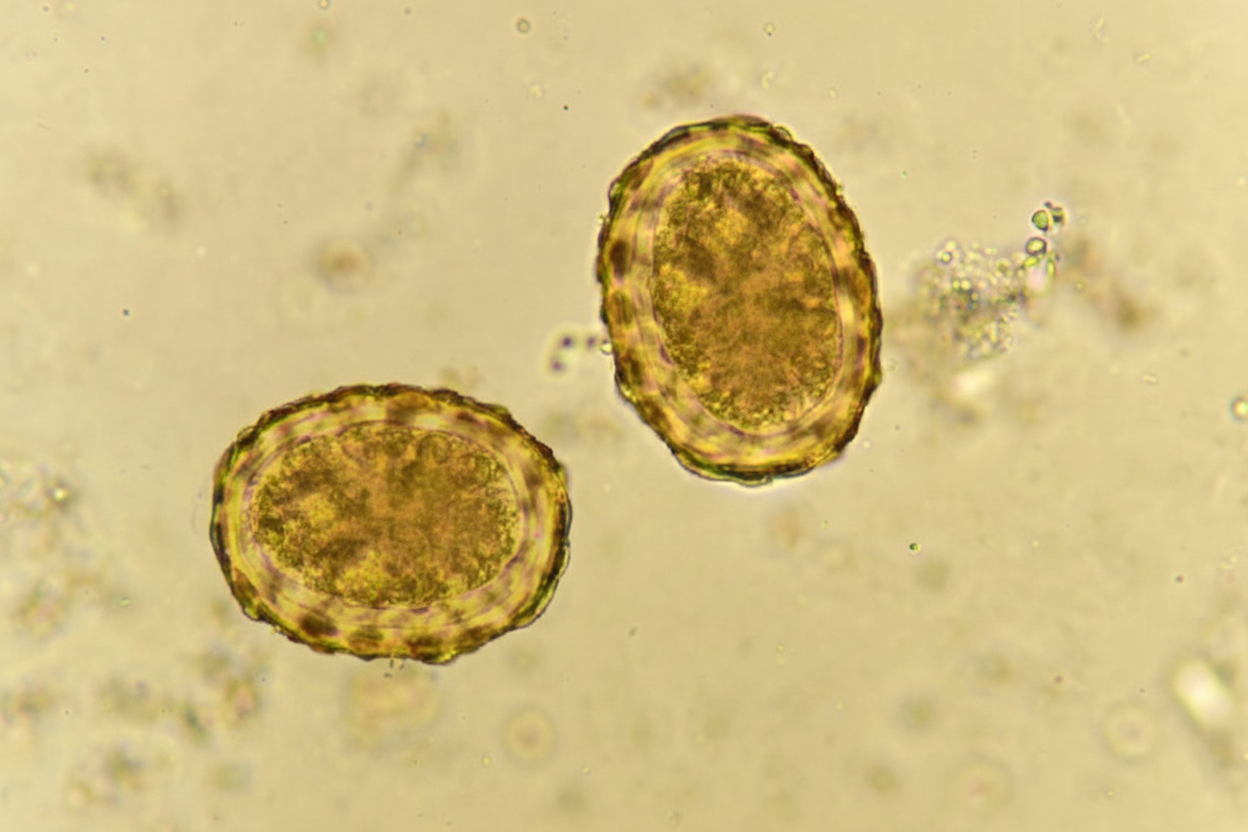
A stool sample from a patient shows ova. How do humans typically acquire this parasitic infection?

In giardiasis, malabsorption is due to all of the following except:
The man-snail-crab life cycle is characteristic of which parasite?
Which of the following helminths has a larval form that is typically found in stool?
Which of the following is NOT true about Plasmodium falciparum?
What is the lifespan of microfilaria in human blood?
Multiple infection of red blood cells is seen with which Plasmodium species?
Babesiosis is transmitted by the bite of which arthropod?
Explanation: **Explanation:** **Flame cells** (also known as protonephridia) are specialized excretory cells found in the simplest freshwater invertebrates, including **Platyhelminthes** (flatworms). 1. **Why Cestodes is correct:** Cestodes (tapeworms) belong to the phylum Platyhelminthes. These organisms lack a circulatory system and a body cavity (acoelomates). To manage waste and maintain osmotic balance, they utilize a primitive excretory system composed of **flame cells**. These cells have a cluster of cilia that flicker like a flame, creating a filtration pressure that pushes waste fluids through canals and out of the body through excretory pores. 2. **Why other options are incorrect:** * **Protozoa:** These are unicellular organisms. They do not have specialized multicellular organs or cells like flame cells; instead, they rely on simple diffusion or contractile vacuoles for osmoregulation. * **Nematodes:** These are roundworms. They possess a more advanced excretory system consisting of **Renette cells** or a tubular system (H-shaped canals), but they do not possess ciliated flame cells. **High-Yield Clinical Pearls for NEET-PG:** * **Flame Cells:** Characteristic of Platyhelminthes (both **Cestodes** and **Trematodes**). * **Renette Cells:** Characteristic of **Nematodes**. * **Solenocytes:** Another term for specialized excretory cells (often used interchangeably with flame cells in certain primitive chordates/invertebrates). * **Cestodes vs. Trematodes:** Remember that while both have flame cells, Cestodes are segmented (proglottids) and lack a digestive tract, whereas Trematodes (flukes) are unsegmented and leaf-like.
Explanation: **Explanation:** **Correct Answer: A. Casoni’s test** Casoni’s test is an immediate hypersensitivity (Type I) skin test used for the diagnosis of **Hydatid disease** (caused by *Echinococcus granulosus*). The test involves the intradermal injection of 0.2 ml of sterile hydatid fluid (obtained from human or sheep cysts). A positive result is indicated by the formation of a large wheal (>2 cm) with pseudopodia within 15–20 minutes. While historically significant, it has largely been replaced by more specific serological assays (ELISA, IHA) and imaging (USG/CT) due to its low specificity and risk of anaphylaxis. **Analysis of Incorrect Options:** * **B. Schick test:** Used to determine immunity against **Diphtheria** (*Corynebacterium diphtheriae*). It detects the presence of circulating antitoxin. * **C. Patch test:** A diagnostic tool used to identify the cause of **Contact Dermatitis** (Type IV hypersensitivity). It involves applying allergens to the skin under adhesive patches for 48 hours. * **D. Dick’s test:** A skin test used to determine susceptibility to **Scarlet Fever**, caused by the erythrogenic toxin of *Streptococcus pyogenes*. **High-Yield Clinical Pearls for NEET-PG:** * **Hydatid Cyst:** Look for "Water lily sign" or "Camelot sign" on imaging. * **Treatment of Choice:** Surgical excision (PAIR technique) combined with **Albendazole**. * **Other Parasitological Skin Tests:** * **Montenegro (Leishmanin) test:** For Kala-azar (Delayed hypersensitivity). * **Bachman intradermal test:** For Trichinellosis. * **Fairley's test:** For Schistosomiasis.
Explanation: ***Ingestion of contaminated food or water*** - Most intestinal parasites like **Ascaris lumbricoides** are transmitted through the **fecal-oral route** via contaminated food, water, or soil. - The parasite's **ova** survive in the environment and are ingested, leading to infection when they hatch in the intestine. *Working in contaminated water sources* - This route is specific for **Schistosoma** species, which penetrate through the **skin** during water contact. - **Ascaris** and most intestinal helminths do not infect through skin penetration but require oral ingestion. *Consumption of improperly cooked beef* - This describes the transmission of **Taenia saginata** (beef tapeworm), which requires ingestion of **cysticerci** in raw/undercooked beef. - **Ascaris** does not have an intermediate host and is transmitted directly through ingestion of embryonated eggs. *Direct contact with an infected individual* - This route is characteristic of **Enterobius vermicularis** (pinworm), which spreads through **perianal-oral** transmission. - **Ascaris** transmission does not occur through direct person-to-person contact but requires environmental contamination.
Explanation: **Explanation:** The pathogenesis of malabsorption in **Giardiasis** (*Giardia lamblia*) is multifactorial, primarily involving mechanical blockage, mucosal damage, and competition for nutrients. **Why Option A is the Correct Answer (The Exception):** The question asks for the factor **not** responsible for malabsorption. While Giardia causes a functional deficiency of brush border enzymes (like lactase), the **"Loss of brush border enzymes"** is a *consequence* of the infection, not the primary mechanism driving the malabsorption process itself in the context of this specific question's logic. However, in many standard textbooks, the primary mechanisms listed are bacterial overgrowth, bile salt deconjugation, and immunological factors. **Analysis of Other Options:** * **B. Bacterial Overgrowth:** Giardia often co-exists with small intestinal bacterial overgrowth (SIBO). These bacteria deconjugate bile salts, impairing micelle formation and leading to fat malabsorption (steatorrhea). * **C. Lactose Intolerance:** This is a hallmark of giardiasis. The parasite causes damage to the microvilli, leading to a functional deficiency of the enzyme lactase. This results in osmotic diarrhea and flatulence. * **D. Hypogammaglobulinaemia:** Patients with Common Variable Immunodeficiency (CVID) or selective IgA deficiency are highly susceptible to chronic, severe giardiasis. The lack of secretory IgA allows the trophozoites to adhere more effectively to the intestinal wall, exacerbating malabsorption. **NEET-PG High-Yield Pearls:** * **Morphology:** Trophozoite is pear-shaped, has 4 pairs of flagella, and a characteristic **"Falling Leaf" motility**. * **Habitat:** Primarily the **Duodenum** and upper Jejunum (acidic pH favors excystation). * **Diagnosis:** Stool microscopy (Cysts/Trophozoites) or **Entero-test (String test)**. * **Antigen Detection:** Immunochromatographic tests for GSA-65 (Giardia Specific Antigen) are highly sensitive. * **Treatment:** Drug of choice is **Tinidazole** (single dose) or Metronidazole.
Explanation: **Explanation:** The correct answer is **Paragonimus westermanii** (the Oriental Lung Fluke). This parasite follows a complex life cycle involving two intermediate hosts: 1. **First Intermediate Host:** Freshwater snails (e.g., *Semisulcospira* spp.). 2. **Second Intermediate Host:** Crustaceans like **crabs** or crayfish. Infection occurs in humans (definitive host) upon consuming raw or undercooked crab meat containing **metacercariae**. Once ingested, the larvae excyst in the duodenum, penetrate the intestinal wall, and migrate through the diaphragm to the lungs. **Analysis of Incorrect Options:** * **Fasciola hepatica (Liver fluke):** The life cycle involves a snail, but the infective metacercariae are found encysted on **aquatic vegetation** (e.g., watercress), not crabs. * **Schistosoma mansoni (Blood fluke):** This parasite has only one intermediate host (snail). Infection occurs via direct **cercarial skin penetration** while swimming in infested water; there is no second intermediate host. * **Echinococcus granulosus (Dog tapeworm):** The cycle involves dogs (definitive host) and sheep/cattle (intermediate host). Humans are accidental intermediate hosts. It does not involve snails or crabs. **NEET-PG High-Yield Pearls:** * **Clinical Presentation:** Mimics Tuberculosis (chronic cough, hemoptysis, and night sweats). * **Diagnosis:** Presence of "golden-brown," operculated eggs in **sputum** or feces. * **Chest X-ray:** May show "ring shadows" or infiltrates. * **Drug of Choice:** Praziquantel.
Explanation: **Explanation:** The correct answer is **Strongyloides stercoralis**. This is a high-yield concept in parasitology because *Strongyloides* is unique among intestinal nematodes regarding its life cycle and diagnostic stage. **1. Why Strongyloides is correct:** In most soil-transmitted helminths, eggs are passed in the stool and hatch in the soil. However, in *Strongyloides stercoralis*, the eggs hatch into **rhabditiform larvae** within the intestinal mucosa. Therefore, the diagnostic stage found in a fresh stool sample is the **larva**, not the egg. This larva can also transform into the infectious filariform stage within the host, leading to **autoinfection**, which can cause life-threatening hyperinfection syndrome in immunocompromised patients. **2. Why the other options are incorrect:** * **Ancylostoma duodenale (Hookworm) & Necator americanus:** These parasites excrete **eggs** in the stool. The eggs only hatch into larvae once they reach warm, moist soil. Finding larvae in stool for hookworms usually only occurs if the stool sample is left at room temperature for a prolonged period. * **Ascaris lumbricoides:** The diagnostic stage is the characteristic **bile-stained, mammillated egg**. Larvae are never seen in the stool; they migrate through the lungs (causing Löffler’s syndrome) but mature into adults in the small intestine. **NEET-PG High-Yield Pearls:** * **Diagnostic Method:** The **Baermann technique** or agar plate culture is used to concentrate *Strongyloides* larvae from stool. * **Drug of Choice:** **Ivermectin** is the preferred treatment for Strongyloidiasis (Albendazole is second-line). * **Clinical Sign:** **Larva currens** (a rapidly moving serpiginous cutaneous eruption) is pathognomonic for chronic *Strongyloides* infection.
Explanation: ### Explanation **1. Why Option C is the correct answer (The False Statement):** In *Plasmodium falciparum* infections, peripheral parasitemia **does not** accurately reflect the total body parasite burden. This is due to a phenomenon called **sequestration**. Mature trophozoites and schizonts express PfEMP-1 (P. falciparum erythrocyte membrane protein 1), which causes infected RBCs to adhere to endothelial cells in deep vascular beds (brain, kidneys, placenta). Consequently, only young ring forms are seen in peripheral blood, while the most pathogenic stages are "hidden" in organs. This leads to an underestimation of the actual severity of the infection. **2. Analysis of Incorrect Options (True Statements):** * **Option A:** The erythrocytic schizogony cycle of *P. falciparum* typically takes **48 hours**, resulting in the classic "malignant tertian" fever pattern. * **Option B:** Unlike *P. vivax* and *P. ovale*, *P. falciparum* does **not** have a secondary exo-erythrocytic (hypnozoite) phase. Once the parasite leaves the liver to enter RBCs, no parasites remain in the liver; hence, relapses do not occur. * **Option C:** *P. falciparum* causes **rosette formation**, where infected RBCs bind to multiple uninfected RBCs. This contributes to microvascular obstruction and is a key factor in the pathogenesis of cerebral malaria. ### NEET-PG High-Yield Pearls: * **Maurer’s Clefts:** Coarse granulations seen in RBCs infected with *P. falciparum*. * **Multiple Parasitism:** It is common to see more than one ring per RBC and "applique" or "accole" forms (rings at the margin of the RBC). * **Gametocytes:** Characteristically **crescent or banana-shaped**. * **Recrudescence:** Seen in *P. falciparum* due to incomplete treatment (not to be confused with "Relapse" seen in *P. vivax*).
Explanation: **Explanation:** The correct answer is **3 Months (Option B)**. This question tests the fundamental knowledge of the life cycle of *Wuchereria bancrofti* and *Brugia malayi*, the primary causative agents of Lymphatic Filariasis. **1. Why 3 Months is Correct:** Microfilariae are the embryonic stages produced by the adult female filarial worms residing in the lymphatic system. Once released into the peripheral bloodstream, their primary goal is to be ingested by a mosquito vector (Culex, Anopheles, or Aedes) to continue the life cycle. In the human host, microfilariae do not multiply and have a limited survival period, which is typically **3 to 6 months**. For examination purposes (standard textbooks like Paniker’s), **3 months** is the most frequently cited and accepted duration for their lifespan in human blood. **2. Analysis of Incorrect Options:** * **Option A (2 Months):** This is too short. While some microfilariae may die early due to immune responses, the average population persists longer. * **Option C & D (4 & 6 Months):** While some literature suggests survival up to 6 months, standard medical entrance exams follow the conservative estimate of 3 months as the baseline physiological lifespan. **3. High-Yield Clinical Pearls for NEET-PG:** * **Lifespan of Adult Worm:** Unlike microfilariae, the adult worms live for **5 to 10 years** in the lymphatic vessels. * **Nocturnal Periodicity:** Microfilariae of *W. bancrofti* usually appear in the blood between **10 PM and 2 AM**, coinciding with the biting habits of the vector. * **Diagnostic Gold Standard:** Direct demonstration of microfilariae in a **peripheral blood smear** (thick film) collected at night. * **Drug of Choice:** **Diethylcarbamazine (DEC)** is the standard treatment, which is effective against both microfilariae and adult worms.
Explanation: **Explanation:** The correct answer is **Plasmodium falciparum**. **Why it is correct:** *Plasmodium falciparum* is characterized by high levels of parasitemia because it can infect red blood cells (RBCs) of all ages (young reticulocytes to old erythrocytes). A hallmark morphological feature seen on a peripheral blood smear is **multiple infection**, where more than one trophozoite (ring form) is seen within a single RBC. This occurs because of the high density of parasites in the blood. Additionally, *P. falciparum* rings are often fine, delicate, and may show "appliqué" or "accole" forms (positioned at the periphery of the RBC). **Why other options are incorrect:** * **Plasmodium vivax:** Primarily infects only young RBCs (reticulocytes). While it causes RBC enlargement and shows Schüffner’s dots, multiple infection of a single RBC is rare. * **Plasmodium ovale:** Similar to *P. vivax*, it prefers reticulocytes. It is characterized by oval-shaped RBCs with fimbriated (tufted) edges. * **Plasmodium malariae:** Prefers older RBCs. It is known for "band forms" of trophozoites and "rosette" schizonts, but not multiple infections. **High-Yield Clinical Pearls for NEET-PG:** * **Maurer’s dots:** Coarse granulations seen in RBCs infected with *P. falciparum*. * **Cerebral Malaria:** Caused by *P. falciparum* due to the expression of **PfEMP-1**, which leads to cytoadherence and sequestration of RBCs in deep capillaries. * **Banana-shaped gametocytes:** Pathognomonic for *P. falciparum*. * **Recrudescence:** Seen in *P. falciparum* and *P. malariae* due to sub-optimal treatment; **Relapse** is seen in *P. vivax* and *P. ovale* due to dormant **hypnozoites** in the liver.
Explanation: **Explanation:** **Babesiosis** is a malaria-like parasitic disease caused by protozoa of the genus *Babesia* (most commonly *Babesia microti*). It is a zoonotic infection primarily transmitted by the bite of the **Ixodes scapularis tick** (also known as the black-legged tick or deer tick). This tick is the same vector responsible for transmitting Lyme disease and Anaplasmosis, often leading to co-infections. **Why the other options are incorrect:** * **Mosquito:** Vectors for Malaria (*Plasmodium*), Filariasis, and various viral fevers (Dengue, Zika), but not Babesiosis. * **Sandfly:** The vector for Leishmaniasis (Kala-azar). * **Reduviid bug:** Also known as the "kissing bug," it transmits *Trypanosoma cruzi*, the causative agent of Chagas disease. **High-Yield Clinical Pearls for NEET-PG:** * **Morphology:** In a peripheral blood smear, *Babesia* appears as pleomorphic ring forms. A pathognomonic feature is the **"Maltese Cross" appearance** (tetrads formed by four daughter cells), which distinguishes it from *Plasmodium falciparum*. * **Clinical Presentation:** It causes hemolytic anemia and hemoglobinuria. It is particularly severe or fatal in **asplenic patients**, as the spleen is responsible for clearing infected erythrocytes. * **Diagnosis:** Giemsa-stained thick and thin peripheral smears are the gold standard. * **Treatment:** The preferred regimen is a combination of **Atovaquone and Azithromycin** (unlike Malaria, which uses Chloroquine/Artemisinin).
Classification of Parasites
Practice Questions
Intestinal Protozoa
Practice Questions
Blood and Tissue Protozoa
Practice Questions
Malaria Parasites
Practice Questions
Leishmaniasis
Practice Questions
Intestinal Helminths: Nematodes
Practice Questions
Tissue Nematodes
Practice Questions
Trematodes
Practice Questions
Cestodes
Practice Questions
Ectoparasites
Practice Questions
Antiparasitic Drugs
Practice Questions
Laboratory Diagnosis of Parasitic Infections
Practice Questions
Get full access to all questions, explanations, and performance tracking.
Start For Free