Which of the following is the largest protozoan?
A patient presents with features of biliary obstruction and a history of consuming raw fish during a recent trip. Which of the following is the most probable etiology?
Flame cells are characteristic structures found in which group of organisms?
What is the characteristic feature of an amoebic ulcer?
Which cycle is observed in Red Blood Cells (RBCs) during malaria?
Which of the following parasitic infections predisposes to malignancies?
What is the minimum number of hosts required for a simple life cycle?
Which disease is caused by hard ticks?
Which of the following statements about Entamoeba histolytica is incorrect?
A 30-year-old man presents with subcutaneous itchy nodules over the left iliac crest. On examination, the nodules are firm, non-tender, and mobile. Skin scrapings contain microfilariae and adult worms. Which parasite is most likely responsible?
Explanation: **Explanation:** The correct answer is **Balantidium coli**. **Why Balantidium coli is correct:** *Balantidium coli* is the **largest protozoan parasite** known to infect humans. It belongs to the Phylum Ciliophora (ciliates). The trophozoite stage is massive, typically measuring **50–200 μm** in length and **40–70 μm** in width. It is the only ciliate that is pathogenic to humans, primarily causing balantidiasis (dysentery-like symptoms) by inhabiting the large intestine. **Why the other options are incorrect:** * **A. Entamoeba histolytica:** This is a common intestinal amoeba, but it is significantly smaller than *B. coli*. The trophozoite measures approximately **15–60 μm**. * **C. Entamoeba coli:** While slightly larger than *E. histolytica* (averaging **20–40 μm**), it is still much smaller than *B. coli* and is generally considered a non-pathogenic commensal. * **D. Plasmodium:** These are intracellular sporozoans. For example, a *Plasmodium falciparum* ring form is only about **1–2 μm**, fitting inside a red blood cell. **High-Yield Clinical Pearls for NEET-PG:** * **Natural Reservoir:** Pigs are the primary reservoir for *B. coli*. Infection is common in pig farmers. * **Morphological Feature:** It possesses two nuclei—a large kidney-shaped **macronucleus** (vegetative functions) and a small **micronucleus** (reproductive functions). * **Locomotion:** It moves via rows of short **cilia** covering its surface. * **Treatment of Choice:** Tetracycline is the first-line drug, followed by Metronidazole or Iodoquinol.
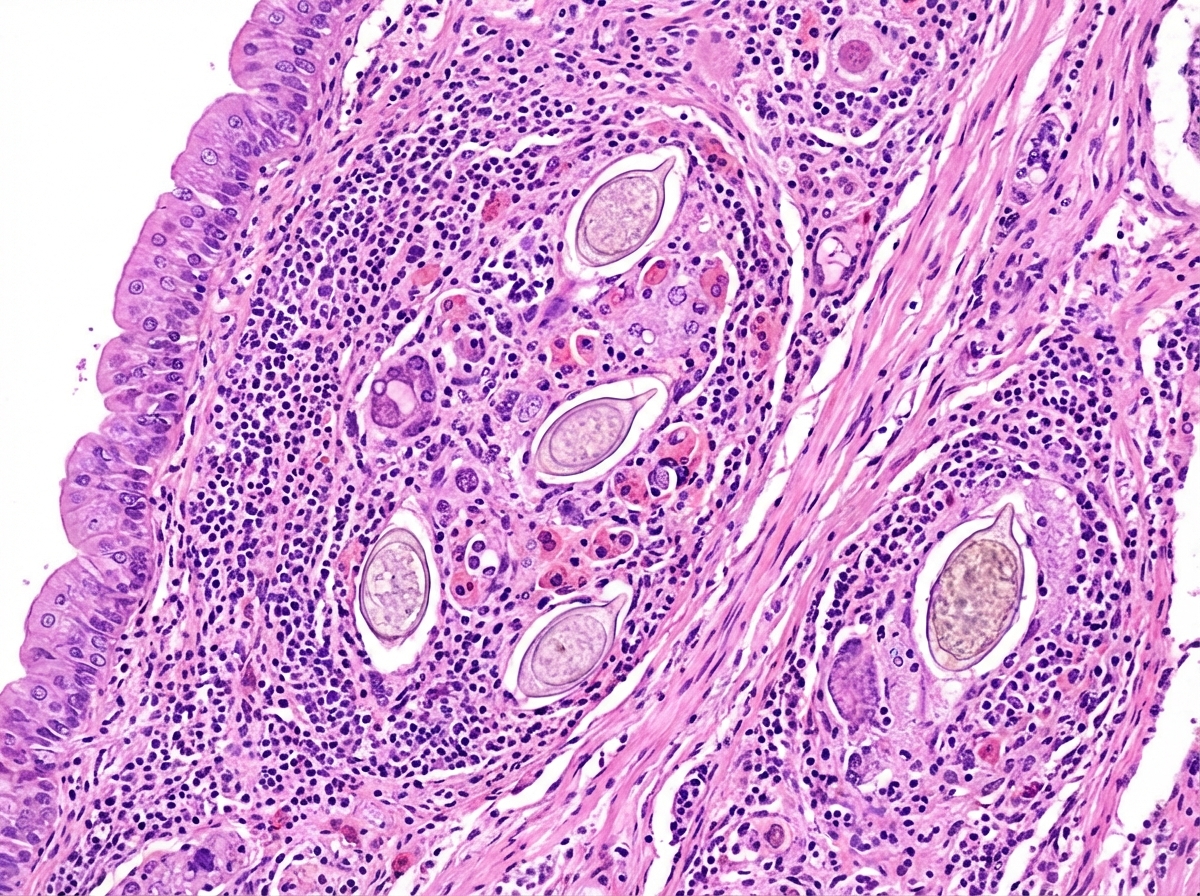
Explanation: ### Explanation **Correct Option: A. *Clonorchis sinensis*** *Clonorchis sinensis*, also known as the **Chinese Liver Fluke**, is a trematode primarily found in East Asia. The infection is acquired by ingesting undercooked or **raw freshwater fish** containing encysted metacercariae. Once ingested, the larvae migrate to the **biliary tract**, where they mature into adults. Chronic infection causes mechanical obstruction, inflammation, and hyperplasia of the bile duct epithelium. This leads to clinical features of **biliary obstruction** (jaundice, right upper quadrant pain) and is a well-known risk factor for **cholangiocarcinoma**. **Why Incorrect Options are Wrong:** * **B. *Ancylostoma* (Hookworm):** Infection occurs via larval skin penetration (filariform larvae). It primarily causes iron-deficiency anemia and GI symptoms, not biliary obstruction. * **C. *Strongyloides stercoralis*:** Also enters via skin penetration. It causes autoinfection and "larva currens." While it can cause malabsorption, it does not typically involve the biliary tree. * **D. *Enterobius vermicularis* (Pinworm):** Transmitted via the feco-oral route. It resides in the cecum and causes perianal pruritus; it is not associated with fish consumption or biliary pathology. **High-Yield Clinical Pearls for NEET-PG:** * **Intermediate Hosts:** 1st host is the Snail (*Parafossarulus*); 2nd host is the Fish (Cyprinidae family). * **Drug of Choice:** Praziquantel. * **Diagnostic Stage:** Ovoid, "operculated" eggs with a small knob at the posterior end, found in feces. * **Key Association:** Always link *Clonorchis sinensis* and *Opisthorchis viverrini* with **Cholangiocarcinoma** (Bile duct cancer).
Explanation: ### Explanation **Correct Option: A (Excretory system of trematodes)** Flame cells (also known as **protonephridia**) are specialized excretory and osmoregulatory cells found in the Phylum Platyhelminthes, which includes **Trematodes** (flukes) and **Cestodes** (tapeworms). These cells contain a tuft of cilia that beat rhythmically, resembling a flickering candle flame—hence the name. Their primary function is to filter interstitial fluid and propel waste products through excretory canals to the exterior via excretory pores. **Why other options are incorrect:** * **Option B (Nematodes):** Nematodes (roundworms) possess a more primitive excretory system consisting of **Renette cells** or a tubular system (H-shaped) without cilia or flame cells. * **Option C & D (Amoeba/Protozoa):** Protozoa are unicellular organisms. They lack complex multicellular organs or specialized cells like flame cells. They typically excrete waste via simple diffusion or **contractile vacuoles** (primarily for osmoregulation). **High-Yield NEET-PG Pearls:** * **Platyhelminthes (Flatworms):** Characterized by flame cells. This group includes *Schistosoma*, *Fasciola*, and *Taenia*. * **Solenocytes:** A variation of protonephridia (similar to flame cells) found in some lower invertebrates (e.g., Amphioxus). * **Schistosomiasis:** In *Schistosoma* species, the detection of "miracidia" (which also contain flame cells) in urine or stool is a key diagnostic feature. * **Nematode Excretion:** Remember "Renette cells" for *Ascaris*—a frequent comparison point in exams.
Explanation: **Explanation:** The characteristic feature of an intestinal amoebic ulcer caused by *Entamoeba histolytica* is the **flask-shaped ulcer**. However, when describing the **morphology of the ulcer's margins**, it is classically described as having **punched-out edges**. 1. **Why "Punched out" is correct:** In amoebiasis, the parasite secretes proteolytic enzymes (histolysin) that cause localized tissue necrosis. This results in a well-defined, deep ulcer that looks as if the tissue has been removed with a mechanical punch. The base is usually covered with necrotic slough. 2. **Why "Flask-shaped" (Option A) is often confused:** While "Flask-shaped" is the most common textbook description for the *overall architecture* (narrow neck in the mucosa and a broad base in the submucosa), "Punched out" specifically describes the appearance of the edges upon gross inspection. 3. **Why other options are incorrect:** * **Undermined edges (Option B):** These are characteristic of **Tubercular ulcers**, where the infection spreads laterally under the mucosal layer. * **Rolled-up/Everted edges (Option C):** These are typical of **Malignant ulcers** (e.g., Squamous Cell Carcinoma). * **Sloping edges:** These are seen in **healing traumatic ulcers**. **High-Yield Clinical Pearls for NEET-PG:** * **Site:** The most common site for amoebic ulcers is the **Cecum** and ascending colon. * **Direction:** The long axis of an amoebic ulcer is **transverse** (unlike Typhoid ulcers, which are longitudinal). * **Stool Microscopy:** Look for **trophozoites with ingested RBCs** (Erythrophagocytosis), which is pathognomonic for invasive *E. histolytica*. * **Complication:** The most common extra-intestinal site is the **Liver** (Amoebic Liver Abscess), characterized by "Anchovy sauce" pus.
Explanation: ### Explanation In the life cycle of *Plasmodium*, the **Endogenous cycle** refers to the phase of development that occurs within the human host (the intermediate host). This cycle includes both the **Exo-erythrocytic schizogony** (in the liver) and the **Erythrocytic schizogony** (in the RBCs). Since the multiplication in RBCs happens inside the human body, it is classified as endogenous. **Analysis of Options:** * **Sexual cycle (Option A):** This occurs primarily in the female *Anopheles* mosquito (the definitive host). It begins with gametogony in humans but concludes with syngamy and ookinete formation in the mosquito gut. * **Sporogony (Option B):** This is the asexual phase of multiplication that occurs in the **mosquito**. It starts after fertilization and results in the production of infectious sporozoites. * **Exogenous cycle (Option C):** This is a synonym for the cycle occurring outside the human host, specifically within the mosquito. It encompasses both the sexual cycle and sporogony. **NEET-PG High-Yield Pearls:** * **Definitive Host:** Female *Anopheles* mosquito (where the sexual cycle occurs). * **Intermediate Host:** Humans (where the asexual/endogenous cycle occurs). * **Infective Form to Humans:** Sporozoites (injected via mosquito bite). * **Infective Form to Mosquito:** Gametocytes (ingested during a blood meal). * **Relapse:** Caused by **hypnozoites** (dormant liver stages) seen in *P. vivax* and *P. ovale*. * **Schüffner’s dots:** Characteristically seen in RBCs infected with *P. vivax* and *P. ovale*.
Explanation: **Explanation:** The association between parasitic infections and malignancy is a high-yield topic in NEET-PG. **Clonorchiasis**, caused by the Chinese liver fluke (*Clonorchis sinensis*), is a well-established risk factor for **Cholangiocarcinoma** (cancer of the bile duct epithelium). **Why Clonorchiasis is correct:** Chronic infection leads to mechanical irritation and the release of excretory-secretory products by the flukes residing in the bile ducts. This triggers chronic inflammation, epithelial hyperplasia, and periductal fibrosis. The International Agency for Research on Cancer (IARC) classifies *Clonorchis sinensis* and *Opisthorchis viverrini* as Group 1 carcinogens because this prolonged inflammatory state promotes DNA damage and malignant transformation of the biliary epithelium. **Analysis of Incorrect Options:** * **Paragonimus westermani:** Known as the lung fluke; it causes pulmonary symptoms mimicking tuberculosis (hemoptysis, cavitary lesions) but is not typically associated with malignancy. * **Guinea worm (Dracunculus medinensis):** Causes cutaneous ulcers and local inflammation upon emergence; it does not have oncogenic potential. * **Ancylostoma (Hookworm):** Primarily causes iron-deficiency anemia and ground itch; it is not linked to cancer. **High-Yield Clinical Pearls for NEET-PG:** 1. **Schistosoma haematobium:** Associated with **Squamous Cell Carcinoma of the Urinary Bladder** (not transitional cell). 2. **Opisthorchis viverrini:** Similar to *Clonorchis*, it is a major cause of Cholangiocarcinoma in Southeast Asia. 3. **Intermediate Host:** For *Clonorchis*, the first intermediate host is a snail, and the second is **freshwater fish**. 4. **Drug of Choice:** Praziquantel is the treatment for most trematode infections, including Clonorchiasis.
Explanation: In parasitology, the complexity of a life cycle is defined by the number of hosts required to complete the parasite's development and reproduction. **Explanation of the Correct Answer:** A **simple life cycle** (also known as a **monoxenous** life cycle) requires only **one host** (the definitive host). In this cycle, the parasite is transmitted directly from one individual to another or via the environment (soil/water) without the need for an intermediate biological vector. * **Mechanism:** The parasite usually leaves the host as an egg or cyst, matures in the environment, and infects a new host. * **Examples:** *Ascaris lumbricoides*, *Entamoeba histolytica*, *Giardia lamblia*, and *Enterobius vermicularis*. **Explanation of Incorrect Options:** * **B (Two hosts):** This is a **complex (heteroxenous)** life cycle. It requires a definitive host (where sexual reproduction occurs) and one intermediate host. Examples: *Taenia saginata* (Human and Cattle) or *Plasmodium* (Human and Mosquito). * **C & D (Three/Four hosts):** These represent highly complex life cycles involving multiple intermediate hosts (paratenic or secondary intermediate hosts). Example: *Diphyllobothrium latum* (requires a crustacean and a fish before reaching humans). **High-Yield Clinical Pearls for NEET-PG:** 1. **Soil-Transmitted Helminths (STHs):** Most STHs (like Hookworm and *Ascaris*) have simple life cycles. 2. **Autoinfection:** Parasites with simple life cycles are often capable of autoinfection (e.g., *Strongyloides stercoralis*, *Hymenolepis nana*). 3. **Rule of Thumb:** If a parasite requires a vector (like a mosquito or sandfly) or an intermediate host (like a snail or pig), it **cannot** have a simple life cycle.
Explanation: **Explanation:** The question asks for the disease caused by **hard ticks** (*Ixodidae*). However, there is a critical distinction in medical parasitology regarding **Relapsing Fever**: * **Endemic Relapsing Fever** is caused by *Borrelia duttonii* and is transmitted by **Soft Ticks** (*Ornithodoros*). * **Epidemic Relapsing Fever** is caused by *Borrelia recurrentis* and is transmitted by **Lice**. In the context of standard NEET-PG patterns, if "Relapsing Fever" is marked as the correct answer for a "Hard Tick" question, it usually refers to a specific subtype or is a common point of confusion in older question banks. **However, scientifically, KFD, Indian Tick Typhus, and Tularemia are classic examples of Hard Tick-borne diseases.** **Analysis of Options:** * **Relapsing Fever (A):** Primarily transmitted by **Soft Ticks** (Endemic) or **Lice** (Epidemic). It is characterized by febrile episodes separated by afebrile periods due to *antigenic variation*. * **Kyasanur Forest Disease (B):** Caused by a Flavivirus and transmitted by the hard tick ***Haemaphysalis spinigera***. It is endemic to Karnataka, India. * **Indian Tick Typhus (C):** Caused by *Rickettsia conorii* and transmitted by hard ticks like ***Rhipicephalus sanguineus***. * **Tularemia (D):** Caused by *Francisella tularensis*; while it can be transmitted by hard ticks (*Dermacentor*), it also spreads via deer flies and direct contact with infected rabbits. **High-Yield Clinical Pearls for NEET-PG:** * **Hard Ticks (*Ixodidae*):** Scutum present, head visible from above. Diseases: KFD, Tick paralysis, Babesiosis, Lyme disease, Bullis fever. * **Soft Ticks (*Argasidae*):** No scutum, head not visible from above. Diseases: Endemic Relapsing Fever. * **Lyme Disease:** Most common tick-borne illness globally (Vector: *Ixodes* hard tick). * **KFD:** Known as "Monkey Fever" due to associated monkey deaths in the forest.
Explanation: **Explanation:** **1. Why Option A is Incorrect (The Correct Answer):** While finding trophozoites in stool (especially those containing ingested RBCs or "erythrophagocytosis") is diagnostic of invasive amoebiasis, they are **not essential** for diagnosis. Trophozoites are labile and often disintegrate rapidly outside the body. In clinical practice, diagnosis frequently relies on the detection of **cysts** in formed stools, stool antigen assays (ELISA for Gal/GalNAc lectin), or PCR. Furthermore, in extra-intestinal cases like Amoebic Liver Abscess (ALA), stool microscopy is negative in 60-90% of patients, necessitating serology or imaging. **2. Analysis of Other Options:** * **Option B:** Correct statement. Approximately **90%** of *E. histolytica* infections are asymptomatic (luminal amoebiasis), where the parasite remains a commensal in the gut. * **Option C:** Correct statement. The liver is the most common site for extra-intestinal amoebiasis. Trophozoites travel via the portal circulation to cause **"Anchovy sauce"** appearance abscesses. * **Option D:** Correct statement. Infection with *E. histolytica* does **not** confer long-term protective immunity. Recurrent infections are common in endemic areas because the immune response (humoral and cellular) is insufficient to prevent reinfection. **High-Yield NEET-PG Pearls:** * **Infective Stage:** Quadrinucleate cyst. * **Pathognomonic Feature:** Trophozoites with ingested RBCs (indicates tissue invasion). * **Culture Media:** Robinson’s medium and NIH polyxenic medium. * **Drug of Choice:** Metronidazole (for invasive disease) followed by a luminal amoebicide (e.g., Paromomycin or Diloxanide furoate) to clear cysts.
Explanation: ### Explanation The clinical presentation of firm, non-tender, mobile subcutaneous nodules (known as **Onchocercomata**) containing both adult worms and microfilariae is pathognomonic for **_Onchocerca volvulus_**. **1. Why the Correct Answer is Right:** _Onchocerca volvulus_ (the causative agent of River Blindness) typically presents with subcutaneous nodules over bony prominences (like the iliac crest or skull). The adult worms reside within these fibrous nodules, where they mate and release microfilariae. Diagnosis is confirmed by identifying microfilariae in **skin snips** (scrapings) or by finding adult worms in an excised nodule. **2. Why the Incorrect Options are Wrong:** * **_Loa loa_ (African Eye Worm):** Characterized by transient, localized subcutaneous swellings called **Calabar swellings**. Adult worms migrate through the subconjunctiva of the eye. Microfilariae are found in the **blood**, not skin scrapings. * **_Brugia malayi_:** A cause of lymphatic filariasis. It primarily affects the lymphatic system, leading to lymphadenitis and elephantiasis of the lower limbs. Microfilariae are found in the **blood** (nocturnal periodicity). * **_Mansonella streptocerca_:** While it can cause itchy skin rashes and hypopigmented macules, it rarely forms the distinct, firm, mobile nodules (onchocercomata) characteristic of _O. volvulus_. **3. High-Yield Clinical Pearls for NEET-PG:** * **Vector:** Blackfly (_Simulium_). * **Mazzotti Reaction:** A severe inflammatory response (fever, rash, tachycardia) occurring after treatment with Diethylcarbamazine (DEC) due to the rapid killing of microfilariae. * **Drug of Choice:** **Ivermectin** (Note: DEC is contraindicated in Onchocerciasis as it can worsen ocular damage). * **Ocular Complication:** "Snowflake" opacities leading to Sclerosing Keratitis (River Blindness).
Classification of Parasites
Practice Questions
Intestinal Protozoa
Practice Questions
Blood and Tissue Protozoa
Practice Questions
Malaria Parasites
Practice Questions
Leishmaniasis
Practice Questions
Intestinal Helminths: Nematodes
Practice Questions
Tissue Nematodes
Practice Questions
Trematodes
Practice Questions
Cestodes
Practice Questions
Ectoparasites
Practice Questions
Antiparasitic Drugs
Practice Questions
Laboratory Diagnosis of Parasitic Infections
Practice Questions
Get full access to all questions, explanations, and performance tracking.
Start For Free