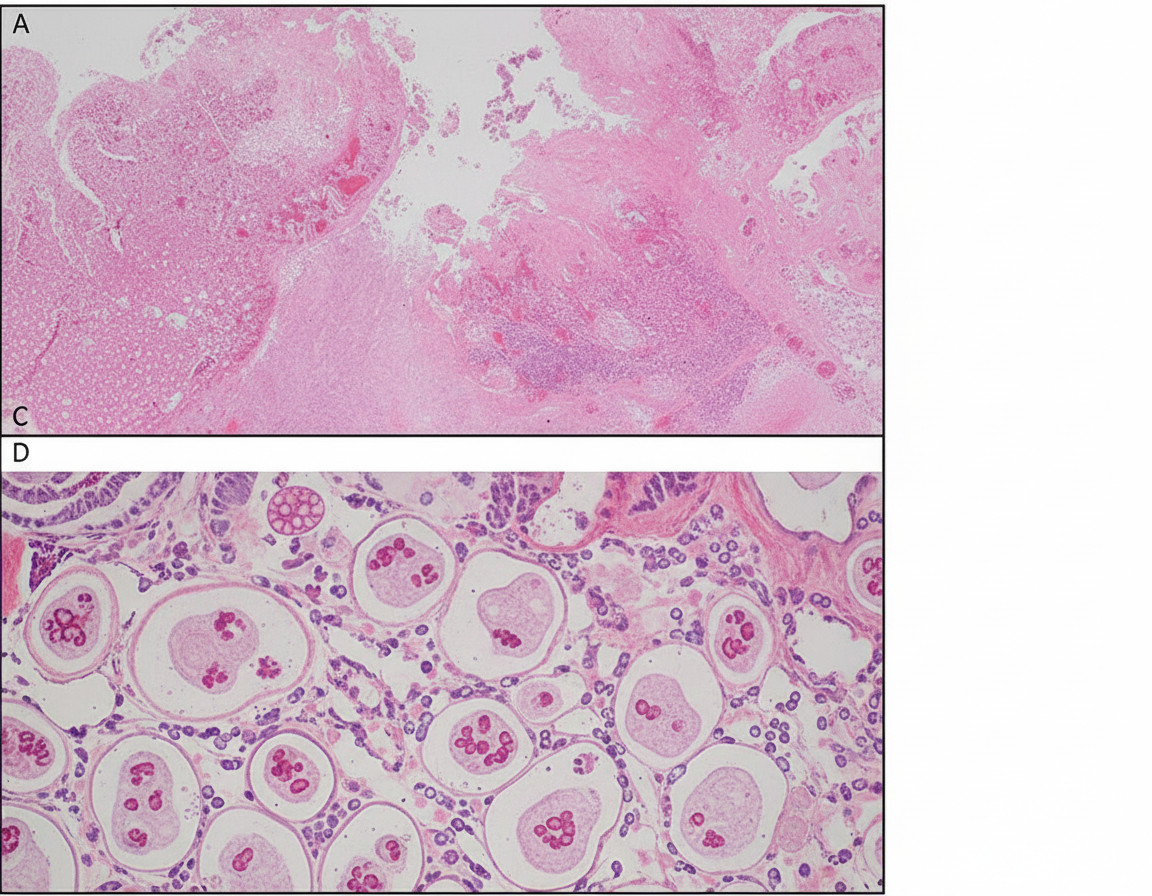
Which of the following parasites targets the liver?
Visceral larva migrans is associated with which of the following?
Which disease is transmitted by mites?
Chyluria is due to:
What is the most common site of extraintestinal amoebiasis?
Which tick-borne fever is characterized by an organism that attacks red blood cells?
Which of the following is a primary host for Toxoplasma gondii?
Amebic abscess is caused by which of the following organisms?
What is the usual reservoir for the protozoan infection caused by Toxoplasma gondii in children?
What is the infective form of the malarial parasite?
Explanation: ### Explanation **Correct Answer: C. Clonorchis sinensis** **Clonorchis sinensis** (the Chinese Liver Fluke) is a trematode that primarily inhabits the **bile ducts** of the liver. After ingestion of undercooked fish containing metacercariae, the larvae excyst in the duodenum and migrate through the ampulla of Vater into the biliary tree. Chronic infection leads to biliary stasis, inflammation, and is a well-documented risk factor for **cholangiocarcinoma** (bile duct cancer). **Analysis of Incorrect Options:** * **A. Fasciola buski:** This is the **Giant Intestinal Fluke**. Unlike *Fasciola hepatica* (which targets the liver), *F. buski* resides in the small intestine (duodenum and jejunum) of humans and pigs. * **B. Paragonimus westermani:** Known as the **Oriental Lung Fluke**, its primary target organ is the lungs, where it forms cystic cavities leading to symptoms mimicking tuberculosis (hemoptysis). * **D. Schistosoma haematobium:** This blood fluke targets the **vesical venous plexus** surrounding the urinary bladder. It is a major cause of hematuria and is strongly associated with squamous cell carcinoma of the bladder. **High-Yield Clinical Pearls for NEET-PG:** * **Liver Flukes:** *Clonorchis sinensis*, *Opisthorchis viverrini*, and *Fasciola hepatica* all target the biliary system. * **Intermediate Hosts:** All trematodes require a **snail** as their first intermediate host. *Clonorchis* requires a freshwater fish as the second intermediate host. * **Diagnosis:** Identification of characteristic "operculated eggs" with a small knob (abopercular protuberance) in the stool. * **Treatment:** **Praziquantel** is the drug of choice for most trematodes, except *Fasciola hepatica* (Triclabendazole).
Explanation: **Explanation:** **Visceral Larva Migrans (VLM)** is a clinical syndrome caused by the migration of non-human nematode larvae through the internal organs of a human host. **Why Toxocara canis is correct:** *Toxocara canis* (dog roundworm) and *Toxocara cati* (cat roundworm) are the primary causative agents. Humans are accidental hosts who ingest embryonated eggs from soil contaminated with animal feces. Since humans are not the definitive hosts, the larvae cannot complete their life cycle to become adult worms. Instead, they penetrate the intestinal wall and migrate through the **liver, lungs, and eyes**, triggering a robust inflammatory response and marked **peripheral eosinophilia**. **Analysis of Incorrect Options:** * **Strongyloides stercoralis:** Causes **Hyperinfection syndrome** or "Larva currens" (a rapidly moving cutaneous track), but it is a human parasite that completes its life cycle in the human gut. * **Ancylostoma braziliense:** This is the primary cause of **Cutaneous Larva Migrans (CLM)** or "creeping eruption." The larvae penetrate the skin but lack the collagenases to penetrate the basement membrane, remaining confined to the epidermis. * **Visceral leishmaniasis (Kala-azar):** This is caused by a protozoan (*Leishmania donovani*), not a helminth. While it affects internal organs (spleen/liver), it does not involve larval migration. **High-Yield Clinical Pearls for NEET-PG:** * **Classic Presentation:** A young child with a history of pica (eating dirt), hepatomegaly, wheezing, and extreme eosinophilia. * **Ocular Larva Migrans (OLM):** A variant where larvae migrate to the eye, often mimicking a retinoblastoma. * **Diagnosis:** Serology (ELISA) is the preferred method; stool examination is useless because the larvae never mature into egg-laying adults in humans. * **Treatment:** Albendazole or Mebendazole.
Explanation: **Explanation:** The correct answer is **Scrub typhus**. This disease is caused by the bacterium *Orientia tsutsugamushi* and is transmitted to humans through the bite of the larval stage (chigger) of **trombiculid mites**. **Breakdown of Options:** * **Scrub Typhus (A):** Transmitted by **larval mites (chiggers)**. A classic clinical sign is the **eschar**—a painless, black necrotic lesion at the site of the mite bite. * **Trench Fever (B):** Caused by *Bartonella quintana* and transmitted by the **human body louse**. * **Endemic Typhus (C):** Also known as Murine typhus, it is caused by *Rickettsia typhi* and transmitted by the **rat flea** (*Xenopsylla cheopis*). * **Epidemic Typhus (D):** Caused by *Rickettsia prowazekii* and transmitted by the **human body louse**. **High-Yield Clinical Pearls for NEET-PG:** 1. **Vector Mnemonic:** Remember "Mite-y Scrub" (Mite = Scrub Typhus) and "Louse-y Epidemic" (Louse = Epidemic Typhus). 2. **Weil-Felix Test:** This is a heterophile agglutination test used for diagnosis. Scrub typhus shows a positive reaction with **OX-K** strains, whereas Epidemic and Endemic typhus react with **OX-19**. 3. **Drug of Choice:** **Doxycycline** is the gold standard treatment for all rickettsial diseases, including scrub typhus. 4. **Reservoir:** For scrub typhus, the mite acts as both the vector and the reservoir due to transovarial transmission.
Explanation: **Explanation:** **Chyluria** is the presence of chyle (a milky fluid consisting of lymph and emulsified fats) in the urine. It occurs due to a communication between the intestinal lymphatics and the urinary tract. **Why Filaria is correct:** The most common cause of chyluria worldwide is **Lymphatic Filariasis**, primarily caused by *Wuchereria bancrofti*. The adult worms reside in the lymphatic vessels, leading to chronic inflammation, fibrosis, and eventual **lymphatic obstruction**. This obstruction causes high pressure within the lymphatics (lymphatic hypertension), leading to the rupture of collateral lymphatic vessels into the renal pelvis, ureter, or bladder. The characteristic "milky white" appearance of urine is due to the presence of chylomicrons. **Why other options are incorrect:** * **Carcinoma:** While retroperitoneal tumors can occasionally cause lymphatic obstruction, they are a rare cause of chyluria compared to parasitic infections. * **Tuberculosis:** Renal TB typically presents with "sterile pyuria" (pus cells in urine without bacterial growth on standard media), not chyluria. * **Malaria:** Malaria causes hemolysis, which may lead to **hemoglobinuria** (Blackwater fever in *P. falciparum*), resulting in dark/cola-colored urine, but not milky chyluria. **NEET-PG High-Yield Pearls:** * **Diagnosis:** Chyluria can be confirmed by the **Ether test** (urine clears after adding ether) or by detecting high triglyceride levels in the urine. * **Microfilariae:** Usually show **nocturnal periodicity** (collected between 10 PM – 2 AM). * **Drug of Choice:** Diethylcarbamazine (DEC) is the mainstay for Filariasis, but it does not reverse established structural lymphatic damage. * **Tropical Pulmonary Eosinophilia (TPE):** A hypersensitivity reaction to filarial antigens characterized by nocturnal cough and high IgE levels.
Explanation: **Explanation:** **Entamoeba histolytica** is primarily an intestinal parasite, but it can spread hematogenously to cause extraintestinal manifestations. **Why Liver is Correct:** The **Liver** is the most common site for extraintestinal amoebiasis. This occurs because trophozoites from the intestinal wall enter the **portal venous system**. Since the portal vein drains directly into the liver, it acts as the first major capillary filter for the parasite. The resulting **Amoebic Liver Abscess (ALA)** typically presents in the right lobe (due to the streamlining of portal blood flow) and is characterized by "anchovy sauce" pus. **Why Other Options are Incorrect:** * **Lungs (Option D):** This is the second most common site. It usually occurs via direct extension from a liver abscess through the diaphragm or, less commonly, through systemic circulation. * **Brain (Option A):** This is a rare, life-threatening complication resulting from hematogenous spread. It typically presents as sudden onset meningoencephalitis. * **Spleen (Option C):** Splenic involvement is extremely rare and usually occurs only in cases of widespread systemic dissemination. **High-Yield Clinical Pearls for NEET-PG:** * **Trophozoite Morphology:** Look for ingested RBCs (Erythrophagocytosis) in the cytoplasm—this is pathognomonic for *E. histolytica*. * **Anchovy Sauce Pus:** The abscess fluid is chocolate-brown, odorless, and sterile (contains no bacteria or trophozoites; trophozoites are found in the abscess wall). * **Treatment:** **Metronidazole** or Tinidazole is the drug of choice for the tissue stage, followed by a luminal amoebicide (e.g., Diloxanide furoate or Paromomycin) to eradicate cysts.
Explanation: **Explanation:** **Babesiosis** is the correct answer because it is a tick-borne zoonosis caused by protozoan parasites of the genus *Babesia* (most commonly *B. microti*). The organism is transmitted by the **Ixodes tick** (the same vector for Lyme disease). Once in the bloodstream, the sporozoites invade **Red Blood Cells (RBCs)**, where they replicate asexually. A hallmark diagnostic feature on a peripheral blood smear is the **"Maltese Cross" appearance** (tetrads of merozoites), which confirms its intra-erythrocytic nature. **Why other options are incorrect:** * **Typhus:** While some forms (like Endemic or Epidemic Typhus) are vector-borne (fleas/lice), **Scrub Typhus** is mite-borne. However, *Rickettsia* species primarily infect **vascular endothelial cells**, not RBCs. * **Dengue:** This is a viral infection transmitted by the **Aedes mosquito**, not ticks. It primarily affects platelets and causes plasma leakage. * **Malaria:** While *Plasmodium* does attack RBCs, it is transmitted by the **Anopheles mosquito**, not ticks. **High-Yield Clinical Pearls for NEET-PG:** * **Vector:** *Ixodes scapularis* (Deer tick). * **Morphology:** Look for "Maltese Cross" or ring forms (often confused with *P. falciparum*, but Babesia lacks hemozoin pigment). * **Clinical Presentation:** Fever, hemolytic anemia, and hemoglobinuria. It can be fatal in asplenic patients. * **Treatment:** Combination of **Atovaquone + Azithromycin** (preferred) or Clindamycin + Quinine.
Explanation: **Explanation:** The correct answer is **A. Cats**. *Toxoplasma gondii* is an obligate intracellular protozoan with a complex life cycle involving two types of hosts: 1. **Definitive (Primary) Host:** Members of the family **Felidae (cats)**. This is the only host where the **sexual cycle** (gametogony and oocyst formation) occurs within the intestinal epithelium. Oocysts are then excreted in the feces, which become infectious after sporulation in the environment. 2. **Intermediate Host:** Humans, mammals (dogs, cows, rats), and birds. In these hosts, only the **asexual cycle** occurs, leading to the formation of tachyzoites and tissue cysts (bradyzoites). **Why other options are incorrect:** * **B, C, and D (Dogs, Rats, Cows):** These animals serve only as **intermediate hosts**. Humans typically acquire the infection by ingesting undercooked meat containing tissue cysts (from cows or pigs) or via accidental ingestion of oocysts from soil or water contaminated by cat feces. Rats play a role in the urban cycle by maintaining the infection in the feline population. **High-Yield Clinical Pearls for NEET-PG:** * **Infective forms:** Sporulated oocysts (from cat feces) or tissue cysts (from undercooked meat). * **Congenital Toxoplasmosis:** Characterized by the classic triad: **Chorioretinitis, Hydrocephalus, and Intracranial calcifications.** * **Immunocompromised patients (HIV/AIDS):** Most common presentation is **Ring-enhancing lesions** in the brain (Toxoplasmic encephalitis). * **Diagnosis:** Sabin-Feldman Dye Test (Gold Standard) and Tachyzoites in Giemsa stain.
Explanation: **Explanation:** **Entamoeba histolytica** is the correct answer. It is a protozoan parasite that primarily causes intestinal amoebiasis. In approximately 1% of cases, the trophozoites migrate from the colon to the liver via the **portal venous system**, leading to **Amoebic Liver Abscess (ALA)**—the most common extra-intestinal manifestation. The abscess typically contains "anchovy sauce" appearance pus (necrotic liver tissue) and is usually located in the right lobe of the liver. **Analysis of Incorrect Options:** * **Staphylococcus aureus:** This is a bacterium and the most common cause of **Pyogenic Liver Abscess**. Unlike the sterile pus of ALA, pyogenic abscesses contain true foul-smelling pus and are often multiple. * **Influenza:** This is a respiratory virus. It does not cause liver abscesses. * **Echinococcus granulosus:** This helminth causes **Hydatid Cyst** disease. While it affects the liver, it presents as a slow-growing, fluid-filled cyst with a "daughter cyst" appearance on imaging, rather than an acute inflammatory abscess. **NEET-PG High-Yield Pearls:** * **Site:** Right lobe of the liver is most common (due to the bulk of blood flow from the superior mesenteric vein). * **Pus Characteristics:** Odorless, chocolate-brown, "anchovy sauce" appearance. Trophozoites are found in the **abscess wall**, not the central pus. * **Diagnosis:** Serology (ELISA) is highly sensitive; Ultrasound shows a round/oval hypoechoic lesion. * **Treatment:** **Metronidazole** is the drug of choice, followed by a luminal amebicide (e.g., Diloxanide furoate) to eradicate the intestinal cyst carrier state.
Explanation: **Explanation:** **Toxoplasma gondii** is an obligate intracellular protozoan. The correct answer is **Cats** because members of the family Felidae are the **only definitive hosts** for this parasite. In the feline intestine, the parasite undergoes sexual reproduction (gametogony), resulting in the excretion of infectious **oocysts** in the feces. Children and adults typically acquire the infection via the fecal-oral route (ingesting oocysts from contaminated soil or cat litter) or by consuming undercooked meat containing tissue cysts. **Analysis of Incorrect Options:** * **B. Sheep:** These are **intermediate hosts**. They harbor the parasite in the form of tissue cysts (bradyzoites). While humans can get infected by eating undercooked mutton, sheep are not the primary reservoir for the environmental spread of oocysts. * **C. Dogs:** Dogs are accidental or intermediate hosts. They do not support the sexual cycle of the parasite and do not shed oocysts. * **D. Rats:** Rodents serve as intermediate hosts and play a crucial role in the life cycle by maintaining the infection in the cat population (cats hunt infected rats), but they are not the primary reservoir for human infection. **High-Yield Clinical Pearls for NEET-PG:** * **Definitive Host:** Domestic and wild cats. * **Intermediate Hosts:** All mammals (including humans) and birds. * **Infective Forms:** Oocysts (from cat feces), Tachyzoites (transplacental), and Tissue cysts/Bradyzoites (undercooked meat). * **Congenital Toxoplasmosis Triad:** Chorioretinitis, Hydrocephalus, and Intracranial calcifications. * **Diagnosis:** Sabin-Feldman Dye Test (Gold Standard) and IgM/IgG ELISA. * **Treatment:** Pyrimethamine and Sulfadiazine (plus folinic acid). Spiramycin is used in pregnancy to prevent vertical transmission.
Explanation: **Explanation:** The life cycle of *Plasmodium* involves two hosts: the female Anopheles mosquito (definitive host) and the human (intermediate host). **Why Sporozoites are the correct answer:** Sporozoites are the **infective stage** for humans. They are produced via sporogony in the mosquito's midgut and migrate to its salivary glands. When an infected mosquito bites a human, these motile, spindle-shaped sporozoites are inoculated into the bloodstream, from where they quickly invade hepatocytes to initiate the pre-erythrocytic (exo-erythrocytic) cycle. **Analysis of Incorrect Options:** * **Trophozoites:** This is the **metabolically active, feeding stage** within the red blood cells (RBCs). The "ring form" is the early trophozoite, crucial for diagnosis on peripheral smears. * **Hypnozoites:** These are **dormant stages** found only in *P. vivax* and *P. ovale* infections. They remain latent in the liver and are responsible for clinical **relapses** weeks or months later. * **Merozoites:** These are the products of schizogony (asexual reproduction). They are released when a liver cell or RBC ruptures. Merozoites are the stage that **infects RBCs**, but they are not the stage introduced by the mosquito. **High-Yield NEET-PG Pearls:** * **Infective form for Mosquito:** Gametocytes (taken up during a blood meal). * **Site of Exflagellation:** Occurs in the mosquito's midgut (microgametes). * **Relapse vs. Recrudescence:** Relapse is due to hypnozoites (*P. vivax/ovale*); Recrudescence is due to persistent low-level parasitemia in the blood (*P. falciparum/malariae*). * **Drug of choice for Hypnozoites:** Primaquine (contraindicated in G6PD deficiency).
Classification of Parasites
Practice Questions
Intestinal Protozoa
Practice Questions
Blood and Tissue Protozoa
Practice Questions
Malaria Parasites
Practice Questions
Leishmaniasis
Practice Questions
Intestinal Helminths: Nematodes
Practice Questions
Tissue Nematodes
Practice Questions
Trematodes
Practice Questions
Cestodes
Practice Questions
Ectoparasites
Practice Questions
Antiparasitic Drugs
Practice Questions
Laboratory Diagnosis of Parasitic Infections
Practice Questions
Get full access to all questions, explanations, and performance tracking.
Start For Free