A young female presents with ptosis showing diurnal variation. CT chest shows an anterior mediastinal mass identified as thymus gland cancer. Which receptor is affected in this patient?
A patient presents with unilateral throbbing pain, photophobia, nausea, and vomiting. The symptoms improve after taking sumatriptan. What is the most likely diagnosis?
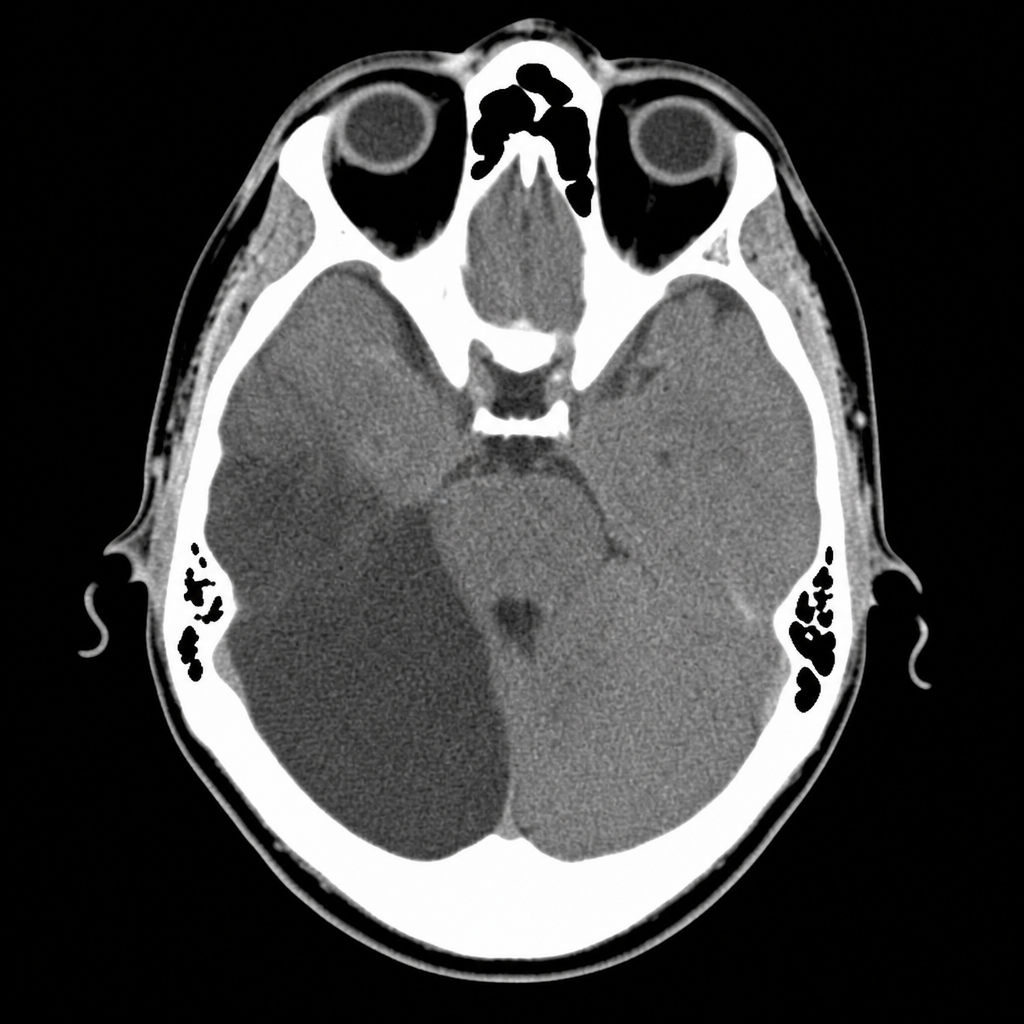
A 60 y/o male suddenly experiences an intense headache, described as the worst headache of his life, followed by vomiting and photophobia. O/E he has neck stiffness and a dilated pupil on the right side. A CT scan reveals bleeding in the subarachnoid space. Which of the following is the most common cause of this condition?
A patient reports difficulty switching between movements and experiences uncontrollable hand movements. What is the most likely diagnosis?
A 35-year-old woman presents with fluctuating muscle weakness, especially affecting her speech and swallowing. Repetitive nerve stimulation shows a decremental response. Her blood tests are negative for acetylcholine receptor (AChR) antibodies. Which of the following antibodies is most likely responsible for her symptoms?
A patient presents with acute onset symmetric lower limb flaccid paralysis and absent deep tendon reflexes. Which condition is most likely?
A patient presents with the palsy of the face as shown. Which of the following is most likely involved?
A young male presented with weakness in the lower half of the right side of his face, with drooping of the angle of his mouth. He is unable to raise his eyebrows and close his eyes on the right side. Which of the following is the most appropriate diagnosis?
Bell's palsy involves
A woman presents with a history of headaches for the past 9 months that worsen in a recumbent position and improves as the day progresses. She also gives a history of taking oral contraceptives. Fundal examination shows papilledema. There are no focal neurological deficits. What is the probable cause of her headaches?
Explanation: ***Post-synaptic ACh Receptor*** - The clinical presentation of **ptosis** with **diurnal variation** (worsening weakness throughout the day) and an associated **thymoma** are hallmark features of **Myasthenia Gravis** [1]. - Myasthenia Gravis is an autoimmune disorder characterized by antibodies that bind to and block or destroy **post-synaptic nicotinic acetylcholine (ACh) receptors** at the neuromuscular junction, leading to impaired muscle contraction [2]. *Presynaptic ACh Receptor* - Autoantibodies in common neuromuscular junction disorders do not target presynaptic ACh receptors. These receptors are typically involved in modulating neurotransmitter release via feedback mechanisms. - The primary presynaptic autoimmune disorder, **Lambert-Eaton Myasthenic Syndrome**, involves antibodies against voltage-gated calcium channels, not ACh receptors [3]. *Voltage-gated calcium channels at the NMJ* - This is the pathological target in **Lambert-Eaton Myasthenic Syndrome (LEMS)**, where antibodies inhibit presynaptic calcium influx, reducing acetylcholine release [3]. - LEMS is clinically distinct, often presenting with weakness that **improves with activity** (incremental response) and is strongly associated with **small cell lung cancer** [3]. *Acetylcholinesterase* - **Acetylcholinesterase (AChE)** is the enzyme responsible for degrading acetylcholine in the synaptic cleft; it is not the target of autoimmunity in Myasthenia Gravis. - In fact, **AChE inhibitors** (e.g., pyridostigmine) are a primary treatment for Myasthenia Gravis, as they increase the concentration and duration of ACh in the synapse to better activate the reduced number of receptors [2].
Explanation: ***Migraine*** - The presentation of **unilateral**, **throbbing pain** combined with associated symptoms like **photophobia**, **nausea**, and **vomiting** constitutes the classic criteria for migraine [1]. - Dramatic symptomatic relief after taking **sumatriptan** (a **triptan**) is highly characteristic, as these drugs are specific abortive treatments for acute **migraine** attacks. *Tension headache* - This headache is typically **bilateral**, described as a **tightening** or **band-like** pressure, and is non-throbbing [1]. - It usually lacks associated features such as **nausea**, **vomiting**, or severe photophobia, and does not typically respond well to triptans. *Cluster headache* - While also highly painful and unilateral, cluster headaches are characterized by **excruciating, non-throbbing** pain, often localized to the **periorbital** or retro-orbital region [1]. - Key associated features are **autonomic**, including ipsilateral **lacrimation**, ptosis, miosis, and rhinorrhea, features not mentioned in this presentation. *Sinus headache* - This diagnosis is associated with symptoms of **sinusitis**, such as facial pressure, pain over the sinuses, fever, and purulent nasal discharge. - The pain is usually localized to the **maxillary** or **frontal** regions and is not typically a severe, throbbing pain that uniquely responds to triptans.
Explanation: ***Intracranial aneurysm***- Rupture of an intracranial **saccular (berry) aneurysm** accounts for approximately 85% of all non-traumatic subarachnoid hemorrhage (SAH) cases, making it the most common cause [2].- The classic presentation of the **"worst headache of his life"** (thunderclap headache), meningismus (**neck stiffness**), and potential Third nerve palsy (dilated pupil due to compression) are highly suggestive of aneurysmal SAH [1].*Hypertension*- Uncontrolled **chronic hypertension** is the leading cause of non-traumatic **intraparenchymal hemorrhage (ICH)**, typically affecting deep brain structures like the basal ganglia.- While hypertension is a major risk factor for SAH, it is not the primary mechanism of bleeding; the rupture of an aneurysm is the direct immediate cause [1].*Arteriovenous malformation (AVM)*- AVMs are abnormal connections that can rupture, causing hemorrhagic stroke, but they are the second most common cause of SAH, accounting for less than 10% of cases.- AVM rupture often leads to a combination of **intraparenchymal hemorrhage** and SAH, and they are typically associated with younger patients.*Brain tumour*- Tumors rarely cause acute, massive SAH; when they bleed, it typically occurs within the tumor mass itself (**intratumoral hemorrhage**).- The clinical presentation usually involves subacute onset of symptoms and progressive focal neurological deficits, rather than the sudden, dramatic thunderclap headache characteristic of SAH [1].
Explanation: ***Dysdiadochokinesis***- This term refers to the impairment in the ability to perform **rapid alternating movements**, directly matching the complaint of "difficulty switching between movements" [2].- It is a classic sign of **cerebellar dysfunction**, which also accounts for the associated **uncontrollable movements** (often reflecting associated **ataxia** or **dysmetria**) [3].*Intentional Tremor*- This tremor is absent at rest, but its amplitude increases significantly as the patient attempts to reach a **visual target** (e.g., during the finger-to-nose test).- While it is a sign of **cerebellar disease**, the primary complaint in the stem is difficulty *switching* movements, which is characteristic of **dysdiadochokinesis**.*Metamorphosis*- This neurological term typically refers to **perceptual distortion** (specifically, *metamorphopsia* is the distortion of visual size or shape), which is unrelated to motor control or coordination.- It is not the term used to describe the inability to perform **rapid alternating movements** or uncontrolled movements due to cerebellar pathology.*Resting Tremor*- A resting tremor is maximal when the limb is completely relaxed and **supported against gravity**, classically seen in **Parkinson's disease** [1].- This tremor usually **improves significantly** or disappears entirely when the patient performs voluntary action, distinguishing it from intentional tremors and general lack of coordination.
Explanation: Detailed clinical evaluation of myasthenia gravis reveals that anti-MuSK antibodies target Muscle-Specific Kinase (MuSK), essential for clustering AChR at the NMJ [1]. Their presence confirms the diagnosis of Myasthenia Gravis (MG) in patients who are seronegative for AChR antibodies, often presenting with prominent bulbar and facial weakness [1]. Anti-dsDNA antibodies are specific for Systemic Lupus Erythematosus (SLE), an autoimmune disease that primarily causes arthritis, renal disease, and malar rash [2]. Although SLE can cause myositis or neuropathy, it does not typically present with the isolated, fluctuating postsynaptic weakness characteristic of Myasthenia Gravis and the decremental response. Anti-thyroid peroxidase (TPO) antibodies are primary markers for Hashimoto's thyroiditis, leading to hypothyroidism; screening for associated autoimmune thyroid disease is recommended in MG patients [1]. Anti-Ro antibodies, characteristic of Sjögren's Syndrome and SLE [2], primarily involve sicca symptoms and occasionally present with myositis, but not the hallmark features of ocular or bulbar MG.
Explanation: ***Guillain-Barré syndrome*** - This acute disorder is a **peripheral neuropathy** characterized by ascending, rapidly worsening, **symmetric weakness (flaccidity)** [1]. - The key distinguishing feature is the early and profound loss of deep tendon reflexes known as **areflexia**, corresponding to the damage of peripheral motor nerves/roots (a true lower motor neuron syndrome) [1]. *Multiple sclerosis* - MS is a **central nervous system** disorder causing demyelination in the brain and spinal cord, typically resulting in **upper motor neuron signs**. - Symptoms typically include spasticity, hyperreflexia, and sensory deficits, which directly contrast with the flaccidity and areflexia seen in this patient. *Amyotrophic lateral sclerosis* - ALS involves damage to both upper and lower motor neurons; while it causes LMN symptoms like flaccidity and atrophy, there is often concurrent **hyperreflexia or mixed reflexes** (UMN involvement) [2]. - It is a chronic, progressive neuronal disorder, not primarily defined by the acute, global **areflexia** consistent with GBS [2]. *Spinal cord injury* - Acute spinal cord injury leads to **spinal shock**, causing transient flaccid paralysis and areflexia below the level of the lesion, which eventually evolves into **spasticity and hyperreflexia**. - Unless the injury involves the **cauda equina** (LMN structure), persistent LMN signs with areflexia below the injury level are usually temporary or localized.
Explanation: ***7th nerve palsy*** - The image shows features of a **lower motor neuron (LMN) lesion** of the **7th cranial (facial) nerve**, affecting both the upper and lower face. Note the inability to wrinkle the left forehead, incomplete eye closure, and drooping of the left corner of the mouth. - This condition, often idiopathic and termed **Bell's palsy**, results in paralysis of all ipsilateral muscles of facial expression, which are innervated by the facial nerve. *3rd nerve palsy* - A **3rd cranial nerve (oculomotor)** palsy would present with **ptosis** (drooping eyelid), a dilated pupil, and the eye positioned "down and out" due to unopposed action of the superior oblique and lateral rectus muscles. - It does not cause paralysis of the lower facial muscles, such as those involved in smiling. *Erb's palsy* - This is an injury to the **upper trunk (C5-C6)** of the **brachial plexus**, typically occurring at birth, which affects the muscles of the shoulder and arm. - It results in the characteristic "**waiter's tip**" posture of the arm and has no effect on the facial muscles. *Orbicularis oculi palsy* - This describes an isolated paralysis of the muscle that closes the eyelids. While this is a component of 7th nerve palsy, it is not the complete diagnosis. - The patient clearly has paralysis of other facial muscles, such as the **frontalis** (forehead) and **zygomaticus** (mouth), indicating a lesion of the main facial nerve trunk, not just a single branch.
Explanation: ***Infranuclear facial palsy on right side***- **Infranuclear (peripheral) facial palsy** involves the facial nerve (CN VII) distal to the nucleus, causing paralysis of the entire ipsilateral side of the face.- The inability to move the upper facial muscles (closing the eye, raising the eyebrow) combined with lower face weakness (mouth drooping) on the right side indicates complete paralysis of the **right facial nerve**.*Supranuclear facial palsy on left side*- A **supranuclear (central) lesion** (e.g., stroke) affects the face contralaterally, leading to weakness on the right face, but the upper face (forehead) would be spared [1].- The ability to move the forehead is preserved in supranuclear palsy because the upper facial nucleus receives bilateral cortical input, which contradicts the bilateral/right upper face involvement described here [1].*Infranuclear facial on left side*- This diagnosis would cause complete paralysis (upper and lower face) on the **left side**.- The patient presents with clinical signs of paralysis (drooping mouth, inability to raise eyebrow) primarily on the **right side**, making a left-sided lesion incorrect.*Supranuclear facial on right side*- A **supranuclear lesion** on the right side would cause weakness of the muscles of the **left lower face** (contralateral presentation).- Supranuclear lesions never cause involvement of the upper facial muscles (unable to raise eyebrows) as seen in this patient [1].
Explanation: ***Ipsilateral upper and lower halves of the face.*** - **Bell's palsy** is the most common cause of **idiopathic peripheral (Lower Motor Neuron - LMN)** facial nerve paralysis [1]. - A peripheral (LMN) lesion affects the **entire distribution** of the facial nerve on the affected side, resulting in paralysis of all muscles, including those controlling the forehead and eye closure. - Facial nerve palsies affect the **ipsilateral** side of the face relative to the site of peripheral nerve injury or brainstem nuclear lesion. *Contralateral upper and lower halves of the face.* - This presentation would imply a **bilateral upper and lower facial paralysis**, which is highly unusual for a single lesion like Bell's palsy. - Facial nerve palsies affect the **ipsilateral** side of the face, not contralateral. *Ipsilateral lower half of the face.* - Paralysis limited to the **ipsilateral lower half of the face** while sparing the upper face (forehead) is characteristic of a **Central (Upper Motor Neuron - UMN)** lesion (like a stroke) located in the contralateral cortex [1]. - This does not define Bell's palsy, which is a **peripheral (LMN)** lesion affecting the entire face. *Contralateral lower half of the face.* - This pattern, involving **paralysis of the lower face contralateral** to the lesion while sparing the forehead, is the classic presentation of a **Central (Upper Motor Neuron - UMN)** lesion [1]. - UMN lesions spare the upper face because the **facial nerve nucleus** receives bilateral cortical input for the muscles of the forehead.
Explanation: ***Pseudotumor cerebri*** - The presentation of headache that worsens in the **recumbent position** (due to increased intracranial pressure, ICP) and improves when upright is highly characteristic of **Idiopathic Intracranial Hypertension (IIH)** [1]. - Confirmation of **papilledema** (swollen optic disc) in a young, likely obese female taking **oral contraceptives** (a risk factor) without other focal signs confirms the diagnosis of **pseudotumor cerebri** [1]. *Myasthenia gravis* - This disease is a neuromuscular disorder characterized by fluctuating **muscle weakness** (diplopia, ptosis, difficulty chewing) that worsens with activity and improves with rest. - It is not associated with primary headache or signs of increased intracranial pressure like **papilledema**. *Temporal arteritis* - This diagnosis is reserved for older patients (usually >50 years) presenting with severe localized headache, **jaw claudication**, tenderness over the temporal artery, and elevated inflammatory markers (ESR/CRP) [2]. - The positional nature of the headache and the patient's young age (implied by OCP use, a risk factor for IIH) make this diagnosis unlikely. *Chronic migraine* - Migraine is a diagnosis of exclusion that typically involves severe, often **pulsatile** headaches, sometimes with aura, photophobia, or nausea [3]. - While chronic migraine involves frequent headaches, it does not cause **papilledema** or have headaches classically exacerbated by the **recumbent position**, which points instead toward a structural or ICP-related etiology [2].
Cerebrovascular Diseases
Practice Questions
Seizure Disorders and Epilepsy
Practice Questions
Headache Disorders
Practice Questions
Movement Disorders
Practice Questions
Demyelinating Diseases
Practice Questions
Neurodegenerative Disorders
Practice Questions
Neuromuscular Junction Disorders
Practice Questions
Peripheral Neuropathies
Practice Questions
CNS Infections
Practice Questions
Neuro-oncology
Practice Questions
Dementia and Cognitive Disorders
Practice Questions
Neurological Emergencies
Practice Questions
Get full access to all questions, explanations, and performance tracking.
Start For Free