Which of the following diseases is commonly referred to as 'breakbone fever'?
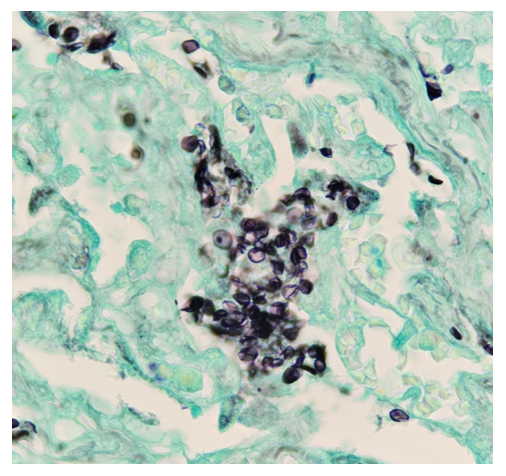
A 44-year-old female presented to OPD with complaints of pallor, fatigue, weakness, palpitations and dyspnea on exeion. Blood tests were conducted, which revealed, Anemia Thrombocytopenia Leukocytosis with neutropenia and increased blasts in the peripheral blood smear. Peripheral blood smear The patient was diagnosed with leukemia and she underwent allogenic stem cell transplantation for the same. After 24 days, she again presented with hypotension, tachycardia, and spO2 of 88% along with a new rash from which biopsy was taken and silver staining was done. Lab findings revealed severe Neutropenia. Which is the most likely organism causing the above skin condition: -
Which of the following is true of typhoid?
The spike of fever in malaria is at the time of release of ?
Major signs for AIDS case definition according to WHO is-
One of your staff nurses sustained a deep needle stick injury from a needle used to inject an HIV positive individual. What is the treatment regime that should be started in her/him? Note that drug resistance was suspected in the HIV patient.
All of the following statements about 'yaws' are true, except:
All of the following are features of mumps, except:
A 2 month old baby presented with acute icteric viral hepatitis. The mother is a known hepatitis B carrier. Mother's hepatitis B virus serological profile is MOST likely to be:
In generalized tetanus, how do toxins typically enter the body?
Explanation: ***Dengue fever*** - The colloquial term "**breakbone fever**" is commonly used to describe dengue due to the severe **myalgia** and **arthralgia** it causes, leading to a sensation of bones breaking [1]. - This **viral infection** is transmitted by mosquitoes and presents with high fever, headache, retro-orbital pain, and a rash, in addition to the characteristic muscle and joint pain [1]. *Typhoid fever* - This is a **bacterial infection** caused by *Salmonella Typhi*, characterized by a sustained fever, malaise, headache, and sometimes a rash (rose spots), but not the severe bone-breaking pain [2]. - It primarily affects the **gastrointestinal tract** and can lead to complications such as intestinal perforation [2]. *Malaria* - Malaria is a **parasitic disease** transmitted by mosquitoes, known for its cyclical fever patterns, chills, headache, and fatigue. - While it causes significant body aches and headaches, it is not typically referred to as "breakbone fever" because the pain is not as intensely localized to the joints and bones as in dengue. *Malignant fever* - "**Malignant fever**" is not a specific disease, but rather a descriptive term sometimes used for severe, high-grade fevers that are uncontrolled or associated with a grave prognosis. - It does not refer to a distinct condition with characteristic "breakbone" symptoms.
Explanation: ***Pseudomonas*** - The clinical presentation of **neutropenia**, fever, and a rapidly progressive skin rash after stem cell transplantation is highly suggestive of **ecthyma gangrenosum**, a severe cutaneous infection typically caused by *Pseudomonas aeruginosa*. - **Silver staining** in a biopsy would highlight bacteria, and *Pseudomonas* is a common cause of severe infections in immunocompromised patients, especially those with **neutropenia**. *Neisseria meningitidis* - While *Neisseria meningitidis* can cause rash (e.g., **petechial or purpuric rash** in meningitis), it is less likely to present as a focal, rapidly necrotic skin lesion like ecthyma gangrenosum, especially in the context of profound neutropenia post-transplant without overt signs of meningococcal disease. - The rash associated with meningococcemia is typically due to **vasculitis and thrombosis**, not direct bacterial colonization leading to necrotic lesions in the same way *Pseudomonas* does. *Staphylococcus aureus* - *Staphylococcus aureus* can cause various skin infections, including **cellulitis, abscesses, or impetigo**, but ecthyma gangrenosum is not its typical presentation. - While *S. aureus* is a significant pathogen in immunocompromised patients, the constellation of severe neutropenia and a rapidly progressive, necrotic skin lesion characteristic of ecthyma gangrenosum points more strongly to *Pseudomonas*. *Vibrio vulnificus* - *Vibrio vulnificus* causes severe skin infections, particularly in individuals with **liver disease** or those exposed to **contaminated seawater** or raw seafood. - This patient's history of leukemia and stem cell transplantation, without mention of relevant exposures, makes *Vibrio vulnificus* a less likely pathogen in this scenario.
Explanation: Female carriers are more common than male carriers - **Chronic carriage** of *Salmonella Typhi* is notably more prevalent in **women** than in men, often due to hormonal factors or gender-specific immunological differences influencing bacterial persistence. - This observation has significant implications for public health strategies focused on identifying and managing **chronic carriers** to prevent disease transmission. *Tetracycline is the drug of choice for treating carriers* - **Tetracyclines** are generally not the drug of choice for treating **typhoid carriers**; quinolones like **ciprofloxacin** or **azithromycin** are preferred due to better efficacy against intracellular *Salmonella Typhi*. - The effectiveness of **tetracyclines** against *Salmonella Typhi* can be limited by **antibiotic resistance** and suboptimal penetration into the gallbladder where bacteria often persist. *Gallbladder is rarely involved in the chronic carrier state* - The **gallbladder** is the primary anatomical site for **chronic carriage** of *Salmonella Typhi*, as bacteria can colonize the bile ducts and form biofilms, making eradication difficult. - Involvement of the **gallbladder** is crucial for understanding disease transmission, as carries intermittently shed bacteria in their feces [1]. *Chronic carriage is more common in young males* - **Chronic carriage** of *Salmonella Typhi* is more frequently observed in **older individuals**, particularly **older women**, rather than young males. - Age and gender are identified risk factors, with **postmenopausal women** having a higher propensity for developing a chronic carrier state.
Explanation: ***Merozoites*** - The **fever spikes** characteristic of malaria coincide with the synchronized **rupture of infected red blood cells** [1] and the release of new **merozoites** into the bloodstream. - These released merozoites then invade new red blood cells [1], continuing the cycle and triggering the host's inflammatory response, leading to fever. *Sporozoites* - **Sporozoites** are the forms injected by the mosquito into the human host and travel to the liver. - Their release from infected liver cells as **merozoites** into the bloodstream does not directly cause the characteristic fever spikes. *Hypnozoites* - **Hypnozoites** are dormant forms of *Plasmodium vivax* and *P. ovale* that persist in the liver and are responsible for **relapses** [1] weeks or months after the initial infection. - They do not directly cause the acute fever spikes associated with the erythrocytic cycle. *None of the options* - This option is incorrect because the release of merozoites is directly responsible for the fever spikes in malaria.
Explanation: Prolonged fever more than 1 month - Prolonged unexplained fever (intermittent or constant) lasting for more than 1 month is a major clinical sign for AIDS case definition according to the WHO clinical staging system for adults and adolescents. - This symptom reflects the chronic systemic inflammation and immune dysregulation characteristic of advanced HIV infection [1]. Prolonged cough for > 1 month - While chronic cough can be a minor sign or an indicator of opportunistic infections like tuberculosis or Pneumocystis pneumonia in HIV-positive individuals, it is not listed as a major sign for the WHO AIDS case definition [1], [2]. - Major signs are those considered to be strong indicators of severe immunodeficiency. Generalized lymphadenopathy - Persistent generalized lymphadenopathy (PGL) is a common finding in early and mid-stage HIV infection, often indicating viral replication but not necessarily advanced immunodeficiency [1]. - It is classified as an HIV clinical stage 1 condition by the WHO, meaning it’s not a major sign for AIDS [1]. Generalized pruritic dermatitis - Generalized pruritic papular eruptions or severe pruritic dermatitis are considered clinical conditions defining WHO clinical stage 2 or stage 3 HIV disease, respectively [1]. - While these can be prominent symptoms, they are not categorized as the primary "major signs" used for the fundamental AIDS case definition as fever or severe weight loss.
Explanation: ***2 NIs + 1 protease inhibitor for 28 days*** - For **occupational post-exposure prophylaxis (PEP)** involving a significant exposure to HIV with suspected drug resistance in the source patient, a **three-drug regimen** is recommended [2]. - This typically includes **two nucleoside reverse transcriptase inhibitors (NRTIs)** and **one protease inhibitor (PI)**, administered for **28 days**. This combination provides potent antiviral activity and addresses potential resistance [2]. *2 NIs for 3 months* - A **two-drug regimen** of NRTIs alone is generally considered **insufficient** for PEP, especially when drug resistance in the source is suspected [2]. - While PEP is typically given for 28 days, a 3-month duration is longer than standard and not justified by a two-drug regimen [1]. *2 protease inhibitors + 2 NtIs for 3 months* - This regimen involves **too many drugs** (four) and an **excessively long duration** (3 months) for standard occupational PEP. - While it offers strong antiviral coverage, the increased risk of **side effects** and **patient non-adherence** outweighs the benefits unless specific, rare circumstances dictate such an aggressive approach [2]. *1 NI and 1 NtI for 28 days* - This regimen contains an **insufficient number of drugs** (only two, one NI and one NtI, which is essentially two NRTIs if 'NtI' refers to nucleotide analogue reverse transcriptase inhibitor) and may not be powerful enough to prevent HIV transmission, especially with suspected drug resistance [2]. - A **three-drug regimen** is the standard for high-risk exposures.
Explanation: ***Late stages of yaws involve heart and nerves*** - Unlike **syphilis**, which is caused by *Treponema pallidum subspecies pallidum*, late-stage yaws (caused by *Treponema pallidum subspecies pertenue*) primarily affects the **skin**, **bones**, and **cartilage**, leading to disfigurement, but generally spares the cardiovascular and nervous systems. - The absence of significant **cardiovascular** or **neurological involvement** is a key differentiating factor between yaws and tertiary syphilis. *Caused by Treponema pertenue* - This statement is true; **yaws** is indeed caused by the bacterium *Treponema pertenue*. - *Treponema pertenue* is a spiral-shaped bacterium closely related to the organism that causes syphilis, belonging to the **spirochete** family. *Transmitted non-venereally* - This statement is true; yaws is typically transmitted through **direct skin-to-skin contact** with an infected person's lesions, often among children in tropical and subtropical regions [1]. - Unlike syphilis, which is primarily a sexually transmitted infection, yaws is **non-venereal**, spreading through casual contact [1]. *Secondary yaws can involve bone* - This statement is true; **secondary yaws** can manifest with various lesions, including **periostitis** and **osteomyelitis**, affecting long bones and other skeletal structures [1]. - Bone involvement manifests as **painful bone swellings** and can lead to **saber shin deformity** or other bone deformities in later stages [1].
Explanation: ***Incubation period is less than 2 weeks*** - Mumps typically has an **incubation period of 16-18 days**, with a range of 12-25 days. An incubation period of less than 2 weeks is uncharacteristic. - This statement is the "except" feature, as it incorrectly describes the typical timeframe for symptom onset after exposure. *Caused by paramyxovirus* - Mumps is indeed caused by the **mumps virus**, which is a single-stranded RNA virus belonging to the **Paramyxoviridae family**. - This is a correct characteristic of the causative agent of mumps. *Orchitis is a complication in adults* - **Orchitis**, the inflammation of one or both testicles, is a well-known and often painful complication of mumps, particularly in **postpubertal males**. - It can lead to testicular atrophy and, in some cases, infertility. *Aseptic meningitis is a complication in children* - **Aseptic meningitis** is a common neurological complication of mumps, occurring in approximately 10-20% of cases, especially in **young children** [1]. - It involves inflammation of the meninges and typically resolves without long-term sequelae.
Explanation: ***HBsAg and HBeAg positive*** - A mother who is **HBsAg and HBeAg positive** has a high viral load and is highly infectious, making vertical transmission to her infant very likely, leading to acute icteric viral hepatitis in the newborn [1]. - **HBeAg positivity** indicates active viral replication, a key factor in efficient perinatal transmission of HBV [1]. *HBsAg and HBe antibody positive* - **HBe antibody positivity** indicates a lower viral load and less active viral replication, suggesting a lower risk of perinatal transmission than if HBeAg were positive [1]. - While the mother is a carrier (HBsAg positive), the presence of HBe antibody usually means the infection is in a less active, potentially chronic persistent phase, with reduced infectivity [1]. *HBsAg positive only* - A mother being **HBsAg positive only** (without HBeAg or antibody information) is insufficient to definitively determine the infectivity status or the likelihood of acute icteric hepatitis in the infant. - **HBsAg positivity** confirms carrier status but doesn't specify the level of viral replication or infectivity as precisely as HBeAg status [1]. *HBV DNA positive* - **HBV DNA positive** indicates the presence of viral genetic material, confirming active infection or replication, but it's a quantitative measure and doesn't replace the serological markers for assessing infectivity in the context of perinatal transmission [1]. - While strongly indicative of active infection, **HBV DNA positive** usually correlates with HBeAg positivity in highly infectious carriers, and HBeAg is the more specific serological marker for this high infectivity state [1].
Explanation: ***Both*** - Tetanus toxins, specifically **tetanospasmin**, can enter the systemic circulation via both the **bloodstream** and the **lymphatic system** from the site of the anaerobic wound [1]. - Once in the general circulation, these toxins are then able to reach the **central nervous system**, where they exert their neurotoxic effects. *Lymphatics* - While toxins *can* enter via the lymphatic system, it's not the sole route; the **bloodstream** also plays a significant role [1]. - The lymphatic system primarily drains interstitial fluid and transports immune cells, but toxins can also be absorbed this way. *Blood stream* - Toxins *can* enter via the bloodstream, but this is not the only route; the **lymphatic system** also contributes to systemic spread [1]. - Direct absorption into capillaries at the wound site allows toxins to quickly enter the general circulation. *None of the options* - This is incorrect as tetanus toxins are known to spread systemically via **both the lymphatic and circulatory systems** [1]. - Systemic absorption is crucial for the toxins to reach the spinal cord and brain, leading to generalized symptoms.
Principles of Antimicrobial Therapy
Practice Questions
Fever of Unknown Origin
Practice Questions
HIV/AIDS and Related Infections
Practice Questions
Tuberculosis and Mycobacterial Diseases
Practice Questions
Tropical and Parasitic Infections
Practice Questions
Viral Infections (Hepatitis, Herpes, etc.)
Practice Questions
Healthcare-Associated Infections
Practice Questions
Fungal Infections
Practice Questions
Sepsis and Septic Shock
Practice Questions
Infection in Immunocompromised Hosts
Practice Questions
Emerging and Re-emerging Infections
Practice Questions
Antimicrobial Resistance
Practice Questions
Vaccination Principles
Practice Questions
Get full access to all questions, explanations, and performance tracking.
Start For Free