A 27-year-old HIV-positive man (CD4 count 250/μL) presents with a 2-month history of perianal ulcer that is painless, clean-based, and indurated. Dark field microscopy and PCR for HSV are negative. VDRL is 1:64, and TPHA is positive. Lumbar puncture shows 30 WBCs (predominantly lymphocytes) and CSF-VDRL is reactive. Despite receiving standard benzathine penicillin therapy 2 weeks ago, the ulcer persists unchanged. What is the most appropriate next step?
A 22-year-old man presents with urethral discharge and dysuria for 3 days. Gram stain shows intracellular gram-negative diplococci. Two weeks after appropriate treatment, he returns with similar symptoms. Repeat testing shows no organisms on Gram stain but leukocytes are present. What is the most likely explanation?
How does HIV infection alter the natural history of syphilis?
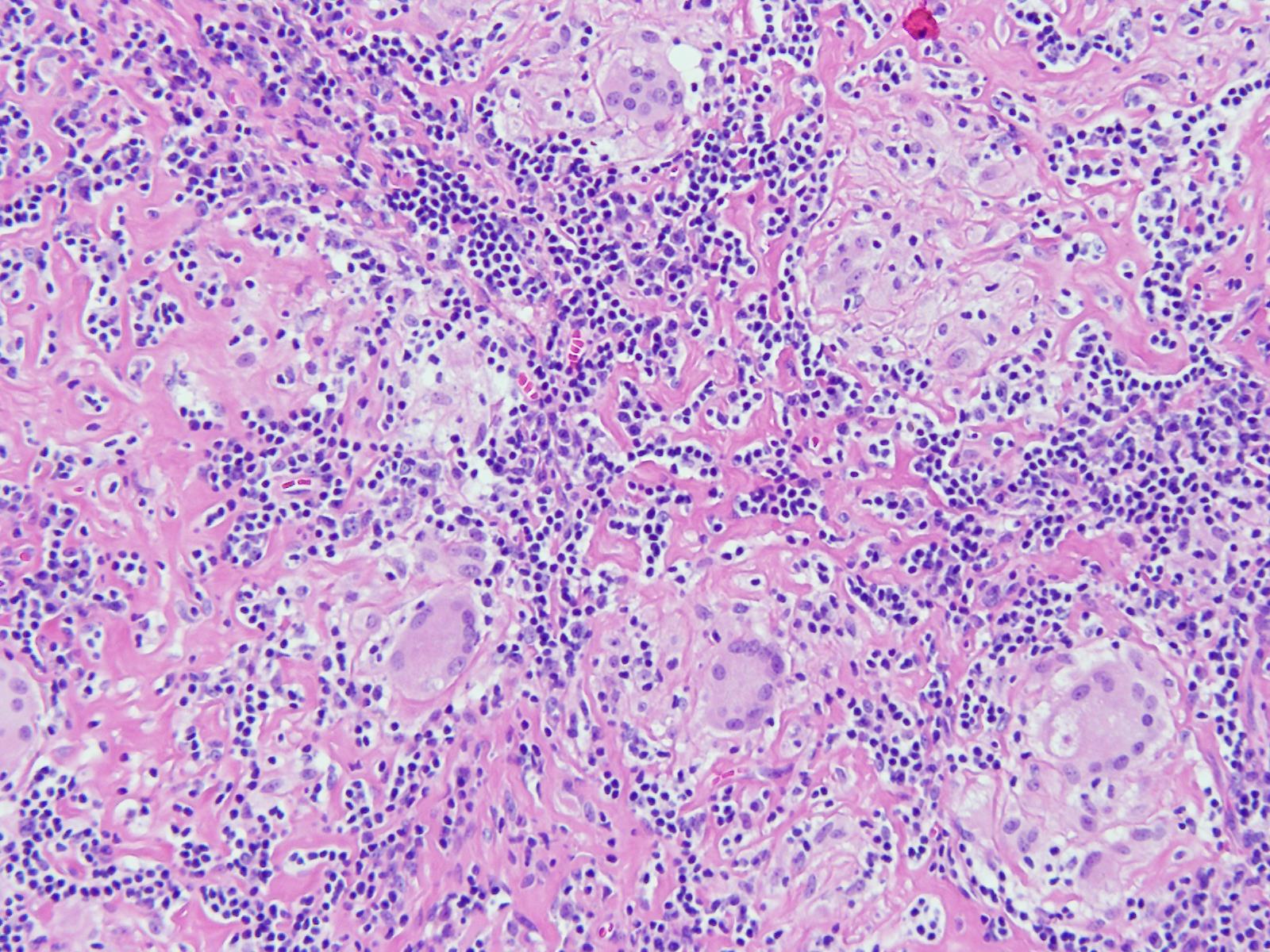
A patient presents with loss of sensation along the ulnar nerve path. The histology is shown in the image, and a Lepromin test was performed. What is the expected outcome?

A patient living with HIV presents with foulsmelling stools. Microscopic examination of the stool reveals no cysts or ova, but a 200-micrometer larva is observed. What is the most likely pathogen?
A farmer presents with severe leg pain, fever, chills, retro-orbital pain, and bilateral conjunctival suffusion. What is the most likely diagnosis?
A 15-year-old patient presents with joint swelling, a pan-systolic murmur, negative rheumatoid factor (RF), and elevated ESR. The patient also reports a recent history of sore throat and exhibits subcutaneous nodules and erythema marginatum on physical examination. What is the most likely diagnosis?
What is the most common site of abdominal tuberculosis?
A patient, who is a known case of HIV with a CD4 count of 200 cells/cu.mm, presents with 5 days of cough and high-grade fever without chills and rigors. There is no history of diarrhoea, vomiting, or nuchal rigidity. Chest x-ray is normal. What treatment will you give?
A person presents to the hospital with fever and chills. Fever profile is ordered and is found to be negative for malaria and dengue. Rk39 test is found to be positive. What is the treatment of choice?
Explanation: - ***Aqueous crystalline penicillin G 18-24 million units IV daily for 14 days*** - This patient presents with an **HIV-positive status**, low **CD4 count**, reactive **CSF-VDRL**, and neurological symptoms (implied by reactive CSF-VDRL), indicating **neurosyphilis**. Given the persistence of the ulcer despite standard benzathine penicillin therapy, it suggests treatment failure, likely due to inadequate penetration of benzathine penicillin into the central nervous system. [1] - **Aqueous crystalline penicillin G IV** is the recommended treatment for neurosyphilis due to its excellent CSF penetration and high efficacy. [1] The duration of 14 days is standard for treating neurosyphilis. - *Repeat benzathine penicillin G 2.4 MU IM weekly for 3 weeks* - This regimen is appropriate for **late latent syphilis** or **tertiary syphilis** without central nervous system involvement. - However, it has **poor penetration into the CNS**, making it ineffective for neurosyphilis or cases with confirmed CSF involvement, as in this patient. - *Doxycycline 100mg twice daily for 28 days* - **Doxycycline** can be used as an alternative therapy for syphilis in penicillin-allergic patients or for late latent syphilis. - However, its efficacy in **neurosyphilis** is less established, and it is generally not preferred as a first-line agent, especially given the confirmed CSF involvement and treatment failure with penicillin in this HIV-positive patient. - *Biopsy of the lesion to rule out malignancy* - While a persistent ulcer in an immunocompromised patient might raise concerns for malignancy, the strong serological and CSF evidence of **syphilis**, specifically neurosyphilis, makes this diagnosis highly probable. - Ruling out malignancy immediately would delay appropriate treatment for neurosyphilis, which requires urgent intervention. Addressing the infectious cause is the priority.
Explanation: ***Concurrent chlamydial infection*** - The initial presentation was consistent with **gonorrhea** (intracellular gram-negative diplococci). After initial treatment, the recurrence of symptoms with **leukocytes but no organisms on Gram stain** is highly suggestive of a co-existing infection that would not be visible on Gram stain or sensitive to the initial gonorrhea treatment [1]. - **Chlamydial infections** are frequently co-transmitted with gonorrhea and present with similar symptoms, often causing **post-gonococcal urethritis** when the gonorrhea is treated but the chlamydia is not [3]. *Antibiotic resistance* - If it were antibiotic resistance, the **intracellular gram-negative diplococci** would likely still be present on repeat Gram stain after treatment, rather than absent. - While possible, the absence of organisms on repeat Gram stain makes this less likely than a co-infection with a pathogen not detectable by Gram stain. *Reinfection with N. gonorrhoeae* - Reinfection would imply a new exposure and would again show **intracellular gram-negative diplococci** on Gram stain, which are explicitly stated to be absent. - Although possible, the rapid recurrence (2 weeks) and absence of the original organism make another pathogen more probable. *Urethral stricture* - A urethral stricture could cause persistent or recurrent symptoms like dysuria and discharge, but it would not typically be associated with the acute presence of **leukocytes** in the absence of an active infection. - Strictures are mechanical issues and would not explain the initial finding of gram-negative diplococci or the subsequent sterile pyuria [2].
Explanation: Increased risk of neurosyphilis - HIV infection causes **immunosuppression**, impairing the host's ability to contain *Treponema pallidum*, leading to more aggressive dissemination to the central nervous system. - This increased vulnerability means that **neurosyphilis** can occur earlier in the course of the syphilis infection and may be more challenging to treat effectively. *Elimination of secondary stage* - HIV infection does **not eliminate** or bypass the secondary stage of syphilis; in fact, the **rash and mucocutaneous lesions** might be more atypical or severe due to immunosuppression. - The disease progression remains largely similar in its stages, though manifestations can be altered. *Reduced serological response* - While some HIV-infected individuals may have **atypical serological responses**, particularly those with severe immunodeficiency, it does **not universally reduce** the serological response. - Many HIV-infected individuals with syphilis still show typical antibody responses, although **false-negative results** can occur. *Faster progression to tertiary stage* - While HIV can lead to **more aggressive syphilis** and an increased risk of complications like neurosyphilis, there is **no clear evidence** that it consistently accelerates progression to the tertiary stage. - Tertiary syphilis still typically develops many years after the initial infection, though **cardiovascular and gummatous syphilis** can also be more severe.
Explanation: ***Tuberculoid leprosy with lepromin positive*** - The image shows **epithelioid cell granulomas** with sparse lymphocytes, characteristic of a **strong cell-mediated immune response** seen in tuberculoid leprosy. - Patients with tuberculoid leprosy typically have a **positive lepromin skin test**, indicating a robust CMI response capable of containing the infection. *Borderline leprosy with lepromin positive* - Borderline leprosy exhibits a wider spectrum of histological features, often with a mix of tuberculoid and lepromatous characteristics, and is typically **lepromin variable or weakly positive**. - The significant presence of well-formed granulomas in the image points more strongly towards the tuberculoid pole rather than borderline forms. *Lepromatous leprosy with lepromin positive* - Lepromatous leprosy is characterized by a **weak or absent cell-mediated immune response**, leading to diffuse infiltration of **foamy macrophages (Virchow cells)** packed with abundant *M. leprae*, and the **absence of well-formed granulomas**. - Patients with lepromatous leprosy are typically **lepromin negative** due to their anergic immune state. *Scrofuloderma* - **Scrofuloderma** is a form of **cutaneous tuberculosis** resulting from direct extension of underlying tuberculous lymphadenitis or osteomyelitis to the skin. - While it involves granulomatous inflammation, the clinical context of ulnar nerve involvement and the specific histological appearance of well-formed epithelioid granulomas with sparse bacilli are more indicative of tuberculoid leprosy.
Explanation: ***Strongyloides stercoralis*** - The presence of **larvae** in the stool [2], particularly **rhabditiform larvae**, is characteristic of *Strongyloides stercoralis* infection, as this parasite has an **autoinfective cycle** involving larval stages in the human host [2]. - In HIV-positive patients, *Strongyloides* can cause **hyperinfection syndrome**, leading to severe gastrointestinal symptoms like foul-smelling stools, and increased larval shedding [2]. *Ascaris lumbricoides* - *Ascaris lumbricoides* is a large intestinal nematode, but it typically presents with **ova** (eggs) in the stool, not larvae, as the eggs hatch in the small intestine. - While it can cause gastrointestinal symptoms, the hallmark microscopic finding in stool samples is the presence of **mammillated or decorticated eggs**. *Ancylostoma duodenale* - *Ancylostoma duodenale* (hookworm) infections are identified by the presence of **eggs** in the stool [1], which are typically oval with a thin shell and contain a developing larva. - Hookworm larvae usually develop in **soil** and infect humans through skin penetration, rather than being commonly found in stool samples from intestinal infection [1]. *Schistosoma mansoni* - *Schistosoma mansoni* is a **blood fluke** that causes intestinal schistosomiasis, characterized by the presence of **spined eggs** in the stool. - The parasite's life cycle involves **freshwater snails** as intermediate hosts, and a **larval stage (cercariae)** that penetrates human skin, but larvae are not typically found in human stool.
Explanation: **Leptospirosis** - The combination of **leg pain**, **fever**, chills, **retro-orbital pain**, and **bilateral conjunctival suffusion** (red eyes without frank pus) in a farmer (occupational exposure to contaminated water/soil) is highly suggestive of **leptospirosis** [1]. - **Conjunctival suffusion** is a classic and distinctive sign of leptospirosis, differentiating it from many other febrile illnesses [1]. *Dengue fever* - While dengue fever can present with **fever**, **retro-orbital pain**, and **myalgia**, **conjunctival suffusion** is not a typical feature, and severe leg pain is less emphasized compared to leptospirosis [2]. - Dengue is also common in tropical/subtropical regions but the specific constellation of symptoms points away from it [2]. *Malaria* - Malaria presents with classic **cyclic fevers**, **chills**, and **sweats**, often accompanied by headache and muscle aches, and sometimes hepatosplenomegaly. - **Conjunctival suffusion** and severe leg pain are not characteristic features of uncomplicated malaria [2]. *Rickettsia infection* - Rickettsial infections (e.g., Rocky Mountain spotted fever, scrub typhus) often present with **fever**, **headache**, and a **rash**, which can be maculopapular or petechial [3]. - **Retro-orbital pain** and **conjunctival suffusion** are not typical symptoms, and a distinctive rash is generally a key diagnostic clue for rickettsial diseases [3].
Explanation: **Acute rheumatic fever** - The combination of **joint swelling**, a recent **sore throat**, **pan-systolic murmur** (indicating carditis), **subcutaneous nodules**, and **erythema marginatum** meets the **Jones criteria** for acute rheumatic fever [1]. - An **elevated ESR** is a common inflammatory marker, and a **negative rheumatoid factor** helps differentiate it from other rheumatic conditions. - Carditis often presents with new or changed murmurs, such as a soft systolic murmur due to mitral regurgitation [1]. Acute rheumatic carditis is also a principal cause of valve regurgitation [2]. *Seronegative rheumatoid arthritis* - This typically presents with chronic inflammatory arthritis, but lacks specific features like **carditis** or characteristic skin rashes like **erythema marginatum** and **subcutaneous nodules**. - While it has a negative RF, the acute presentation with a preceding sore throat points away from chronic arthropathy. *Juvenile idiopathic arthritis* - This is a diagnosis of exclusion for chronic arthritis in children under 16, lacking acute rheumatic fever's hallmark cardiac involvement, **subcutaneous nodules**, or **erythema marginatum**. - While it can cause joint swelling and elevated ESR, the constellation of symptoms strongly points to an acute systemic illness. *Ankylosing spondylitis* - This primarily affects the **axial skeleton** (spine and sacroiliac joints) and is characterized by back pain and stiffness, predominantly in young adults. - It does not typically present with a **pan-systolic murmur**, **subcutaneous nodules**, or **erythema marginatum**, and is rarely seen in 15-year-old patients with this acute presentation.
Explanation: ***Ileocecal junction*** - The **ileocecal junction** is the most common site for abdominal tuberculosis due to its rich lymphoid tissue (Peyer's patches) and physiological stasis. - Tuberculous infection at this site can lead to **mucosal ulceration**, stricture formation, and mass lesions. *Colon* - While the colon can be affected by abdominal tuberculosis, it is **less common** than the ileocecal region. - Colonic involvement often presents with symptoms such as abdominal pain, diarrhea, and weight loss. *Small intestine* - Though other parts of the small intestine can be involved, the **distal ileum** and its junction with the cecum are disproportionately affected. - Involvement of the jejunum and duodenum is less frequent. *Rectum* - **Rectal involvement** in abdominal tuberculosis is rare and typically occurs in conjunction with more extensive colonic or disseminated disease. - Symptoms may include tenesmus, rectal bleeding, or fistula formation.
Explanation: ***Co-trimoxazole only*** - The patient has a CD4 count of 200 cells/cu.mm with cough and fever and a normal chest X-ray, all of which are highly suggestive of **Pneumocystis jirovecii pneumonia (PJP)**, even without classic infiltrates. Therefore, **co-trimoxazole** (trimethoprim-sulfamethoxazole) is the first-line treatment [1]. - In a patient with HIV and a CD4 count below 200, **PJP prophylaxis** with co-trimoxazole should also be considered [2], and its empirical treatment is indicated in this scenario. *Co-trimoxazole + steroids* - While co-trimoxazole is the correct treatment for PJP, **steroids** are typically reserved for patients with more severe disease, indicated by **hypoxia** (PaO2 < 70 mmHg or A-a gradient > 35 mmHg) or diffuse interstitial infiltrates on chest imaging, neither of which are described here [1]. - Adding steroids without clear indications could increase the risk of side effects in an immunocompromised patient. *Amoxicillin-clavulanic acid + Azithromycin* - This combination targets typical **bacterial community-acquired pneumonia**, which is less likely given the patient's HIV status, low CD4 count, and normal chest X-ray. - This regimen would not effectively treat **PJP**, which is the most probable diagnosis in this immunocompromised setting. *Antitubercular treatment* - While tuberculosis is common in HIV patients, the normal chest X-ray makes pulmonary tuberculosis less likely, especially without other classic symptoms like night sweats, weight loss, or hemoptysis. In patients with CD4 counts below 200, the clinical presentation of TB differences substantially from those without HIV [1]. - **Antitubercular treatment** would not address the immediate concern of possible PJP, which can rapidly progress if untreated.
Explanation: Amphotericin B - A positive RK39 test suggests visceral leishmaniasis (kala-azar), especially with fever and chills in an endemic area [1]. - Amphotericin B (specifically liposomal Amphotericin B) is a highly effective and often the drug of choice for treating visceral leishmaniasis, particularly in severe cases or regions with antimonial resistance. Dapsone - Dapsone is primarily used in the treatment of leprosy and بعض forms of dermatitis (e.g., dermatitis herpetiformis). - It has no significant role in treating leishmaniasis. Hydroxychloroquine - Hydroxychloroquine is an antimalarial drug also used for certain autoimmune diseases like lupus and rheumatoid arthritis [2]. - It is ineffective against leishmaniasis. Griseofulvin - Griseofulvin is an antifungal medication used to treat dermatophyte infections (e.g., ringworm of the skin, hair, or nails). - It has no activity against Leishmania parasites.
Principles of Antimicrobial Therapy
Practice Questions
Fever of Unknown Origin
Practice Questions
HIV/AIDS and Related Infections
Practice Questions
Tuberculosis and Mycobacterial Diseases
Practice Questions
Tropical and Parasitic Infections
Practice Questions
Viral Infections (Hepatitis, Herpes, etc.)
Practice Questions
Healthcare-Associated Infections
Practice Questions
Fungal Infections
Practice Questions
Sepsis and Septic Shock
Practice Questions
Infection in Immunocompromised Hosts
Practice Questions
Emerging and Re-emerging Infections
Practice Questions
Antimicrobial Resistance
Practice Questions
Vaccination Principles
Practice Questions
Get full access to all questions, explanations, and performance tracking.
Start For Free