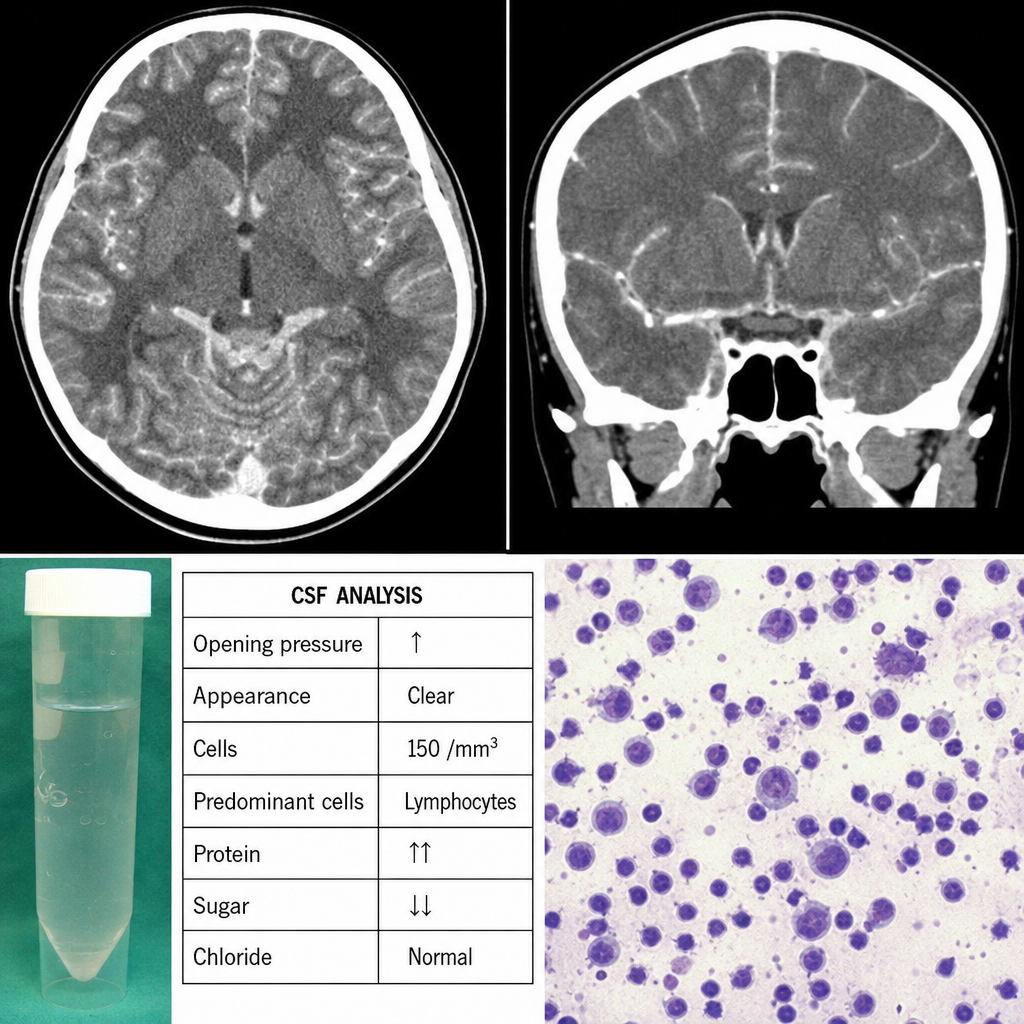
A 65-year-old man presents with fever, severe headache, and nuchal rigidity. Physical examination shows a Glasgow coma score of 7. Lumbar puncture reveals cloudy cerebrospinal fluid (CSF) with 1200 neutrophils/mm3, elevated protein, and decreased glucose. Which of the following is the most probable etiologic agent of this condition?
What is the primary purpose of using combination therapy with anti-tubercular drugs?
What is the most common late central nervous system complication of HIV infection?
What is the drug of choice for treating Leptospirosis?
A 16-year-old female presents with a one-week history of small ulcers on her cheek and tongue, accompanied by a mild fever. Oral examination reveals multiple ulcers on the buccal and labial mucosa. She reports that her board examinations are in one week. What is the most appropriate management for this patient?
Which of the following drugs are useful in the treatment of chronic Hepatitis B infection?
A 23-year-old patient, studying abroad, visited his hometown and developed a high-grade fever (103°F) after 3 days. He took acetaminophen and subsequently complained of myalgias, cough, and mild shortness of breath. A nasopharyngeal swab tested positive for COVID-19. Which of the following statements regarding the patient's next steps in management is false?
The most sensitive among the following tests for the diagnosis of malaria is?
In which of the following conditions are immunoglobulins indicated for a viral infection?
CSF examination of a patient shows high protein, markedly low sugar, low chloride, and increased neutrophils. What is the most likely diagnosis?
Explanation: **Explanation:** The clinical presentation of fever, headache, and nuchal rigidity (meningismus) combined with a GCS of 7 indicates **Acute Bacterial Meningitis**. [1] **1. Why Streptococcus pneumoniae is correct:** The CSF analysis is the diagnostic gold standard. A "cloudy" appearance with a high neutrophil count (>1000/mm³), elevated protein, and low glucose is classic for bacterial etiology. In adults over 20 years of age, **Streptococcus pneumoniae** is the most common cause of community-acquired bacterial meningitis. The severe presentation (GCS 7) is also characteristic, as pneumococcal meningitis often carries a higher morbidity and mortality rate compared to other pathogens. [1] **2. Why the other options are incorrect:** * **Arbovirus & Herpesvirus:** These cause viral meningitis/encephalitis. CSF typically shows **lymphocytic pleocytosis**, normal glucose levels, and clear fluid. [1] While HSV-1 can cause severe encephalitis, the CSF profile here (1200 neutrophils, low glucose) is purely bacterial. * **Mycobacterium tuberculosis:** Tuberculous meningitis usually presents subacutely. [2] CSF analysis typically shows a **lymphocytic predominance** (not neutrophils) and a characteristically very high protein level with moderately low glucose. [2] **3. NEET-PG High-Yield Pearls:** * **Most common cause overall (Adults):** *S. pneumoniae*. * **Most common cause (Adolescents/Young Adults):** *Neisseria meningitidis* (look for petechial rashes). * **Empiric Treatment:** Ceftriaxone + Vancomycin. Add **Ampicillin** if *Listeria* is suspected (elderly or immunocompromised). [1] * **Steroids:** Dexamethasone should be given **before or with** the first dose of antibiotics to reduce neurological complications (especially in pneumococcal meningitis). * **CSF Glucose:** A CSF-to-serum glucose ratio of **<0.4** is highly suggestive of bacterial meningitis.
Explanation: The primary rationale for combination therapy in Tuberculosis (TB) is the **prevention of drug resistance** [2]. *Mycobacterium tuberculosis* has a high rate of spontaneous genetic mutations. In any large bacterial population (such as in a cavitary lesion), a small fraction of bacilli will naturally possess resistance to a single drug (e.g., 1 in $10^6$ for Isoniazid). If monotherapy is used, these resistant mutants survive and multiply, leading to "acquired resistance." By using multiple drugs with different mechanisms of action simultaneously, the probability of a bacterium being resistant to all drugs at once becomes mathematically negligible (e.g., $10^{-6} imes 10^{-8} = 10^{-14}$), effectively sterilizing the lesion [3]. **Analysis of Incorrect Options:** * **Option A:** Combination therapy does not allow for a reduction in the standard therapeutic dose of individual drugs. Each drug must be administered at its full, effective dose to ensure bactericidal or bacteriostatic activity [1]. * **Option B:** Using multiple drugs actually **increases** the risk of adverse effects (e.g., combined hepatotoxicity from Isoniazid, Rifampicin, and Pyrazinamide) rather than minimizing them [1]. * **Option D:** Since A and B are incorrect, "All of the above" is invalid. **High-Yield Clinical Pearls for NEET-PG:** * **Bactericidal Drugs:** Isoniazid (INH), Rifampicin (RIF), Pyrazinamide (PZA), and Streptomycin. * **Bacteriostatic Drug:** Ethambutol (primarily used to prevent resistance to RIF if INH resistance exists). * **Sterilizing Action:** Rifampicin and Pyrazinamide are the most effective at killing semi-dormant bacilli, which reduces the risk of relapse. * **DOTS (Directly Observed Treatment Short-course):** The strategy used to ensure compliance and further prevent the emergence of Multi-Drug Resistant TB (MDR-TB) [2].
Explanation: **Explanation:** **HIV-Associated Dementia (HAD)**, also known as AIDS Dementia Complex, is the most common late-stage CNS complication of HIV infection [3]. It typically occurs when CD4 counts drop below **200 cells/mm³**. The underlying pathophysiology involves the direct infection of brain macrophages and microglia by HIV, leading to a chronic inflammatory state and neuronal damage, primarily affecting the subcortical structures. Clinically, it presents as a triad of cognitive decline, behavioral changes, and motor dysfunction. **Analysis of Options:** * **A. Dementia (Correct):** It is the hallmark late neurocognitive complication [1]. With the advent of HAART, the incidence has decreased, but it remains the most frequent primary CNS manifestation in advanced AIDS. * **B. Ataxia:** While ataxia can occur as part of the motor symptoms of HAD or due to opportunistic infections like Progressive Multifocal Leukoencephalopathy (PML), it is a focal sign rather than the most common overall complication. * **C. Seizures:** These are usually secondary to space-occupying lesions (e.g., CNS Toxoplasmosis or Primary CNS Lymphoma) [2] rather than a primary effect of the virus itself. * **D. Delirium:** This is an acute, reversible state of confusion often caused by systemic infections, metabolic derangements, or drug side effects, rather than a chronic late-stage complication of the virus. **Clinical Pearls for NEET-PG:** * **Most common opportunistic infection of CNS in HIV:** Toxoplasmosis [2]. * **Most common fungal infection of CNS in HIV:** Cryptococcal Meningitis. * **Most common cause of a space-occupying lesion in HIV:** Toxoplasmosis (Ring-enhancing lesions) [2]. * **Key distinction:** HAD is a **subcortical dementia** (characterized by psychomotor slowing), unlike Alzheimer’s, which is a cortical dementia.
Explanation: Leptospirosis is a zoonotic infection caused by the spirochete Leptospira interrogans. The choice of treatment depends on the severity of the clinical presentation [1]. 1. Why Penicillin is the Correct Answer: For severe or hospitalized cases of Leptospirosis (including Weil’s disease), Intravenous Penicillin G is traditionally considered the drug of choice. It effectively clears the spirochetemia and reduces the duration of fever and organ dysfunction. If the patient is allergic to penicillin, IV Ceftriaxone is a preferred alternative. 2. Analysis of Incorrect Options: * B. Tetracycline (Doxycycline): While Doxycycline is the drug of choice for mild/outpatient leptospirosis and is used for prophylaxis, Penicillin remains the standard answer for "drug of choice" in a general context or severe cases in medical examinations. * C. Sulfonamide: These are ineffective against spirochetes and have no role in the treatment of Leptospirosis. * D. Erythromycin: This is a second-line alternative used primarily in pregnant women who are allergic to Penicillin, but it is less effective than first-line agents. High-Yield Clinical Pearls for NEET-PG: * Jarisch-Herxheimer Reaction: Be alert for this reaction (fever, chills, hypotension) shortly after starting Penicillin due to the release of endotoxins from dying spirochetes. * Prophylaxis: Oral Doxycycline (200 mg once weekly) is used for individuals with high-risk exposure (e.g., floods, sewage workers). * Weil’s Disease Triad: Characterized by Jaundice, Renal failure (azotemia), and Hemorrhage (often pulmonary) [1]. * Gold Standard Diagnosis: Microscopic Agglutination Test (MAT) [1].
Explanation: ### Explanation **Diagnosis: Recurrent Aphthous Stomatitis (RAS)** The clinical presentation of multiple small, painful ulcers on the non-keratinized mucosa (buccal and labial) in a young patient, triggered by the stress of upcoming examinations, is classic for **Recurrent Aphthous Stomatitis (RAS)** [1]. **Why Option B is Correct:** The management of RAS is primarily supportive and focused on reducing inflammation and pain. 1. **Symptomatic treatment:** Analgesics and topical anesthetics (e.g., Lidocaine gel) provide immediate pain relief [1]. 2. **Topical steroids:** These are the first-line pharmacological treatment to reduce the duration and severity of the ulcers, such as 0.1% triamcinolone [1]. 3. **Relaxation techniques:** Since stress is a well-documented trigger for aphthous ulcers, addressing the underlying psychological stress (board exams) is crucial for preventing recurrence. **Why Other Options are Incorrect:** * **Option A:** Antibiotics are ineffective as RAS is an inflammatory/autoimmune condition, not a bacterial infection. * **Option B:** Anti-fungal medications are used for Oral Candidiasis (thrush), which typically presents as white, curd-like plaques that can be scraped off, rather than discrete painful ulcers. * **Option D:** Systemic steroids are reserved for severe, recalcitrant cases (Major Aphthous Ulcers) or systemic syndromes like Behçet’s. **NEET-PG High-Yield Pearls:** * **Site:** Aphthous ulcers occur on **non-keratinized mucosa** (buccal mucosa, floor of mouth) [1]. In contrast, Herpetic ulcers usually involve keratinized mucosa (gingiva, hard palate). * **Triggers:** Stress, trauma, nutritional deficiencies (B12, Folate, Iron), and certain foods. * **Behçet’s Disease:** If oral ulcers are associated with genital ulcers and uveitis, consider Behçet’s syndrome (pathergy test positive). * **Treatment Gold Standard:** Topical Clobetasol or Triamcinolone acetonide in orabase [1].
Explanation: ### Explanation The treatment of **Chronic Hepatitis B (CHB)** focuses on suppressing viral replication to prevent the progression of cirrhosis and hepatocellular carcinoma. **1. Why Option A is Correct:** * **Lamivudine:** A nucleoside analogue that inhibits the HBV reverse transcriptase. While newer agents like Tenofovir and Entecavir are now preferred due to lower resistance rates, Lamivudine remains a classic, FDA-approved treatment for CHB. * **Alpha Interferon (IFN-α):** An immunomodulator that enhances the host immune response and has direct antiviral properties [1]. It is administered as a finite course (usually 48 weeks) and is particularly useful in patients with favorable genotypes and high ALT levels [1]. **2. Why Other Options are Incorrect:** * **Ribavirin (Options B, C, & D):** This is a cornerstone for treating **Hepatitis C (HCV)** (in combination with Interferon or DAAs) but has **no clinical efficacy** against Hepatitis B. * **Acyclovir (Option D):** This is an anti-herpetic medication used for HSV and VZV [2]. It does not inhibit the HBV polymerase effectively and is not used in the management of Hepatitis B [2]. **3. High-Yield Clinical Pearls for NEET-PG:** * **First-line Agents (Current Guidelines):** Tenofovir (TDF/TAF) and Entecavir are the preferred oral antivirals due to their high barrier to resistance. * **Interferon Contraindications:** Avoid in decompensated cirrhosis, pregnancy, and severe psychiatric illness [1]. * **HBeAg Seroconversion:** The primary goal of finite therapy (like IFN) is the loss of HBeAg and the development of anti-HBe [1]. * **HBV DNA:** The most sensitive marker for monitoring treatment response [1].
Explanation: The management of COVID-19 has evolved significantly based on large-scale clinical trials (like the RECOVERY and SOLIDARITY trials). This question tests the knowledge of outdated or ineffective therapies versus current evidence-based protocols. **Why Option D is the Correct Answer (The False Statement):** Early in the pandemic, **Hydroxychloroquine (HCQ) and Azithromycin** were used empirically. However, multiple randomized controlled trials demonstrated that this combination **does not provide clinical benefit** in terms of mortality or recovery time. Furthermore, both drugs can cause **QTc prolongation**, increasing the risk of fatal cardiac arrhythmias (Torsades de pointes) when used together. Current guidelines explicitly recommend against their use for COVID-19. **Analysis of Other Options:** * **Options A & B (Doxycycline and Ivermectin):** While these drugs are no longer standard of care in most international guidelines due to a lack of robust evidence, they were included in various national and local protocols (including early ICMR guidelines in India) for mild cases. In the context of a "False" statement question, the proven harm/inefficacy of HCQ+Azithromycin makes it the most definitive "wrong" management step. * **Option C (Dexamethasone):** Corticosteroids are the cornerstone of management for patients with **hypoxia or requiring oxygen support**. Since the patient reports shortness of breath, if his oxygen saturation (SpO2) drops below 94%, Dexamethasone is indicated to reduce mortality. **NEET-PG High-Yield Pearls:** 1. **Steroid Timing:** Dexamethasone is beneficial *only* in the inflammatory phase (hypoxic patients). Giving it too early (viremic phase) may actually delay viral clearance. 2. **Drug of Choice:** **Remdesivir** is an antiviral used for hospitalized patients with moderate disease; **Nirmatrelvir/Ritonavir** is used for high-risk outpatients. 3. **IL-6 Inhibitor:** **Tocilizumab** is used in patients with rapidly escalating oxygen needs and high inflammatory markers (CRP). 4. **Gold Standard Test:** RT-PCR remains the definitive diagnostic tool for COVID-19. **Additional Clinical Context:** Travelers returning to their homeland may have diminished immunity to local pathogens [1]. In a patient presenting with fever and travel history, initial screening should exclude malaria [2], though a positive COVID-19 swab establishes the primary diagnosis in this clinical scenario.
Explanation: The diagnosis of malaria relies on the detection of Plasmodium parasites or their components in the blood. The **Quantitative Buffy Coat (QBC)** test is the most sensitive method among the options provided. [1] **1. Why QBC is the correct answer:** The QBC technique involves staining a specialized capillary tube with acridine orange and centrifuging it. [1] Centrifugation concentrates the parasites (which contain DNA) into a small area just below the white blood cell layer (the buffy coat). Because the parasites are **concentrated** and fluoresce under a microscope, QBC can detect as few as **5 parasites per microliter** of blood, making it significantly more sensitive than standard microscopy. **2. Why other options are incorrect:** * **Thin peripheral blood smear:** While excellent for **speciation** (identifying the species) and quantifying parasite density, it is less sensitive than thick smears or QBC because it uses a smaller volume of blood. * **PfHRP2 (Rapid Diagnostic Test):** This detects the Histidine-Rich Protein 2 of *P. falciparum*. While fast, it can yield false negatives in low parasitemia or "prozone effect" scenarios and false positives due to persistent antigens after treatment. [1] * **Pan plasmodial LDH:** This enzyme-based RDT is less sensitive than QBC and HRP2, particularly at low parasite levels, and is primarily used to monitor treatment response as LDH is only produced by live parasites. [1] **Clinical Pearls for NEET-PG:** * **Gold Standard:** Light microscopy (Thick and Thin smears) remains the "Gold Standard" for routine diagnosis. * **Thick Smear:** Used for **screening** (more sensitive than thin smear). * **Thin Smear:** Used for **species identification**. * **Most Sensitive Overall:** PCR (Polymerase Chain Reaction) is the most sensitive test available, but among the clinical/microscopic options listed, QBC is superior. [1] [2]
Explanation: The correct answer is **Severe Combined Immunodeficiency (SCID)**. **Why SCID is correct:** SCID is a primary immunodeficiency disorder characterized by a profound defect in both T-cell and B-cell functions [1]. Patients are unable to produce their own antibodies (hypogammaglobulinemia) and are highly susceptible to life-threatening viral, bacterial, and fungal infections [1]. **Intravenous Immunoglobulin (IVIG)** is a cornerstone of management; it provides passive immunity by supplying exogenous IgG to prevent recurrent infections while the patient awaits definitive treatment, such as a Hematopoietic Stem Cell Transplant (HSCT) [1]. **Why the other options are incorrect:** * **HIV:** While HIV causes secondary immunodeficiency, the primary treatment is **Antiretroviral Therapy (ART)** to restore the patient's own immune system. IVIG is not a standard treatment for the viral infection itself, though it may be used in specific complications like pediatric HIV with recurrent bacterial infections or associated ITP. * **Dengue Fever:** Treatment is primarily **supportive** (fluid management). Immunoglobulins have no proven role in treating the virus and, theoretically, pre-existing antibodies can worsen the disease via Antibody-Dependent Enhancement (ADE). * **Severe Malnutrition:** While it leads to secondary immunosuppression, the management focuses on **nutritional rehabilitation** and treating specific opportunistic infections with antimicrobials, not routine immunoglobulin therapy. **High-Yield Clinical Pearls for NEET-PG:** * **IVIG Indications in Virology:** Post-exposure prophylaxis (e.g., Rabies, Hepatitis B, Varicella-Zoster) and specific treatments like CMV-IG for transplant patients. * **SCID Diagnosis:** Look for "absent thymic shadow" on X-ray and low/absent T-cell receptor excision circles (TRECs) on newborn screening. * **Contraindication:** Avoid **live vaccines** (e.g., BCG, OPV, MMR) in patients with SCID as they can cause disseminated disease.
Explanation: The CSF findings described—**high protein, markedly low sugar, and increased neutrophils**—are the classic biochemical signature of **Acute Bacterial Meningitis**. [1] ### 1. Why Meningococcal Meningitis is Correct Meningococcal meningitis (caused by *Neisseria meningitidis*) is a form of pyogenic bacterial meningitis. * **Increased Neutrophils (Polymorphonuclear Leucocytosis):** Bacteria trigger a massive recruitment of neutrophils to the subarachnoid space. * **Markedly Low Sugar (Hypoglycorrhachia):** Bacteria and active WBCs consume glucose; additionally, glucose transport into the CSF is impaired. * **High Protein:** Increased permeability of the blood-brain barrier and the presence of bacterial debris/inflammatory exudate raise protein levels. [1] * **Low Chloride:** Often seen in systemic infections and severe meningeal inflammation. ### 2. Why Other Options are Incorrect * **Viral Meningitis:** Typically presents with **lymphocytic** pleocytosis, **normal sugar**, and only mildly elevated protein. [1] * **Tuberculous Meningitis (TBM):** While it features high protein and low sugar, the predominant cells are **lymphocytes**, not neutrophils. TBM also typically has the lowest chloride levels among all types. * **Fungal Meningitis:** Similar to TBM, it presents with a **lymphocytic** picture and low sugar (though often not as low as bacterial). ### 3. NEET-PG Clinical Pearls * **Normal CSF Glucose:** 40–70 mg/dL (or >60% of blood glucose). * **Normal CSF Protein:** 15–45 mg/dL. * **The "Cobweb Coagulum":** Classically associated with Tuberculous Meningitis if the CSF is left standing. * **Drug of Choice:** For Meningococcal meningitis, **IV Ceftriaxone** is the mainstay. Prophylaxis for close contacts is **Rifampicin** (or Ciprofloxacin/Ceftriaxone).
Principles of Antimicrobial Therapy
Practice Questions
Fever of Unknown Origin
Practice Questions
HIV/AIDS and Related Infections
Practice Questions
Tuberculosis and Mycobacterial Diseases
Practice Questions
Tropical and Parasitic Infections
Practice Questions
Viral Infections (Hepatitis, Herpes, etc.)
Practice Questions
Healthcare-Associated Infections
Practice Questions
Fungal Infections
Practice Questions
Sepsis and Septic Shock
Practice Questions
Infection in Immunocompromised Hosts
Practice Questions
Emerging and Re-emerging Infections
Practice Questions
Antimicrobial Resistance
Practice Questions
Vaccination Principles
Practice Questions
Get full access to all questions, explanations, and performance tracking.
Start For Free