Which of the following parasitic infestations is most commonly associated with malabsorption?
Q1372
Which of the following is not seen in tubercular meningitis:
Q1373
A primigravida in the first trimester was observed to be sputum positive for acid-fast bacilli, with no previous history of tuberculosis. Which treatment strategy should be employed?
Q1374
In humans, cryptosporidiosis typically presents as?
Q1375
A 50-year-old HIV-positive patient presents with a painless, purple lesion on the skin. What is the most likely diagnosis?
Infectious Diseases Indian Medical PG Practice Questions and MCQs
Question 1371: Which of the following parasitic infestations is most commonly associated with malabsorption?
A. Giardia lamblia (Correct Answer)
B. Ascaris lumbricoides
C. Necator Americanus
D. Ancylostoma duodenale
Explanation: ***Giardia lamblia***
- **Giardia lamblia** is a common cause of **giardiasis**, an intestinal infection characterized by **malabsorption** due to damage to the intestinal villi [2].
- It often presents with **diarrhea, steatorrhea, abdominal cramps, and weight loss**, all indicative of malabsorption.
*Ascaris lumbricoides*
- While *Ascaris lumbricoides* can cause malnutrition, it primarily affects nutrient absorption less directly through its sheer biomass or mechanical obstruction rather than specific villous damage associated with malabsorption.
- Heavy infestations can cause **intestinal obstruction** or **biliary obstruction**, but malabsorption as a primary symptom is less common than with *Giardia*.
*Necator Americanus*
- *Necator americanus* (New World hookworm) primarily causes **iron deficiency anemia** due to chronic blood loss from the intestinal attachment sites [1].
- While it can contribute to malnutrition, direct **malabsorption** of macronutrients is not its most common presentation or primary mechanism of pathology [1].
*Ancylostoma duodenale*
- *Ancylostoma duodenale* (Old World hookworm) also primarily leads to **iron deficiency anemia** through blood sucking in the small intestine [1].
- Similar to *N. americanus*, its main impact on health is through **blood loss** rather than significant malabsorption of nutrients [1].
Question 1372: Which of the following is not seen in tubercular meningitis:
A. Evidence of old pulmonary lesions or a miliary pattern is found on chest radiography.
B. CSF culture provides rapid diagnosis in most cases within 24-48 hours.
C. It is seen most often in young children but also develops in adults.
D. Cerebrospinal fluid reveals a low leukocyte count. (Correct Answer)
Explanation: ***Cerebrospinal fluid reveals a low leukocyte count***
- **Tubercular meningitis** typically causes a **leukocytosis** in the cerebrospinal fluid, predominantly lymphocytic, not a low leukocyte count.
- A low leukocyte count would be highly atypical for an active meningeal infection.
*Evidence of old pulmonary lesions or a miliary pattern is found on chest radiography.*
- **Tubercular meningitis** is often a manifestation of **disseminated tuberculosis**, and a chest X-ray commonly reveals signs of current or past pulmonary tuberculosis, or **miliary patterns** [2].
- These findings suggest an underlying source of *Mycobacterium tuberculosis* infection.
*CSF culture provides rapid diagnosis in most cases within 24-48 hours.*
- CSF culture for *Mycobacterium tuberculosis* is known to be **slow-growing** and can take several weeks (typically 3-6 weeks) to yield results, making it unsuitable for rapid diagnosis within 24-48 hours.
- While highly specific, its lack of speed necessitates starting empiric treatment based on clinical suspicion and other CSF parameters.
*It is seen most often in young children but also develops in adults.*
- **Tuberculous meningitis** affects both children and adults, but it is particularly common and severe in **young children** due to their developing immune systems [1].
- It remains a significant health concern across all age groups, especially in endemic areas and among immunocompromised individuals [1].
Question 1373: A primigravida in the first trimester was observed to be sputum positive for acid-fast bacilli, with no previous history of tuberculosis. Which treatment strategy should be employed?
A. Category I DOTS (Correct Answer)
B. Category II DOTS
C. Category III DOTS
D. Defer treatment
Explanation: ***Category I DOTS***
- This patient is a **newly diagnosed, sputum-positive pulmonary TB case**, and Category I DOTS is the standard treatment regimen for such patients. [1]
- The regimen includes daily fixed-dose combinations of **Isoniazid, Rifampicin, Pyrazinamide, and Ethambutol** for an intensive phase, followed by a continuation phase. [1]
*Category II DOTS*
- Category II DOTS is reserved for **retreatment cases** (e.g., relapse, treatment failure, treatment after default) with previously treated tuberculosis.
- The patient has **no previous history of tuberculosis**, making Category II inappropriate.
*Category III DOTS*
- Category III DOTS is typically for **new sputum-negative pulmonary tuberculosis** or **extra-pulmonary tuberculosis** cases.
- The patient is **sputum-positive for acid-fast bacilli**, excluding Category III. [1]
*Defer treatment*
- **Tuberculosis in pregnancy** poses significant risks to both the mother and the fetus, including increased maternal morbidity, prematurity, and congenital TB.
- **Prompt treatment is essential** and should not be deferred, as the benefits of treatment generally outweigh the risks of medication to the fetus. Pyridoxine should be prescribed in pregnant women to reduce the risk of peripheral neuropathy with isoniazid. [1]
Question 1374: In humans, cryptosporidiosis typically presents as?
A. Meningitis
B. Pneumonia
C. Hepatitis
D. Diarrhea (Correct Answer)
Explanation: ***Diarrhea***
- Cryptosporidiosis is primarily a **gastrointestinal infection** caused by the parasite *Cryptosporidium parvum* and typically manifests as **watery diarrhea** [1].
- The parasite infects the **epithelial cells of the small intestine**, leading to malabsorption and fluid loss.
*Meningitis*
- **Meningitis** is an inflammation of the membranes surrounding the brain and spinal cord, commonly caused by bacterial or viral infections.
- While *Cryptosporidium* can cause disseminated disease in severely immunocompromised individuals, **meningitis is not a typical or primary presentation**.
*Pneumonia*
- **Pneumonia** is an infection that inflames the air sacs in one or both lungs, typically caused by bacteria, viruses, or fungi.
- Although **pulmonary cryptosporidiosis** can occur, especially in immunocompromised patients, it is a relatively rare and atypical presentation, not the primary clinical picture.
*Hepatitis*
- **Hepatitis** is an inflammation of the liver, most commonly caused by viral infections (e.g., hepatitis A, B, C).
- While *Cryptosporidium* can potentially affect the **biliary tract** and cause cholangitis or cholecystitis, **true hepatitis is not a typical symptom** of cryptosporidiosis.
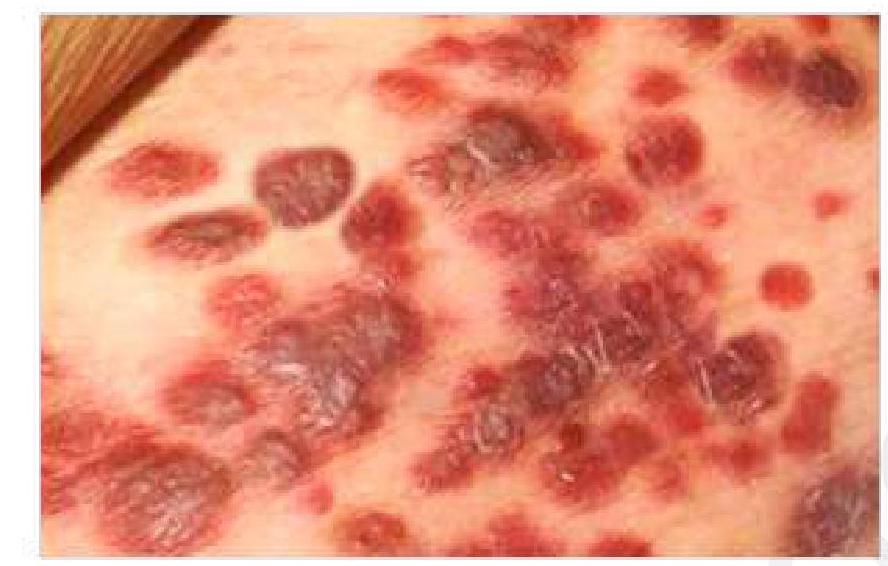
Question 1375: A 50-year-old HIV-positive patient presents with a painless, purple lesion on the skin. What is the most likely diagnosis?
A. Kaposi's sarcoma (Correct Answer)
B. Squamous cell carcinoma
C. Malignant melanoma
D. Basal cell carcinoma
Explanation: ***Kaposi's sarcoma***
- The presentation of **painless, purple skin lesions** in an **HIV-positive patient** is highly characteristic of Kaposi's sarcoma.
- This is a vascular tumor caused by **Human Herpesvirus 8 (HHV-8)**, often seen in immunocompromised individuals.
*Malignant melanoma*
- Malignant melanoma typically presents as a **dark, irregularly shaped lesion** with varying colors and often exhibits change in size, shape, or color over time (**ABCDEs of melanoma**).
- While it can be purple or dark, the multiple, widespread nature and association with HIV points away from typical melanoma.
*Squamous cell carcinoma*
- Squamous cell carcinoma usually presents as a **red, scaly patch, nodule, or an open sore** that doesn't heal, often found in sun-exposed areas.
- It is not typically described as a painless purple lesion, and while HIV patients have increased risk, the lesion morphology is more consistent with Kaposi's.
*Basal cell carcinoma*
- Basal cell carcinoma commonly appears as a **pearly or waxy bump**, a **flat, flesh-colored lesion**, or a **brown, scar-like lesion**, often with a rolled border and telangiectasias.
- Unlike the description, it is not typically purple and painless, and while common, the clinical picture with HIV is not classic for BCC.