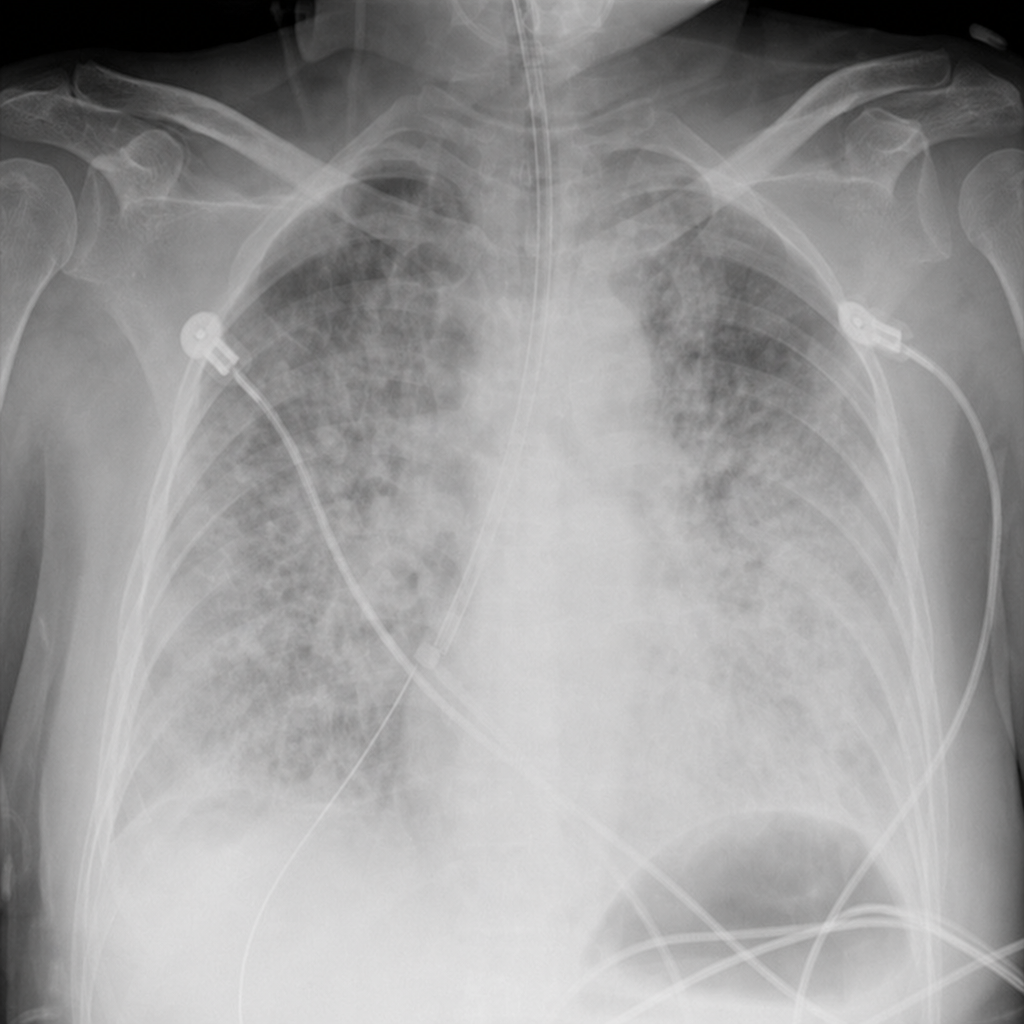
A 40-year-old woman with a clinical suspicion of sepsis develops moderate hemoptysis one hour after a procedure. She has sinus tachycardia and clear lung fields. She has received IV fluids, blood cultures have been drawn, she is on antibiotics, and subcutaneous heparin for thromboembolic prophylaxis. A CXR has been performed. What is the next best step in management?
When evaluating an arterial blood gas (ABG) from a client with a subdural hematoma, the nurse notes the PaCO2 is 30 mm Hg. Which of the following responses best describes this finding?
Among patients who require nutritional resuscitation in an intensive care unit, what is the best evidence that nutritional support is adequate?
In which of the following conditions is a rapid reduction of blood pressure indicated?
A 57-year-old male suffering from acute pancreatitis develops sudden onset breathlessness with a CVP < 18 mmHg. The chest X-ray shows bilateral infiltrates. What is the most likely diagnosis?
All are seen in ARDS, except:
What complication can be caused by intermittent positive pressure ventilation (IPPV)?
Which of the following is a feature of shock?
Which of the following is true regarding Acute Respiratory Distress Syndrome (ARDS)?
Which of the following describes the features of neurogenic shock?
Explanation: ### Explanation The clinical presentation strongly suggests **Pulmonary Artery (PA) Rupture**, a rare but life-threatening complication of **Pulmonary Artery Catheterization (Swan-Ganz catheter)**. In a septic patient, the sudden onset of hemoptysis shortly after a procedure (catheter insertion or wedge pressure measurement) is the classic hallmark of this injury. Pulmonary artery catheters are advanced through the right heart until the tip lies in the pulmonary artery, where inflating the balloon allows measurement of the wedge pressure [1]. #### Why "Withdraw the Catheter" is Correct: The immediate priority is to stop the source of trauma. The catheter tip is likely migrated too distally or the balloon over-inflation has caused a linear tear in the pulmonary artery. Withdrawing the catheter by **2–3 cm** (into the main pulmonary artery) prevents further trauma and allows for proximal pressure monitoring while preparing for definitive interventions like bronchial artery embolization or surgery. #### Why Other Options are Incorrect: * **A. Urgent Echocardiogram:** While useful for assessing cardiac function in sepsis, it does not address the acute airway emergency (hemoptysis) or the mechanical trauma caused by the catheter. * **B. Administer Protamine Sulfate:** This reverses heparin. While the patient is on prophylactic heparin, the volume of hemoptysis in PA rupture is due to mechanical arterial injury, not a coagulopathy. Reversal will not stop the bleeding. * **C. Start Inotropic Agents:** These are used for septic or cardiogenic shock. In the setting of active hemoptysis, increasing cardiac output without securing the bleed may worsen the hemorrhage. #### NEET-PG High-Yield Pearls: * **Classic Triad of PA Rupture:** Recent PA catheterization + Sudden hemoptysis + New infiltrate on CXR (though CXR may be clear initially). * **Risk Factors:** Elderly, pulmonary hypertension, anticoagulation, and distal migration of the catheter. * **Immediate Management:** Place the patient in the **lateral decubitus position** with the **affected lung down** (to protect the healthy lung from aspiration) and withdraw the catheter. * **Gold Standard for Diagnosis:** Emergent Pulmonary Angiography. * **Differential Diagnosis of Hemoptysis:** Common causes include pulmonary thromboembolism, bronchiectasis, and pneumonia [2].
Explanation: ### Explanation **1. Why Option A is Correct:** In patients with intracranial pathology like a subdural hematoma, managing **Intracranial Pressure (ICP)** is critical. Carbon dioxide ($CO_2$) is a potent vasodilator of cerebral blood vessels. A $PaCO_2$ of 30 mm Hg (normal: 35–45 mm Hg) indicates mild hypocapnia, often achieved through therapeutic hyperventilation [2]. Lowering $PaCO_2$ causes **cerebral vasoconstriction**, which reduces cerebral blood volume and subsequently lowers ICP. This is a standard temporary measure to prevent brain herniation. **2. Why the Other Options are Incorrect:** * **Option B:** $PaCO_2$ reflects ventilation, not necessarily oxygenation ($PaO_2$). A low $PaCO_2$ suggests hyperventilation, not poor oxygenation [2]. * **Option C:** A $PaCO_2$ of 30 mm Hg is below the normal physiological range (35–45 mm Hg), so it is not "normal," though it is "appropriate" in this specific clinical context [2]. * **Option D:** Alveolar hypoventilation would result in **hypercapnia** (high $PaCO_2$), not hypocapnia [1]. A $PaCO_2$ of 30 mm Hg indicates alveolar **hyperventilation** [2]. **3. NEET-PG High-Yield Pearls:** * **The Monro-Kellie Doctrine:** The cranial vault is a fixed volume; an increase in one component (blood, CSF, or brain tissue/hematoma) must be compensated by a decrease in another to maintain normal ICP. * **Therapeutic Window:** For ICP management, $PaCO_2$ should typically be maintained between **30–35 mm Hg**. Dropping $PaCO_2$ below 25 mm Hg is avoided as it can cause excessive vasoconstriction leading to cerebral ischemia. * **Duration:** Hyperventilation is a short-term bridge; its effect lasts only 6–24 hours as the brain's pH eventually equilibrates. * **Cushing’s Triad (Sign of high ICP):** Hypertension, Bradycardia, and Irregular respirations.
Explanation: **Explanation:** In the context of the ICU, assessing nutritional adequacy is challenging due to the systemic inflammatory response. **Serum Albumin (Option C)** is considered the most reliable indicator among the choices provided for assessing long-term nutritional status and the adequacy of resuscitation in a clinical setting. While albumin has a long half-life (approx. 20 days) and is a "negative acute-phase reactant" (levels drop during stress/inflammation), a rising or stabilizing trend during the recovery phase of critical illness serves as a strong surrogate marker that the patient is transitioning from a catabolic to an anabolic state, indicating adequate nutritional support. **Why other options are incorrect:** * **Urinary Nitrogen Excretion (Option A):** This measures nitrogen balance. While it helps estimate protein requirements, it is technically difficult to perform accurately in the ICU and is more a measure of catabolic stress than a marker of "adequate support." * **Total Serum Protein (Option B):** This is too non-specific. It includes globulins, which rise during infection or inflammation, masking true nutritional deficits. * **Serum Transferrin (Option D):** While it has a shorter half-life than albumin (8–10 days), its levels are heavily influenced by iron status (rising in iron deficiency), making it an unreliable marker for protein-energy malnutrition in critically ill patients. **NEET-PG High-Yield Pearls:** * **Pre-albumin (Transthyretin):** Often considered the *best* laboratory marker for acute nutritional changes due to its short half-life (2 days), though not listed here. * **Negative Acute Phase Reactants:** Albumin, Transferrin, and Pre-albumin levels *decrease* during inflammation. * **Positive Acute Phase Reactants:** CRP, Ferritin, and Fibrinogen levels *increase* during inflammation. * **Clinical Gold Standard:** Indirect Calorimetry is the gold standard for determining energy requirements in the ICU.
Explanation: The core concept in managing hypertension is distinguishing between a **Hypertensive Urgency** and a **Hypertensive Emergency**. A hypertensive emergency is defined by severely elevated blood pressure (usually >180/120 mmHg) accompanied by **acute target organ damage**. **Why Hypertensive Encephalopathy is Correct:** Hypertensive encephalopathy is a classic hypertensive emergency [1]. It occurs when blood pressure exceeds the upper limit of cerebral autoregulation, leading to breakthrough vasodilation, cerebral edema, and neurological symptoms (headache, confusion, seizures). **Rapid reduction** of Mean Arterial Pressure (MAP) by approximately 20–25% within the first hour is indicated to prevent permanent neurological damage and reduce intracranial pressure [1]. **Why Other Options are Incorrect:** * **Cerebral Infarct:** In acute ischemic stroke, "permissive hypertension" is often maintained to ensure collateral perfusion to the ischemic penumbra. BP is generally not lowered unless it exceeds 220/120 mmHg (or 185/110 mmHg if thrombolysis is planned) [2]. * **Myocardial Infarction:** While BP should be controlled to reduce myocardial oxygen demand, it must be lowered **gradually** and cautiously using beta-blockers or nitroglycerin to avoid compromising coronary perfusion pressure. * **Any patient with hypertension:** Asymptomatic hypertension (Urgency) should be lowered over 24–48 hours using oral medications [1]. Rapid reduction in these patients can precipitate organ ischemia (stroke or MI) due to a shift in the autoregulatory curve. **High-Yield Clinical Pearls for NEET-PG:** * **Drug of Choice:** IV Labetalol or Nicardipine are preferred for most emergencies. Use **Esmolol** for Aortic Dissection and **Nitroglycerin** for Acute Heart Failure/MI [1]. * **Aortic Dissection Exception:** This is the only condition where BP must be reduced **abruptly** (SBP <120 mmHg within 20 minutes) to prevent fatal rupture [2]. * **Avoid:** Nifedipine (sublingual) is contraindicated due to the risk of unpredictable, precipitous BP drops.
Explanation: ### Explanation The clinical presentation of sudden onset breathlessness, bilateral pulmonary infiltrates, and a predisposing factor (acute pancreatitis) strongly suggests **Acute Respiratory Distress Syndrome (ARDS)**. **Why ARDS is the Correct Answer:** ARDS is a form of non-cardiogenic pulmonary edema characterized by increased alveolar-capillary permeability [1]. According to the **Berlin Definition**, the diagnosis requires [1]: 1. **Acute onset** (within 1 week of a known clinical insult). 2. **Bilateral opacities** on chest imaging not fully explained by effusions or collapse [1]. 3. **Non-cardiogenic origin:** This is confirmed here by a **CVP < 18 mmHg** (or PCWP ≤ 18 mmHg), which rules out hydrostatic/left heart failure. Acute pancreatitis is a classic "indirect" cause of ARDS due to the systemic release of inflammatory mediators (cytokines and pancreatic enzymes) that damage the alveolar-capillary membrane [4]. **Why Other Options are Incorrect:** * **Congestive Left Heart Failure:** While it causes bilateral infiltrates, it is characterized by **elevated** filling pressures (CVP/PCWP > 18 mmHg) due to fluid backup [2]. * **Myocardial Infarction (MI):** While MI can lead to cardiogenic shock and pulmonary edema, the low CVP makes it an unlikely primary cause for the infiltrates in this scenario. * **Pulmonary Embolism:** Typically presents with a clear chest X-ray (or specific signs like Westermark sign) rather than diffuse bilateral infiltrates [3]. **High-Yield Clinical Pearls for NEET-PG:** * **PaO2/FiO2 Ratio in ARDS:** Mild (200–300), Moderate (100–200), Severe (< 100). * **Management Gold Standard:** Low tidal volume ventilation (6 mL/kg) to prevent volutrauma. * **Most common cause of ARDS:** Sepsis (Direct cause: Pneumonia). * **Radiology:** Characterized by "sparing of costophrenic angles" (unlike CHF).
Explanation: **Explanation:** Acute Respiratory Distress Syndrome (ARDS) is characterized by diffuse alveolar damage leading to increased permeability of the alveolar-capillary membrane. **Why Hypercapnia is the correct answer (the "Except"):** In the early to middle stages of ARDS, the primary gas exchange abnormality is **hypoxemia** (refractory to oxygen therapy) due to right-to-left shunting [1]. Patients typically present with **hypocapnia** (low $PaCO_2$) and respiratory alkalosis because the profound hypoxia and stimulation of irritant receptors drive a high respiratory rate (tachypnea) [2]. Hypercapnia is generally not a feature of ARDS unless the patient reaches the point of respiratory muscle fatigue or end-stage respiratory failure. **Analysis of Incorrect Options:** * **Pulmonary Edema:** This is a hallmark of ARDS. It is **non-cardiogenic** (protein-rich fluid) caused by leaky capillaries rather than increased hydrostatic pressure (PCWP < 18 mmHg) [1]. * **Decreased Tidal Volume:** Due to alveolar flooding and collapse, the "functional" lung volume is significantly reduced (often called **"Baby Lung"**). This necessitates lower tidal volumes (6 mL/kg) during mechanical ventilation to prevent volutrauma [3]. * **Decreased Compliance:** The accumulation of fluid and loss of surfactant make the lungs stiff [1]. This reduction in lung compliance is a classic physiological finding in ARDS [3]. **High-Yield Clinical Pearls for NEET-PG:** * **Berlin Criteria:** Acute onset (<1 week), bilateral opacities on imaging, $PaO_2/FiO_2$ ratio < 300 mmHg, and edema not fully explained by heart failure [1]. * **Management:** The cornerstone is **Lung Protective Ventilation** (Low tidal volume, High PEEP). * **Prone Positioning:** Recommended for severe ARDS ($PaO_2/FiO_2$ < 150) to improve V/Q matching. * **Radiology:** Characterized by "White-out" lungs or bilateral "ground-glass" opacities.
Explanation: **Explanation:** **Intermittent Positive Pressure Ventilation (IPPV)** involves the mechanical delivery of air into the lungs under pressure. The primary complication associated with this process is **Barotrauma** [1]. **Why Barotrauma is the correct answer:** Barotrauma refers to tissue injury caused by a pressure gradient. In the context of IPPV, high peak inspiratory pressures (PIP) or excessive alveolar distension can lead to alveolar rupture [1]. This allows air to escape into extra-alveolar spaces, manifesting as pulmonary interstitial emphysema, pneumomediastinum, or subcutaneous emphysema. While pneumothorax is a *type* of barotrauma, "Barotrauma" serves as the overarching pathological mechanism and the most comprehensive clinical term for pressure-induced injury in this context [1]. **Analysis of Incorrect Options:** * **Option B (Pleural effusion):** This is an accumulation of fluid in the pleural space. IPPV actually tends to *decrease* venous return and can occasionally exacerbate edema, but it is not a direct causative mechanism for pleural effusion. * **Option C (Pneumothorax):** While IPPV is a common cause of iatrogenic pneumothorax, pneumothorax is considered a *consequence* or a specific manifestation of barotrauma [1]. In medical examinations, when both a specific manifestation and the broad pathological process (Barotrauma) are listed, the broader category is typically the preferred answer. **High-Yield Clinical Pearls for NEET-PG:** * **Volutrauma vs. Barotrauma:** Modern critical care emphasizes that "Volutrauma" (injury from high tidal volumes) is often more damaging than pressure alone [1]. * **Protective Lung Strategy:** To prevent barotrauma, clinicians use low tidal volumes (6 mL/kg of predicted body weight) and aim to keep **Plateau Pressure < 30 cm H₂O**. * **Hemodynamic Effect:** IPPV increases intrathoracic pressure, which decreases preload and can lead to hypotension, especially in hypovolemic patients.
Explanation: Shock is defined as a state of **cellular and tissue hypoxia** due to reduced oxygen delivery, increased oxygen consumption, or inadequate oxygen utilization. Regardless of the etiology (hypovolemic, cardiogenic, distributive, or obstructive), the common denominator is **systemic hypoperfusion** [1]. **1. Why Decreased GFR is Correct:** In shock, the body prioritizes blood flow to vital organs (brain and heart) at the expense of "non-vital" organs like the kidneys and skin. Reduced cardiac output leads to **renal hypoperfusion**. This triggers a drop in hydrostatic pressure within the glomerular capillaries, directly resulting in a **Decreased Glomerular Filtration Rate (GFR)**. Clinically, this manifests as oliguria (urine output <0.5 mL/kg/hr) and is a hallmark of Acute Kidney Injury (AKI) in shock. **2. Why the other options are incorrect:** * **Increased/Decreased Renin:** While renin levels actually **increase** during shock (as part of the compensatory RAAS activation to maintain blood pressure), the question asks for a *feature* of the shock state itself. However, in the context of standard medical examinations, the physiological *consequence* of hypoperfusion (Decreased GFR) is the primary pathological feature. * **Decreased Cortisol:** Shock is a major physiological stressor. The hypothalamic-pituitary-adrenal (HPA) axis is activated, leading to **increased cortisol** levels to maintain vascular tone and glucose levels. A decrease in cortisol (adrenal insufficiency) can actually be a *cause* of refractory shock, but it is not a feature of the shock state itself. **Clinical Pearls for NEET-PG:** * **Earliest sign of shock:** Tachycardia (except in neurogenic shock, which presents with bradycardia). * **Best indicator of tissue perfusion:** Serum Lactate levels (reflects anaerobic metabolism). * **Shock Index:** Heart Rate / Systolic BP (Normal: 0.5–0.7; >0.9 suggests significant hypovolemia). * **Warm vs. Cold Shock:** Distributive shock (Sepsis) presents with warm extremities initially, while Hypovolemic/Cardiogenic shock presents with cold, clammy skin.
Explanation: Explanation: **Acute Respiratory Distress Syndrome (ARDS)** is characterized by diffuse alveolar damage leading to increased permeability of the alveolar-capillary membrane. 1. **Why Option B is Correct:** In ARDS, the alveoli are filled with protein-rich edema fluid and inflammatory debris, and there is a significant loss of functional surfactant [1]. This leads to alveolar collapse (atelectasis) and makes the lungs "stiff." Therefore, **lung compliance is markedly decreased**, requiring higher pressures to achieve the same tidal volume (often referred to as "Baby Lung" physiology) [1]. 2. **Why Other Options are Incorrect:** * **Option A:** ARDS typically causes **Type 1 Respiratory Failure** (Hypoxemic) [2]. While $CO_2$ retention can occur in late stages or due to protective lung ventilation strategies (permissive hypercapnia), the hallmark is profound hypoxemia due to right-to-left shunting [2]. * **Option C:** The **diffusion capacity (DLCO) is decreased**, not increased. The accumulation of fluid and the formation of hyaline membranes thicken the blood-gas barrier, severely impairing gas exchange. **High-Yield Clinical Pearls for NEET-PG:** * **Berlin Criteria:** Acute onset (within 1 week), bilateral opacities on imaging not fully explained by effusions/collapse, and respiratory failure not fully explained by heart failure (PCWP < 18 mmHg) [1]. * **Severity:** Based on $PaO_2/FiO_2$ ratio: Mild (201–300), Moderate (101–200), Severe (≤ 100). * **Management:** The mainstay is **Low Tidal Volume Ventilation** (6 mL/kg of predicted body weight) to prevent volutrauma and **Prone Positioning** (for at least 16 hours/day in severe cases) to improve V/Q matching.
Explanation: **Explanation:** Neurogenic shock is a type of **distributive shock** typically resulting from a high cervical or upper thoracic spinal cord injury. The fundamental pathophysiology is the **loss of sympathetic vasomotor tone** and unopposed vagal activity [2]. 1. **Why Option C is Correct:** * **Decreased Peripheral Resistance:** The loss of sympathetic outflow leads to massive arterial and venous vasodilation. This results in a significant drop in Systemic Vascular Resistance (SVR) [2]. * **Decreased Cardiac Output:** Unlike other forms of shock where the heart compensates with tachycardia [1], neurogenic shock involves the loss of cardiac accelerator fibers (T1-T4). This leads to **bradycardia** and decreased contractility. Additionally, venous pooling (due to vasodilation) reduces venous return (preload) [3], further lowering the cardiac output. 2. **Why Other Options are Incorrect:** * **Option A:** Increased resistance is seen in hypovolemic and cardiogenic shock as a compensatory mechanism. * **Option B:** Venous return is decreased due to peripheral pooling in dilated veins; cardiac output is decreased, not increased [3]. * **Option D:** Neurogenic shock causes **venodilation**, not venoconstriction. **High-Yield Clinical Pearls for NEET-PG:** * **The Classic Triad:** Hypotension, Bradycardia, and Hypothermia (due to poikilothermia/loss of thermoregulation). * **Hemodynamics:** Low SVR, Low PCWP (Preload), and Low Cardiac Output. * **Differentiating Factor:** It is the only type of shock where you typically see **bradycardia** instead of compensatory tachycardia. * **Management:** Initial resuscitation with IV fluids; if refractory, vasopressors with alpha and beta-adrenergic activity (e.g., Norepinephrine or Dopamine) are preferred to address both vasodilation and bradycardia.
Shock Syndromes and Management
Practice Questions
Acute Respiratory Distress Syndrome
Practice Questions
Mechanical Ventilation Principles
Practice Questions
Hemodynamic Monitoring
Practice Questions
Nutrition in Critical Illness
Practice Questions
Sedation and Analgesia in ICU
Practice Questions
Multi-organ Dysfunction Syndrome
Practice Questions
Acid-Base and Electrolyte Disturbances
Practice Questions
Toxicologic Emergencies
Practice Questions
Neurological Emergencies in ICU
Practice Questions
Renal Replacement Therapy
Practice Questions
End-of-Life Care in ICU
Practice Questions
Get full access to all questions, explanations, and performance tracking.
Start For Free