Which of the following drugs is not recommended in septic shock?
Brain death is indicated by suppression of all reflexes except which of the following?
All are true of septic shock, except?
Which of the following is FALSE regarding ARDS?
In gram-negative septicemia, what are the early findings preceding shock?
Hypovolemic shock is seen in all except?
Which of the following intravenous fluids, if given during resuscitation of cardiac arrest, is most likely to worsen the patient's outcome?
Synthetic oxygen carrier is made up of which of the following elements?
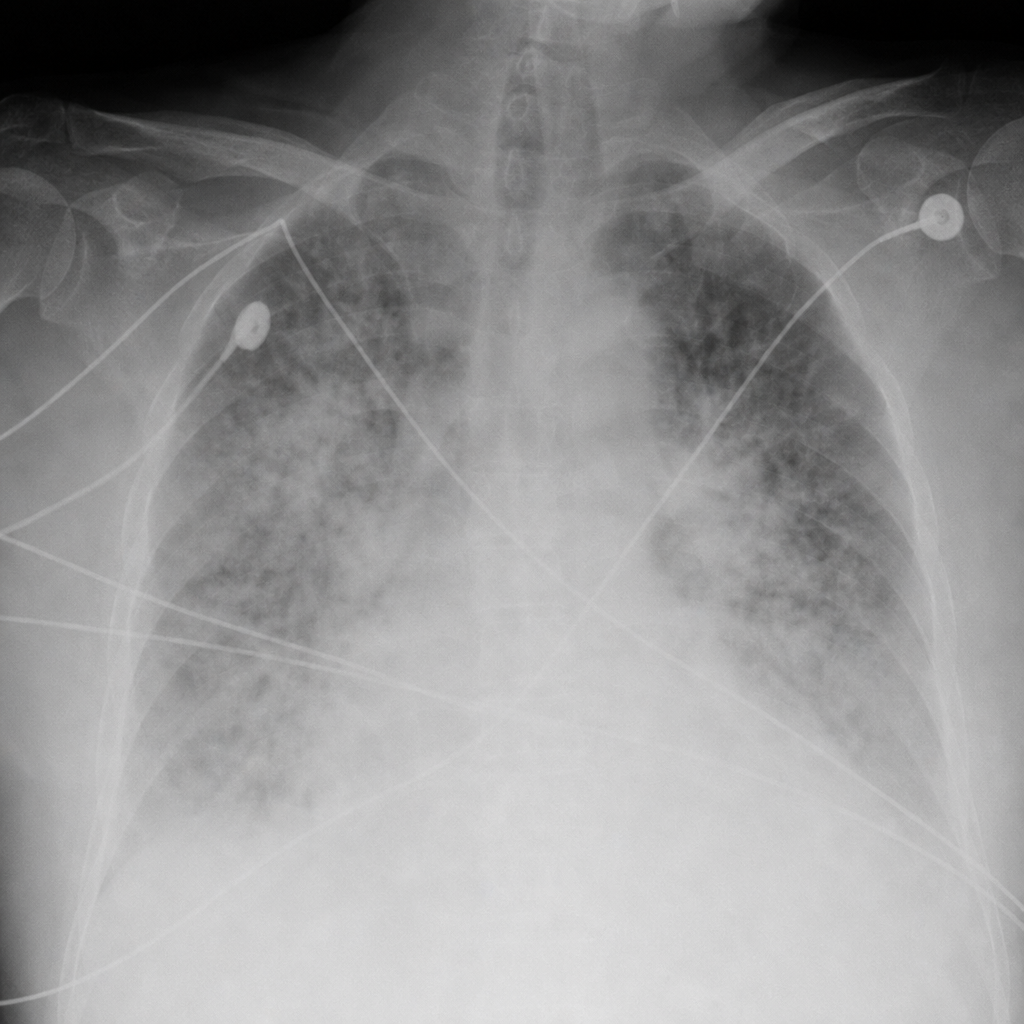
A patient on a ventilator presents with bilateral crepitations in all lung fields. What is the likely finding on chest X-ray?
Acute Lung Injury (ALI) is characterized by all of the following except?
Explanation: Septic shock is a subset of sepsis characterized by profound circulatory, cellular, and metabolic abnormalities. The management focuses on fluid resuscitation, vasopressors, and addressing the underlying infection and inflammatory response [1]. **Why Rituximab is the correct answer:** **Rituximab** is a monoclonal antibody directed against the **CD20 antigen** on B-lymphocytes. It is primarily used in B-cell lymphomas, rheumatoid arthritis, and certain autoimmune conditions. It has **no role** in the acute management of septic shock. In fact, because it causes profound B-cell depletion and immunosuppression, it can increase the risk of opportunistic infections, potentially worsening the prognosis in a septic patient. **Analysis of other options:** * **Normal Saline (A):** Crystalloids are the first-line fluids for volume resuscitation in sepsis. The Surviving Sepsis Campaign recommends at least 30 mL/kg of IV crystalloid within the first 3 hours. * **Activated Protein C (B):** (Historical Context) Drotrecogin alfa (recombinant human activated protein C) was previously used for severe sepsis with multi-organ failure (PROWESS trial). While it was withdrawn from the market globally in 2011 due to the PROWESS-SHOCK trial showing no mortality benefit, it remains a classic "distractor" in medical exams. However, compared to Rituximab, it was once a recognized treatment. * **Steroids (C):** Low-dose IV hydrocortisone (200 mg/day) is recommended in patients with septic shock who remain hemodynamically unstable despite adequate fluid resuscitation and vasopressor therapy. **High-Yield Clinical Pearls for NEET-PG:** * **Target MAP:** The goal for vasopressor therapy in septic shock is a Mean Arterial Pressure (MAP) of **65 mmHg**. * **First-choice Vasopressor:** **Norepinephrine** is the preferred first-line agent. * **Lactate:** Elevated serum lactate (>2 mmol/L) is a key marker of tissue hypoperfusion in sepsis. * **Antibiotics:** Should be initiated as early as possible, ideally within the **first hour** of recognition [1].
Explanation: The diagnosis of brain death requires the irreversible loss of all functions of the entire brain, including the brainstem [3]. The underlying medical concept is that **brain death is a clinical diagnosis** based on the absence of cerebral and brainstem functions, while the **spinal cord may remain intact.** **1. Why the Patellar Tendon Reflex is correct:** The patellar tendon reflex (knee-jerk) is a **monosynaptic spinal reflex**. Its circuit involves the peripheral nerves and the spinal cord segments (L2-L4), bypassing the brain entirely. Since the spinal cord can remain viable even when the brain is dead, spinal reflexes (including deep tendon reflexes, plantar flexion, or the "Lazarus sign") can still be elicited and do not preclude a diagnosis of brain death. **2. Why the other options are incorrect:** * **Oculovestibular reflex (Caloric testing):** This is a brainstem reflex involving the vestibular nuclei (pons/medulla) and the cranial nerves III and VI [1], [2]. Its absence is a mandatory criterion for brain death. * **Corneal reflex:** This reflex tests the integrity of the trigeminal nerve (afferent) and the facial nerve (efferent), mediated through the pons [1], [2]. * **Pharyngeal (Gag) reflex:** This is a lower brainstem reflex involving the glossopharyngeal and vagus nerves (medulla) [1], [2]. **Clinical Pearls for NEET-PG:** * **Prerequisites for Brain Death Testing:** Normothermia (>36°C), systolic BP ≥100 mmHg, and exclusion of drug intoxication or neuromuscular blocking agents [2]. * **The Apnea Test:** This is the definitive clinical test. A positive result (supporting brain death) is a $PCO_2$ >60 mmHg or >20 mmHg above baseline in the absence of respiratory effort [2]. * **Confirmatory Tests (if clinical exam is inconclusive):** Cerebral angiography (gold standard showing "no flow"), EEG (isoelectric/flat), or Transcranial Doppler.
Explanation: ### Explanation **Septic shock** is a subset of sepsis characterized by profound circulatory, cellular, and metabolic abnormalities. Understanding its hemodynamic profile is crucial for NEET-PG. **Why Option D is the correct answer (The "Except"):** Historically, gram-negative bacteria (due to endotoxin/LPS) were the most common cause. However, current epidemiological data shows that **gram-positive bacteria** (e.g., *Staphylococcus aureus, Streptococcus pneumoniae*) are now the **most frequent cause** of septic shock [1]. Therefore, stating it is "caused by gram-positive bacteria" is a **true** statement, making the question technically flawed or based on outdated "classic" teaching where gram-negatives were the focus. *Note: In many competitive exams, if this is the marked key, it implies the examiner is testing the traditional association of endotoxic shock with gram-negatives, or it is a distractor.* **Analysis of other options:** * **A. Tachycardia:** This is a compensatory mechanism to maintain cardiac output in the face of systemic vasodilation and is a hallmark of the Systemic Inflammatory Response Syndrome (SIRS). * **B. Warm skin:** Septic shock is a type of **distributive shock**. Early (hyperdynamic) phase involves massive vasodilation due to inflammatory mediators (NO, prostaglandins), leading to warm, flushed extremities. * **C. Decreased cardiac output:** In the **early/warm phase**, cardiac output is actually **increased** (High CO, Low SVR). Cardiac output only decreases in the late/cold (hypodynamic) phase or due to sepsis-induced myocardial depression. **High-Yield Clinical Pearls for NEET-PG:** * **Hemodynamic Profile:** Low Systemic Vascular Resistance (SVR), High Cardiac Output (CO), and Low Pulmonary Capillary Wedge Pressure (PCWP). * **Drug of Choice:** **Norepinephrine** is the first-line vasopressor. * **qSOFA Score:** Includes Altered Mentation (GCS <15), Systolic BP ≤100 mmHg, and Respiratory Rate ≥22/min. * **Lactate:** A key marker of tissue hypoperfusion; levels >2 mmol/L despite fluid resuscitation are diagnostic of septic shock.
Explanation: In ARDS (Acute Respiratory Distress Syndrome), the primary pathophysiological hallmark is **Type 1 Respiratory Failure**, which is characterized by profound hypoxemia without an initial increase in $CO_2$ [1]. **Why Hypercapnia is the Correct (False) Statement:** Early and middle stages of ARDS are typically associated with **hypocapnia** (low $PaCO_2$) rather than hypercapnia. This occurs because hypoxemia stimulates the peripheral chemoreceptors, leading to compensatory tachypnea and hyperventilation, which "washes out" carbon dioxide [2]. Hypercapnia is generally a late-stage finding indicating respiratory muscle fatigue or a massive increase in dead space, but it is not a defining or characteristic feature of ARDS itself. **Analysis of Other Options:** * **Hypoxemia:** This is the cardinal feature of ARDS. It results from right-to-left intrapulmonary shunting due to collapsed or fluid-filled alveoli [1]. * **Pulmonary Edema:** ARDS is defined by non-cardiogenic pulmonary edema caused by increased alveolar-capillary permeability (leaky endothelium), leading to protein-rich fluid accumulation in the alveoli [1]. * **Decreased Tidal Volume:** Due to the accumulation of fluid and inflammatory debris, the lungs become stiff (decreased compliance), often referred to as "Baby Lung." This leads to a reduction in effective tidal volume and necessitates a lung-protective ventilation strategy [1]. **NEET-PG High-Yield Pearls:** * **Berlin Criteria:** Acute onset (within 1 week), bilateral opacities on imaging, $PaO_2/FiO_2$ ratio $\leq 300$ mmHg, and edema not fully explained by heart failure [1]. * **Management:** Low tidal volume ventilation (6 mL/kg) is the gold standard to prevent Volutrauma. * **Prone Positioning:** Indicated if $PaO_2/FiO_2 < 150$ to improve V/Q matching.
Explanation: ### Explanation In the early stages of gram-negative septicemia (often referred to as **"Warm Shock"** or **Hyperdynamic Phase**), the primary pathophysiological event is massive peripheral vasodilation. **Why Option B is Correct:** Gram-negative bacteria release **endotoxins (LPS)**, which trigger a systemic inflammatory response. This leads to the release of potent vasodilators like **Nitric Oxide (NO)** and prostaglandins. 1. **Decreased Total Peripheral Resistance (TPR):** Vasodilation causes a significant drop in systemic vascular resistance. 2. **Increased Cardiac Output (CO):** To compensate for the falling blood pressure and decreased afterload, the heart increases its stroke volume and heart rate. This results in a hyperdynamic state where the skin feels warm and the pulse is bounding. **Analysis of Incorrect Options:** * **Option A:** Incorrect because peripheral resistance *decreases* due to vasodilation, not increases. Increased TPR is characteristic of hypovolemic or cardiogenic shock ("Cold Shock"). * **Option C:** "Transient" resistance is not a standard hemodynamic description of the septic process; the decrease in TPR is sustained until the compensatory mechanisms fail or treatment is initiated. * **Option D:** (Note: This option is identical to B in your list). **NEET-PG High-Yield Pearls:** * **Hemodynamic Profile of Early Sepsis:** ↑ Cardiac Output, ↓ PCWP (Pulmonary Capillary Wedge Pressure), ↓ SVR (Systemic Vascular Resistance), and ↑ Mixed Venous Oxygen Saturation ($SvO_2$) because tissues cannot extract oxygen efficiently. * **Warm vs. Cold Shock:** Early sepsis is "Warm Shock" (vasodilation). Late-stage sepsis or septic shock with myocardial depression presents as "Cold Shock" (↓ CO, ↑ SVR). * **Mediator of Vasodilation:** Inducible Nitric Oxide Synthase (iNOS) is the key enzyme responsible for the profound drop in TPR in sepsis.
Explanation: ### Explanation **Concept Overview:** Hypovolemic shock occurs when there is a critical reduction in intravascular volume, leading to decreased preload, reduced cardiac output, and inadequate tissue perfusion [1]. This loss can be **hemorrhagic** (blood loss) or **non-hemorrhagic** (fluid and electrolyte loss) [1], [2]. **Why Starvation is the Correct Answer:** In **Starvation (Option B)**, the body undergoes metabolic adaptation. While there is a lack of caloric intake and potential muscle wasting, the body maintains its intravascular volume through compensatory mechanisms (like ADH and Renin-Angiotensin-Aldosterone System activation) as long as water intake is maintained. Starvation leads to cachexia and malnutrition, but it does **not** acutely deplete intravascular volume to the point of shock unless accompanied by severe dehydration. **Analysis of Incorrect Options:** * **Hemorrhage (Option A):** The most common cause of hypovolemic shock. Loss of whole blood directly reduces the circulating volume [2]. * **Vomiting (Option C) & Diarrhoea (Option D):** These are classic causes of non-hemorrhagic hypovolemic shock. Massive gastrointestinal losses lead to significant depletion of water and electrolytes (sodium, potassium), rapidly reducing the plasma volume. **High-Yield Clinical Pearls for NEET-PG:** * **Hemodynamics of Hypovolemic Shock:** Characterized by **Decreased** Central Venous Pressure (CVP), **Decreased** Cardiac Output (CO), and **Increased** Systemic Vascular Resistance (SVR) as a compensatory mechanism to maintain BP [2]. * **The "Cold Shock":** Hypovolemic shock is a "cold shock" because peripheral vasoconstriction (increased SVR) leads to cold, clammy extremities. * **Class III Hemorrhage:** This is the stage where systolic blood pressure typically begins to fall (30-40% blood loss). * **Management:** The priority is volume replacement with **Isotonic Crystalloids** (Normal Saline or Ringer’s Lactate) and blood products if hemorrhagic.
Explanation: Explanation: The correct answer is **5% Dextrose**. During cardiac arrest, the brain undergoes global ischemia. If dextrose-containing fluids are administered, the body cannot metabolize the glucose aerobically due to lack of oxygen. This leads to **anaerobic glycolysis**, resulting in the excessive production of **lactic acid** within the brain tissue (cerebral intracellular acidosis). This acidosis exacerbates neuronal injury, increases the risk of cerebral edema, and significantly worsens neurological outcomes post-resuscitation. Furthermore, hyperglycemia itself is associated with poorer outcomes in critically ill patients. **Analysis of Incorrect Options:** * **Ringer’s Lactate (RL):** This is an isotonic crystalloid and is generally considered a safe fluid for volume expansion during resuscitation, although Normal Saline (0.9% NaCl) is often preferred in the immediate arrest phase. * **Colloids:** While not the first-line choice due to cost and potential renal side effects, they do not cause the specific metabolic neurotoxicity associated with dextrose. * **Whole Blood Transfusion:** While rarely used in the acute "code" setting (unless the arrest is due to hemorrhagic shock), it provides oxygen-carrying capacity and does not inherently worsen neurological outcomes like glucose does. **Clinical Pearls for NEET-PG:** * **Rule of Thumb:** Never use dextrose-containing fluids (D5, D10, DNS) during cardiac arrest or acute stroke unless documented **hypoglycemia** is present. * **Preferred Fluid:** Isotonic crystalloids (Normal Saline or Ringer's Lactate) are the fluids of choice for volume expansion during ACLS [1]. * **Post-Resuscitation Care:** Maintain blood glucose levels between **140–180 mg/dL**; both hypoglycemia and severe hyperglycemia must be avoided to protect the brain.
Explanation: The correct answer is **Fluorine**. Synthetic oxygen carriers, specifically **Perfluorocarbons (PFCs)**, are chemically synthesized compounds consisting entirely of carbon and fluorine atoms. They are being developed as "blood substitutes" because they possess a high gas-solubility coefficient, allowing them to dissolve large amounts of oxygen and carbon dioxide. Unlike hemoglobin, which binds oxygen chemically, PFCs carry oxygen through **physical dissolution** (Henry’s Law), making oxygen delivery highly dependent on the fraction of inspired oxygen ($FiO_2$). **Analysis of Options:** * **Option A (Iron):** While iron is the central atom in natural hemoglobin (heme) responsible for oxygen binding, it is not the primary constituent of synthetic perfluorocarbon-based carriers. * **Option B (Bronze):** Bronze is an alloy of copper and tin; it has no physiological role in oxygen transport or medical therapeutics. * **Option C (Molybdenum):** This is a trace element and a cofactor for enzymes like sulfite oxidase and xanthine oxidase, but it does not function as an oxygen carrier. * **Option D (Fluorine):** Perfluorocarbons (e.g., Perflubron) are the hallmark of synthetic oxygen carriers due to the strength of the Carbon-Fluorine bond, which makes them chemically inert and stable for clinical use. **High-Yield Clinical Pearls for NEET-PG:** * **Mechanism:** PFCs follow a linear relationship between $PO_2$ and oxygen content, unlike the sigmoidal curve of hemoglobin. * **Advantages:** They are universal (no cross-matching required), have a long shelf life, and their small size (0.1–0.2 μm) allows them to pass through constricted or partially obstructed capillaries where RBCs cannot. * **Side Effects:** A common side effect of early PFCs was "flu-like symptoms" due to activation of the reticuloendothelial system (RES). * **Other Synthetic Types:** Apart from PFCs, the other major class is **Hemoglobin-Based Oxygen Carriers (HBOCs)**, which use polymerized or conjugated human/bovine hemoglobin.
Explanation: ### Explanation **Correct Option: B. Noncardiogenic pulmonary edema** The clinical scenario describes a patient on a ventilator developing bilateral crepitations, which is a hallmark presentation of **Acute Respiratory Distress Syndrome (ARDS)**—the most common form of noncardiogenic pulmonary edema in the ICU. [1] In the context of mechanical ventilation, lung injury often occurs due to systemic inflammation or direct alveolar insult. Unlike cardiogenic edema, which is caused by increased hydrostatic pressure (heart failure), noncardiogenic pulmonary edema results from **increased alveolar-capillary permeability**. On a chest X-ray, this typically manifests as **bilateral, diffuse alveolar or interstitial infiltrates** without signs of cardiac enlargement or pleural effusion. [1] **Why other options are incorrect:** * **A. Cardiogenic pulmonary edema:** While it presents with crepitations, it is usually associated with specific X-ray findings like cardiomegaly, Kerley B lines, and cephalization of pulmonary veins (absent here). * **C. Neurogenic pulmonary edema:** This occurs following a massive CNS insult (e.g., head trauma or subarachnoid hemorrhage). While it is a form of noncardiogenic edema, it is less likely than ARDS in a general ventilated patient unless a primary neurological event is specified. * **D. Chemical pneumonitis:** This typically follows the aspiration of gastric contents (Mendelson syndrome). While it causes localized or patchy infiltrates, it does not typically present as diffuse bilateral crepitations across all lung fields unless it progresses to ARDS. **High-Yield Clinical Pearls for NEET-PG:** * **Berlin Criteria for ARDS:** 1) Acute onset (within 1 week); 2) Bilateral opacities on X-ray not explained by effusions/collapse; 3) Edema not fully explained by heart failure; 4) $PaO_2/FiO_2$ ratio < 300 mmHg. [1] * **PCWP (Pulmonary Capillary Wedge Pressure):** In noncardiogenic edema, PCWP is typically **< 18 mmHg**, distinguishing it from cardiogenic causes. * **Ventilator Strategy:** Use **Low Tidal Volume (6 mL/kg)** to prevent Volutrauma. [2]
Explanation: The diagnosis of Acute Lung Injury (ALI) and Acute Respiratory Distress Syndrome (ARDS) was historically defined by the **American-European Consensus Conference (AECC)** criteria. [1] This question tests the specific physiological threshold that distinguishes ALI from ARDS. **1. Why Option A is the correct answer:** According to the AECC criteria, the defining difference between ALI and ARDS is the severity of hypoxemia measured by the **PaO2/FiO2 ratio**: * **ALI:** PaO2/FiO2 ratio **≤ 300 mm Hg**. * **ARDS:** PaO2/FiO2 ratio **≤ 200 mm Hg**. Therefore, a ratio < 200 mm Hg characterizes ARDS, not specifically ALI (though ARDS is the most severe form of ALI). **2. Analysis of incorrect options:** * **Option B (Bilateral infiltrates):** Both ALI and ARDS require the presence of bilateral pulmonary infiltrates on frontal chest radiograph, representing non-cardiogenic pulmonary edema. [1] * **Options C & D (PCWP < 18 mm Hg / Normal LA pressure):** A hallmark of ALI/ARDS is that the edema is **non-cardiogenic**. To rule out left heart failure, the Pulmonary Capillary Wedge Pressure (PCWP) must be < 18 mm Hg, or there must be no clinical evidence of elevated Left Atrial (LA) pressure. [1] **Clinical Pearls for NEET-PG:** * **Berlin Definition (2012):** Note that modern clinical practice has replaced the term "ALI" with the Berlin Definition, which categorizes ARDS into **Mild** (P/F 200–300), **Moderate** (P/F 100–200), and **Severe** (P/F < 100). [1] * **Key Trigger:** Sepsis is the most common cause of ARDS. * **Management:** The mainstay of treatment is **Low Tidal Volume Ventilation** (6 mL/kg) to prevent volutrauma.
Shock Syndromes and Management
Practice Questions
Acute Respiratory Distress Syndrome
Practice Questions
Mechanical Ventilation Principles
Practice Questions
Hemodynamic Monitoring
Practice Questions
Nutrition in Critical Illness
Practice Questions
Sedation and Analgesia in ICU
Practice Questions
Multi-organ Dysfunction Syndrome
Practice Questions
Acid-Base and Electrolyte Disturbances
Practice Questions
Toxicologic Emergencies
Practice Questions
Neurological Emergencies in ICU
Practice Questions
Renal Replacement Therapy
Practice Questions
End-of-Life Care in ICU
Practice Questions
Get full access to all questions, explanations, and performance tracking.
Start For Free