A female patient of 26 years, presents with oral ulcers, photosensitivity and skin malar rash in face sparing the nasolabial folds of both side.
Which of the following conditions is NOT typically associated with low glucose levels in pleural fluid?
A patient presents to you with fever, night sweats, ptosis, and bilateral facial nerve palsy. Investigations showed leukocytosis and bilateral hilar lymphadenopathy. Which of the following is the most likely diagnosis?
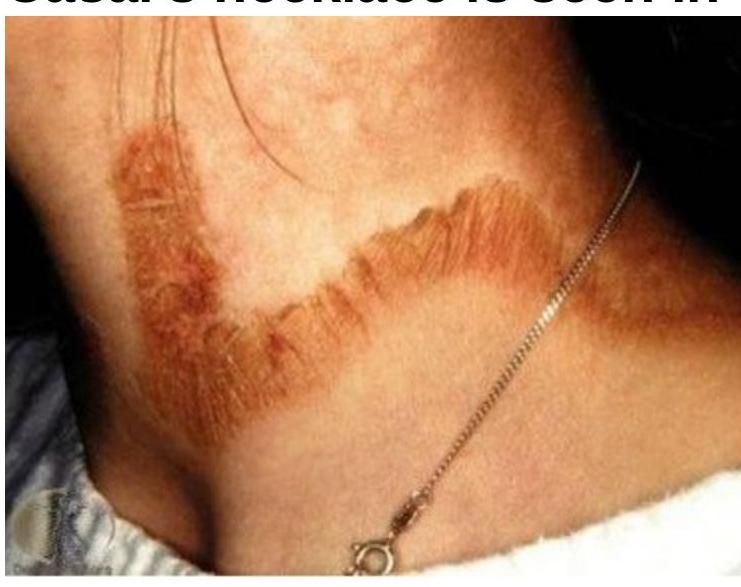
Casal's necklace is associated with the deficiency of:
Which vitamin deficiency is commonly associated with night blindness and other vision problems?
Which of the following exocrine glandular ducts are not obstructed in cystic fibrosis?
A 50 year old male presents with fever and malaise for 4 months and pain in the knees and ankles. Blood tests are normal apart from a raised ESR. Chest x-ray shows bilateral hilar adenopathy and pulmonary infiltrates most severe in the upper and mid zones. Mantoux test is negative. What is the most likely diagnosis?
What is the most common cause of delirium?
Which of the following conditions is least likely to cause multiple painful ulcers on the tongue?
Obesity is commonly associated with all of the following conditions except?
Explanation: ***SLE*** - The combination of **oral ulcers**, **photosensitivity**, and a **malar rash** that spares the nasolabial folds is highly characteristic of **Systemic Lupus Erythematosus (SLE)** [1]. - SLE is an autoimmune disease with diverse clinical manifestations involving multiple organ systems. *Sturge weber syndrome* - This is a neurocutaneous disorder characterized by a **port-wine stain** (nevus flammeus) typically on the face, neurological abnormalities like seizures, and ocular involvement. - It does not present with oral ulcers or photosensitivity as primary features. *Dermatitis* - **Dermatitis** is a general term for skin inflammation, often presenting with redness, itching, and sometimes blisters. - It does not typically involve the specific constellation of oral ulcers, photosensitivity, and a malar rash that spares nasolabial folds. *Psoriasis* - **Psoriasis** is a chronic autoimmune disease primarily affecting the skin, characterized by red, scaly patches (plaques) [2]. - While it can cause nail changes and sometimes joint pain, it does not present with photosensitivity, oral ulcers, or the characteristic malar rash described.
Explanation: ***Dressler's syndrome*** - Also known as post-myocardial infarction syndrome, is an **inflammatory reaction** that typically presents with a **transudative pleural effusion**. - Pleural fluid analysis in Dressler's syndrome usually shows n**ormal or slightly elevated glucose levels**, as inflammation is not severe enough to cause significant glucose consumption by metabolic activity in the pleural space. *Empyema* - Characterized by significant **bacterial activity** within the pleural space, leading to a high metabolic demand. - Bacteria and inflammatory cells consume glucose, resulting in **very low pleural fluid glucose levels**. *Malignant pleural effusion* - Malignant cells within the pleural space have a high metabolic rate and consume glucose. - This often leads to **low pleural fluid glucose levels**, especially in extensive or rapidly growing malignancies. *Rheumatoid arthritis* - Pleural effusions associated with **rheumatoid arthritis** often present with very low glucose levels. - This is due to the presence of numerous **inflammatory cells** and high metabolic activity within the inflamed pleura.
Explanation: ***Sarcoidosis*** - The combination of **fever**, **night sweats**, **bilateral facial nerve palsy**, **ptosis**, and **bilateral hilar lymphadenopathy** is highly suggestive of **neurosarcoidosis** manifesting as Heerfordt's syndrome (uveoparotid fever) [1]. - **Leukocytosis** is a non-specific finding but can be present due to inflammatory processes in sarcoidosis. *Tuberculosis* - While tuberculosis can cause **fever**, **night sweats**, and **hilar lymphadenopathy** [2] [3], it is less likely to present with **bilateral facial nerve palsy** and **ptosis** simultaneously. - Pulmonary tuberculosis often shows specific patterns like **apical infiltrates** or cavitations, rather than solely bilateral hilar lymphadenopathy, especially without other classic symptoms like productive cough. *Lymphoma* - Lymphoma can cause **fever**, **night sweats**, and **lymphadenopathy** (including hilar) [4]. - However, **bilateral facial nerve palsy** and **ptosis** are not typical primary manifestations of lymphoma and would require other evidence of direct mass effect or widespread infiltration. *Hypersensitive pneumonitis* - This condition is characterized by **inflammation of the lung alveoli** and small airways due to repeated exposure to inhaled antigens, leading to symptoms like cough, dyspnea, and fever. - It typically does **not cause neurological symptoms** such as facial nerve palsy or ptosis, nor is it prominently associated with hilar lymphadenopathy.
Explanation: ***Deficiency of Niacin (Vitamin B3)*** - **Casal's necklace** is a characteristic dermatological manifestation of **pellagra**, which is caused by **niacin (Vitamin B3) deficiency**. - It presents as a **symmetrical, photosensitive dermatitis** on the neck and other sun-exposed areas, resembling a necklace. *Deficiency of Vitamin A* - Vitamin A deficiency primarily affects **vision**, leading to **night blindness** and **xerophthalmia**. - It can also cause follicular **hyperkeratosis** (dry, rough skin), but not the distinct 'necklace' pattern seen in pellagra. *Deficiency of Iron* - Iron deficiency typically causes **anemia**, leading to symptoms like **fatigue**, **pallor**, and **koilonychia** (spoon-shaped nails). - It does not directly cause skin lesions like Casal's necklace. *Deficiency of Vitamin B12* - Vitamin B12 deficiency is associated with **megaloblastic anemia** and **neurological symptoms** (e.g., peripheral neuropathy, cognitive impairment). - While it can cause **hyperpigmentation** in some cases, it does not specifically manifest as Casal's necklace.
Explanation: ### Vitamin A - **Vitamin A** (retinol) is a crucial component of **rhodopsin**, a pigment found in the **rod cells** of the retina, which is essential for vision in **low light conditions** [1], [2]. - A deficiency in Vitamin A leads to **impaired rhodopsin regeneration**, causing **night blindness** (nyctalopia) and, in severe cases, can progress to **xerophthalmia** and permanent blindness due to damage to the cornea and conjunctiva [1], [4]. ### Vitamin C - **Vitamin C** (ascorbic acid) is important for **collagen synthesis**, acting as an antioxidant, and supporting immune function. - Deficiency leads to **scurvy**, characterized by gum inflammation, bleeding, and poor wound healing, but it is not directly associated with night blindness. ### Vitamin E - **Vitamin E** is a powerful **antioxidant** that protects cell membranes from oxidative damage. - While it plays a role in nerve and muscle health, its deficiency is mainly associated with neurological problems like **ataxia** and peripheral neuropathy, not night blindness [3]. ### Vitamin B12 - **Vitamin B12** (cobalamin) is vital for **red blood cell formation**, neurological function, and DNA synthesis. - Deficiency can cause **megaloblastic anemia** and neurological damage, including **peripheral neuropathy** and visual disturbances such as optic neuropathy, but night blindness is not a primary symptom.
Explanation: ***Sweat gland*** - In cystic fibrosis, the **CFTR protein** in sweat glands is defective, leading to **impaired chloride reabsorption** and excessively salty sweat [1]. - This defect causes dysfunctional sweat production but **does not result in obstruction** of the sweat gland ducts, which continue to secrete. *Pancreas* - The **exocrine pancreatic ducts** are frequently obstructed in cystic fibrosis due to the production of **thick, sticky mucus**. - This obstruction leads to maldigestion and **pancreatic insufficiency**, requiring enzyme replacement therapy. *Lung* - **Bronchial ducts** and airways in the lungs are severely affected by the accumulation of **viscous mucus**, leading to chronic obstruction [1]. - This obstruction impairs mucociliary clearance, making patients susceptible to recurrent **pulmonary infections** and progressive lung damage [1], [2]. *None of the options* - This option is incorrect because sweat glands are indeed not obstructed, making option C the appropriate answer.
Explanation: ***Sarcoidosis*** - The constellation of **bilateral hilar adenopathy**, pulmonary infiltrates (especially in upper/mid zones), **arthralgia** (knees and ankles), and a **negative Mantoux test** in a patient with unexplained fever and malaise is highly suggestive of sarcoidosis [1]. - A **raised ESR** is a non-specific inflammatory marker often seen in sarcoidosis. *Tuberculosis* - While tuberculosis can cause fever, malaise, pulmonary infiltrates, and elevated ESR, a **negative Mantoux test** makes primary or active tuberculosis less likely in an immunocompetent individual. - **Bilateral hilar adenopathy** is also less typical of primary pulmonary tuberculosis compared to sarcoidosis. *Asbestosis* - This is an **occupational lung disease** caused by asbestos exposure, primarily presenting with **progressive dyspnea** and **restrictive lung disease**. - It characteristically involves the **lower lobes**, causes **pleural plaques**, and is not typically associated with acute arthralgia, fever, or prominent hilar adenopathy. *Berylliosis* - This is another **occupational lung disease** resulting from beryllium exposure, often mimicking sarcoidosis both clinically and pathologically [2]. - However, without a history of **beryllium exposure** and given the classic presentation, sarcoidosis is a more prevalent default diagnosis [2].
Explanation: ***Infection*** - **Infections**, particularly urinary tract infections (UTIs) or pneumonia, are a very common and often reversible cause of **delirium**, especially in elderly or immunocompromised patients [1]. - The systemic inflammatory response to infection can lead to neuroinflammation and direct effects on brain function, manifesting as acute changes in attention and cognition. *Liver failure* - While **liver failure** can cause **hepatic encephalopathy**, which presents with altered mental status, it typically has a more gradual onset and a different neurochemical profile than acute delirium caused by infection. - Hepatic encephalopathy is characterized by abnormal ammonia metabolism and often includes motor signs like **asterixis**, which are not universally present in delirium from infection. *Belladonna poisoning* - **Belladonna poisoning** (due to **anticholinergic toxicity**) can cause **delirium**, along with a constellation of symptoms like dilated pupils, dry mouth, and tachycardia. - However, it is a specific toxicological cause and not as broad or commonly encountered as infection as a general cause of new-onset delirium in hospitalized or elderly populations. *None of the options* - This option is incorrect because **infection** is indeed a very common and recognized cause of delirium [1].
Explanation: ***Sarcoidosis*** - While sarcoidosis can affect any organ, **oral involvement is rare** and typically presents as **nodules, plaques, or generalized swelling**, not usually multiple painful ulcers on the tongue. - The lesions, when they occur, are often **painless** and appear as submucosal nodules, red patches, or diffuse swelling. *TB* - Oral tuberculosis can present as **multiple painful ulcers** on the tongue, often with a **granulomatous appearance** mimicking squamous cell carcinoma. - These ulcers are typically **irregular, undermined, and persistent**, often associated with pulmonary TB. *Herpes* - **Herpes simplex virus (HSV)** infection, particularly primary herpetic gingivostomatitis, commonly causes **multiple painful ulcers** on the tongue, gums, and other oral mucosa. - These ulcers begin as vesicles that **rupture to form painful erosions** and are a classic presentation of oral herpes. *Behcet disease* - **Oral aphthous ulcers** are a hallmark feature of Behcet disease, commonly presenting as **multiple, recurrent, painful ulcers** on the tongue and other oral mucosal surfaces. - These ulcers are clinically indistinguishable from common aphthous stomatitis but are more frequent and often associated with genital ulcers, skin lesions, and ocular inflammation.
Explanation: ***Anorexia nervosa*** - This is an **eating disorder** characterized by an abnormally low body weight, intense fear of gaining weight, and a distorted perception of weight [1]. - Individuals with anorexia nervosa are typically **underweight**, the opposite of obesity, and often engage in extreme dietary restriction. *Cushing syndrome* - This syndrome is caused by **prolonged exposure to high levels of cortisol**, often leading to characteristic symptoms like central obesity, moon face, and buffalo hump [3]. - The **central adiposity** seen in Cushing syndrome is a form of obesity, making it commonly associated with overweight or obese states . *Pickwickian syndrome* - Also known as **obesity hypoventilation syndrome (OHS)**, this condition is strongly linked to severe obesity. - It is characterized by **sleep-disordered breathing** and chronic daytime hypoventilation in obese individuals, leading to hypercapnia and hypoxemia. *Prader-Willi syndrome* - This is a **genetic disorder** associated with several physical, mental, and behavioral problems, including chronic feelings of hunger [2]. - This **insatiable appetite** often leads to compulsive eating and severe, early-onset obesity [2].
Approach to Common Symptoms (Fever, Pain, Fatigue)
Practice Questions
Constitutional Symptoms and Their Differential Diagnosis
Practice Questions
Syncope and Presyncope
Practice Questions
Dizziness and Vertigo
Practice Questions
Dyspnea and Respiratory Distress
Practice Questions
Chest Pain Evaluation
Practice Questions
Abdominal Pain Assessment
Practice Questions
Headache Classification and Management
Practice Questions
Weight Loss and Cachexia
Practice Questions
Edema and Fluid Retention
Practice Questions
Get full access to all questions, explanations, and performance tracking.
Start For Free