In cases of severe abdominal pain, identifying the location of McBurney's point is crucial for diagnosing which condition?
A 30-year-old woman presents with a painful breast lump that has increased in size over the past two weeks. She also reports fever and malaise. What is the most likely diagnosis?
A 35-year-old male presents with nasal obstruction, rhinorrhea, and sneezing. Examination reveals pale, edematous nasal mucosa. What is the most likely diagnosis?
Which vitamin deficiency is associated with Bitot's spots?
A 24-year-old woman presents with recurrent vulvovaginal candidiasis. Which condition should be considered?
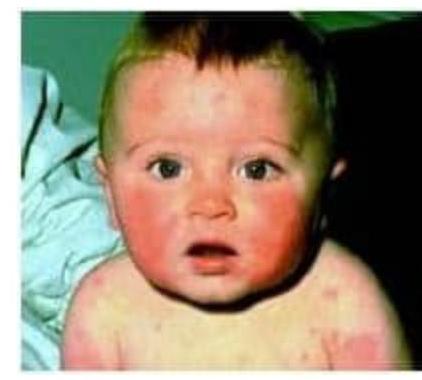
A child with history of fever, photosensitivity, rash sparing nasolabial fold presents to OP. Identify the condition?
Which of the following conditions does not lead to pseudoparalysis?
Cullen's sign is associated with which of the following conditions?
Presence of Velcro crackles at the lung base on auscultation is a sign of which condition?
Which of the following is the most specific risk factor for esophageal cancer in Plummer-Vinson syndrome?
Explanation: ***Appendicitis*** - **McBurney's point** is specifically located one-third of the way from the **anterior superior iliac spine (ASIS)** to the umbilicus, and tenderness here is a classic sign of **acute appendicitis** [1]. - Pain at McBurney's point indicates a high probability of inflammation of the **vermiform appendix**, which is commonly found in this anatomical region [1]. *Pancreatitis* - Pancreatitis typically causes severe **epigastric pain** that often radiates to the back [2]. - It is not associated with tenderness at **McBurney's point**. *Gallstones* - Pain from gallstones (biliary colic or cholecystitis) is usually located in the **right upper quadrant** or epigastrium. - This pain can radiate to the right shoulder or back but is not linked to **McBurney's point**. *Diverticulitis* - Diverticulitis most commonly affects the **sigmoid colon**, leading to pain in the **left lower quadrant** of the abdomen. - Tenderness at **McBurney's point** is not a feature of diverticulitis.
Explanation: ***Breast abscess*** - The presentation of a **painful breast lump**, fever, and malaise suggests an **infective process** leading to localized pus formation. - Typically, a **breast abscess occurs** after complications from mastitis, particularly in lactating women [1]. *Breast carcinoma* - Usually presents as a **painless lump** and does not typically cause **fever or malaise** in the early stages. - Characteristically demonstrates **hard, irregular borders** on examination, which is less likely in this acute scenario. - The possibility of **inflammatory carcinoma** mimicking a non-neoplastic inflammatory disorder should always be considered [1]. *Mastitis* - While it can cause **painful swelling** and fever, mastitis usually presents with **localized redness and warmth**, and does not typically lead to a discrete lump. - If left untreated, mastitis can lead to a **breast abscess**, but it is not the definitive diagnosis in this case. *Fibroadenoma* - Fibroadenomas are **benign tumors** that are usually **painless and mobile**, not associated with acute symptoms. - They typically do not cause systemic symptoms like **fever** or **malaise** and are more stable in size than the rapid increase seen here. **References:** [1] Kumar V, Abbas AK, et al.. Robbins and Cotran Pathologic Basis of Disease. 9th ed. The Breast, p. 1052.
Explanation: ***Allergic rhinitis*** - The combination of **nasal obstruction**, **rhinorrhea**, **sneezing**, and importantly, **pale, edematous nasal mucosa**, strongly suggests allergic rhinitis. - This presentation is typical of an **IgE-mediated hypersensitivity reaction** to inhaled allergens. *Acute rhinitis* - Often caused by a **viral infection**, leading to symptoms like rhinorrhea, sneezing, and nasal obstruction. - However, the nasal mucosa in acute rhinitis is typically **erythematous** (red and inflamed), not pale and edematous. *Vasomotor rhinitis* - Characterized by chronic rhinitis symptoms that are **non-allergic** and non-infectious, often triggered by environmental changes like temperature or strong odors. - While it can cause similar symptoms, the nasal mucosa is usually **normal in appearance** or mildly congested without the distinct pallor and edema seen in allergic rhinitis. *Nasal polyp* - Presents primarily with **nasal obstruction** and possibly anosmia (loss of smell) and postnasal drip. - While chronic inflammation may be present, the classic mucosal appearance of **pale, edematous tissue** throughout the nasal cavity, as described, is not the primary feature of a localized nasal polyp.
Explanation: ***Vitamin A*** - **Bitot's spots** are characteristic white or gray foamy patches on the conjunctiva, which are a classic sign of **vitamin A deficiency** [1]. - **Vitamin A** plays a critical role in maintaining the health and integrity of **epithelial tissues**, including those found in the conjunctiva and retina [1]. *Vitamin B12* - Deficiency in **vitamin B12** (cobalamin) is primarily associated with **megaloblastic anemia** and neurological symptoms, such as paresthesias and cognitive impairment. - While it can affect mucous membranes (e.g., glossitis), it does not cause **Bitot's spots**. *Vitamin C* - A deficiency in **vitamin C** (ascorbic acid) causes **scurvy**, characterized by weakened connective tissue, bleeding gums, poor wound healing, and perifollicular hemorrhages. - It has no known association with **Bitot's spots** or ocular surface changes like those seen in vitamin A deficiency. *Vitamin D* - **Vitamin D** deficiency is well-known for its role in bone health, leading to conditions like **rickets** in children and **osteomalacia** in adults [2]. - While essential for calcium metabolism, it does not cause **Bitot's spots** or other distinct ocular manifestations.
Explanation: ***Diabetes mellitus*** - **Uncontrolled blood sugar** provides a rich environment for *Candida* overgrowth, leading to recurrent infections [1]. - Impaired immune response in diabetes also makes individuals more susceptible to **opportunistic fungal infections** [1]. *Hypertension* - **Hypertension** is a cardiovascular condition characterized by elevated blood pressure and is not directly linked to fungal infections. - It does not significantly alter the vaginal microenvironment or immune response in a way that would predispose to recurrent candidiasis. *Hypothyroidism* - **Hypothyroidism** involves insufficient thyroid hormone production and can cause symptoms like fatigue and weight gain. - There is no direct physiological link between thyroid hormone levels and susceptibility to vulvovaginal candidiasis. *Hyperlipidemia* - **Hyperlipidemia** is characterized by high levels of lipids (fats) in the blood and is a risk factor for cardiovascular disease. - This condition does not create a predisposition to recurrent *Candida* infections.
Explanation: ***SLE*** - The combination of **fever**, **photosensitivity**, and a **rash sparing the nasolabial folds** (malar rash or butterfly rash) is highly characteristic of Systemic Lupus Erythematosus (SLE). - Childhood-onset SLE can present with similar mucocutaneous and systemic features as adult-onset disease. *Polymorphous light eruption* - This condition is primarily characterized by **photosensitive skin lesions** but typically does not involve systemic symptoms like fever. - While it presents with rash in sun-exposed areas, it generally lacks the distinct malar rash appearance and systemic involvement seen in SLE. *Discoid lupus* - Discoid lupus is a form of **cutaneous lupus** characterized by chronic, scaly, disfiguring plaques, often on the face and scalp. - It usually **lacks systemic symptoms** like fever and does not present as a widespread malar rash sparing nasal folds. *Skin tuberculosis* - Skin tuberculosis (lupus vulgaris or scrofuloderma) presents with **nodular, plaque-like lesions** or cold abscesses, often with ulceration and scarring. - It is not typically associated with **photosensitivity** or a malar rash, and fever, if present, is usually due to systemic Mycobacterium infection.
Explanation: ***Viral infection directly causing motor neuron damage*** - **Pseudoparalysis** is apparent paralysis due to extreme pain or discomfort, not actual neurological damage. A viral infection directly causing motor neuron damage results in **true paralysis**, not pseudoparalysis [1]. - This option describes a **neurological deficit** leading to actual motor weakness or paralysis, which is distinct from the pain-induced immobility seen in pseudoparalysis. *Scurvy causing joint pain* - **Scurvy** can cause severe joint pain due to **subperiosteal hematomas** and hemorrhage, leading a child to avoid moving the limb, thus mimicking paralysis. - This pain-induced immobility, despite intact neurological function, is a classic example of **pseudoparalysis**. *Septic arthritis causing severe joint pain* - **Septic arthritis** causes extreme inflammation and pain in a joint, which can lead a child to refuse to move the affected limb. - This reluctance to move due to pain, despite normal nerve and muscle function, fits the definition of **pseudoparalysis**. *Osteomyelitis causing severe pain* - **Osteomyelitis**, an infection of the bone, can cause intense pain, swelling, and tenderness in the affected limb, leading to a refusal to move it. - The immobility results from the severe pain rather than a neurological deficit, making it a form of **pseudoparalysis**.
Explanation: Detailed explanation of Cullen's sign and its associations: ***Acute pancreatitis*** - **Cullen's sign** is periumbilical ecchymosis (bruising around the navel) caused by **hemorrhagic pancreatitis**, where pancreatic enzymes leak into the abdominal cavity [1]. - This symptom indicates severe disease and often signifies **retroperitoneal hemorrhage** [1]. *Acute cholecystitis* - This condition involves inflammation of the gallbladder, typically causing **right upper quadrant pain**, fever, and leukocytosis. - While it can be severe, it does not typically present with the characteristic periumbilical bruising of Cullen's sign. *Acute hepatitis* - Acute hepatitis is an inflammation of the liver, leading to symptoms like **jaundice**, fatigue, and hepatomegaly. - It does not involve hemorrhagic changes that would produce Cullen's sign, which is specific to pancreatitis-induced retroperitoneal bleeding. *Blunt injury abdomen* - While blunt abdominal trauma can cause significant internal bleeding and bruising, **Cullen's sign specifically refers to periumbilical ecchymosis** due to pancreatic injury and retroperitoneal hemorrhage. - A general blunt injury might cause diffuse abdominal bruising, but not necessarily the distinct Cullen's sign associated with pancreatic damage.
Explanation: ***Scleroderma*** - **Velcro crackles** at the lung base are a characteristic finding in **interstitial lung disease (ILD)**, which is a common and severe complication of **systemic sclerosis (scleroderma)** [1]. - The crackles are caused by the **fibrosis and stiffening of the alveoli** and small airways, which "pop open" during inspiration [2]. *Systemic Lupus Erythematosus* - While SLE can cause **pleuritis** and **lupus pneumonitis**, it is less commonly associated with **Velcro crackles** as a primary pulmonary manifestation [1]. - Lung involvement in SLE often presents as **pleural effusions** or diffuse alveolar hemorrhage, rather than restrictive ILD with crackles [1]. *Wegener's Granulomatosis* - This condition primarily affects the **upper and lower respiratory tracts** and kidneys, causing **granulomatous inflammation** and vasculitis. - Lung involvement typically manifests as **nodules**, **cavitation**, and **hemorrhage**, not typically **Velcro crackles**. *Polyarteritis Nodosa* - This is a **necrotizing vasculitis** that affects medium-sized muscular arteries. - Lung involvement is rare or atypical in PAN, and it does not characteristically present with **interstitial lung disease** or **Velcro crackles**.
Explanation: ***Risk factor for adenocarcinoma*** - Patterson-Kelly-Brown syndrome is **not** known to be a direct risk factor for adenocarcinoma, which makes this statement false. - The syndrome primarily involves esophageal symptoms without a proven link to increased cancer risk. *Anemia* - Anemia is a common feature in Patterson-Kelly-Brown syndrome due to **iron deficiency** from poor dietary intake or malabsorption. - It may also result from chronic blood loss associated with esophageal webs. *Esophageal webs* - Esophageal webs are a hallmark of Patterson-Kelly-Brown syndrome, causing **dysphagia** and other swallowing difficulties. - They are formed due to mucosal alterations and are a classic manifestation of the condition. *Glossitis* - Glossitis, or inflammation of the tongue, is often observed in patients with Patterson-Kelly-Brown syndrome due to **iron deficiency** and **nutritional deficiencies**. - It is associated with the underlying nutritional issues that often accompany the syndrome.
Approach to Common Symptoms (Fever, Pain, Fatigue)
Practice Questions
Constitutional Symptoms and Their Differential Diagnosis
Practice Questions
Syncope and Presyncope
Practice Questions
Dizziness and Vertigo
Practice Questions
Dyspnea and Respiratory Distress
Practice Questions
Chest Pain Evaluation
Practice Questions
Abdominal Pain Assessment
Practice Questions
Headache Classification and Management
Practice Questions
Weight Loss and Cachexia
Practice Questions
Edema and Fluid Retention
Practice Questions
Get full access to all questions, explanations, and performance tracking.
Start For Free