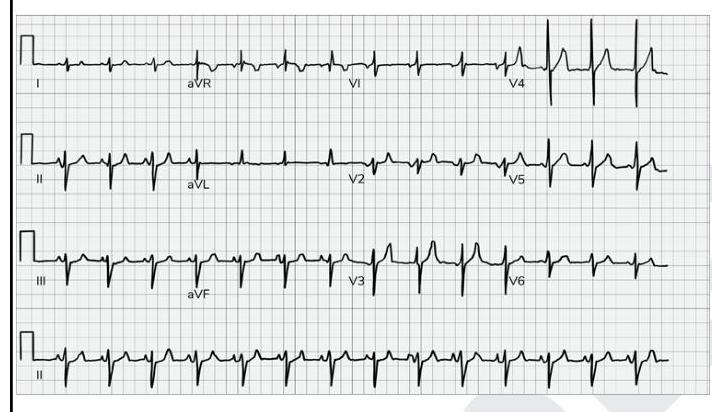
Which of the following is false regarding the Austin-Flint murmur?
What is the treatment of choice in ventricular fibrillation?
Paroxysmal supraventricular tachycardia responds to which of the following management options?
Loud S1 is present in which of the following conditions?
Left ventricular hypertrophy is caused by all except?
A 46-year-old female presents to casualty with chest pain. Her BP is 140/80mmHg, heart rate is 90bpm, and saturations are 99% on room air. What should be your next step?
Acute aortic regurgitation occurs in-
Reversed splitting of S2 heart sound is heard in which of the following conditions?
Diastolic heart failure is impairment in the filling of the left ventricle. Which of the following is LEAST likely to occur?
What is true regarding a second-degree heart block?
Explanation: The **Austin-Flint murmur** is a classic physical finding in cardiology, and understanding its mechanism is high-yield for NEET-PG. ### **Explanation of the Correct Answer** **Option A is FALSE** because the Austin-Flint murmur is a **mid-to-late diastolic murmur**, not a systolic one [1]. It occurs during the filling phase of the heart. The murmur is produced when a severe **Aortic Regurgitation (AR)** jet flows back into the left ventricle and strikes the **anterior leaflet of the mitral valve** [1]. This causes the leaflet to vibrate and partially close, creating a functional (relative) mitral stenosis. Since it mimics the flow pattern of mitral stenosis, it occurs during diastole. ### **Analysis of Other Options** * **Option B:** It is indeed associated with **severe, chronic aortic regurgitation** [1]. The volume of the regurgitant jet must be significant enough to displace the mitral leaflet. * **Option C:** The anatomical site of origin is the **anterior mitral valve leaflet** [1]. The regurgitant jet from the aorta pushes this leaflet upward, narrowing the mitral orifice. * **Option D:** It is frequently **confused with mitral stenosis (MS)** because both are low-pitched diastolic rumbles heard at the apex [2]. However, Austin-Flint lacks the "opening snap" and loud S1 characteristic of organic MS. ### **Clinical Pearls for NEET-PG** * **Differentiation:** To distinguish Austin-Flint from Mitral Stenosis, use **Amyl Nitrite**. Amyl nitrite decreases peripheral resistance, reducing AR and softening the Austin-Flint murmur. Conversely, it increases cardiac output, which makes the murmur of true MS louder. * **Location:** Best heard at the **apex** with the bell of the stethoscope [2]. * **Mechanism:** It is a "functional" murmur, meaning the mitral valve itself is structurally normal [1].
Explanation: **Explanation:** **Ventricular Fibrillation (VF)** is a life-threatening cardiac arrhythmia characterized by disorganized, rapid electrical activity that prevents the ventricles from contracting effectively, leading to immediate loss of cardiac output and sudden cardiac death [1], [2]. **Why Cardioversion (Defibrillation) is the Correct Answer:** The definitive treatment for VF is **immediate electrical defibrillation** (unsynchronized cardioversion) [1]. The goal is to deliver a high-energy shock to depolarize the entire myocardium simultaneously, allowing the heart's natural pacemaker (the SA node) to resume a normal rhythm [2]. In clinical practice, for pulseless VT or VF, "Defibrillation" is the specific term used, but "Cardioversion" is often used broadly in exam contexts to denote electrical therapy. **Why Other Options are Incorrect:** * **Sotalol (Option A):** A Class III anti-arrhythmic used for maintaining sinus rhythm in atrial fibrillation or treating stable ventricular tachycardia. It is contraindicated in the acute management of VF. * **Ibutilide (Option C):** A Class III agent primarily used for the acute pharmacological cardioversion of recent-onset atrial fibrillation or flutter. It has no role in VF. * **Adenosine (Option D):** The drug of choice for terminating Supraventricular Tachycardia (SVT) [3]. It slows conduction through the AV node and is ineffective for ventricular arrhythmias [3]. **High-Yield Clinical Pearls for NEET-PG:** * **Time is Myocardium:** For every minute defibrillation is delayed, the probability of survival declines by 7–10% [1]. * **ACLS Protocol:** If the first shock fails, CPR should be resumed immediately for 2 minutes before the next rhythm check. **Epinephrine** (1mg every 3-5 mins) and **Amiodarone** (300mg bolus) are the adjunctive drugs of choice for refractory VF. * **Shockable vs. Non-shockable:** VF and Pulseless VT are **shockable** rhythms; Asystole and PEA (Pulseless Electrical Activity) are **non-shockable**.
Explanation: **Explanation:** Paroxysmal Supraventricular Tachycardia (PSVT), most commonly caused by AV Nodal Reentrant Tachycardia (AVNRT), is characterized by a re-entrant circuit involving the AV node [1]. The management strategy focuses on **increasing vagal tone** or **blocking the AV node** to break the circuit and restore sinus rhythm [2]. * **Vagal Maneuvers (Options B & C):** These are the first-line non-pharmacological interventions. The **Valsalva maneuver** (increasing intrathoracic pressure) and **Carotid sinus massage** (stimulating baroreceptors) both increase parasympathetic (vagal) outflow to the heart. This slows conduction through the AV node, which can successfully terminate the re-entrant arrhythmia [1]. * **IV Verapamil (Option A):** If vagal maneuvers fail, pharmacological intervention is required. Verapamil is a non-dihydropyridine Calcium Channel Blocker (CCB) that specifically targets the AV node, prolonging its refractory period and effectively terminating PSVT. **Why "All of the above" is correct:** All three options are established, evidence-based methods for terminating an acute episode of PSVT. While Adenosine is currently the drug of choice (DOC), Verapamil remains a highly effective alternative. **High-Yield Clinical Pearls for NEET-PG:** 1. **Drug of Choice (DOC):** IV Adenosine (6mg rapid bolus) is the first-line drug for stable PSVT. 2. **Hemodynamically Unstable Patients:** The immediate treatment is **Synchronized DC Cardioversion**. 3. **Definitive Treatment:** Radiofrequency Ablation (RFA) of the slow pathway is the gold standard for preventing recurrence. 4. **Contraindication:** Avoid Carotid sinus massage in patients with carotid bruits or a history of TIA/Stroke to prevent embolic events.
Explanation: The intensity of the first heart sound (S1) is primarily determined by the velocity and force of the closure of the Mitral (M1) and Tricuspid (T1) valves. **Why Option A is Correct:** In **Mitral Stenosis (MS)**, the elevated left atrial pressure keeps the mitral leaflets wide apart until the very end of diastole. When ventricular systole begins, the leaflets must travel a greater distance to close, slamming shut with high velocity, which creates a **loud (accentuated) S1** [2]. However, this requires the leaflets to be **pliable** (mobile). **Why the other options are incorrect:** * **B. Mitral stenosis with a calcified valve:** If the valve leaflets become rigid, fibrosed, or heavily calcified, their mobility is restricted. They cannot "snap" shut, leading to a **soft or muffled S1** [1]. * **C. Mitral regurgitation:** In chronic MR, the leaflets often fail to appose properly or are structurally damaged, leading to a **soft S1**. * **D. Aortic stenosis:** S1 is produced by the AV valves (Mitral/Tricuspid). Aortic stenosis primarily affects the second heart sound (S2), often causing a soft A2 or paradoxical splitting. **High-Yield Clinical Pearls for NEET-PG:** * **Loud S1 Causes:** Mitral Stenosis (pliable valve), Tachycardia, Short PR interval (WPW syndrome), and Hyperdynamic states (Anemia, Pregnancy, Thyrotoxicosis) [2]. * **Soft S1 Causes:** Mitral Regurgitation, Calcified MS, Long PR interval (1st-degree heart block), and Obesity/COPD (due to sound dampening). * **Variable S1:** Characteristic of **Atrial Fibrillation** and **Complete Heart Block** (Cannon sounds). * In MS, a loud S1 and an **Opening Snap** are clinical indicators that the valve is still mobile and potentially amenable to Valvotomy [1], [2].
Explanation: Explanation: Left Ventricular Hypertrophy (LVH) occurs when the left ventricle (LV) is subjected to chronic **pressure overload** (leading to concentric hypertrophy) or **volume overload** (leading to eccentric hypertrophy). * **Why Mitral Stenosis (MS) is the correct answer:** In MS, there is a mechanical obstruction between the Left Atrium (LA) and the Left Ventricle. This prevents the LV from filling adequately, often resulting in a **normal or small (underfilled) left ventricle** [1]. The primary burden falls on the Left Atrium and the pulmonary circulation, leading to Left Atrial Enlargement (LAE) and Right Ventricular Hypertrophy (RVH) due to secondary pulmonary hypertension [1]. * **Why the other options are incorrect:** * **Aortic Stenosis (AS):** Causes significant **pressure overload** as the LV must generate higher pressures to pump blood through a narrowed valve, leading to concentric LVH. * **Aortic Regurgitation (AR):** Causes **volume overload** because the LV receives blood from both the LA and the leaking aorta during diastole, leading to eccentric LVH and dilatation. * **Mitral Regurgitation (MR):** Also causes **volume overload** as the stroke volume increases to compensate for the blood leaking back into the LA, leading to eccentric LVH [2]. **Clinical Pearls for NEET-PG:** 1. **Pure Mitral Stenosis** is the classic "sparing" condition of the Left Ventricle. If LVH is present in a patient with MS, look for associated MR, AR, or systemic hypertension. 2. **Concentric Hypertrophy:** Increased wall thickness, normal cavity size (e.g., AS, Hypertension). 3. **Eccentric Hypertrophy:** Increased wall thickness with dilated cavity (e.g., AR, MR, Dilated Cardiomyopathy) [2]. 4. **ECG Hallmark:** In MS, the most common ECG finding is **'P mitrale'** (broad, notched P waves) indicating LA enlargement [1], not LVH.
Explanation: **Explanation:** In any patient presenting with acute chest pain, the primary objective is to rule out life-threatening conditions, most importantly **Acute Coronary Syndrome (ACS)** [1]. **1. Why Option D is Correct:** The **12-lead Electrocardiogram (ECG)** is the gold-standard initial diagnostic tool for chest pain [1]. According to AHA/ESC guidelines, an ECG should be performed and interpreted within **10 minutes** of arrival at the emergency department. It is essential for differentiating between ST-elevation myocardial infarction (STEMI), NSTEMI, or non-cardiac causes, which dictates the entire management pathway (e.g., immediate reperfusion vs. further observation) [2]. **2. Why Other Options are Incorrect:** * **Option A (Oxygen):** Routine oxygen administration is no longer recommended unless the patient is hypoxic (SpO2 <90-94%). This patient has a saturation of 99%, making oxygen unnecessary and potentially harmful due to hyperoxia-induced vasoconstriction. * **Option B (Analgesia):** While pain relief is important, it should not precede diagnosis. Masking pain with analgesics (like morphine) before an ECG can delay the recognition of an evolving MI. * **Option C (Aspirin):** Although aspirin is a cornerstone of ACS management, it is administered *after* or *concurrently* with the initial assessment. The ECG remains the absolute priority to establish the diagnosis. **High-Yield Clinical Pearls for NEET-PG:** * **Door-to-ECG time:** <10 minutes. * **Door-to-Balloon time (PCI):** <90 minutes. * **Door-to-Needle time (Thrombolysis):** <30 minutes. * In females, diabetics, and the elderly, chest pain may be absent; always maintain a high index of suspicion for "atypical presentations" (dyspnea, epigastric pain) [3].
Explanation: **Explanation:** **Aortic Regurgitation (AR)** can be classified into acute and chronic forms based on the speed of onset and the heart's compensatory mechanisms. **Why Infective Endocarditis (IE) is correct:** Infective endocarditis is the most common cause of **acute** aortic regurgitation [1]. The mechanism involves rapid destruction of the valve leaflets or the development of a perforation/vegetation that prevents proper coaptation [1]. Because the left ventricle (LV) does not have time to dilate and accommodate the sudden volume overload, LV end-diastolic pressure rises sharply, leading to rapid-onset pulmonary edema and cardiogenic shock [1]. **Why the other options are incorrect:** * **Ankylosing Spondylitis (B):** This causes **chronic** AR due to aortitis and thickening of the aortic root, leading to gradual valve distortion. * **Marfan’s Syndrome (C):** This is a classic cause of **chronic** AR. It results from cystic medial necrosis leading to progressive aortic root dilation (aneurysm) and secondary valvular insufficiency. * **Rheumatoid Arthritis (D):** This is a rare cause of **chronic** AR, typically occurring due to rheumatoid nodules on the valve or non-specific aortitis. **High-Yield Clinical Pearls for NEET-PG:** * **Acute AR Causes:** Infective Endocarditis, Aortic Dissection (Type A), and Chest Trauma [1]. * **Physical Exam:** In acute AR, the classic "wide pulse pressure" and "Austin Flint murmur" may be **absent** because the LV cannot dilate [1]. The pulse pressure is often normal or narrow due to low stroke volume. * **Management:** Acute AR is a surgical emergency. **Beta-blockers are contraindicated** in acute AR (as they block the compensatory tachycardia needed to maintain cardiac output), whereas they are used in chronic AR/dissection.
Explanation: ### Explanation The second heart sound (S2) consists of two components: **A2** (Aortic valve closure) and **P2** (Pulmonary valve closure). Normally, A2 precedes P2, and the gap increases during inspiration (physiological splitting) [2]. **Reversed (paradoxical) splitting** occurs when P2 precedes A2. This happens when there is a significant delay in the closure of the aortic valve. **Why Option D is Correct:** In **Left Bundle Branch Block (LBBB)**, electrical activation of the left ventricle is delayed. This results in delayed mechanical contraction and prolonged ejection time of the left ventricle, causing the aortic valve to close *after* the pulmonary valve. During inspiration, P2 moves later (closer to A2), narrowing the split; during expiration, P2 moves earlier, widening the split—the opposite of normal physiology. **Analysis of Incorrect Options:** * **A. Ventricular Septal Defect (VSD):** Typically causes a **wide, fixed S2** (if large) or a normal split. It does not delay A2 enough to cause reversal. * **B. Right Bundle Branch Block (RBBB):** Causes a **wide physiological split**. Delay in right ventricular activation delays P2, increasing the distance between A2 and P2. * **C. Acute Pulmonary Embolism:** Leads to right ventricular strain and delayed P2, resulting in a **wide physiological split**, not reversed. **High-Yield Clinical Pearls for NEET-PG:** * **Causes of Reversed Splitting:** LBBB, Aortic Stenosis (severe), Hypertrophic Obstructive Cardiomyopathy (HOCM), and Left Ventricular failure [1]. * **Wide Fixed Splitting:** Pathognomonic for **Atrial Septal Defect (ASD)**. * **Wide Physiological Splitting:** Seen in RBBB, Pulmonary Stenosis, and Mitral Regurgitation. * **Mnemonic for Reversed Split:** "**A**lways **L**earn **H**eart **S**ounds" (**A**ortic Stenosis, **L**BBB, **H**OCM, **S**ystolic Hypertension).
Explanation: **Explanation:** Diastolic heart failure, now commonly referred to as **Heart Failure with Preserved Ejection Fraction (HFpEF)**, is characterized by impaired ventricular relaxation and filling rather than a failure of contraction. **Why Option D is the correct answer (LEAST likely):** In diastolic heart failure, the systolic function (contractility) is typically normal or near-normal. **Positive inotropic agents** (like Digoxin or Dobutamine) increase the force of contraction, which is not the underlying problem. Furthermore, inotropes can increase myocardial oxygen demand and potentially worsen diastolic filling by increasing heart rate or aggravating hypertrophy. Therefore, they provide no clinical benefit and are least likely to improve the patient’s condition. **Analysis of Incorrect Options:** * **Option A:** Calcium channel blockers (like Verapamil) can be beneficial. They act as **lusitropic agents**, improving myocardial relaxation, and their negative chronotropic effect increases diastolic filling time. * **Option B:** Decreased compliance is the hallmark of HFpEF. The ventricle becomes "stiff" due to hypertrophy or fibrosis, requiring higher pressures to achieve normal filling volumes. * **Option C:** Because the left ventricle is stiff, the **Left Ventricular End-Diastolic Pressure (LVEDP)** rises. This pressure is transmitted backward, leading to increased left atrial pressure and subsequent pulmonary congestion. **High-Yield Clinical Pearls for NEET-PG:** * **Definition:** HFpEF is defined by an Ejection Fraction (EF) **≥ 50%**. * **Most Common Cause:** Long-standing systemic hypertension leading to Left Ventricular Hypertrophy (LVH). * **Echo Finding:** Look for evidence of diastolic dysfunction (e.g., abnormal E/A ratio on Doppler). * **Management Goal:** Control heart rate (to allow more filling time) and manage fluid overload with diuretics. Avoid tachycardia.
Explanation: ### Explanation **1. Why Option D is Correct:** In second-degree heart block, some atrial impulses (P waves) fail to conduct to the ventricles. This results in "dropped beats," where a P wave is not followed by a QRS complex [1]. Because every atrial contraction does not result in a ventricular contraction, the **atrial rate (PP interval) will always be higher than the ventricular rate (RR interval)**. This is the hallmark of all partial heart blocks (Mobitz Type I and Type II). **2. Why Other Options are Incorrect:** * **Option A:** This is incorrect because second-degree block is an **incomplete** block. Complete heart block refers to Third-degree heart block, where there is total AV dissociation. * **Option B:** Idioventricular rhythm occurs in **Third-degree (complete) heart block**, where a distal pacemaker takes over because no impulses from the atria reach the ventricles [2]. In second-degree block, the rhythm is usually conducted from the SA node, albeit intermittently. * **Option C:** While severe bradycardia can cause syncope, **Stokes-Adams attacks** (sudden collapse due to asystole or ventricular fibrillation) are classically associated with **Third-degree heart block** [3] or advanced Mobitz Type II block. **3. Clinical Pearls for NEET-PG:** * **Mobitz Type I (Wenckebach):** Characterized by progressive PR interval lengthening until a beat is dropped [1]. Usually localized at the **AV node** and has a benign prognosis. * **Mobitz Type II:** Constant PR interval followed by a sudden dropped QRS [1]. Usually localized **infra-nodal (Bundle of His)** and carries a high risk of progressing to complete heart block; often requires a permanent pacemaker. * **Vagal Maneuvers:** Carotid sinus massage worsens Mobitz Type I (slows AV node) but may improve Mobitz Type II (slows sinus rate, allowing the His-Purkinje system more time to recover).
Coronary Artery Disease and Angina
Practice Questions
Acute Coronary Syndromes
Practice Questions
Heart Failure
Practice Questions
Cardiac Arrhythmias
Practice Questions
Valvular Heart Diseases
Practice Questions
Cardiomyopathies
Practice Questions
Pericardial Diseases
Practice Questions
Congenital Heart Disease in Adults
Practice Questions
Hypertension and Hypertensive Emergencies
Practice Questions
Pulmonary Hypertension
Practice Questions
Non-invasive Cardiac Diagnostics
Practice Questions
Preventive Cardiology
Practice Questions
Get full access to all questions, explanations, and performance tracking.
Start For Free