A 63-year-old woman develops exertional angina and has had two episodes of syncope. Examination shows a systolic ejection murmur with radiation to the carotids and a soft S2. Which of the following is the most likely diagnosis?
Which of the following is NOT included in the differential diagnosis of this ECG finding?

In which condition is the intensity of a systolic murmur increased?
Which of the following is the most common identifiable cause for restrictive cardiomyopathy?
Which of the following is NOT true regarding lifestyle modifications for managing essential hypertension as recommended by the American Heart Association (AHA)?
A patient with diabetes mellitus of 4 years duration presents with dizziness and a heart rate of 52 beats per minute. What is the probable cause?
What is the investigation of choice (IOC) for cardiac tamponade?
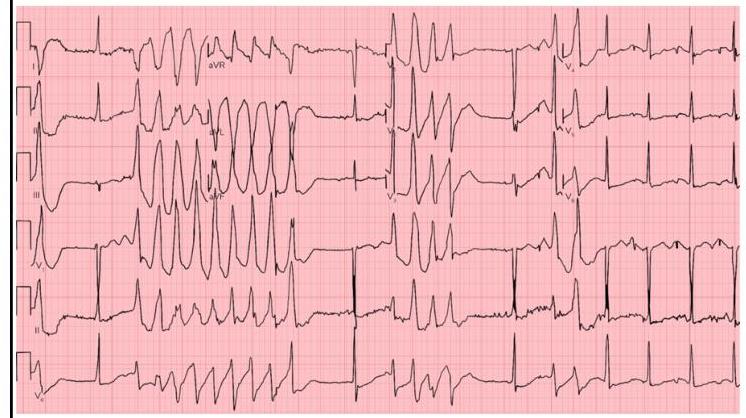
Which of the following conditions will predispose to the cardiac rhythm shown?

Which of the following is not a feature of right heart failure?
What is the initial management of newly diagnosed hypertension?
Explanation: ### Explanation **Correct Answer: C. Aortic Stenosis** The clinical presentation described is the classic triad of **Aortic Stenosis (AS)**: **A**ngina, **S**yncope, and **D**yspnea (often remembered by the mnemonic **SAD**). * **Mechanism:** In AS, the narrowed aortic valve orifice creates a pressure gradient between the left ventricle (LV) and the aorta. To maintain cardiac output, the LV undergoes concentric hypertrophy, increasing oxygen demand and leading to **angina** (even without CAD) [1]. **Syncope** occurs during exertion because the fixed cardiac output cannot meet the systemic demand, leading to cerebral hypoperfusion [2]. * **Auscultation:** The **systolic ejection murmur** (crescendo-decrescendo) is loudest at the right second intercostal space and characteristically **radiates to the carotids** [1]. The **soft S2** [3] occurs because the aortic valve leaflets are calcified and immobile [2], reducing the intensity of the A2 component [1]. --- ### Why the other options are incorrect: * **Mitral Stenosis (MS):** Presents with a **mid-diastolic rumbling murmur** with an opening snap [3], usually following rheumatic fever. It does not cause a systolic murmur radiating to the carotids. * **Mitral Insufficiency (MR):** Presents with a **holosystolic murmur** at the apex that radiates to the **axilla**, not the carotids. * **Aortic Insufficiency (AR):** Characterized by an **early diastolic decrescendo murmur** [4] and wide pulse pressure signs (e.g., Corrigan’s pulse). --- ### NEET-PG High-Yield Pearls: 1. **Pulsus Parvus et Tardus:** A small-volume, slow-rising carotid pulse is the hallmark physical sign of severe AS [1]. 2. **Gallavardin Phenomenon:** In elderly patients, the harsh systolic murmur of AS may sound musical at the apex, mimicking MR [1]. 3. **Indication for Surgery:** The onset of symptoms (Angina, Syncope, Heart Failure) in AS is a critical turning point, indicating a significant drop in survival and the need for valve replacement. 4. **Reverse Splitting of S2:** May be seen in severe AS due to delayed closure of the aortic valve.
Explanation: ***Hypercalcemia*** - Hypercalcemia causes **shortened QT interval** on ECG, not deep T-wave inversions. - The classic finding is **QT shortening** due to accelerated ventricular repolarization, making it an incorrect differential for deep symmetric T-wave inversions. *Intracranial Hemorrhage (ICH)* - Can cause **deep symmetric T-wave inversions** in precordial leads, particularly in subarachnoid hemorrhage. - Associated with **QT prolongation** and other repolarization abnormalities due to autonomic dysfunction. *Apical Hypertrophy of the heart* - Classic finding includes **giant T-wave inversions** in precordial leads, particularly V4-V6. - Often seen in **hypertrophic cardiomyopathy** with apical variant, creating deep symmetric T-wave changes. *Wellens' Syndrome* - Characterized by **deep symmetric T-wave inversions** in anterior precordial leads (V2-V4). - Indicates **critical LAD stenosis** and high risk for anterior wall myocardial infarction.
Explanation: **Explanation:** The intensity of a systolic murmur is primarily determined by the volume and velocity of blood flow across a valve or orifice. In **Severe Aortic Stenosis (AS)**, the murmur is a harsh, crescendo-decrescendo midsystolic murmur [2]. As the stenosis progresses from mild to severe, the pressure gradient across the calcified aortic valve increases significantly. This high-pressure gradient forces blood through a narrowed opening at a higher velocity, thereby increasing the turbulence and the resulting intensity of the murmur [2]. **Analysis of Options:** * **Hypertrophic Cardiomyopathy (HOCM):** While HOCM presents with a systolic murmur, its intensity typically *decreases* with increased preload (e.g., squatting) and *increases* with decreased preload (e.g., Valsalva) [1]. It does not inherently increase in intensity simply by the progression of the disease state in the same hemodynamic manner as fixed AS. * **Mitral Stenosis (MS):** This condition produces a **diastolic** murmur (mid-diastolic rumble with an opening snap), not a systolic one [3]. * **Aortic Regurgitation (AR):** This condition produces a high-pitched, blowing **early diastolic** murmur [3]. While a flow systolic murmur may coexist due to increased stroke volume, the primary pathology is diastolic. **High-Yield Clinical Pearls for NEET-PG:** * **AS Murmur Character:** The peak of the murmur occurs later in systole as the stenosis becomes more severe ("Late-peaking" murmur) [2]. * **Pulsus Parvus et Tardus:** A small, slow-rising carotid pulse is a classic sign of severe AS [2]. * **Gallavardin Phenomenon:** In elderly patients, the high-frequency components of the AS murmur may be heard best at the apex, mimicking mitral regurgitation [2]. * **Reverse Splitting of S2:** Often seen in severe AS due to delayed closure of the aortic valve.
Explanation: Explanation: **Amyloidosis** is the most common identifiable cause of restrictive cardiomyopathy (RCM). The underlying pathophysiology involves the extracellular deposition of insoluble amyloid fibrils (misfolded proteins) within the myocardial interstitium. This leads to increased ventricular wall thickness and stiffness, resulting in impaired diastolic filling (diastolic dysfunction) while systolic function is often preserved until late stages. On echocardiography, this classically presents as a "speckled" or "granular" myocardial appearance. **Analysis of Incorrect Options:** * **Alcohol (A):** This is a common cause of **Dilated Cardiomyopathy (DCM)**, not restrictive [1]. It leads to toxic injury of myocytes and ventricular enlargement [1]. * **Hemochromatosis (B):** While iron overload can cause RCM, it more frequently presents as **Dilated Cardiomyopathy**. It is a less common cause of RCM compared to amyloidosis. * **Sarcoidosis (D):** This is an infiltrative disease that can cause RCM due to non-caseating granulomas; however, it is statistically less common than amyloidosis and often presents with conduction blocks or arrhythmias. **High-Yield Clinical Pearls for NEET-PG:** * **Kussmaul’s Sign:** A paradoxical rise in JVP during inspiration, frequently seen in RCM. * **ECG Paradox:** Amyloidosis often shows **low voltage complexes** on ECG despite the appearance of "thickened" ventricular walls on Echo (which is actually protein infiltration, not true hypertrophy). * **Endomyocardial Biopsy:** The gold standard for diagnosis; amyloid shows **Congo Red staining** with **apple-green birefringence** under polarized light. * **Differentiating RCM from Constrictive Pericarditis:** RCM typically has a higher BNP level and lacks the respiratory variation in mitral inflow velocities seen in pericarditis.
Explanation: The correct answer is **A (Low potassium diet)** because the AHA and most international guidelines (like JNC and ESC) actually recommend **increased** dietary potassium intake (3,500–5,000 mg/day) for individuals with hypertension, provided they do not have advanced chronic kidney disease. Potassium helps lower blood pressure by promoting sodium excretion (natriuresis) and reducing vascular tone. **Analysis of other options:** * **B. Dietary sodium intake <1.5g/day:** The AHA recommends a goal of less than 1,500 mg/day of sodium for optimal blood pressure reduction, though a general reduction to <2,300 mg/day is the initial target. * **C. DASH diet:** The "Dietary Approaches to Stop Hypertension" diet is a cornerstone of management. It emphasizes fruits, vegetables, low-fat dairy, and reduced saturated fats [1]. * **D. Limit alcohol consumption:** Excessive alcohol raises BP [1]. Guidelines recommend limiting intake to ≤2 drinks/day for men and ≤1 drink/day for women. **High-Yield Clinical Pearls for NEET-PG:** * **Weight Loss:** The most effective non-pharmacological intervention for BP reduction (approx. 1 mmHg drop per 1 kg weight loss) [1]. * **Physical Activity:** Aim for 90–150 minutes of aerobic and/or dynamic resistance exercise per week [1]. * **Sodium-Potassium Ratio:** A high sodium-to-potassium ratio is a stronger predictor of hypertension risk than sodium intake alone. * **Contraindication:** High potassium intake is contraindicated in patients taking **ACE inhibitors, ARBs, or Potassium-sparing diuretics** if they have underlying renal impairment, due to the risk of life-threatening hyperkalemia.
Explanation: **Explanation:** The correct answer is **Inferior Wall Myocardial Infarction (IWMI)**. **Why IWMI is the most probable cause:** In patients with Diabetes Mellitus, myocardial infarction often presents atypically (silent MI) due to autonomic neuropathy, meaning chest pain may be absent. Instead, patients present with "anginal equivalents" like dizziness, nausea, or syncope. The bradycardia (52 bpm) is a classic hallmark of IWMI. This occurs because: 1. **Nodal Artery Involvement:** The Right Coronary Artery (RCA) supplies the SA node (in 60% of people) and the AV node (in 90%). Ischemia to these nodes leads to sinus bradycardia or heart blocks. 2. **Bezold-Jarisch Reflex:** Stimulation of vagal afferent receptors in the inferior wall of the left ventricle triggers a reflex increase in parasympathetic tone, resulting in bradycardia and hypotension. **Analysis of Incorrect Options:** * **A. Hypoglycaemia:** Typically presents with **tachycardia** and diaphoresis due to a compensatory sympathoadrenal surge. * **C. Sick Sinus Syndrome:** While it causes bradycardia, it is usually a chronic, degenerative condition of the elderly. In an acute presentation of a diabetic patient, an ischemic event must be ruled out first. * **D. Autonomic Dysfunction:** While common in long-standing diabetes, it usually manifests as **resting tachycardia** (due to loss of vagal tone) and orthostatic hypotension, rather than acute symptomatic bradycardia. **NEET-PG Clinical Pearls:** * **Silent MI:** Always suspect MI in a diabetic, elderly, or female patient presenting with unexplained fatigue or dizziness. * **RCA Occlusion:** Look for ST elevation in leads II, III, and aVF. * **Management:** Bradycardia in IWMI is often transient and responds well to **Atropine**. If associated with Right Ventricular MI, avoid nitrates and give IV fluids.
Explanation: **Explanation:** **Cardiac tamponade** is a life-threatening clinical emergency caused by the accumulation of fluid in the pericardial space, leading to increased intrapericardial pressure and compression of the heart chambers [1]. **Why 2D Echocardiography is the Investigation of Choice (IOC):** Echocardiography is the gold standard for diagnosis because it is rapid, non-invasive, and can be performed at the bedside (Point-of-Care) [1]. It not only confirms the presence of pericardial effusion but also assesses the **hemodynamic significance**. Key diagnostic findings include: * **Early diastolic collapse of the Right Ventricle (RV):** Highly specific. * **Late diastolic collapse of the Right Atrium (RA):** The earliest sign. * **Swinging Heart:** Seen in large effusions [1]. * **Plethoric IVC:** Dilated Inferior Vena Cava with <50% inspiratory collapse (indicates high central venous pressure). **Analysis of Incorrect Options:** * **B. Ultrasound (USG):** While technically used in the FAST protocol (Focused Assessment with Sonography for Trauma) to detect fluid, 2D Echo is the specific modality required to evaluate cardiac chamber collapse and valvular flow. * **C. CT Scan:** Though highly sensitive for detecting small amounts of fluid or loculated effusions, it is not the IOC because it cannot assess real-time hemodynamics and is impractical for unstable patients. * **D. MRI Scan:** Provides excellent anatomical detail but is time-consuming and contraindicated in emergency settings where rapid intervention is required. **NEET-PG High-Yield Pearls:** * **Clinical Diagnosis:** Tamponade is primarily a clinical diagnosis based on **Beck’s Triad**: Hypotension, Jugular Venous Distension (JVD), and Muffled heart sounds. * **Pulsus Paradoxus:** A drop in systolic BP >10 mmHg during inspiration. * **ECG Findings:** Low voltage complexes and **Electrical Alternans** (pathognomonic) [1]. * **Treatment:** Immediate **Pericardiocentesis** (often ultrasound-guided) [1].
Explanation: ***Hypomagnesemia*** - **Hypomagnesemia** prolongs the **QT interval** and predisposes to **Torsades de Pointes** by affecting cardiac ion channels and repolarization. - **Magnesium sulfate** is the first-line treatment for Torsades de Pointes, making this the most likely predisposing factor. *Hyponatremia* - **Hyponatremia** primarily affects neurological function and does not significantly impact **cardiac repolarization** or QT interval. - This electrolyte disturbance is not associated with **Torsades de Pointes** or ventricular arrhythmias. *Hypercalcemia* - **Hypercalcemia** actually **shortens the QT interval** by accelerating cardiac repolarization, which is protective against Torsades de Pointes. - This condition would make the patient less likely to develop the **polymorphic ventricular tachycardia** shown. *Hypothermia* - **Hypothermia** characteristically causes **Osborn J waves** (positive deflection after QRS complex) rather than Torsades de Pointes. - While hypothermia can cause arrhythmias, it does not typically predispose to **QT prolongation** and Torsades de Pointes.
Explanation: ### Explanation The fundamental concept in heart failure is the "backwards" transmission of pressure. In **Right Heart Failure (RHF)**, the right ventricle fails to pump blood effectively into the pulmonary circulation, leading to systemic venous congestion. **Why "Basal Crepitations" is the Correct Answer:** Basal crepitations (crackles) are a hallmark of **Left Heart Failure (LHF)** [1]. When the left ventricle fails, pressure increases in the left atrium and pulmonary veins, leading to pulmonary edema (fluid in the alveoli) [1]. This manifests clinically as crepitations [1]. In isolated RHF, the lungs are typically "clear" because the pathology is distal to the pulmonary circuit. **Analysis of Incorrect Options (Features of RHF):** * **Jugular Venous Distension (JVD):** This is the most sensitive clinical sign of RHF [3]. Increased right atrial pressure is transmitted directly to the internal jugular vein. * **Hepatomegaly:** Congestion of the systemic venous system leads to "nutmeg liver" (congestive hepatopathy). The liver becomes enlarged and often tender. * **Ascites:** Chronic systemic venous hypertension leads to fluid transudation into the peritoneal cavity. This is part of the spectrum of dependent edema seen in RHF [2]. **High-Yield Clinical Pearls for NEET-PG:** 1. **Most common cause of RHF:** The most common cause of right-sided heart failure is actually **Left-sided heart failure** (due to secondary pulmonary hypertension). 2. **Cor Pulmonale:** This refers to isolated RHF caused by primary pulmonary disease (e.g., COPD, Interstitial Lung Disease). 3. **Bernheim Effect:** A rare phenomenon where a severely hypertrophied interventricular septum (from LV overload) bulges into the RV, causing RHF symptoms despite normal RV function. 4. **Kussmaul’s Sign:** A paradoxical rise in JVP during inspiration, often seen in constrictive pericarditis or severe RHF.
Explanation: **Explanation:** The initial management of newly diagnosed hypertension (Stage 1 or Elevated BP) always begins with **Lifestyle Modification**. According to the JNC-8 and AHA/ACC guidelines, non-pharmacological interventions are the first line of defense because they can significantly lower systolic blood pressure (SBP) and reduce overall cardiovascular risk before initiating lifelong drug therapy [1]. **Why Lifestyle Modification is Correct:** Interventions such as the DASH diet (rich in fruits/vegetables, low in saturated fat), sodium restriction (<1500–2300 mg/day), weight loss, and regular aerobic exercise can reduce SBP by 5–20 mmHg [2]. In patients with Stage 1 hypertension (130–139/80–89 mmHg) and a low 10-year ASCVD risk (<10%), lifestyle changes are recommended for 3–6 months before reassessing the need for medication [1]. **Why Other Options are Incorrect:** * **ACE Inhibitors (B) and Diuretics (D):** While these are first-line *pharmacological* agents (especially in diabetics or the elderly), they are typically initiated only if lifestyle changes fail or if the patient presents with Stage 2 hypertension (≥140/90 mmHg) or high cardiovascular risk [3]. ACE inhibitors are specifically noted for reducing risks in patients with comorbidities like CKD [4]. * **Beta-blockers (C):** These are no longer considered first-line therapy for uncomplicated hypertension due to a higher risk of stroke compared to other classes. They are reserved for patients with specific "compelling indications" like heart failure or post-MI [3]. **High-Yield Clinical Pearls for NEET-PG:** * **Most effective lifestyle change:** Weight loss (approx. 1 mmHg reduction per 1 kg lost) [2]. * **DASH Diet:** Can reduce SBP by ~11 mmHg. * **Sodium intake:** Aim for <1500 mg/day for optimal BP reduction. * **Initial drug of choice:** For non-black patients, it's Thiazides, ACEIs, ARBs, or CCBs. For black patients, Thiazides or CCBs are preferred [3].
Coronary Artery Disease and Angina
Practice Questions
Acute Coronary Syndromes
Practice Questions
Heart Failure
Practice Questions
Cardiac Arrhythmias
Practice Questions
Valvular Heart Diseases
Practice Questions
Cardiomyopathies
Practice Questions
Pericardial Diseases
Practice Questions
Congenital Heart Disease in Adults
Practice Questions
Hypertension and Hypertensive Emergencies
Practice Questions
Pulmonary Hypertension
Practice Questions
Non-invasive Cardiac Diagnostics
Practice Questions
Preventive Cardiology
Practice Questions
Get full access to all questions, explanations, and performance tracking.
Start For Free