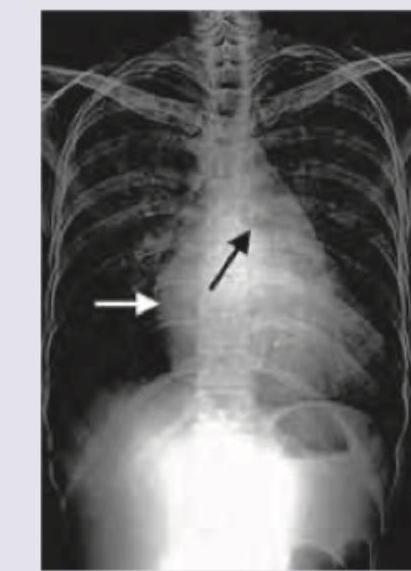
All of the following statements about mitral valve prolapse are true except?
Hibernating myocardium is:
Severity of mitral stenosis is assessed by?
Cardiomyopathy may be seen in all of the following conditions except:
Pulsus alternans occurs in which of the following conditions?
De Musset's sign is seen in which of the following conditions?
Which of the following is NOT an indication for treadmill testing?
A pansystolic murmur heard at the apex with a soft first heart sound is the key sign of which one of the following conditions?
A patient with Deep Vein Thrombosis (DVT) on a therapeutic dose of Warfarin presents with complaints of breathlessness and hypotension. Which statement regarding management is true?
Which of the following is a cause of secondary hypertension?
Explanation: **Explanation** **Mitral Valve Prolapse (MVP)**, also known as Barlow’s Syndrome, is the most common cause of isolated mitral regurgitation in developed countries. **Why Option B is the Correct Answer (The False Statement):** The vast majority of patients with MVP are **asymptomatic** and remain so throughout their lives. The diagnosis is often an incidental finding during routine physical examination (noting a mid-systolic click) [1] or echocardiography [2]. While some patients may report "atypical" chest pain, palpitations, or anxiety (often termed 'MVP Syndrome'), these are not the norm for the general MVP population. **Analysis of Other Options:** * **Option A:** MVP is indeed more common in **females** (historically cited as a 2:1 ratio, though modern data suggests a narrower gap). It is also frequently associated with connective tissue disorders like Marfan Syndrome. * **Option C:** For most individuals, MVP follows a **benign clinical course** [2]. The annual mortality rate is similar to the general population unless significant mitral regurgitation or ventricular dysfunction develops. * **Option D:** **Transient Cerebral Ischemia (TIA)** or stroke is a recognized, albeit rare, complication. It is thought to result from microthrombi forming on the roughened surface of the redundant valve leaflets. **NEET-PG High-Yield Pearls:** * **Auscultation:** Characterized by a **Mid-Systolic Click** [1] followed by a late systolic murmur. * **Dynamic Auscultation:** Any maneuver that **decreases LV volume** (e.g., Standing, Valsalva strain phase) makes the click/murmur occur **earlier** in systole and often louder. Squatting (increasing preload) delays the click. * **Pathology:** Characterized by **myxomatous degeneration** of the valve leaflets (excessive dermatan sulfate deposition). * **Complications:** Severe MR, Infective Endocarditis, Arrhythmias, and Sudden Cardiac Death (rare) [2].
Explanation: **Explanation:** **Hibernating Myocardium** refers to a state of persistent myocardial dysfunction due to **chronic, severe reduction in coronary blood flow**. The myocardium remains viable but "shuts down" its contractile function to match the low oxygen supply, preventing irreversible necrosis [1]. 1. **Why Option C is Correct:** Hibernating myocardium is a protective adaptation to **chronic severe coronary stenosis**. The hallmark is that the tissue is viable but hypocontractile. Crucially, this dysfunction is **reversible** upon restoration of blood flow (revascularization). 2. **Why Other Options are Incorrect:** * **Option A (Irreversible):** Incorrect. By definition, hibernating myocardium is **reversible**. If the dysfunction were permanent, it would be classified as myocardial infarction (scar tissue). * **Option B (Recovery is spontaneous):** Incorrect. Unlike "Stunned Myocardium" (which recovers spontaneously after an acute event), hibernating myocardium **requires intervention** (PCI or CABG) to restore flow before function can return. * **Option C vs D:** While there is a reduction in both flow and function, the term "mismatch" is more specifically used in PET imaging to describe **preserved glucose uptake (metabolism) despite decreased perfusion**, which identifies the tissue as hibernating. **NEET-PG High-Yield Pearls:** * **Stunned Myocardium:** Acute ischemia followed by reperfusion; function is lost temporarily but recovers *spontaneously*. * **Hibernating Myocardium:** Chronic ischemia; function is lost to preserve viability; recovers *only after revascularization* [1]. * **Gold Standard Investigation:** **PET Scan** (shows FDG uptake/metabolic activity in the absence of flow). * **Clinical Significance:** Identifying hibernating myocardium is vital because these patients benefit significantly from bypass surgery or angioplasty.
Explanation: The severity of Mitral Stenosis (MS) is primarily determined by the pressure gradient between the left atrium and left ventricle. This is clinically reflected by the timing of the opening snap and the duration of the diastolic murmur [1]. ### **Explanation of the Correct Answer** **Option B** is correct because: 1. **A2-OS Interval:** The Opening Snap (OS) occurs when the mitral valve opens. As MS becomes more severe, Left Atrial Pressure (LAP) rises. This higher pressure forces the stenotic valve open earlier in diastole, **shortening the interval** between the second heart sound (A2) and the OS [1]. Therefore, a "closer" or "louder" OS (closer to S2) indicates higher severity. 2. **Length of Murmur:** The mid-diastolic rumbling murmur persists as long as the pressure gradient exists. In severe MS, the gradient remains high throughout diastole; thus, the **longer the duration** of the murmur, the more severe the stenosis [3]. ### **Why Other Options are Incorrect** * **Loud S1 (Option C):** While a loud S1 is a classic sign of MS [2], it indicates a **pliable** valve. As MS progresses and the valve becomes calcified and rigid, S1 actually becomes soft. Thus, S1 intensity reflects valve mobility, not the degree of stenosis [1]. * **Splitting of Sounds (Option D):** This is generally related to electrical delays (RBBB) or volume changes (ASD) and is not a primary indicator of MS severity. ### **NEET-PG High-Yield Pearls** * **Most reliable clinical sign of severity:** Short A2-OS interval [1] and long duration of the mid-diastolic murmur [3]. * **Signs of "Tight" (Severe) MS:** A2-OS interval < 0.07 seconds, presence of Pulmonary Hypertension (loud P2), and a diastolic murmur that extends up to S1. * **The "Rule of Lous":** In MS, S1 is loud, P2 is loud (if PH develops), and the Opening Snap is loud (if the valve is pliable) [2]. * **Gold Standard for Assessment:** Echocardiography (Mitral Valve Area < 1.0 cm² indicates severe MS) [4].
Explanation: Explanation: The core of this question lies in distinguishing between **primary myocardial involvement (Cardiomyopathy)** and **secondary inflammatory involvement (Myocarditis/Pancarditis)**. **Why SLE is the Correct Answer:** In Systemic Lupus Erythematosus (SLE), the heart is frequently involved, but the classic manifestation is **Libman-Sacks Endocarditis** (sterile vegetations) or **Pericarditis** (the most common cardiac feature). While SLE can cause "Lupus Myocarditis," it is characterized by acute inflammation rather than the chronic structural and functional remodeling defined as "Cardiomyopathy." Therefore, SLE is typically excluded from the standard classification of cardiomyopathies. **Analysis of Incorrect Options:** * **Myocarditis (Option A):** Acute viral or inflammatory myocarditis is a well-recognized precursor to **Dilated Cardiomyopathy (DCM)**. Chronic inflammation leads to ventricular thinning and systolic dysfunction. * **Sarcoidosis (Option B):** This is a classic cause of **Restrictive Cardiomyopathy**. Non-caseating granulomas infiltrate the myocardium, leading to conduction blocks, arrhythmias, and heart failure. * **Hemochromatosis (Option C):** Iron overload leads to iron deposition in myocytes. It initially presents as **Restrictive Cardiomyopathy (diastolic dysfunction)** but can eventually progress to a **Dilated** phenotype. **High-Yield Clinical Pearls for NEET-PG:** * **Most common cardiac manifestation of SLE:** Pericarditis. * **Specific cardiac lesion in SLE:** Libman-Sacks Endocarditis (verrucous vegetations on both sides of the valves). * **Hemochromatosis:** Reversible if treated early with phlebotomy or chelation. * **Amyloidosis:** The most common cause of Restrictive Cardiomyopathy (shows "sparkling" appearance on Echo).
Explanation: Explanation: **Pulsus alternans** is a clinical sign characterized by a regular heart rhythm but with alternating strong and weak pulses. This occurs due to alternating stroke volumes and is a hallmark of **severe left ventricular (LV) systolic dysfunction.** 1. **Why Myocardial Infarction is correct:** A large **Myocardial Infarction (MI)** leads to significant loss of viable myocardium, resulting in acute or chronic LV failure. The mechanism involves the **Frank-Starling law**: after a weak contraction, the end-diastolic volume increases, stretching the fibers and leading to a stronger subsequent contraction [1]. In failing hearts, the recovery of calcium cycling in myocytes is delayed, causing this beat-to-beat variation in contractile force [2]. 2. **Why other options are incorrect:** * **Constrictive Pericarditis:** This is classically associated with **Pulsus Paradoxus** (an exaggerated drop in systolic BP >10 mmHg during inspiration) and Kussmaul’s sign, not pulsus alternans. * **Viral Myocarditis:** While severe myocarditis *can* cause heart failure, MI is the more classic and frequently tested association for pulsus alternans in the context of ischemic cardiomyopathy. * **Hypokalemia:** This typically causes ECG changes (U waves, T-wave flattening, ST depression) and arrhythmias, but does not directly cause mechanical pulsus alternans. **High-Yield Clinical Pearls for NEET-PG:** * **Pulsus Alternans:** Best felt in the **femoral artery**; indicates LV failure. * **Pulsus Paradoxus:** Seen in Cardiac Tamponade, Constrictive Pericarditis, and severe Asthma/COPD. * **Pulsus Bisferiens:** Two systolic peaks; seen in AR, HOCM, and AS+AR. * **Pulsus Parvus et Tardus:** Slow-rising, low-amplitude pulse; classic for **Aortic Stenosis.** * **Electrical Alternans:** Alternating QRS amplitude on ECG; pathognomonic for **Cardiac Tamponade/Massive Pericardial Effusion.**
Explanation: **Explanation:** **De Musset’s sign** is a clinical finding characterized by rhythmic nodding or jerking of the head in synchrony with each heartbeat. It is a classic peripheral sign of **Chronic Aortic Regurgitation (AR)** [1]. **Why it occurs:** In Aortic Regurgitation, a large volume of blood leaks back into the Left Ventricle during diastole. This leads to an increased stroke volume and a widened pulse pressure (high systolic and low diastolic pressure). The forceful ejection of this large stroke volume into the carotid arteries creates a high-amplitude pulse wave that causes the head to bob rhythmically [1]. **Analysis of Incorrect Options:** * **Tricuspid Regurgitation:** Characterized by giant 'v' waves in the JVP and a pulsatile liver, but not head nodding. * **Mitral Stenosis:** Typically presents with a "malar flush" and a loud S1; it is a low-output state and does not produce hyperdynamic peripheral signs. * **Marfan Syndrome:** While Marfan syndrome is a common *cause* of aortic root dilation leading to AR, the sign itself is a physical manifestation of the valvular lesion (AR), not the genetic syndrome itself. **High-Yield Clinical Pearls for NEET-PG:** Other eponymous peripheral signs of Chronic AR [2] include: * **Corrigan’s Pulse:** "Water-hammer" or collapsing pulse [1]. * **Quincke’s Sign:** Capillary pulsations in the nail beds. * **Traube’s Sign:** "Pistol shot" sounds heard over the femoral arteries. * **Duroziez’s Sign:** Systolic and diastolic murmurs heard over the femoral artery when compressed. * **Müller’s Sign:** Systolic pulsations of the uvula. * **Hill’s Sign:** Popliteal systolic pressure exceeding brachial systolic pressure by >20 mmHg (the most sensitive sign for AR severity).
Explanation: ### Explanation The Treadmill Test (TMT) is a form of **Exercise Stress Testing** used to induce controlled myocardial ischemia. The fundamental principle is to increase myocardial oxygen demand to see if the coronary supply can meet it [1]. **1. Why "Unstable Angina" is the correct answer:** Unstable Angina (UA) is a component of Acute Coronary Syndrome (ACS). In UA, the coronary plaque is unstable, and the patient is at high risk for an acute myocardial infarction (MI) or sudden cardiac death [2]. Performing a stress test in this state can trigger a total occlusion or fatal arrhythmia. Therefore, **Unstable Angina is an absolute contraindication** for TMT. The patient must be stabilized first. **2. Analysis of other options:** * **To evaluate unstable myocardial infarction:** While the option says "unstable," the standard contraindication is **Acute MI (within 2 days)**. However, once a patient is stable (post-MI), a submaximal TMT is often performed before discharge (at 4-6 days) for risk stratification [1]. (Note: If the option implies an *active/evolving* MI, it is also a contraindication, but UA is the classic textbook contraindication for this specific question format). * **To assess outcomes after revascularization:** TMT is indicated to evaluate the success of PCI or CABG, especially if the patient remains symptomatic or for functional capacity assessment [1]. * **To diagnose exercise-induced arrhythmias:** TMT is a standard tool to provoke and identify arrhythmias that occur specifically during physical exertion. **High-Yield Clinical Pearls for NEET-PG:** * **Absolute Contraindications:** Acute MI (<48 hrs), Unstable Angina, Symptomatic Severe Aortic Stenosis, Acute Myocarditis/Pericarditis, and Acute Aortic Dissection. * **Target Heart Rate:** 85% of the maximum predicted heart rate (220 – age). * **Positive Test:** Characterized by >1 mm horizontal or down-sloping ST-segment depression measured 80 ms after the J-point [1]. * **Most Common Protocol:** Bruce Protocol (increases speed and gradient every 3 minutes).
Explanation: **Explanation:** The clinical presentation of a **pansystolic (holosystolic) murmur** heard loudest at the **apex** is the hallmark of **Mitral Regurgitation (MR)** [1]. **Why Mitral Regurgitation is correct:** In MR, the mitral valve fails to close completely during ventricular systole. Since the pressure gradient between the left ventricle and the left atrium persists throughout the entire systolic phase (from the closure of the mitral valve to its reopening), the murmur lasts from S1 to S2. The **soft S1** occurs because the mitral leaflets fail to coapt properly or are structurally damaged, leading to an inadequate "closure" sound. **Analysis of Incorrect Options:** * **Aortic Regurgitation (AR):** Characterized by a high-pitched, blowing **early diastolic murmur**, heard best at the left sternal border (Erb’s point) [3]. * **Ventricular Septal Defect (VSD):** While VSD also produces a pansystolic murmur, it is typically loudest at the **left lower sternal border** (Erb's area) rather than the apex and is often accompanied by a palpable thrill. * **Atrial Septal Defect (ASD):** Does not produce a systolic murmur at the apex. It classically presents with a **fixed wide splitting of S2** and a mid-systolic flow murmur over the pulmonary area due to increased stroke volume [2]. **NEET-PG High-Yield Pearls:** * **Radiation:** The murmur of MR classically radiates to the **axilla** [1]. * **Dynamic Auscultation:** The MR murmur increases with **handgrip** (increased afterload) and decreases with the **Valsalva maneuver**. * **S3 Gallop:** The presence of an S3 in chronic MR indicates volume overload and signifies severe regurgitation [1]. * **Differential for Pansystolic Murmur:** Remember the triad—**MR, TR (Tricuspid Regurgitation), and VSD.** TR is distinguished by *Carvallo’s sign* (intensity increases with inspiration).
Explanation: ### Explanation The patient presents with symptoms suggestive of **Pulmonary Embolism (PE)**—breathlessness and hypotension—despite being on therapeutic anticoagulation for DVT. This scenario tests the management of "breakthrough" venous thromboembolism (VTE) and the target therapeutic range for Warfarin. **1. Why Option C is Correct:** For most patients with VTE (DVT or PE), the standard therapeutic target for Warfarin is an **International Normalized Ratio (INR) of 2.0 to 3.0** (target 2.5) [3]. Maintaining an INR of approximately 2.0 ensures a balance between preventing further clot propagation/embolization and minimizing the risk of major hemorrhage. In clinical practice, if a patient develops a PE while on Warfarin, the first step is to verify if the INR was subtherapeutic. If it was therapeutic, the strategy is to maintain the target range or consider switching to Low Molecular Weight Heparin (LMWH). **2. Why Other Options are Incorrect:** * **Option A:** While 6 months is a common duration for provoked VTE, the question focuses on the immediate management of a new complication (hypotension/PE), not just the duration. * **Option B:** An INR of 3.5 is generally too high for standard VTE management. Higher targets (2.5–3.5) are typically reserved for specific high-risk scenarios, such as mechanical prosthetic heart valves in the mitral position [2]. * **Option D:** Discontinuing Warfarin in the setting of an active, symptomatic PE is contraindicated and life-threatening, as it would allow for further clot formation. **3. High-Yield Clinical Pearls for NEET-PG:** * **Target INR:** 2.0–3.0 for DVT, PE, and Atrial Fibrillation [3]. * **Warfarin Mechanism:** Inhibits Vitamin K Epoxide Reductase (VKOR), affecting Factors II, VII, IX, X, and Proteins C and S [2]. * **Initial Management:** Always overlap Warfarin with Heparin/LMWH (Bridge Therapy) for at least 5 days and until the INR is ≥2.0 for 24 hours to avoid "Warfarin-induced skin necrosis" caused by the rapid drop in Protein C [3]. * **Massive PE:** A patient with PE and hypotension (obstructive shock) is classified as having **Massive PE**, where thrombolysis (e.g., Alteplase) is the treatment of choice if there are no contraindications [1].
Explanation: **Renal parenchymal disease** is the most common cause of secondary hypertension [1]. It leads to elevated blood pressure through two primary mechanisms: impaired sodium excretion (leading to volume expansion) and the activation of the Renin-Angiotensin-Aldosterone System (RAAS) due to intrarenal ischemia [1]. Common examples include glomerulonephritis, polycystic kidney disease, and diabetic nephropathy. **Analysis of Options:** * **A. Old age:** This is associated with **Essential (Primary) Hypertension**. With aging, the large arteries lose elasticity and become stiff, leading to increased peripheral resistance and isolated systolic hypertension. * **C. Pregnancy-induced hypertension (PIH):** While PIH involves high blood pressure, it is classified as a **gestational condition** rather than a "secondary" cause in the traditional sense of chronic systemic hypertension. Secondary hypertension refers to an underlying, potentially reversible systemic disease (like endocrine or renal issues) [1]. * **D. Hypothyroidism:** While hypothyroidism can cause a mild increase in diastolic blood pressure, it is a less frequent cause compared to **Hyperthyroidism** or **Hyperaldosteronism**. In the context of standard medical examinations, renal causes always take precedence as the "classic" secondary cause. **High-Yield Clinical Pearls for NEET-PG:** * **Most common cause of secondary HTN:** Renal parenchymal disease [1]. * **Most common curable/surgical cause of secondary HTN:** Renovascular hypertension (Renal artery stenosis). * **Screening:** Suspect secondary HTN if the patient is <30 or >55 years old, has resistant hypertension (uncontrolled on 3 drugs), or sudden onset of Grade 3 HTN. * **Key Clue:** If a patient develops worsening renal function after starting an ACE inhibitor, suspect **Bilateral Renal Artery Stenosis**.
Coronary Artery Disease and Angina
Practice Questions
Acute Coronary Syndromes
Practice Questions
Heart Failure
Practice Questions
Cardiac Arrhythmias
Practice Questions
Valvular Heart Diseases
Practice Questions
Cardiomyopathies
Practice Questions
Pericardial Diseases
Practice Questions
Congenital Heart Disease in Adults
Practice Questions
Hypertension and Hypertensive Emergencies
Practice Questions
Pulmonary Hypertension
Practice Questions
Non-invasive Cardiac Diagnostics
Practice Questions
Preventive Cardiology
Practice Questions
Get full access to all questions, explanations, and performance tracking.
Start For Free