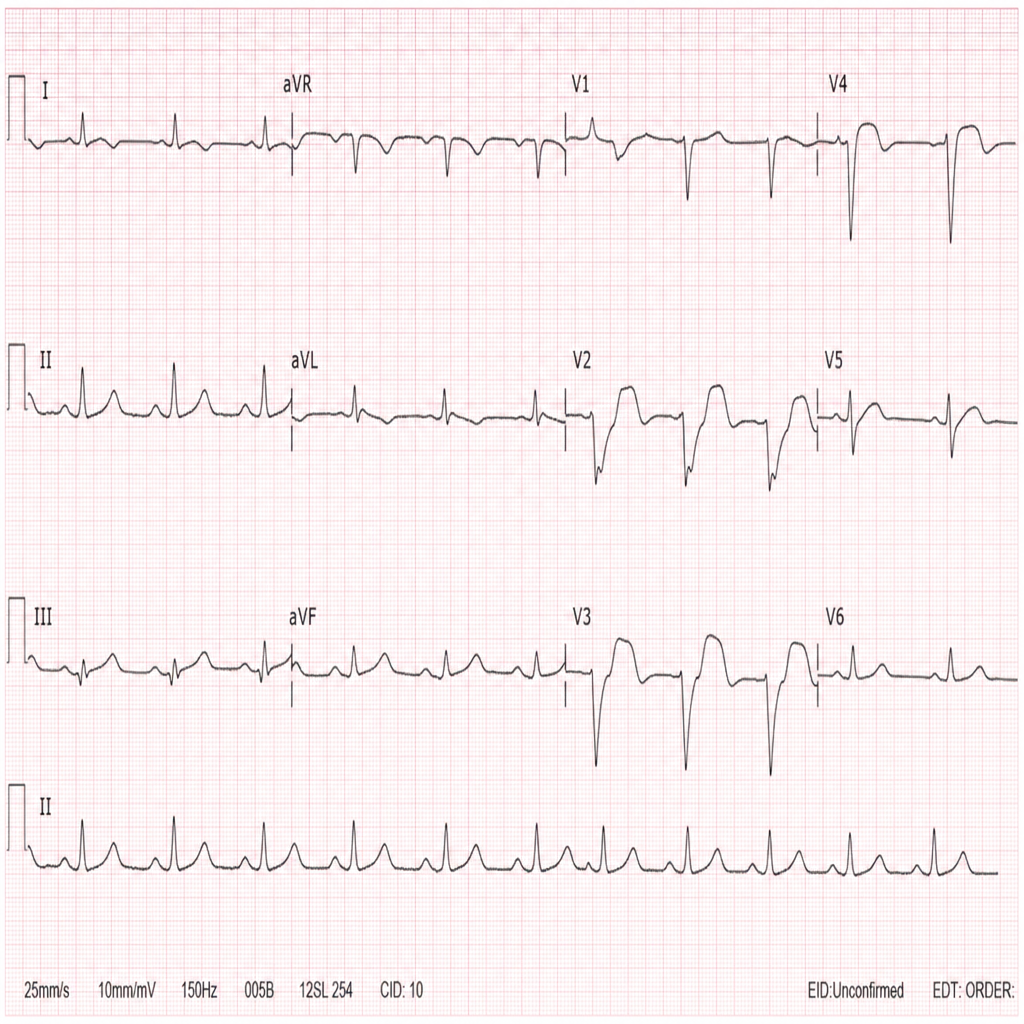
The most common accessory pathway leading to Wolff-Parkinson-White syndrome is:
Which of the following is used for the management of a 65-year-old patient presenting with respiratory distress, given that bedside echocardiography shows an ejection fraction of 45%?
A middle-aged lady was diagnosed with an incidentally found ejection systolic murmur at the pulmonary area. A fixed wide split of the second heart sound was also noted. What is the diagnosis?
A 70-year-old man presented with worsening cough and difficulty in breathing, especially at night. On physical examination, raised JVP, bipedal edema, and hepatomegaly were noted. USG revealed hepatomegaly measuring 16.8 cm. Despite resuscitation attempts, the patient could not be saved. Based on the clinical presentation and investigations, what is the most common etiology for the patient's clinical condition?
ST-segment elevation is seen in all the following except?
Kussmaul's sign is a feature of pericarditis with which of the following?
Vasospasm is the cause of which of the following conditions?
A 40-year-old female patient presents with leg swelling for one day, with no history of fever. Two years prior, she was treated for metastatic breast adenocarcinoma with paclitaxel and radiotherapy. Her vital signs are: Blood pressure 120/76 mmHg, Pulse rate 84/min, temperature 37.6 C, Respiratory rate 16/min, and oxygen saturation 99% on room air. Physical examination revealed warmth and tenderness over the left leg and thigh. Lung auscultation showed clear fields. A urine pregnancy test was negative, and CT chest was normal. Ultrasound of the left leg revealed a thrombus in the superficial femoral vein. What is the most appropriate treatment?
A 55-year-old patient presents with a history of recent myocardial infarction and a 5-day hospital stay for mild congestive heart failure. The patient is now asymptomatic with a normal physical exam. Which of the following medications should be recommended?
All of the following are true about acute pericarditis except:
Explanation: **Explanation:** Wolff-Parkinson-White (WPW) syndrome is caused by the presence of an accessory pathway (the Bundle of Kent) that bypasses the AV node, leading to pre-excitation of the ventricles. **1. Why Left Free Wall is Correct:** Epidemiological studies and electrophysiological mapping consistently show that the **left free wall** is the most common location for these accessory pathways, accounting for approximately **50–60%** of all cases. These pathways are typically located along the mitral valve annulus. **2. Analysis of Incorrect Options:** * **Posteroseptal (Option B):** This is the second most common location, occurring in about **25–30%** of cases. It is located near the coronary sinus ostium. * **Right Free Wall (Option C):** This location is less common, accounting for approximately **10–15%** of cases, usually along the tricuspid annulus. * **Anteroseptal (Option D):** This is the rarest location, seen in roughly **5%** of patients. **3. High-Yield Clinical Pearls for NEET-PG:** * **ECG Triad:** Short PR interval (<0.12s), Delta wave (slurred upstroke of QRS), and widened QRS complex (>0.12s). * **Localization Tip:** A positive QRS complex (dominant R wave) in lead V1 (Type A WPW) usually suggests a **left-sided** pathway, whereas a negative QRS in V1 (Type B WPW) suggests a **right-sided** pathway. * **Treatment of Choice:** Radiofrequency catheter ablation is the definitive treatment. * **Drug Contraindication:** Avoid AV nodal blockers (ABCD: **A**denosine, **B**eta-blockers, **C**alcium channel blockers, **D**igoxin) in patients with WPW and Atrial Fibrillation, as they can paradoxically increase conduction through the accessory pathway, leading to Ventricular Fibrillation.
Explanation: ### Explanation **Concept: Management of Acute Heart Failure (AHF)** The patient presents with respiratory distress and an Ejection Fraction (EF) of 45%, indicating **Acute Decompensated Heart Failure (ADHF)** with mildly reduced/preserved ejection fraction. In the acute setting, the primary goal is to reduce pulmonary congestion (preload) and systemic vascular resistance (afterload) [1]. **Why Option C is Correct:** * **Lasix (Furosemide):** A loop diuretic that reduces fluid overload and provides rapid venodilation, decreasing preload [1]. * **Nitrates (Nitroglycerin):** Acts as a potent vasodilator. It reduces both preload and afterload, rapidly relieving pulmonary edema [1]. * **Morphine:** Traditionally used in acute pulmonary edema to reduce anxiety (anxiolytic) and provide mild venodilation, which helps decrease the work of breathing and sympathetic drive. **Why Other Options are Incorrect:** * **Option A & B (Sacubitril-Valsartan):** While ARNI (Sacubitril-Valsartan) is a cornerstone for *chronic* HFrEF management, it is not the first-line treatment for an *acute* episode of respiratory distress in the emergency department. * **Option B (Norepinephrine):** This is a vasopressor used in cardiogenic shock (hypotension). There is no evidence of shock here; adding a vasopressor would increase afterload and worsen respiratory distress. * **Option D (Digoxin/ACEi):** ACE inhibitors are for long-term survival and are usually started once the patient is stabilized. Digoxin is primarily used for rate control in Atrial Fibrillation or refractory chronic HF, not for acute respiratory distress. **Clinical Pearls for NEET-PG:** * **LMNOP Mnemonic:** The classic management for Acute Pulmonary Edema: **L**asix, **M**orphine, **N**itrates, **O**xygen, and **P**ositioning (propped up). * **EF 45%:** This falls under **HFmrEF** (Heart Failure with mildly reduced EF, 41-49%). * **Contraindication:** Avoid Beta-blockers during the *acute* phase of decompensation as they can worsen heart failure; they should only be started/restarted once the patient is euvolemic [2].
Explanation: ### Explanation **Correct Answer: B. Atrial septal defect (ASD)** The clinical presentation of a **fixed wide split of the second heart sound (S2)** combined with an **ejection systolic murmur (ESM)** at the pulmonary area is the classic hallmark of an Atrial Septal Defect [1]. * **Mechanism of S2 Splitting:** In ASD, the persistent communication between the atria leads to a left-to-right shunt [1]. This increases the blood volume in the right ventricle (RV), prolonging RV ejection time and delaying the closure of the pulmonary valve (P2). The split is "fixed" because the respiratory variations in venous return are balanced out by reciprocal changes in the shunt volume across the ASD, keeping the interval between A2 and P2 constant. * **The Murmur:** The ESM is not caused by the flow across the defect itself (which is low-pressure) but by the **increased stroke volume** flowing across the pulmonary valve (relative pulmonary stenosis) [3]. **Why Incorrect Options are Wrong:** * **A. Tetralogy of Fallot:** Characterized by a **single S2** (due to an inconspicuous P2) and a harsh systolic murmur at the left sternal border. * **C. Mitral Stenosis:** Presents with a loud S1, an opening snap [2], and a **mid-diastolic rumbling murmur** at the apex [3]. * **D. Mitral Valve Prolapse:** Typically presents with a **mid-systolic click** followed by a late systolic murmur at the apex [2]. **High-Yield NEET-PG Pearls:** * **Most common type of ASD:** Ostium secundum [1]. * **ECG in ASD:** Right axis deviation and RSR' pattern in V1 (Partial RBBB). * **Chest X-ray:** Enlarged pulmonary artery and increased pulmonary vascular markings (Plethora). * **Lutembacher Syndrome:** Combination of ASD and acquired Mitral Stenosis.
Explanation: ### Explanation **Correct Option: A. Right heart failure** The patient presents with the classic triad of **Congestive Heart Failure (CHF)**: respiratory distress (orthopnea/paroxysmal nocturnal dyspnea), signs of systemic venous congestion (raised JVP, bipedal edema), and **congestive hepatomegaly** (liver size >15 cm) [1]. In Right Heart Failure (RHF), the inability of the right ventricle to pump blood forward leads to increased pressure in the right atrium, which is transmitted backward into the venous system [2]. This results in: 1. **Raised JVP:** Reflecting high central venous pressure [3]. 2. **Hepatomegaly:** Due to passive congestion of the liver (often called "Nutmeg liver" on pathology). 3. **Dependent Edema:** Due to increased hydrostatic pressure in the systemic capillaries. **Why Incorrect Options are Wrong:** * **B. Hepatitis A:** While it causes hepatomegaly, it typically presents with jaundice, prodromal viral symptoms (fever, malaise), and elevated transaminases. It does not cause raised JVP or bipedal edema. * **C. Riedel lobe of liver:** This is an anatomical variant (a downward tongue-like projection of the right lobe). It is a benign finding and does not present with signs of heart failure or systemic congestion. * **D. Metabolic disease of liver:** Conditions like NAFLD or Wilson’s disease cause hepatomegaly but are not associated with acute respiratory distress, nocturnal dyspnea, or elevated JVP. ### NEET-PG High-Yield Pearls * **Most common cause of Right Heart Failure:** Left Heart Failure (due to back-pressure into pulmonary circulation). * **Isolated Right Heart Failure:** Most commonly caused by **Cor Pulmonale** (secondary to lung diseases like COPD). * **Hepatojugular Reflux:** A specific bedside test to confirm that hepatomegaly and edema are cardiac in origin. * **Nutmeg Liver:** The characteristic gross appearance of the liver in chronic passive congestion due to RHF (centrilobular congestion vs. periportal pallor).
Explanation: **Explanation** The correct answer is **Right Bundle Branch Block (RBBB)**. In RBBB, the depolarization of the right ventricle is delayed, leading to secondary repolarization abnormalities. Characteristically, this manifests as **ST-segment depression** and T-wave inversion in the right precordial leads (V1-V3), rather than ST elevation. **Analysis of Options:** * **Tako-tsubo Syndrome (Stress-induced Cardiomyopathy):** This condition mimics an acute coronary syndrome. It typically presents with chest pain and **ST-segment elevation** (most commonly in the precordial leads), despite the absence of obstructive coronary artery disease. * **Acute Pericarditis:** This is a classic cause of **diffuse, concave-upwards ST-segment elevation** across almost all leads (except aVR and V1), often accompanied by PR-segment depression. * **Myocardial Infarction (STEMI):** Transmural ischemia causes a current of injury that manifests as **convex (tombstone) ST-segment elevation** in the leads overlying the infarcted area [1]. **High-Yield Clinical Pearls for NEET-PG:** 1. **LBBB vs. RBBB:** While RBBB causes ST depression, a **New-onset Left Bundle Branch Block (LBBB)** is considered a STEMI equivalent in the clinical context of chest pain. 2. **ST Elevation Differential:** Remember the mnemonic **ELEVATION**: **E**lectrolytes (Hyperkalemia), **L**BBB, **E**arly Repolarization, **V**entricular Aneurysm, **A**bscess (Cardiac), **T**umor, **I**njury (Infarction), **O**ther (Pericarditis/Tako-tsubo), **N**ormal variant. 3. **Spodick’s Sign:** Downsloping TP segment, often seen in viral pericarditis, helps differentiate it from MI. 4. **Brugada Syndrome:** Another high-yield cause of ST elevation in V1-V3 with a pseudo-RBBB pattern.
Explanation: ### Explanation **Kussmaul’s sign** is defined as a paradoxical rise (or lack of fall) in Jugular Venous Pressure (JVP) during inspiration. Normally, inspiration creates negative intrathoracic pressure, increasing venous return to the right heart and causing JVP to fall. #### Why Constrictive Pericarditis is Correct In **Constrictive Pericarditis**, the heart is encased in a rigid, non-compliant pericardium [1]. During inspiration, the increased venous return cannot be accommodated by the right ventricle because the stiff pericardium prevents outward expansion. This leads to a backup of pressure into the vena cava, causing the JVP to rise—the hallmark of Kussmaul’s sign. #### Analysis of Incorrect Options * **A. Cardiac Tamponade:** This is a classic "trap" for NEET-PG. In tamponade, Kussmaul’s sign is **absent** because the intrapericardial pressure is elevated throughout the respiratory cycle, but the heart is still "compressible" enough to allow some respiratory variation [2]. Instead, tamponade is characterized by *Pulsus Paradoxus*. * **C. Restrictive Cardiomyopathy:** While Kussmaul’s sign *can* be seen here, the question specifically asks for a feature of **pericarditis**. Restrictive cardiomyopathy is a myocardial disease, not a pericardial one [3]. * **D. Pericardial Effusion:** Simple effusion without hemodynamically significant tension (tamponade) or constriction does not typically result in Kussmaul’s sign. #### NEET-PG High-Yield Pearls * **Kussmaul’s Sign vs. Pulsus Paradoxus:** Kussmaul’s is seen in Constrictive Pericarditis; Pulsus Paradoxus is seen in Cardiac Tamponade. * **Other causes of Kussmaul’s sign:** Right Ventricular Infarction (most common acute cause), Tricuspid Stenosis, and Restrictive Cardiomyopathy. * **Square Root Sign:** On cardiac catheterization, Constrictive Pericarditis shows a "dip and plateau" appearance in diastolic pressure. * **Pericardial Knock:** A high-pitched sound heard in early diastole, specific to Constrictive Pericarditis.
Explanation: The correct answer is **Variant angina**, also known as **Prinzmetal angina**. **1. Why Variant Angina is Correct:** Variant angina is characterized by a sudden, reversible reduction in coronary blood flow caused by **focal coronary artery vasospasm**, rather than fixed atherosclerotic narrowing. This spasm leads to transmural ischemia, which manifests on an ECG as **transient ST-segment elevation**. Unlike typical angina, it usually occurs at rest, often in the early morning hours, and frequently affects younger patients who may not have traditional cardiovascular risk factors (except smoking). **2. Why Other Options are Incorrect:** * **Stable Angina (Classical Angina):** These are caused by a **fixed atherosclerotic obstruction** (usually >70% stenosis) [1]. The pain is predictable and occurs when myocardial oxygen demand exceeds supply (e.g., during exertion) [2]. * **Unstable Angina:** This is part of the Acute Coronary Syndrome (ACS) spectrum. It is primarily caused by **plaque rupture** with non-occlusive thrombus formation, leading to increased frequency or severity of chest pain at rest [3]. **3. High-Yield Clinical Pearls for NEET-PG:** * **Triggers:** Can be induced by cold weather, emotional stress, or drugs like cocaine and ergotamines. * **ECG Finding:** Transient ST-elevation during the episode which returns to baseline once the pain subsides. * **Drug of Choice:** **Calcium Channel Blockers (CCBs)** are the mainstay of treatment as they promote vasodilation. Nitrates are also effective for acute episodes. * **Contraindication:** **Non-selective Beta-blockers** (e.g., Propranolol) are strictly contraindicated as they can lead to unopposed alpha-adrenergic stimulation, worsening the vasospasm. * **Gold Standard Diagnosis:** Coronary angiography with provocative testing (e.g., using Ergonovine or Acetylcholine).
Explanation: ### Explanation **1. Why Option C is Correct:** The patient presents with **Deep Vein Thrombosis (DVT)**, confirmed by ultrasound showing a thrombus in the superficial femoral vein (despite the name, this is a deep vein) [3]. The standard management for an acute DVT is immediate anticoagulation [2]. **Warfarin** (a Vitamin K antagonist) has a delayed onset of action (4–5 days) and initially creates a prothrombotic state by inhibiting Proteins C and S [4]. Therefore, it must be "bridged" with a rapid-acting parenteral anticoagulant like **Enoxaparin** (Low Molecular Weight Heparin). The parenteral agent is continued for at least 5 days AND until the International Normalized Ratio (INR) is therapeutic (2.0–3.0) for 24 hours [2]. **2. Analysis of Incorrect Options:** * **Option A:** Dalteparin and Enoxaparin are both LMWHs. Using two parenteral anticoagulants simultaneously is redundant and increases bleeding risk without added benefit. * **Option B:** Warfarin monotherapy is contraindicated in acute DVT due to the "warfarin skin necrosis" risk and the slow onset of action. * **Option D:** Aspirin is an antiplatelet agent, not an anticoagulant. It is insufficient for treating an established venous thrombus. **3. Clinical Pearls for NEET-PG:** * **Superficial Femoral Vein:** Do not be misled by the name; it is part of the **deep venous system**. Thrombus here is a DVT and requires full anticoagulation. * **Cancer-Associated Thrombosis (CAT):** While this patient has a history of malignancy [1], current guidelines (ACCP/ASCO) often prefer LMWH monotherapy or DOACs (Rivaroxaban/Apixaban) [2] for long-term treatment. However, in the context of standard board exams, the "bridge to Warfarin" remains a classic correct answer for DVT management. * **Wells Criteria:** Always calculate the Wells score to determine the pre-test probability of DVT before ordering an ultrasound [1]. * **Phlegmasia Cerulea Dolens:** A limb-threatening complication of DVT characterized by massive edema and cyanosis.
Explanation: ### Explanation **1. Why ACE Inhibitors are the Correct Choice:** Following a myocardial infarction (MI), the heart undergoes **ventricular remodeling**, a process where the left ventricle changes shape and size, often leading to progressive heart failure [3]. ACE inhibitors (e.g., Enalapril, Ramipril) are the cornerstone of post-MI management because they inhibit the renin-angiotensin-aldosterone system (RAAS). This reduces afterload, prevents maladaptive remodeling, and significantly **reduces mortality** and the risk of future heart failure [2]. Even if the patient is currently asymptomatic, ACE inhibitors are indicated for long-term cardioprotection. **2. Why the Other Options are Incorrect:** * **B. Digoxin:** This is a positive inotrope used primarily for rate control in atrial fibrillation or for symptomatic relief in advanced heart failure (HFrEF). It has **no mortality benefit** and is not indicated in an asymptomatic post-MI patient. * **C. Furosemide:** This is a loop diuretic used to manage fluid overload. Since the patient is currently **asymptomatic with a normal physical exam** (no signs of congestion like edema or rales), diuretics are not required [1]. They do not improve survival. * **D. Hydralazine plus Nitrates:** This combination is typically reserved for patients who cannot tolerate ACE inhibitors/ARBs (due to renal failure or hyperkalemia) or as an add-on therapy specifically in African American patients with persistent symptoms [2]. **3. NEET-PG High-Yield Pearls:** * **Mortality-Reducing Drugs Post-MI:** ACE inhibitors, Beta-blockers, Aldosterone antagonists (if EF <40%), and Statins. * **Timing:** ACE inhibitors should ideally be started within the first 24 hours of a stable MI. * **Contraindications:** Avoid ACE inhibitors in patients with bilateral renal artery stenosis, pregnancy, or a history of angioedema. * **Side Effect:** The most common reason for switching from an ACE inhibitor to an ARB is a **persistent dry cough** (due to increased bradykinin).
Explanation: In acute pericarditis, the characteristic chest pain is **pleuritic** and **positional**. The correct answer is **C** because it describes the position-related pain incorrectly: the pain is actually **relieved by sitting up and leaning forward** (which reduces pressure on the parietal pericardium) and is **intensified by lying supine**. ### Explanation of Options: * **Option A (True):** Pericardial pain often radiates to the **trapezius ridge** (left shoulder and arm) because the phrenic nerve, which innervates the pericardium, enters the spinal cord at C3-C5 [2]. * **Option B (True):** The classic ECG evolution starts with **diffuse ST-segment elevation** (concave upwards) across most leads (except aVR and V1), followed by a return to baseline before T-wave inversion occurs [1]. * **Option D (True):** Corticosteroids are effective in relieving symptoms by reducing inflammation. However, they are generally reserved for refractory cases or specific etiologies (like connective tissue disease) because they are associated with an increased risk of recurrence [1]. ### High-Yield Clinical Pearls for NEET-PG: * **ECG Hallmark:** The most specific early ECG finding for acute pericarditis is **PR-segment depression** (best seen in lead II and V6), except in lead aVR where PR elevation occurs [1]. * **Physical Sign:** A **pericardial friction rub** (high-pitched, scratchy sound with three components) is pathognomonic. * **First-line Treatment:** High-dose NSAIDs or Aspirin plus **Colchicine** (Colchicine reduces the risk of recurrence) [1]. * **Etiology:** Most common cause is viral (Coxsackievirus B). In India, always consider Tuberculosis as a major differential [1].
Coronary Artery Disease and Angina
Practice Questions
Acute Coronary Syndromes
Practice Questions
Heart Failure
Practice Questions
Cardiac Arrhythmias
Practice Questions
Valvular Heart Diseases
Practice Questions
Cardiomyopathies
Practice Questions
Pericardial Diseases
Practice Questions
Congenital Heart Disease in Adults
Practice Questions
Hypertension and Hypertensive Emergencies
Practice Questions
Pulmonary Hypertension
Practice Questions
Non-invasive Cardiac Diagnostics
Practice Questions
Preventive Cardiology
Practice Questions
Get full access to all questions, explanations, and performance tracking.
Start For Free