All the following are major criteria for the diagnosis of rheumatic fever except?
A 41-year-old woman presents with chest pain, shortness of breath, and worsening fatigue for the past day. The chest pain initially worsened with lying down and improved with leaning forward, but now it seems equal in intensity over all positions. On examination, she has labored, fast breathing and appears to be in pain. She has jugular venous distention. She is tachycardic, and has distant heart sounds with a friction rub. Her lungs are clear to auscultation bilaterally, and she has no limb edema. Her pulse is 126/min, BP is 89/66 mm Hg, respiratory rate is 32/min, and oxygen saturation is 98% on room air. Which of the following is the most likely diagnosis?
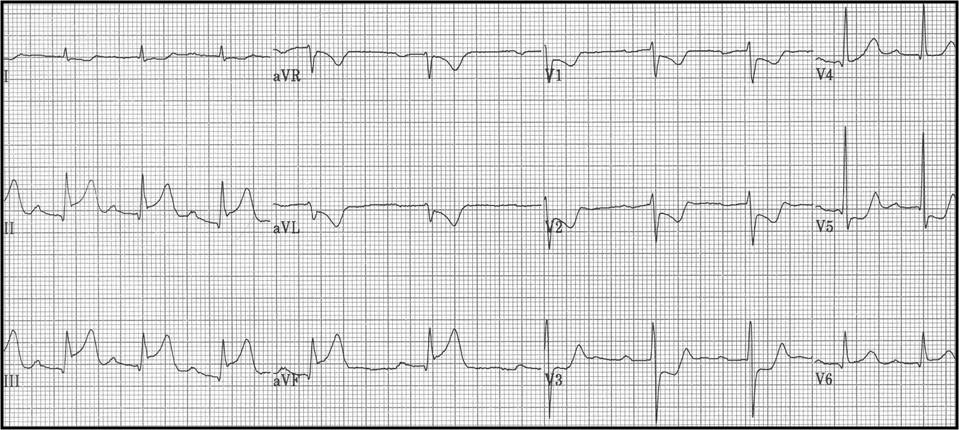
Which of the following statements regarding the ECG findings in acute pericarditis is FALSE?
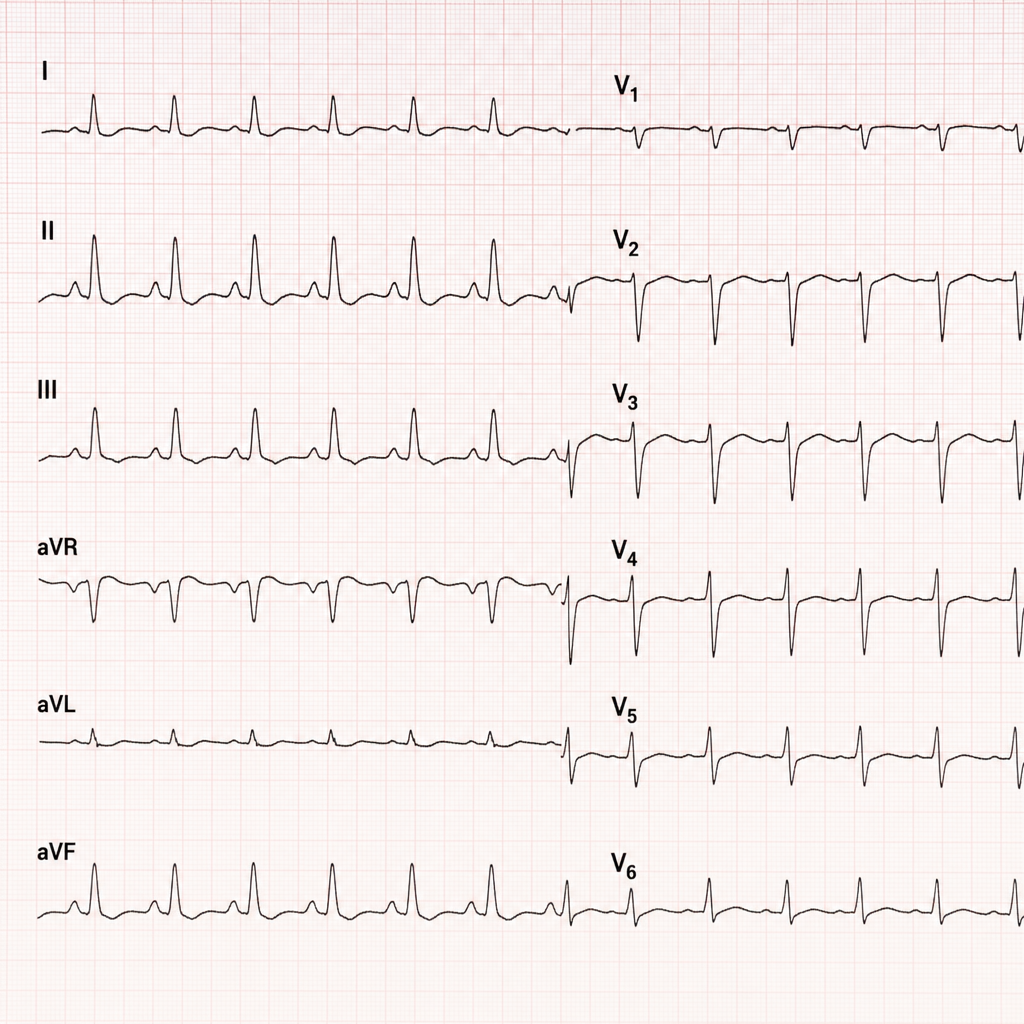
What does the ECG show?

What type of mutation is most commonly associated with Brugada syndrome?
Elevated JVP is seen in all except?
Pulse deficit may be seen in all of the following, except:
A dicrotic pulse is observed in which condition?
Which of the following conditions is also known as pulseless disease?
Which is not a feature of chronic mitral regurgitation?
Explanation: The diagnosis of Acute Rheumatic Fever (ARF) is based on the **Revised Jones Criteria**. To make a diagnosis, one requires evidence of a preceding Group A Streptococcal infection plus either two major criteria or one major and two minor criteria [1]. ### Why "Fever" is the Correct Answer **Fever** is classified as a **Minor Criterion**, not a major one. While it is a common presenting symptom of ARF, it lacks the diagnostic specificity required to be a major manifestation. ### Explanation of Major Criteria (Incorrect Options) The major criteria are represented by the mnemonic **J♥NES**: * **J (Joints): Polyarthritis.** This is typically migratory, affecting large joints (knees, ankles, elbows, wrists). It is the most common major manifestation. * **♥ (Carditis):** This is the most serious manifestation and can involve the endocardium, myocardium, or pericardium (pancarditis) [1]. It is the only manifestation that leads to chronic valvular heart disease [2]. * **N (Nodules): Subcutaneous nodules.** These are firm, painless, and usually found over bony prominences or extensor tendons. * **E (Erythema marginatum):** A characteristic non-pruritic, evanescent, pink rash with serpiginous (snake-like) borders, primarily on the trunk and limbs. * **S (Sydenham’s Chorea):** Delayed neurological manifestation characterized by involuntary, purposeless movements and emotional lability. ### NEET-PG Clinical Pearls * **Minor Criteria:** Fever, Arthralgia (joint pain without inflammation), elevated ESR/CRP, and prolonged PR interval on ECG. * **High-Yield Note:** In high-risk populations, **monoarthritis** or **polyarthralgia** can be considered major criteria (2015 AHA revision). * **Essential Requirement:** Evidence of preceding Strep infection (elevated ASO titer, positive throat culture, or Rapid Antigen Test) is mandatory for the initial diagnosis [1].
Explanation: ### Explanation The patient presents with a classic progression from **Acute Pericarditis** to **Cardiac Tamponade**. **1. Why Cardiac Tamponade is correct:** The initial chest pain (pleuritic, relieved by leaning forward) and the presence of a **friction rub** indicate pericarditis [2]. However, the development of hypotension (BP 89/66), tachycardia, jugular venous distention (JVD), and distant heart sounds signifies the accumulation of pericardial fluid under high pressure [1]. This constitutes **Beck’s Triad** (Hypotension, JVD, Muffled heart sounds), which is pathognomonic for tamponade. The fact that her pain no longer changes with position suggests the pericardial layers are now separated by fluid, preventing the friction that caused the positional pain. **2. Why the other options are incorrect:** * **Acute Pericarditis:** While this was the likely inciting event, the presence of hypotension and JVD indicates it has progressed to a life-threatening complication (tamponade) [1]. Pericarditis alone does not cause obstructive shock. * **Congestive Heart Failure (CHF):** While CHF causes JVD and tachycardia, the **lungs are clear** in this patient [3]. Left-sided heart failure typically presents with pulmonary rales/edema. Furthermore, distant heart sounds and a friction rub are not typical of simple CHF. * **Panic Attack:** This cannot explain the objective physical findings of hypotension, JVD, or muffled heart sounds. **3. NEET-PG High-Yield Pearls:** * **Beck’s Triad:** Hypotension, JVD, Muffled heart sounds (Seen in <50% of cases but highly specific). * **Pulsus Paradoxus:** A drop in systolic BP >10 mmHg during inspiration; a hallmark of tamponade. * **ECG Findings:** Low voltage QRS and **Electrical Alternans** (beat-to-beat variation in QRS amplitude due to the heart "swinging" in fluid) [1]. * **Echocardiography:** The gold standard for diagnosis; look for **early diastolic collapse of the Right Ventricle** [1]. * **Treatment:** Immediate **Pericardiocentesis**.
Explanation: Explanation: Acute pericarditis typically evolves through four distinct ECG stages. Understanding this progression is crucial for differentiating it from Acute Myocardial Infarction (AMI). **1. Why Option A is the Correct (False) Statement:** In acute pericarditis, T-wave inversions (Stage 3) occur **only after** the ST segments have returned to the isoelectric baseline (Stage 2) [1]. If T-wave inversion occurs while the ST segment is still elevated, it strongly suggests **Acute MI** [2] or **Myopericarditis** rather than isolated pericarditis [1]. Therefore, the sequence is: ST elevation → ST normalization → T-wave inversion. **2. Analysis of Other Options:** * **Option B (True):** Stage 1 is characterized by **diffuse (global)** concave-upwards ST-segment elevation [1]. Unlike MI, it does not follow a specific vascular territory (except in leads aVR and V1, where ST depression is seen). * **Option C (True):** Sinus tachycardia is the most common rhythm finding due to pain and inflammation. * **Option D (True):** **PR segment depression** (Stage 1) is a highly specific finding for acute pericarditis, reflecting atrial inflammation (atrial injury current) [1]. It is best seen in lead II, while PR elevation is seen in lead aVR. **High-Yield Clinical Pearls for NEET-PG:** * **Most Specific Finding:** PR segment depression (except in aVR) [1]. * **Spodick’s Sign:** Downsloping TP segment, seen in about 80% of patients. * **Differentiating from MI:** Pericarditis shows **concave** ST elevation and lacks reciprocal changes (except in aVR/V1) [1]. MI shows **convex** (tombstone) ST elevation with reciprocal changes [2]. * **Electrical Alternans:** If pericarditis leads to a large pericardial effusion/tamponade, look for beat-to-beat variation in QRS amplitude.
Explanation: ***Mobitz type 1 heart block*** - Shows **progressive lengthening of PR intervals** followed by a **dropped QRS complex**, creating the characteristic **Wenckebach phenomenon**. - After the dropped beat, the **PR interval resets** to its shortest duration and the cycle repeats, indicating intact but fatiguing AV conduction. *First degree heart block* - Characterized by a **fixed prolonged PR interval** (>0.20 seconds) with **no dropped beats**. - All P waves are followed by QRS complexes, unlike the intermittent dropped beats seen in this ECG. *Complete heart block* - Shows **complete AV dissociation** with P waves and QRS complexes occurring independently at different rates. - The **ventricular escape rhythm** is typically slower (30-50 bpm) with no relationship between P waves and QRS complexes. *Mobitz type II heart block* - Features **fixed PR intervals** with **sudden dropped QRS complexes** without prior PR prolongation. - Carries a **worse prognosis** than Mobitz type I and often requires pacemaker implantation due to risk of progression to complete heart block.
Explanation: **Explanation:** **Brugada Syndrome** is an autosomal dominant genetic channelopathy characterized by a predisposition to ventricular arrhythmias and sudden cardiac death. **1. Why "Loss of Function" is correct:** The most common genetic defect in Brugada Syndrome involves the **SCN5A gene**, which encodes the alpha subunit of the cardiac **sodium channel (Nav1.5)**. The mutation leads to a **Loss of Function (LOF)** of these sodium channels. This reduction in inward sodium current ($I_{Na}$) during Phase 0 of the action potential causes an imbalance between inward and outward currents, particularly in the right ventricular outflow tract (RVOT) epicardium. This results in the characteristic ST-segment elevation (Coved pattern) and provides the substrate for re-entrant arrhythmias. **2. Why other options are incorrect:** * **Gain of Function (GOF):** GOF mutations in the SCN5A gene lead to **Long QT Syndrome Type 3 (LQT3)**, where the sodium channel fails to inactivate properly, prolonging the action potential. * **Antimorphic mutation:** This refers to a dominant-negative effect where the mutant gene product actively opposes the wild-type. While some SCN5A mutations may show this, the primary underlying mechanism is classified as LOF. * **Lethal mutation:** While Brugada syndrome can cause sudden death, the mutation itself is not "lethal" in a genetic sense (embryonic lethal), as individuals survive to adulthood. **High-Yield Clinical Pearls for NEET-PG:** * **ECG Hallmark:** "Coved" ST-elevation >2mm followed by a negative T-wave in V1-V2 (Type 1 pattern). * **Triggers:** Fever, large meals, and certain drugs (Sodium channel blockers like Ajmaline/Flecainide). * **Inheritance:** Autosomal Dominant. * **Management:** The only proven effective treatment for symptomatic patients or survivors of cardiac arrest is an **Implantable Cardioverter Defibrillator (ICD)**. Quinidine can be used for electrical storms.
Explanation: **Explanation:** The **Jugular Venous Pressure (JVP)** is a clinical reflection of the pressure in the right atrium. Elevated JVP occurs when there is an increase in right-sided heart pressures or an obstruction to blood flow into or through the right heart. **Why Aortic Stenosis (Correct Answer) is right:** Aortic stenosis is a left-sided valvular lesion [1]. It leads to left ventricular hypertrophy and increased left-sided pressures [2]. Unless the patient develops secondary pulmonary hypertension and subsequent right heart failure (a late-stage complication), isolated aortic stenosis does not cause an elevation in JVP. Therefore, it is the least likely among the options to present with elevated JVP. **Why the other options are wrong:** * **Pulmonary Arterial Hypertension (PAH):** Increased resistance in the pulmonary arteries leads to right ventricular pressure overload and right heart failure, directly increasing JVP. * **Tetralogy of Fallot (TOF):** This condition involves right ventricular outflow tract obstruction and a large VSD. The right ventricle works against high pressure, leading to right-sided hypertrophy and elevated JVP (often with a prominent 'a' wave). * **Mitral Stenosis:** This causes a "back-pressure" effect: Mitral stenosis → Left Atrial enlargement → Pulmonary venous congestion → Pulmonary arterial hypertension → Right heart failure [3]. This sequence frequently leads to elevated JVP. **NEET-PG High-Yield Pearls:** 1. **Kussmaul’s Sign:** Paradoxical rise in JVP on inspiration; seen in Constrictive Pericarditis (most common) and Restrictive Cardiomyopathy. 2. **Giant 'a' waves:** Seen in Tricuspid Stenosis, Pulmonary Stenosis, and PAH (Right atrium contracting against resistance). 3. **Cannon 'a' waves:** Seen in AV dissociation (e.g., Complete Heart Block, VT) where the atrium contracts against a closed tricuspid valve. 4. **Absent 'a' waves:** Characteristic of Atrial Fibrillation [3].
Explanation: **Explanation:** **Pulse deficit** is defined as the difference between the **apical heart rate** (measured by auscultation) and the **peripheral pulse rate** (measured by palpation). It occurs when ventricular contractions are too weak or happen too early to generate a pressure wave strong enough to open the aortic valve or reach the peripheral arteries. **Why Bradyarrhythmias is the Correct Answer:** In bradyarrhythmias (e.g., complete heart block), the heart rate is slow, allowing for prolonged diastolic filling time. This ensures that every ventricular contraction results in a significant stroke volume, producing a palpable peripheral pulse for every audible heartbeat. Therefore, the apical and radial rates are equal, and there is **no pulse deficit**. **Analysis of Other Options:** * **Atrial Fibrillation (AF):** This is the most common cause of pulse deficit. Variable diastolic filling times and "short cycles" result in some contractions being too weak to be felt peripherally. * **Ventricular Premature Contractions (VPC):** An early beat occurs before the ventricles have filled sufficiently. The resulting stroke volume is often inadequate to produce a palpable radial pulse, though the beat is heard on auscultation. * **Tachyarrhythmias:** Rapid heart rates shorten diastole significantly, leading to reduced stroke volume in many beats, thereby creating a deficit. **Clinical Pearls for NEET-PG:** * **Diagnostic Threshold:** A pulse deficit of **>10 beats/minute** is clinically significant and highly suggestive of Atrial Fibrillation. * **Measurement:** To be accurate, the apical and radial pulses should be counted simultaneously by two observers for one full minute. * **Pulsus Alternans:** Do not confuse pulse deficit with pulsus alternans (seen in left ventricular failure), where every beat reaches the periphery but with alternating strength.
Explanation: **Explanation:** A **dicrotic pulse** is characterized by two peaks in the arterial pulse waveform during a single cardiac cycle: one in systole and the second in diastole (following the dicrotic notch). It occurs due to an exaggerated dicrotic wave, typically seen in states with **low cardiac output** and **high systemic vascular resistance** (high peripheral resistance) [1]. **1. Why Dilated Cardiomyopathy (DCM) is correct:** In DCM, the stroke volume is significantly reduced (low cardiac output) [1]. This leads to a low-amplitude systolic peak. Simultaneously, the compensatory increase in peripheral resistance makes the dicrotic wave (rebound of blood against the closed aortic valve) more prominent [2]. The combination of a small systolic peak and a prominent diastolic peak results in the classic "double-peaked" dicrotic pulse. **2. Analysis of Incorrect Options:** * **HOCM:** Characterized by a **Bisferiens pulse** (two systolic peaks). The first peak is due to rapid ejection, followed by a dip due to mid-systolic obstruction, and a second peak as ejection continues. * **Restrictive Cardiomyopathy (RCM):** Usually presents with signs of right heart failure and Kussmaul’s sign, but not typically a dicrotic pulse. * **Left Ventricular Failure (LVF):** While LVF can lead to a dicrotic pulse if severe, it is more classically associated with **Pulsus Alternans** (alternating strong and weak beats) [1]. **3. High-Yield NEET-PG Pearls:** * **Dicrotic Pulse:** Seen in DCM, severe Heart Failure, and sometimes in young patients with Febrile illnesses (e.g., Typhoid). * **Bisferiens Pulse:** Seen in AR (Aortic Regurgitation), AS+AR, and HOCM. * **Anacrotic Pulse (Slow-rising):** Classic for Aortic Stenosis [3]. * **Pulsus Paradoxus:** Seen in Cardiac Tamponade [4], Severe Asthma, and COPD. * **Water-hammer Pulse:** Seen in AR, PDA, and High-output states [2].
Explanation: ### Explanation **Takayasu’s Arteritis (Correct Answer)** Takayasu’s arteritis is a chronic, large-vessel vasculitis that primarily involves the **aorta and its major branches**. It is most common in young women (usually <40 years). The term **"Pulseless Disease"** is used because the chronic inflammation leads to segmental stenosis, occlusion, or aneurysmal dilation of the arteries. When the subclavian or brachiocephalic arteries are involved, it results in weakened or absent peripheral pulses (typically in the upper limbs) and significant blood pressure discrepancies between the arms. **Why the other options are incorrect:** * **Microscopic Polyangiitis (MPA):** This is a **small-vessel vasculitis** associated with p-ANCA [2]. It typically affects the kidneys (glomerulonephritis) and lungs (capillaritis) rather than large arteries [1]. * **Giant Cell Arteritis (GCA):** While also a large-vessel vasculitis, it primarily affects the **extracranial branches of the carotid artery** (e.g., temporal artery) in patients >50 years. While it can involve the aorta, it is not classically termed "pulseless disease." * **Polyarteritis Nodosa (PAN):** This is a **medium-vessel vasculitis** that affects visceral and renal arteries. It is characterized by "beading" on angiography and is frequently associated with Hepatitis B, but it does not cause the loss of limb pulses seen in Takayasu’s. **High-Yield Clinical Pearls for NEET-PG:** * **Demographics:** Most common in Asian females under age 40. * **Clinical Sign:** Bruits (especially over the carotid or subclavian arteries) and limb claudication [2]. * **Diagnosis:** Gold standard is **CT/MR Angiography** showing "skip lesions" or narrowing of the aorta. * **Classification:** It is the only vasculitis that specifically targets the aorta and its primary branches [1].
Explanation: In chronic Mitral Regurgitation (MR), the primary pathophysiology involves a volume overload of the left atrium and left ventricle. [1] **Explanation of the Correct Answer:** **D. Narrow split S1:** This is the correct answer because it is **not** a feature of MR. In chronic MR, the S1 is typically **soft or muffled**. This occurs because the mitral valve leaflets fail to coapt properly or are structurally damaged, and the rate of pressure rise in the left ventricle is offset by the leak into the low-pressure left atrium, leading to a quieter closure. **Explanation of Incorrect Options:** * **A. Mid-diastolic murmur:** In severe MR, the massive volume of blood returning from the left atrium to the left ventricle during diastole creates a "functional mitral stenosis" effect, resulting in a low-pitched mid-diastolic flow murmur at the apex [2]. * **B. Wide split S2:** MR causes early closure of the aortic valve (A2) because the left ventricle empties rapidly into both the aorta and the low-pressure left atrium (decreased afterload). This shortened LV ejection time leads to an early A2 and a wide physiological split of S2. * **C. Pan-systolic murmur radiating to axilla:** This is the classic hallmark of MR. The murmur starts with S1 and continues through S2 as the pressure gradient between the LV and LA persists throughout systole [1]. Radiation to the axilla is characteristic of anterior leaflet involvement. **Clinical Pearls for NEET-PG:** * **S3 Gallop:** A common finding in chronic MR, indicating volume overload and rapid ventricular filling [1]. * **Murmur Radiation:** If the **posterior** leaflet is involved, the murmur may radiate to the base of the heart/sternum (mimicking aortic stenosis). * **Handgrip Exercise:** Increases systemic vascular resistance, which **increases** the intensity of the MR murmur (useful for bedside differentiation).
Coronary Artery Disease and Angina
Practice Questions
Acute Coronary Syndromes
Practice Questions
Heart Failure
Practice Questions
Cardiac Arrhythmias
Practice Questions
Valvular Heart Diseases
Practice Questions
Cardiomyopathies
Practice Questions
Pericardial Diseases
Practice Questions
Congenital Heart Disease in Adults
Practice Questions
Hypertension and Hypertensive Emergencies
Practice Questions
Pulmonary Hypertension
Practice Questions
Non-invasive Cardiac Diagnostics
Practice Questions
Preventive Cardiology
Practice Questions
Get full access to all questions, explanations, and performance tracking.
Start For Free