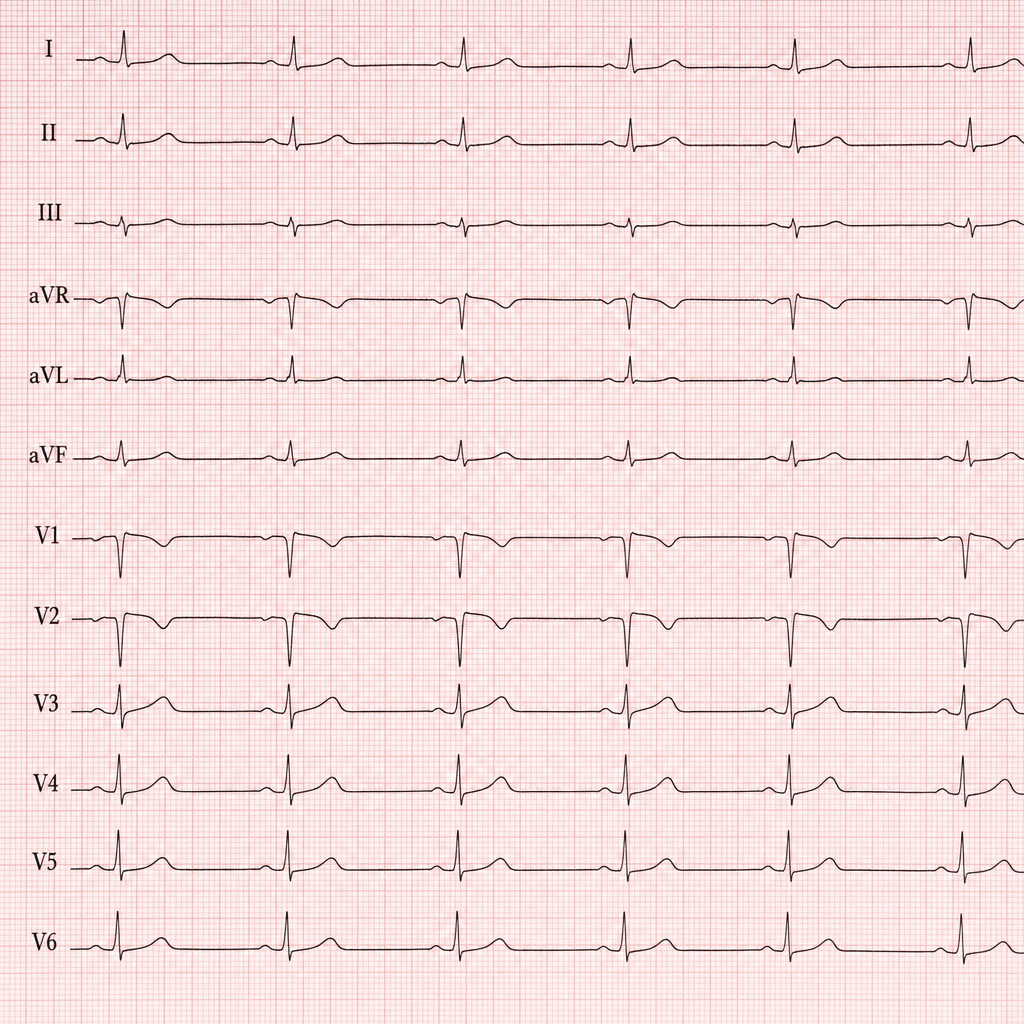
A 60-year-old female presented to the ER with chest pain and dyspnea, along with palpitations, nausea, vomiting, and a few episodes of syncope. MI was suspected. ECG and lab findings revealed raised cardiac enzymes. ECHO was also done. The patient was planned for coronary angiography, but no coronary artery stenosis was observed. What is the drug of choice for the above condition?
Which of the following arteries is most common to undergo atherosclerotic changes leading to coronary artery disease?
Which of the following conditions is characterized by an early diastolic murmur?
Water hammer pulse is also known as:
All of the following factors predispose to Aortic dissection, EXCEPT:
A patient presents to the emergency department in an unconscious state after a 15-minute delay following a call. The patient has a barely palpable radial pulse and no signs of trauma. The systolic blood pressure is 58 mm Hg. An ECG and ultrasound film are shown. Which electrolyte abnormality is most likely to cause this clinical scenario?

Low renin hypertension is seen in all of the following conditions, except:
Acute aortic regurgitation is seen in all the following conditions except?
In Myocardial infarction, what is the most specific marker?
What is true about pulsus paradoxus?
Explanation: ### Explanation The clinical presentation describes a classic case of **Takotsubo Cardiomyopathy** (also known as "Broken Heart Syndrome" or "Stress-induced Cardiomyopathy"). **Why Propranolol is the Correct Answer:** Takotsubo Cardiomyopathy typically occurs in postmenopausal women following intense emotional or physical stress. The pathophysiology involves a **"catecholamine surge"** leading to myocardial stunning, apical ballooning, and left ventricular dysfunction. This mimics an Acute Coronary Syndrome (ACS) with chest pain, ST-segment changes, and elevated cardiac enzymes, but **coronary angiography reveals normal/non-obstructive arteries**. [2] * **Beta-blockers (like Propranolol)** are the mainstay of treatment because they antagonize the effects of excess catecholamines, reduce myocardial oxygen demand, and help prevent complications like left ventricular outflow tract (LVOT) obstruction and arrhythmias. [1] **Why Other Options are Incorrect:** * **Streptokinase:** This is a thrombolytic used for STEMI. Since angiography confirmed no coronary stenosis (no clot), thrombolysis is contraindicated and would only increase bleeding risk. [1] * **Aspirin & Rosuvastatin:** These are standard for atherosclerotic Coronary Artery Disease (CAD). While often started empirically in the ER for suspected MI, they do not treat the underlying catecholamine-driven mechanism of Takotsubo once CAD is ruled out. **Clinical Pearls for NEET-PG:** * **ECHO Finding:** Pathognomonic "Apical Ballooning" (hyperkinesis of the base and akinesis of the apex), resembling a Japanese octopus trap (*Takotsubo*). * **Demographics:** Most common in postmenopausal females. * **Prognosis:** Generally excellent; ventricular function usually recovers spontaneously within 1–4 weeks with supportive care. * **Trigger:** Excessive sympathetic stimulation is the key driver. [2]
Explanation: ### Explanation **1. Why Left Anterior Descending (LAD) is Correct:** The **Left Anterior Descending (LAD) artery** is the most common site for clinically significant atherosclerosis and occlusion. This is primarily due to hemodynamic factors; the LAD experiences high wall stress and turbulent flow at its bifurcation from the Left Main coronary artery. It supplies the majority of the left ventricular myocardium (apex, anterior wall, and anterior 2/3rd of the interventricular septum). Because of its critical role and high frequency of occlusion, it is famously nicknamed the **"Widow Maker."** **2. Analysis of Incorrect Options:** * **Right Coronary Artery (RCA):** While frequently involved in atherosclerosis (the second most common site), it is statistically less common than the LAD. RCA occlusion typically leads to inferior wall MIs. * **Left Circumflex (LCx) Artery:** This is generally the third most common site for atherosclerotic changes. It supplies the lateral wall of the left ventricle. * **Left Main Coronary Artery (LMCA):** While atherosclerosis here is the most dangerous (as it compromises both the LAD and LCx), isolated or primary atherosclerotic narrowing of the LMCA is less frequent than in its distal branches. **3. NEET-PG High-Yield Pearls:** * **Frequency Hierarchy:** LAD > RCA > LCx. * **Anatomical Landmark:** The LAD travels in the anterior interventricular groove. * **ECG Correlation:** Occlusion of the LAD typically presents as ST-elevation in leads **V1–V4**. * **Blood Supply:** The LAD provides the primary blood supply to the **Bundle of His** and bundle branches; thus, LAD infarcts are often associated with new-onset bundle branch blocks.
Explanation: **Explanation** **Correct Answer: C. Aortic Regurgitation (AR)** The hallmark of Aortic Regurgitation is a high-pitched, blowing **Early Diastolic Murmur (EDM)** [1]. This occurs because, immediately after the closure of the semilunar valves (S2), the pressure in the aorta significantly exceeds the pressure in the left ventricle [2]. This pressure gradient causes blood to regurgitate back into the ventricle at the very beginning of diastole. It is best heard at the left sternal border (Erb’s point) with the patient sitting forward and in deep expiration [2]. **Analysis of Incorrect Options:** * **A. Ventricular Septal Defect (VSD):** Characterized by a loud, harsh **Pansystolic (Holosystolic) murmur**, loudest at the left lower sternal border. * **B. Atrial Septal Defect (ASD):** Does not produce a murmur across the defect itself. Instead, it causes a **Mid-systolic flow murmur** over the pulmonary area due to increased stroke volume across the pulmonary valve, along with a characteristic **fixed split S2** [1]. * **D. Pulmonic Regurgitation (PR):** While PR can cause an EDM (Graham Steell murmur), it is typically associated with pulmonary hypertension. In the context of standard NEET-PG questions, AR is the classic and most common cause of an EDM [2]. Note: Severe PR without pulmonary hypertension usually produces a *mid-diastolic* murmur. **NEET-PG High-Yield Pearls:** * **Austin Flint Murmur:** A mid-diastolic rumble heard in severe AR due to the regurgitant jet displacing the mitral valve leaflet [2]. * **Peripheral Signs of AR:** Look for "Water-hammer pulse" (Corrigan’s pulse), Quincke’s sign (capillary pulsations), and de Musset’s sign (head nodding). * **Dynamic Maneuvers:** Left-sided murmurs (AR, MR, AS) increase in intensity with **expiration**, while right-sided murmurs increase with **inspiration** (Carvallo's sign).
Explanation: **Explanation:** **Corrigan’s pulse** (Water hammer pulse) is a classic clinical finding in **Aortic Regurgitation (AR)** [1]. It is characterized by a rapid, forceful upstroke (due to increased stroke volume) followed by a sudden, rapid collapse (due to backflow of blood into the left ventricle and runoff into the periphery) [1]. It is best palpated at the radial artery with the patient's arm elevated. **Analysis of Incorrect Options:** * **Duroziez’s sign:** This refers to a double murmur (systolic and diastolic) heard over the **femoral artery** when it is compressed with a stethoscope. * **Traube’s sign:** Also known as "pistol-shot sounds," these are booming systolic and diastolic sounds heard over the **femoral artery**. * **Quincke’s sign:** This refers to rhythmic **capillary pulsations** visible in the nail beds when light pressure is applied. **Clinical Pearls for NEET-PG:** * **Pathophysiology:** All these signs are manifestations of a **wide pulse pressure**, which is the hallmark of chronic severe Aortic Regurgitation [2]. * **De Musset’s sign:** Rhythmic head nodding in sync with the heartbeat [1]. * **Müller’s sign:** Systolic pulsations of the uvula. * **Hill’s sign:** The most sensitive sign for AR; it is defined as a popliteal systolic blood pressure exceeding brachial systolic blood pressure by >20 mmHg (severe AR if >60 mmHg). * **Bisferiens Pulse:** A "double-peaked" pulse seen in AR combined with Aortic Stenosis or in HOCM.
Explanation: **Explanation:** Aortic dissection occurs when a tear in the tunica intima allows blood to surge into the tunica media, creating a false lumen. The primary pathophysiology involves **cystic medial necrosis** or high hemodynamic stress. **Why Option C is the correct answer:** While pregnancy is a known risk factor for aortic dissection, it typically occurs in the **third trimester** [1] or the early postpartum period. This is due to the combination of hyperdynamic circulation (increased cardiac output and blood volume) and hormonal changes (estrogen and progesterone) that alter the structural integrity of the aortic wall. The first trimester does not involve these significant hemodynamic shifts, making it an incorrect timing for predisposition. **Analysis of Incorrect Options:** * **A. Systemic Hypertension:** This is the **most common** risk factor for aortic dissection [1] (present in >70% of cases). Chronic high pressure causes mechanical stress and thickening of the vasa vasorum, leading to ischemic changes in the media. * **B. Coarctation of Aorta:** This congenital narrowing causes turbulent flow and upper-body hypertension, which increases the risk of proximal aortic dissection [1] and is often associated with a bicuspid aortic valve. * **D. Takayasu's Arteritis:** This large-vessel vasculitis causes chronic inflammation of the aortic wall, weakening its structural layers and predisposing it to both aneurysm formation and dissection. **High-Yield Clinical Pearls for NEET-PG:** 1. **Most common site:** Right lateral wall of the ascending aorta (highest shear stress). 2. **Genetic Associations:** Marfan Syndrome (Fibrillin-1 mutation) and Ehlers-Danlos Syndrome (Type IV collagen) are high-yield associations [1]. 3. **Classification:** Stanford Type A (involves ascending aorta; surgical emergency) vs. Type B (descending aorta only; medical management) [1]. 4. **Clinical Sign:** Sudden "tearing" chest pain radiating to the back with a blood pressure discrepancy between arms (>20 mmHg).
Explanation: ***Hyperkalemia*** - **Severe hyperkalemia** (>6.5 mEq/L) causes **cardiac conduction abnormalities** leading to **bradycardia**, **hypotension**, and potential **cardiac arrest**, explaining the unconscious state and barely palpable pulse. - ECG findings progress from **peaked T waves** to **wide QRS complexes** to **sine wave pattern** and ultimately **asystole**; ultrasound may show **hypokinetic** or **dilated heart** with poor contractility. *Hypokalemia* - Typically causes **muscle weakness** and **paralysis** but rarely leads to such severe **hemodynamic collapse** with unconsciousness. - ECG shows **flattened T waves**, **U waves**, and **prolonged QT interval**, not the pattern typically associated with cardiac arrest. *Hypocalcemia* - Primarily causes **neuromuscular irritability** with **tetany**, **seizures**, and **laryngospasm** rather than severe cardiovascular collapse. - ECG findings include **prolonged QT interval** and **T wave inversions**, but rarely cause hemodynamic instability severe enough for unconsciousness. *Hypercalcemia* - Usually presents with **"stones, bones, groans, and psychiatric overtones"** including **kidney stones**, **bone pain**, and **confusion**. - ECG shows **shortened QT interval** and rarely causes acute cardiovascular collapse leading to unconsciousness and severe hypotension.
Explanation: **Explanation:** The Renin-Angiotensin-Aldosterone System (RAAS) is the primary regulator of blood pressure. To answer this question, one must distinguish between conditions where hypertension is driven by **excess mineralocorticoids** (which suppress renin) versus conditions where hypertension is driven by **decreased renal perfusion** (which stimulates renin). **Why Renovascular Hypertension is the correct answer:** Renovascular hypertension (e.g., Renal Artery Stenosis) is a classic cause of **High Renin Hypertension** [1]. The narrowed artery causes the juxtaglomerular apparatus to perceive a state of low blood pressure (hypoperfusion), leading to the compensatory release of massive amounts of **Renin** [2]. This triggers the RAAS cascade, resulting in secondary hyperaldosteronism. **Analysis of Incorrect Options:** * **Essential Hypertension:** Approximately 25-30% of patients with primary hypertension have **Low Renin Hypertension**, often due to increased sensitivity to sodium or genetic factors. * **Conn’s Syndrome (Primary Hyperaldosteronism):** An adrenal adenoma secretes excess aldosterone. The resulting volume expansion and high blood pressure provide negative feedback to the kidneys, **suppressing Renin** levels [1]. * **Liddle’s Syndrome:** A genetic "pseudo-hyperaldosteronism" caused by overactivity of ENaC channels in the distal tubule. This leads to massive sodium reabsorption and volume expansion, which **suppresses both Renin and Aldosterone**. **NEET-PG High-Yield Pearls:** * **Aldosterone-to-Renin Ratio (ARR):** This is the screening test of choice for Primary Hyperaldosteronism. A high ratio (High Aldosterone, Low Renin) suggests Conn’s. * **Liddle’s Syndrome Triad:** Hypertension + Hypokalemia + Metabolic Alkalosis (similar to Conn’s), but with **Low Aldosterone**. * **Renovascular HTN:** Suspect this in young females (Fibromuscular dysplasia) or elderly males (Atherosclerosis) with resistant hypertension and an abdominal bruit.
Explanation: The key to this question lies in distinguishing between conditions that cause **Acute Aortic Regurgitation (AR)** versus those that cause **Chronic AR** or other valvular complications. **1. Why Acute Myocardial Infarction (MI) is the correct answer:** Acute MI is a classic cause of **Acute Mitral Regurgitation**, typically due to papillary muscle rupture (most commonly the posteromedial papillary muscle). It does **not** cause acute aortic regurgitation. The aortic valve is a semilunar valve and does not rely on the chordae tendineae or papillary muscles affected during an MI. **2. Analysis of other options:** * **Bacterial Endocarditis:** This is a leading cause of **Acute AR**. Vegetations can cause rapid destruction or perforation of the aortic valve leaflets, leading to sudden, severe hemodynamic collapse [1]. * **Marfan’s Syndrome:** While often associated with chronic dilation, Marfan’s predisposes patients to **Aortic Dissection**. An acute Type A dissection can retrograde into the aortic root, causing sudden malcoaptation of the leaflets and resulting in **Acute AR**. * **Ankylosing Spondylitis:** This is primarily associated with **Chronic AR** due to aortitis and root dilation. However, in the context of this "except" question, it is traditionally grouped with aortic root pathologies. (Note: If the question asks for the *most* common cause of acute AR, it is Endocarditis or Dissection). **Clinical Pearls for NEET-PG:** * **Physical Exam:** In *Acute* AR, the classic "wide pulse pressure" and "Water-hammer pulse" are often **absent** because the left ventricle hasn't had time to dilate and compensate [1]. * **Auscultation:** The murmur of Acute AR is typically **short and low-pitched** (due to rapid equilibration of aortic and LV pressures) compared to the long, high-pitched blowing murmur of Chronic AR. * **Management:** Acute AR is a surgical emergency. Vasodilators (Nitroprusside) and Inotropes (Dobutamine) are used to stabilize; **Beta-blockers and IABP are contraindicated** as they can worsen the regurgitation or decrease cardiac output.
Explanation: The diagnosis of Myocardial Infarction (MI) relies on the detection of a rise and/or fall of cardiac biomarkers, with **Cardiac Troponins (I and T)** being the preferred markers due to their high **myocardial specificity** and sensitivity [1]. **Why Troponin T is the Correct Answer:** Troponins are structural proteins of the cardiac myofibrils. Unlike other enzymes, Troponin I and T have isoforms that are unique to cardiac myocytes. They are released into the bloodstream following even minute areas of myocardial necrosis [1]. Troponin T begins to rise within 3–6 hours of injury and can remain elevated for up to 10–14 days, providing a wide diagnostic window. **Analysis of Incorrect Options:** * **Pro-BNP:** This is a marker of ventricular wall stretch and is primarily used for the diagnosis and prognosis of **Heart Failure**, not for identifying acute necrosis. * **Myoglobin:** This is the **earliest marker** to rise (within 1–2 hours). However, it lacks specificity because it is also found in skeletal muscle and can be elevated due to trauma or strenuous exercise. * **CPK-MB:** While specific to the heart, it is less specific than Troponins [1]. Its primary utility is in detecting **re-infarction** because it returns to baseline quickly (within 48–72 hours), whereas Troponins stay elevated longer. **NEET-PG High-Yield Pearls:** * **Most Specific Marker:** Troponin I (slightly more specific than T in patients with renal failure). * **Earliest Marker:** Myoglobin. * **Marker for Re-infarction:** CPK-MB. * **Gold Standard for Diagnosis:** Cardiac Troponins [1]. * **Bedside Test:** Troponin T (Rapid immunochromatographic test).
Explanation: **Explanation:** **Pulsus paradoxus** is defined as an exaggerated fall in systolic blood pressure (>10 mmHg) during inspiration. Under normal physiological conditions, inspiration increases venous return to the right heart, causing the interventricular septum to bulge slightly into the left ventricle (LV). In conditions like **cardiac tamponade**, the heart is compressed within a fixed space by fluid. The increased right-sided filling during inspiration forces the septum to shift significantly toward the left, further reducing LV filling and stroke volume, leading to the characteristic drop in blood pressure. **Analysis of Options:** * **Option C (Correct):** Pericardial tamponade is the classic cause. Other causes include severe asthma, COPD, and constrictive pericarditis (though less common than in tamponade). * **Option A:** Arm-tongue circulation time is a measure of blood flow velocity (prolonged in heart failure). It is not a diagnostic feature or a physiological component of pulsus paradoxus. * **Option B:** Stroke volume actually **decreases** during inspiration in pulsus paradoxus, leading to the drop in systolic pressure. * **Option D:** In severe left ventricular failure, pulsus paradoxus is typically **absent**. In fact, LV failure can sometimes cause "reversed pulsus paradoxus" (seen in HOCM or IPPV). **High-Yield Clinical Pearls for NEET-PG:** * **Kussmaul’s Sign vs. Pulsus Paradoxus:** Kussmaul’s sign (rise in JVP on inspiration) is classic for **Constrictive Pericarditis**, whereas Pulsus Paradoxus is classic for **Cardiac Tamponade**. * **Reverse Pulsus Paradoxus:** Seen in Hypertrophic Obstructive Cardiomyopathy (HOCM) and patients on positive pressure ventilation. * **Exception:** Pulsus paradoxus may be absent in tamponade if there is co-existing ASD or Aortic Regurgitation.
Coronary Artery Disease and Angina
Practice Questions
Acute Coronary Syndromes
Practice Questions
Heart Failure
Practice Questions
Cardiac Arrhythmias
Practice Questions
Valvular Heart Diseases
Practice Questions
Cardiomyopathies
Practice Questions
Pericardial Diseases
Practice Questions
Congenital Heart Disease in Adults
Practice Questions
Hypertension and Hypertensive Emergencies
Practice Questions
Pulmonary Hypertension
Practice Questions
Non-invasive Cardiac Diagnostics
Practice Questions
Preventive Cardiology
Practice Questions
Get full access to all questions, explanations, and performance tracking.
Start For Free