Which of the following statements regarding torsades de pointes is FALSE?
Osler's nodes are seen at:
A continuous murmur is heard in all of the following conditions except?
Which of the following statements about Osler's nodes is FALSE?
Non-ejection clicks are heard in which of the following conditions?
Changing character of a murmur in a patient with joint pain and embolic phenomenon indicates which of the following diagnoses?
Women with myocardial infarction are more likely to present with which of the following complications than males?
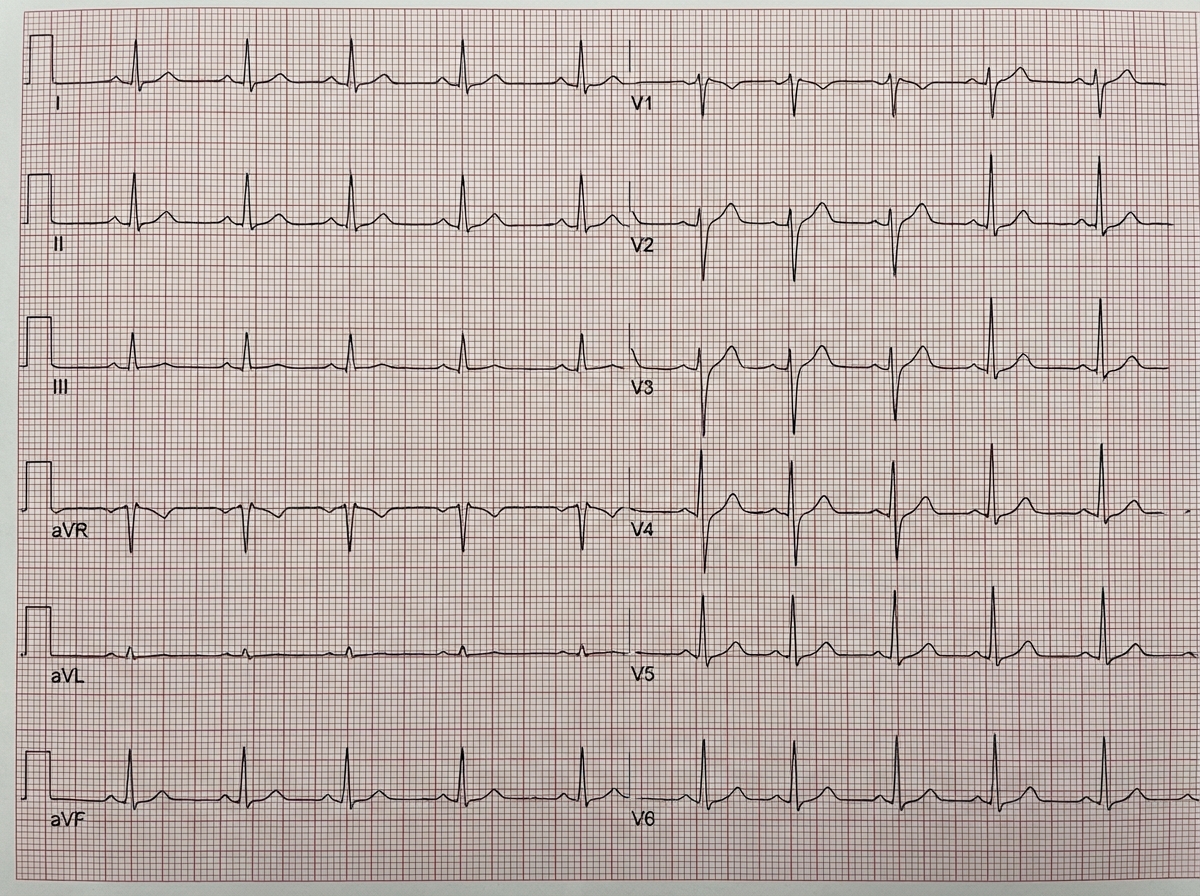
All the following statements are true regarding the given ECG except?

A 45-year-old man experiences crushing substernal chest pain after arriving at work one morning. Over the next 4 hours, the pain persists and begins to radiate to his left arm. He becomes diaphoretic and short of breath but waits until the end of his 8-hour shift to go to the hospital. An elevated serum value of which of the following laboratory tests would be most useful for the diagnosis of this patient on admission to the hospital?
Which of the following is NOT true regarding Mitral valve prolapse syndrome?
Explanation: **Explanation** **Torsades de Pointes (TdP)** is a specific form of polymorphic ventricular tachycardia characterized by a "twisting of the points" around the isoelectric line, occurring in the setting of a prolonged QT interval [1]. **Why Option A is the correct (False) statement:** The question asks for the **FALSE** statement. Option A is actually a **true** clinical fact: Torsades de pointes is significantly **more common in females** than in males [1]. This is due to gender-based differences in cardiac repolarization and the fact that women generally have longer baseline QTc intervals [1]. Therefore, stating it is more common in females is a true statement, making it the "correct" answer choice for a "False" question format. **Analysis of other options:** * **Option B (Hypocalcemia):** This is **True**. Electrolyte imbalances that prolong the QT interval, specifically **Hypokalemia, Hypomagnesemia, and Hypocalcemia**, are classic triggers for TdP. * **Option C (IV Magnesium):** This is **True**. Intravenous Magnesium Sulfate is the **first-line treatment** for hemodynamically stable TdP, regardless of the baseline magnesium level, as it stabilizes the cardiac membrane. * **Option D (Beta-blockers):** This is **True**. For congenital Long QT Syndromes (like Romano-Ward), **Beta-blockers** (specifically Propranolol or Nadolol) are the mainstay of therapy to prevent sympathetic surges that trigger arrhythmias [2]. **High-Yield NEET-PG Pearls:** * **Drug-induced TdP:** Common culprits include Class IA and III antiarrhythmics, Macrolides, Fluoroquinolones, and Antipsychotics (e.g., Haloperidol). * **Management:** If IV Magnesium fails, the next steps include **increasing the heart rate** (Overdrive pacing or Isoproterenol) to shorten the QT interval. * **Congenital Syndromes:** Jervell and Lange-Nielsen (Autosomal Recessive + Sensorineural deafness) and Romano-Ward (Autosomal Dominant, no deafness) [2].
Explanation: **Explanation:** **Osler’s nodes** are a classic peripheral stigmata of **Infective Endocarditis (IE)**. They are small, tender, raised, erythematous nodules typically found on the **pulp of the fingers and toes** (tips of the digits) and the **thenar/hypothenar eminences** of the palms and soles. [1] **Pathophysiology:** The underlying mechanism is an **immunological phenomenon** (Type III hypersensitivity). They represent the deposition of immune complexes in the dermal arterioles, leading to localized vasculitis [2]. Unlike Janeway lesions, Osler’s nodes are characteristically **painful/tender**. **Analysis of Options:** * **Option C (Correct):** The distal extremities, specifically the fleshy tips of the fingers and toes (palms and soles), are the primary sites for these immune-mediated lesions. [1] * **Options A, B, and D:** These are incorrect because Osler’s nodes do not occur on the head, large joints (like the knee), or the trunk (abdominal wall). These areas lack the specific small-vessel distribution and clinical presentation associated with IE-related vasculitis. **High-Yield Clinical Pearls for NEET-PG:** * **Osler’s Nodes vs. Janeway Lesions:** * **Osler’s:** Tender, Immunological, found on finger/toe pads. ("**O**sler = **O**uch") * **Janeway:** Non-tender, Embolic (micro-abscesses), found on palms/soles. * **Duke’s Criteria:** Both Osler’s nodes and Roth spots (retinal hemorrhages) are categorized under the **Minor Clinical Criteria** for the diagnosis of Infective Endocarditis. * **Other Peripheral Signs:** Splinter hemorrhages (nails) and Petechiae (conjunctiva/mucosa).
Explanation: **Explanation:** The core concept behind a **continuous murmur** is a persistent pressure gradient between two chambers or vessels throughout both systole and diastole, leading to uninterrupted flow. **Why Option A is the Correct Answer:** In **Ventricular Septal Defect (VSD) with Aortic Regurgitation (AR)**, two distinct murmurs are produced, creating a **"To-and-Fro" murmur**, not a continuous one. [1] 1. The VSD produces a pansystolic murmur. [3] 2. The AR produces an early diastolic decrescendo murmur. Unlike a continuous murmur, a "to-and-fro" murmur has a brief pause or change in character between S1 and S2, as the flow direction or mechanism changes between systole and diastole. **Analysis of Incorrect Options:** * **B. Patent Ductus Arteriosus (PDA):** The classic cause of a continuous "machinery" murmur, loudest at the left infraclavicular area, due to the constant aorta-to-pulmonary artery gradient. [2] * **C. Coronary Arteriovenous Fistula:** Results in a continuous murmur because the pressure in the coronary artery remains higher than the receiving chamber (usually the right ventricle or atrium) throughout the cardiac cycle. * **D. Venous Hum:** A benign continuous murmur caused by turbulent flow in the internal jugular veins. It is unique because it disappears when the patient lies supine or when the vein is compressed. **NEET-PG High-Yield Pearls:** * **Continuous Murmur vs. To-and-Fro:** Continuous murmurs wrap around S2; To-and-Fro murmurs have a distinct gap. * **Common Causes of Continuous Murmurs:** PDA, Ruptured Sinus of Valsalva (RSOV), Venous hum, Mammary souffle, and Arteriovenous fistulas. * **Gibson’s Murmur:** Another name for the PDA murmur. * **Clinical Tip:** If a question mentions a murmur that disappears with neck pressure, always think **Venous Hum**.
Explanation: **Explanation:** The correct answer is **B (Painless)** because Osler’s nodes are characteristically **painful/tender**. In the context of Infective Endocarditis (IE), distinguishing between Osler’s nodes and Janeway lesions is a classic high-yield topic for NEET-PG. **1. Why "Painless" is the False Statement:** Osler’s nodes are immunologically mediated phenomena (Type III hypersensitivity) involving the deposition of immune complexes in the small vessels. This inflammatory response leads to localized pain and tenderness. Therefore, the statement that they are "painless" is incorrect. **2. Analysis of Other Options:** * **Option A (Swellings at fingertips):** This is **True**. Osler’s nodes are small, raised, erythematous nodules typically found on the pads of the fingers and toes (pulp space). * **Option C (Common in Staph aureus endocarditis):** This is **True**. While historically associated with Subacute Bacterial Endocarditis (SBE) caused by *Streptococcus viridans*, they are frequently seen in acute presentations caused by *Staphylococcus aureus* due to the high bacterial load and systemic immune response. **Clinical Pearls for NEET-PG:** To remember the difference, use the mnemonic: **"O" for Osler = "O"uch (Painful)**. | Feature | Osler’s Nodes | Janeway Lesions | | :--- | :--- | :--- | | **Pain** | **Painful / Tender** | Painless | | **Pathology** | Immune Complex Deposition | Microabscesses / Septic Emboli | | **Location** | Pads of fingers/toes | Palms and Soles | | **Nature** | Nodular | Macular (Flat) | **High-Yield Note:** Osler’s nodes are part of the **Duke Criteria** (Minor Criteria) for the diagnosis of Infective Endocarditis under "Immunological phenomena."
Explanation: **Explanation:** **Correct Answer: D. Mitral valve prolapse (MVP)** The hallmark auscultatory finding of Mitral Valve Prolapse is a **mid-to-late non-ejection systolic click** [1], often followed by a late systolic murmur. The click is produced by the sudden tensing of the redundant valve leaflets and elongated chordae tendineae as they "prolapse" or balloon into the left atrium during ventricular systole. Unlike ejection clicks, which occur at the start of systole, this click occurs after the mitral valve has already closed [1]. **Analysis of Incorrect Options:** * **A. Aortic Stenosis:** This condition is associated with an **ejection click** (early systolic) [1]. It occurs due to the abrupt opening of a mobile but stenotic aortic valve. * **B. Atrial Myxoma:** This is typically associated with a **"tumor plop,"** a low-pitched sound heard in early or mid-diastole as the pedunculated tumor falls across the mitral orifice. * **C. Mitral Regurgitation:** Chronic MR usually presents with a holosystolic murmur and a soft S1 [2]. It does not typically feature a systolic click unless it is secondary to MVP. **High-Yield Clinical Pearls for NEET-PG:** * **Dynamic Auscultation of MVP:** The timing of the click and murmur is highly sensitive to postural changes. * **Standing/Valsalva (Decreased Preload):** The click occurs **earlier** in systole (closer to S1) and the murmur becomes longer/louder. * **Squatting (Increased Preload):** The click occurs **later** in systole (closer to S2) and the murmur becomes shorter/softer. * **Barlow’s Syndrome:** Another name for MVP [1], often associated with connective tissue disorders like Marfan or Ehlers-Danlos syndrome.
Explanation: ### Explanation The correct answer is **Subacute Bacterial Endocarditis (SBE)**. This diagnosis is classically characterized by the clinical triad of a pre-existing heart murmur, embolic phenomena, and systemic signs of infection (like fever or joint pain) [1]. **1. Why Subacute Bacterial Endocarditis is correct:** * **Changing Character of Murmur:** This is a hallmark of Infective Endocarditis (IE) [1]. It occurs due to the progressive destruction of valve leaflets, chordae tendineae rupture, or the growth of large, friable vegetations that alter blood flow dynamics. * **Joint Pain:** Arthralgia or arthritis occurs in about 25-50% of IE cases due to the deposition of immune complexes (Type III hypersensitivity). * **Embolic Phenomenon:** Vegetations can break off and embolize to the brain, spleen, kidneys, or extremities, leading to infarctions or splinter hemorrhages [2]. **2. Why the other options are incorrect:** * **Mitral Stenosis:** While it can cause embolic phenomena (due to Left Atrial enlargement and AFib), the murmur is typically stable and "rumbling" rather than "changing" in character. * **Rheumatoid Arthritis:** Can cause joint pain and occasionally valvular nodules, but it does not typically present with a rapidly changing murmur or systemic embolic events. * **Aortic Regurgitation:** While AR can be a *result* of endocarditis, the isolated diagnosis of AR does not explain the systemic embolic phenomena or joint pain mentioned in the triad [3]. **High-Yield Clinical Pearls for NEET-PG:** * **Duke’s Criteria:** Used for the diagnosis of IE (Major: Positive blood cultures and Echo evidence; Minor: Predisposition, Fever, Vascular/Immunologic phenomena) [2]. * **Immunologic Phenomena:** Look for Osler nodes (painful), Roth spots (retinal), and Glomerulonephritis. * **Vascular Phenomena:** Look for Janeway lesions (painless) and Splinter hemorrhages. * **Most Common Organism (SBE):** *Streptococcus viridans* (often following dental procedures). * **Most Common Organism (Acute IE/IV Drug Users):** *Staphylococcus aureus*.
Explanation: **Explanation:** The correct answer is **Cardiac arrest**. **Why Cardiac Arrest?** Clinical studies and registries (such as the American Heart Association data) consistently show that women presenting with acute myocardial infarction (MI) have a higher risk of **in-hospital mortality** and **sudden cardiac arrest** compared to men [1]. This is attributed to several factors: 1. **Atypical Presentation:** Women often present with non-chest pain symptoms (dyspnea, fatigue, nausea), leading to significant **pre-hospital delays** and underdiagnosis [1]. 2. **Pathophysiology:** Women are more likely to have non-obstructive coronary artery disease (MINOCA) or microvascular dysfunction, which can be harder to detect on standard angiography. 3. **Demographics:** Women typically present at an older age with more comorbidities (diabetes, hypertension) compared to men. **Analysis of Incorrect Options:** * **Ventricular Tachycardia (VT):** While life-threatening arrhythmias occur in both sexes, men are statistically more likely to present with ventricular tachyarrhythmias in the acute phase of MI due to differences in scar substrate and ion channel expression. * **Atrial Fibrillation (AF):** AF is a common complication of MI due to atrial ischemia or heart failure, but it does not show a specific female predominance in the acute MI setting compared to the higher relative risk of arrest. * **Aortic Dissection:** This is a differential diagnosis for chest pain, not a complication of myocardial infarction itself. **High-Yield Clinical Pearls for NEET-PG:** * **Killip Classification:** Used to post-stratify MI patients based on heart failure severity; Women often present with higher Killip classes. * **Diabetes Mellitus:** The "cardioprotective" effect of estrogen is lost in diabetic women, making their prognosis significantly worse than diabetic men [1]. * **Most common symptom:** Despite atypical presentations, **chest pain** remains the most common presenting symptom in both sexes, but women have a higher frequency of *associated* symptoms [1].
Explanation: ***Treated with ibutilide*** - **Ibutilide** is contraindicated in **Torsades de Pointes** as it prolongs the **QT interval** and can worsen the arrhythmia. - The treatment of choice for **TdP** is **intravenous magnesium sulfate**, even in patients with normal magnesium levels. *Seen in hypomagnesemia* - **Hypomagnesemia** is a well-established precipitant of **Torsades de Pointes** by affecting cardiac repolarization. - Low magnesium levels contribute to **QT prolongation** and increased susceptibility to this polymorphic ventricular tachycardia. *Seen in hypokalemia* - **Hypokalemia** is another major electrolyte abnormality that predisposes to **Torsades de Pointes**. - Low potassium levels cause **QT prolongation** and create an unstable electrical environment in the myocardium. *Can convert to ventricular fibrillation* - **Torsades de Pointes** can spontaneously degenerate into **ventricular fibrillation**, which is life-threatening. - This progression requires immediate **defibrillation** and makes TdP a medical emergency requiring prompt recognition and treatment.
Explanation: The patient is presenting with classic symptoms of an **Acute Myocardial Infarction (AMI)**. The key to this question lies in the **timing of the presentation**. The patient arrives at the hospital approximately **12 hours** after the onset of chest pain (4 hours of initial pain + 8 hours of waiting). [1] **Why CK-MB is the correct answer:** Creatine Kinase-MB (CK-MB) is a cardiac-specific isoenzyme. It begins to rise **3–6 hours** after the onset of myocardial injury, peaks at **12–24 hours**, and returns to baseline within 48–72 hours. Since the patient presented at the 12-hour mark, CK-MB would be significantly elevated, making it a reliable marker for diagnosis in this window. While Troponins (T and I) are the current gold standard due to higher sensitivity, CK-MB remains a high-yield answer in exams, especially for detecting **re-infarction** due to its rapid clearance. [3] **Analysis of Incorrect Options:** * **ALT (Alanine Aminotransferase):** Primarily a marker for hepatocellular injury; it has no diagnostic role in AMI. [2] * **AST (Aspartate Aminotransferase):** Historically used for MI diagnosis, but it is non-specific (found in liver and muscle) and has been replaced by more sensitive cardiac biomarkers. [2] * **C-reactive protein (CRP):** An acute-phase reactant indicating systemic inflammation. While elevated in MI, it is non-specific and cannot be used for a definitive diagnosis. **Clinical Pearls for NEET-PG:** * **Earliest Marker:** Myoglobin (rises in 1–2 hours), but it is non-specific. * **Most Specific/Gold Standard:** Cardiac Troponins (remain elevated for 7–14 days). [3] * **Marker for Re-infarction:** CK-MB (because it returns to normal quickly). * **LDH Flip:** In MI, LDH-1 becomes higher than LDH-2 (peaks at 3–4 days). [2]
Explanation: Mitral Valve Prolapse (MVP), also known as Barlow’s syndrome, is the most common cause of isolated mitral regurgitation. [1] **Why Option B is the correct answer:** The majority of patients with MVP are **asymptomatic** throughout their lives. When symptoms do occur, they are often non-specific (atypical chest pain, palpitations, or fatigue) and do not necessarily correlate with the severity of the prolapse. Diagnosis is frequently an incidental finding during routine physical examination or echocardiography. **Analysis of other options:** * **Option A (More common in females):** MVP shows a distinct female preponderance (roughly 2:1 ratio), particularly in younger populations, though it can affect both sexes. * **Option C (High incidence of arrhythmia):** Patients with MVP have an increased incidence of both supraventricular and ventricular arrhythmias. Premature ventricular contractions (PVCs) and paroxysmal supraventricular tachycardia are common findings. * **Option D (Transient cerebral ischemia):** MVP is associated with an increased risk of systemic embolization. Fibrin-platelet microemboli can form on the roughened surfaces of the redundant leaflets, leading to Transient Ischemic Attacks (TIAs) or even strokes. **High-Yield Clinical Pearls for NEET-PG:** * **Auscultation:** Characterized by a **Mid-systolic click** followed by a **Late systolic murmur**. * **Dynamic Auscultation:** Squatting (increased preload) delays the click and shortens the murmur; Standing/Valsalva (decreased preload) makes the click occur earlier and lengthens the murmur. * **Association:** Strongly associated with connective tissue disorders like **Marfan Syndrome** and Ehlers-Danlos Syndrome. * **Pathology:** Characterized by **myxomatous degeneration** of the valve leaflets.
Coronary Artery Disease and Angina
Practice Questions
Acute Coronary Syndromes
Practice Questions
Heart Failure
Practice Questions
Cardiac Arrhythmias
Practice Questions
Valvular Heart Diseases
Practice Questions
Cardiomyopathies
Practice Questions
Pericardial Diseases
Practice Questions
Congenital Heart Disease in Adults
Practice Questions
Hypertension and Hypertensive Emergencies
Practice Questions
Pulmonary Hypertension
Practice Questions
Non-invasive Cardiac Diagnostics
Practice Questions
Preventive Cardiology
Practice Questions
Get full access to all questions, explanations, and performance tracking.
Start For Free