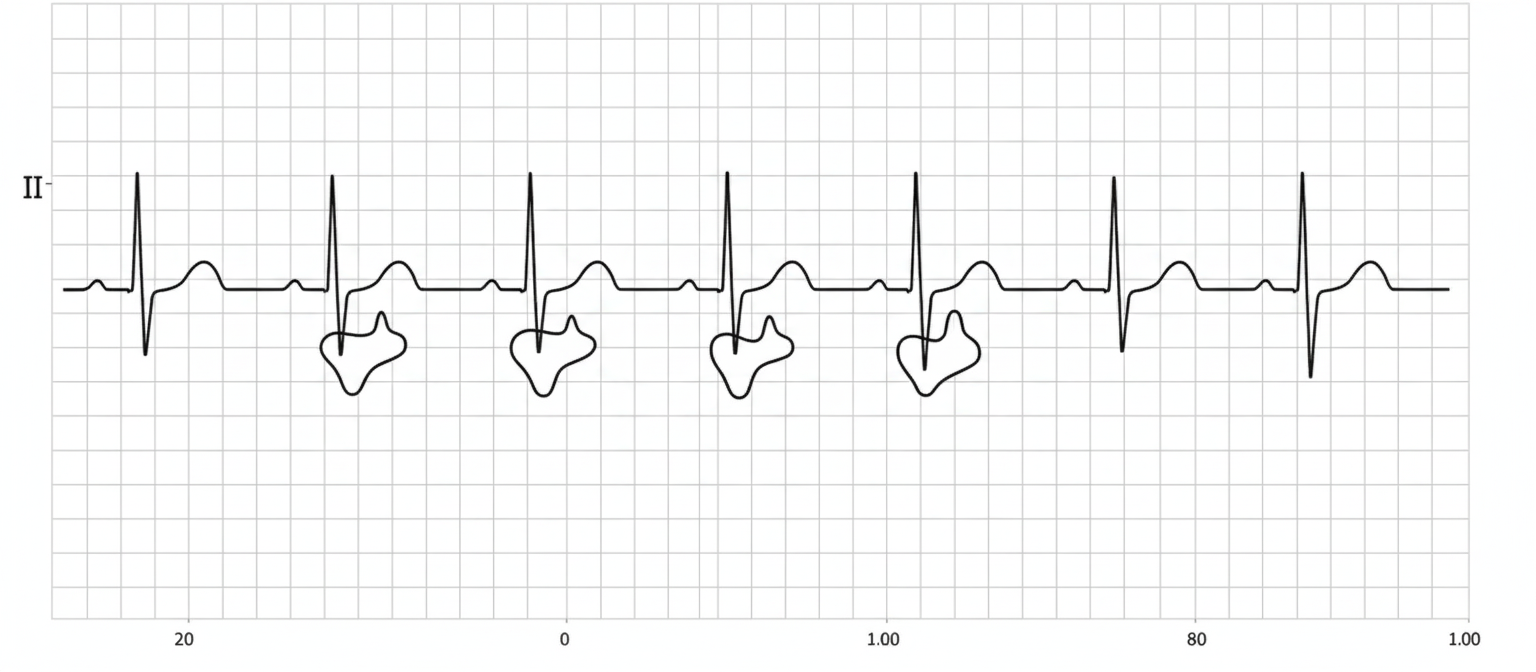
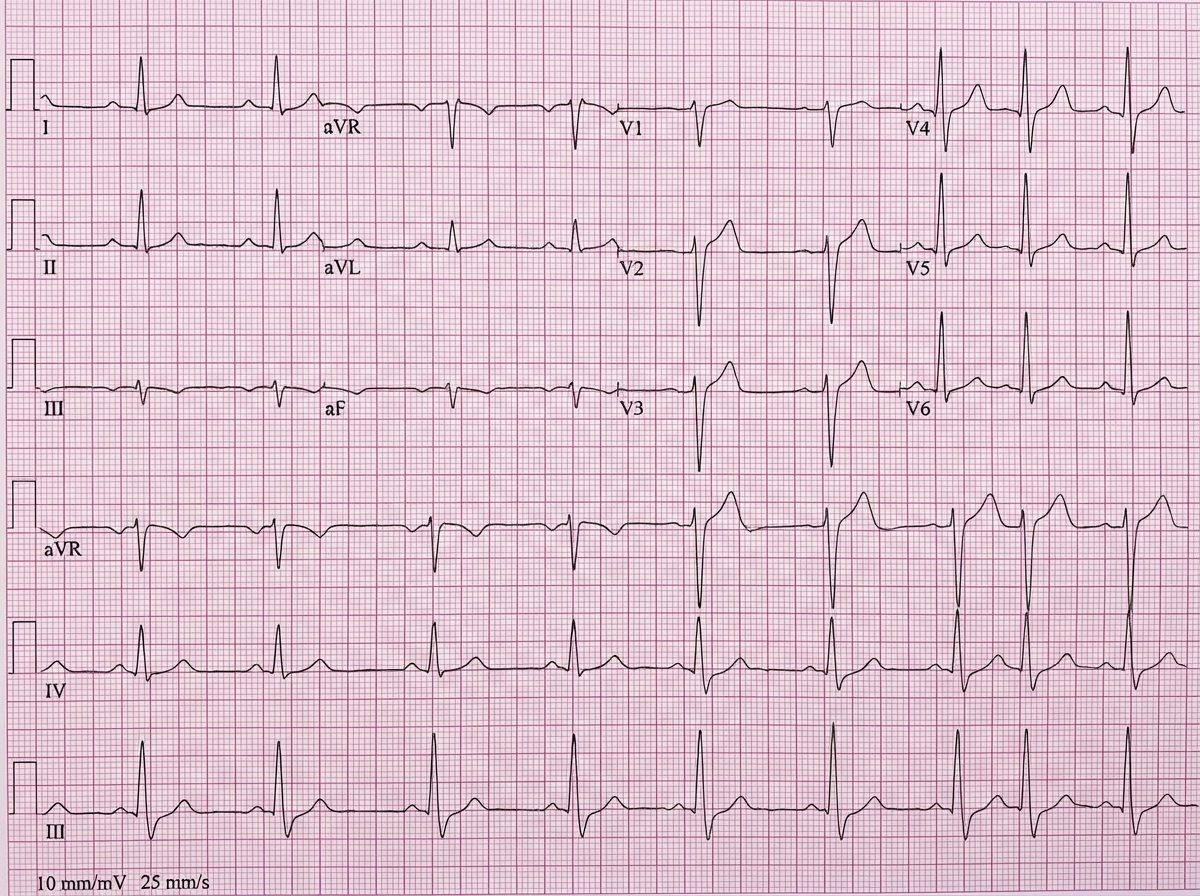
A 20-year-old college basketball player presents with chest pain and palpitations during practice. He denies dyspnea, tachypnea, family history of cardiac disease, and social history of alcohol or drug use. Cardiac auscultation is unremarkable, and ECG shows frequent premature ventricular contractions (PVCs). What is the most appropriate next step in evaluation and/or management?
What is the investigation of choice to assess cardiotoxicity of anthracycline drugs?
What is the most common cause of dilated cardiomyopathy?
A 32-year-old asymptomatic woman has a rapidly rising, forceful pulse that collapses quickly. Which of the following is the most likely diagnosis?
A 55-year-old hypertensive patient presents with a standing blood pressure of 190/105 mmHg and a sitting blood pressure of 180/100 mmHg. The patient also exhibits an irregularly irregular rhythm, a double apical impulse, and bilateral basal crepitations, with no audible murmurs. The heart rate is not determinable. What is the likely underlying cause?
Peripheral edema in Congestive Cardiac Failure (CCP) is due to which of the following mechanisms?
What is the most common cause of hypertension in adults?
A 50-year-old man is admitted to the hospital with acute myocardial infarction. After 12 hours, he becomes hypotensive and oliguric. His blood pressure is 90/60 mmHg, heart rate is 60 BPM, and JVP is 15 cm H2O. Cardiac auscultation reveals regular heart sounds without gallop, murmur, or rub, and lung auscultation is clear. What is the most appropriate next step?
Adams-Stokes syndrome is caused due to?
A 46-year-old diabetic man complains of soreness of the left leg. He is moderately obese and had undergone cholecystectomy 2 weeks ago. Examination revealed swelling in the lower leg along with tenderness in the calf that increased when the calf was gently squeezed. No redness of the leg was noted and the patient was afebrile. What is the most likely diagnosis?
Explanation: ### Explanation **Correct Option: A. Obtain urine drug screen** The clinical presentation of a young, healthy athlete with sudden onset chest pain, palpitations, and frequent premature ventricular contractions (PVCs) in the absence of a significant family history or structural heart disease should raise immediate suspicion for **sympathomimetic drug use**, specifically **cocaine or amphetamines**. [1] In the NEET-PG context, when a young patient presents with acute cardiac symptoms and an unremarkable physical exam, "occult substance abuse" must be ruled out before proceeding to invasive or chronic cardiac management. Cocaine increases synaptic dopamine and norepinephrine, leading to coronary vasospasm, tachycardia, and increased myocardial excitability (PVCs). A urine drug screen is the most appropriate, non-invasive next step to confirm the etiology. **Why other options are incorrect:** * **B. Treadmill stress test:** While used to evaluate exercise-induced arrhythmias, it is contraindicated in the acute phase of chest pain until a myocardial infarction or drug-induced vasospasm is ruled out. [2] * **C. Doppler ultrasound:** This is used to diagnose DVT/Pulmonary Embolism. The patient lacks risk factors (immobilization, surgery) and clinical signs (tachypnea, calf swelling) for thromboembolism. * **D. Beta-blocker therapy:** This is contraindicated if cocaine use is suspected. "Unopposed alpha-stimulation" following beta-blockade can worsen coronary vasospasm and hypertension. **High-Yield Clinical Pearls for NEET-PG:** * **Cocaine-induced MI:** Treatment of choice is **Benzodiazepines** (to reduce sympathetic outflow) and Nitrates. **Avoid Beta-blockers.** * **PVCs in Athletes:** Most are benign; however, if they increase with exercise, they require evaluation for Hypertrophic Cardiomyopathy (HCM) or Arrhythmogenic Right Ventricular Dysplasia (ARVD). [1] * **Young patient + Chest Pain:** Always consider Cocaine, Prinzmetal Angina, or Pericarditis.
Explanation: **Explanation:** **Anthracycline-induced cardiotoxicity** (caused by drugs like Doxorubicin and Daunorubicin) typically manifests as dose-dependent, irreversible dilated cardiomyopathy. **1. Why Echocardiography is the Correct Choice:** Transthoracic Echocardiography (TTE) is the **investigation of choice** because it is non-invasive, widely available, and allows for the serial monitoring of the **Left Ventricular Ejection Fraction (LVEF)** [1]. A decline in LVEF is the primary marker used to diagnose cardiotoxicity and guide the discontinuation of chemotherapy. Modern guidelines also emphasize **Global Longitudinal Strain (GLS)** via speckle-tracking echocardiography as a more sensitive tool to detect subclinical toxicity before the LVEF actually drops [1]. **2. Why Other Options are Incorrect:** * **Myocardial Biopsy:** While this is the *most definitive* (gold standard) method to detect early histological changes (like vacuolization), it is invasive and carries risks, making it impractical for routine screening. * **ECG:** Though it may show non-specific ST-T wave changes or arrhythmias, it lacks the sensitivity and specificity to quantify ventricular function or predict heart failure [2]. * **CT Angiography:** This is used to visualize coronary anatomy and is not the standard modality for functional assessment of chemotherapy-induced muscle damage [3]. **Clinical Pearls for NEET-PG:** * **MUGA Scan:** Historically considered the most accurate/reproducible for LVEF, but Echocardiography is preferred today due to lack of radiation. * **Dexrazoxane:** An iron-chelating agent used to *prevent* anthracycline-induced cardiomyopathy. * **Cumulative Dose:** Risk increases significantly once Doxorubicin exceeds **450–550 mg/m²**. * **Biomarkers:** Elevated **Troponin I** levels during chemotherapy can also predict a higher risk of subsequent cardiotoxicity.
Explanation: **Explanation:** **Dilated Cardiomyopathy (DCM)** is characterized by ventricular dilation and impaired systolic function [1]. While the majority of cases are classified as "idiopathic," **Alcohol** is recognized as the most common identifiable (non-idiopathic) cause of secondary dilated cardiomyopathy [1]. 1. **Why Alcohol is Correct:** Chronic ethanol consumption has a direct toxic effect on the myocardium and its metabolites (like acetaldehyde). It interferes with mitochondrial function, calcium handling, and protein synthesis. It is dose-dependent; however, unlike many other causes, alcoholic cardiomyopathy is potentially reversible if the patient practices total abstinence in the early stages [1]. 2. **Analysis of Incorrect Options:** * **Viral Infection:** While viral myocarditis (e.g., Coxsackie B, Adenovirus) is a frequent precursor to DCM, it is statistically less common than chronic alcohol-induced damage in the general adult population. * **Pregnancy:** Peripartum cardiomyopathy is a specific, rare form of DCM occurring in the last month of pregnancy or the first five months postpartum. It is not the "most common" cause. * **Metabolic Disease:** Conditions like thiamine deficiency (Wet Beriberi) or thyroid dysfunction can cause DCM, but these represent a much smaller percentage of cases compared to toxins like alcohol. **High-Yield Clinical Pearls for NEET-PG:** * **Most common cause of DCM overall:** Idiopathic (often has a genetic basis, e.g., *TTN* gene mutation encoding Titin) [1]. * **Most common identifiable cause:** Alcohol [1]. * **Reversibility:** Alcoholic DCM is one of the few reversible forms of heart failure with lifestyle modification [1]. * **Drug-induced DCM:** Doxorubicin (Anthracyclines) is a classic board-favorite cause of irreversible, dose-dependent DCM. * **Echo Finding:** "Global hypokinesia" with a reduced ejection fraction (EF <40%).
Explanation: ### Explanation The clinical description of a "rapidly rising, forceful pulse that collapses quickly" refers to a **Water-hammer pulse** (also known as Corrigan’s pulse or a Bounding pulse) [1]. **1. Why Aortic Regurgitation (AR) is correct:** In AR, the pulse pressure is widened due to two mechanisms: * **Increased Stroke Volume:** During diastole, blood leaks back from the aorta into the left ventricle (LV). The LV compensates by increasing its end-diastolic volume, leading to a forceful systolic contraction and a "rapidly rising" pulse [1], [3]. * **Diastolic Collapse:** The rapid backflow of blood into the LV and the peripheral runoff during diastole cause the arterial pressure to fall precipitously, resulting in the "quick collapse" [1]. **2. Why the other options are incorrect:** * **Mitral Stenosis (A):** Typically presents with a **low-volume pulse** (pulsus parvus) because the narrowed mitral valve limits LV filling, thereby reducing stroke volume. * **Mitral Regurgitation (B):** While it can cause a brisk upstroke, it does not typically produce the classic "collapsing" quality seen in AR because the aortic diastolic pressure remains relatively stable. * **Aortic Stenosis (C):** Characterized by **Pulsus Parvus et Tardus** (a small-volume pulse with a delayed peak/slow upstroke), which is the physiological opposite of the pulse described [2]. **3. High-Yield Clinical Pearls for NEET-PG:** * **Palpation Tip:** A water-hammer pulse is best felt by grasping the patient's forearm and elevating it above the level of the heart. * **Associated Signs of AR:** * **De Musset’s sign:** Head nodding with each heartbeat [1]. * **Quincke’s sign:** Capillary pulsations in the nail beds. * **Traube’s sign:** "Pistol shot" sounds heard over the femoral arteries. * **Duroziez’s sign:** Systolic and diastolic murmurs heard over the femoral artery when compressed. * **Murmur:** AR is characterized by a **high-pitched, blowing early diastolic murmur** heard best at the left 3rd intercostal space [3].
Explanation: **Explanation:** The clinical presentation points toward **Left Ventricular Hypertrophy (LVH)** secondary to long-standing hypertension. 1. **Why LVH is correct:** * **Double Apical Impulse:** This is the hallmark of the case. In a hypertrophied, non-compliant left ventricle, there is a forceful atrial contraction (atrial kick) against a stiff ventricle to assist filling. This produces a palpable **S4 (presystolic impulse)** just before the main systolic outward thrust, resulting in a "double" impulse. * **Hypertension & Heart Failure:** The high BP (190/105 mmHg) and bilateral basal crepitations suggest hypertensive heart disease leading to left-sided heart failure (pulmonary edema). * **Irregularly Irregular Rhythm:** Chronic LVH and atrial stretch often lead to **Atrial Fibrillation**, explaining the rhythm and the "undeterminable" heart rate. 2. **Why incorrect options are wrong:** * **Left Atrial Myxoma:** Usually presents with a "tumor plop" or a murmur mimicking mitral stenosis/regurgitation that changes with posture. * **Mitral Regurgitation:** While it can cause heart failure and atrial fibrillation, it would characteristically present with a **pansystolic murmur** radiating to the axilla. * **Cor Pulmonale:** This refers to right-sided heart failure due to lung disease. It would present with raised JVP, pedal edema, and loud P2, rather than systemic hypertension and basal crepitations. **NEET-PG High-Yield Pearls:** * **Double Apical Impulse:** Seen in LVH (S4 + Apex beat) and Hypertrophic Cardiomyopathy (HCM). * **Triple Apical Impulse:** Pathognomonic for **HCM** (S4 + double systolic impulse due to mid-systolic obstruction). * **S4 Requirement:** An S4 (and thus the presystolic component of a double impulse) can only occur if the patient is in **sinus rhythm**. If the patient has progressed to permanent Atrial Fibrillation, the S4 disappears. However, in exam vignettes, these signs are often grouped to describe the underlying pathology (LVH).
Explanation: **Explanation:** In Congestive Cardiac Failure (CCF), the primary trigger for edema is a reduction in effective arterial blood volume due to decreased cardiac output. This activates the **Sympathetic Nervous System (SNS)** as a compensatory mechanism. **Why Option A is correct:** Increased sympathetic tone leads to renal vasoconstriction and stimulates the **Renin-Angiotensin-Aldosterone System (RAAS)**. This results in significant sodium and water retention by the kidneys. The expanded plasma volume increases venous pressure, which eventually leads to fluid extravasation into the interstitial space (edema). While hydrostatic pressure is the *immediate* physical cause, the *pathophysiological mechanism* driving the fluid overload in CCF is the neurohormonal activation (SNS and RAAS). **Why other options are incorrect:** * **B. ANP deficiency:** In CCF, ANP levels are actually **increased** due to atrial stretch. However, the body becomes "resistant" to its natriuretic effects, or the SNS/RAAS activation simply overwhelms the compensatory action of ANP. * **C. Increased hydrostatic pressure:** While increased hydrostatic pressure is the physical force that pushes fluid out of capillaries, it is a *consequence* of the volume expansion and venous congestion initiated by sympathetic and RAAS activation. In many NEET-PG contexts, the "mechanism" refers to the underlying physiological trigger. * **D. Pulmonary hypertension:** This leads to right-sided heart failure, which can cause peripheral edema, but it is a cause of failure rather than the systemic mechanism of fluid retention itself. **High-Yield Clinical Pearls for NEET-PG:** * **Forward Failure Theory:** Focuses on decreased renal perfusion leading to salt/water retention (SNS/RAAS). * **Backward Failure Theory:** Focuses on elevated venous pressures (Hydrostatic pressure). * **Pitting Edema:** Requires a minimum of **5 liters** of fluid accumulation before it becomes clinically apparent. * **Drug of Choice:** Loop diuretics (Furosemide) are used to counteract this fluid retention by promoting natriuresis.
Explanation: **Explanation:** **1. Why Essential Hypertension is Correct:** Essential (Primary) hypertension is defined as high blood pressure with no identifiable secondary cause. It accounts for approximately **90–95% of all adult cases** [1]. The underlying pathophysiology is multifactorial, involving a complex interplay of genetic predisposition, environmental factors (high salt intake, obesity), and neurohormonal activation (Sympathetic Nervous System and RAAS) [1]. Because it lacks a single discrete cause, it remains the most prevalent diagnosis in clinical practice [2]. **2. Why the Other Options are Incorrect:** * **Pheochromocytoma (B):** This is a rare catecholamine-secreting tumor of the adrenal medulla. While it is a classic "textbook" cause of secondary hypertension, it accounts for less than 0.2% of cases. * **Renal Artery Stenosis (C):** This is the most common cause of *secondary* hypertension (specifically renovascular hypertension), but it is far less common than essential hypertension in the general population. * **Chronic Glomerulonephritis (D):** This is a common cause of *renal parenchymal* hypertension. While renal disease is the most frequent cause of secondary hypertension in children, it does not surpass essential hypertension in adults. **3. NEET-PG High-Yield Pearls:** * **Most common cause of Secondary HTN:** Renal Parenchymal Disease (e.g., Glomerulonephritis). * **Most common *curable* cause of HTN:** Renal Artery Stenosis (Atherosclerosis in elderly; Fibromuscular Dysplasia in young females). * **Definition of HTN (ACC/AHA):** ≥130/80 mmHg. * **Rule of Thumb:** If a question asks for the "most common cause" of a systemic condition and "Essential/Idiopathic" is an option, it is statistically the most likely answer.
Explanation: ### Explanation **Clinical Diagnosis: Right Ventricular (RV) Infarction** The patient presents with the classic triad of RV infarction: **Hypotension, Clear Lungs, and Elevated JVP** (distended neck veins) following an acute MI. The absence of crackles on lung auscultation and the lack of murmurs rule out left ventricular failure and mechanical complications like papillary muscle rupture. [1] **1. Why "Digoxin and Dopamine" is the Correct Answer:** In the setting of RV infarction, the right ventricle fails to pump blood effectively to the lungs, leading to decreased left-sided preload and subsequent systemic hypotension. * **Dopamine:** Acts as a positive inotrope and vasopressor to improve cardiac output and maintain mean arterial pressure. * **Digoxin:** While not the first-line agent in modern ACLS, in the context of this specific NEET-PG question format, it represents the need for **inotropic support** to enhance RV contractility when the patient remains hypotensive despite initial measures. [2] **2. Why Other Options are Incorrect:** * **A. Intravenous Furosemide:** Diuretics are **contraindicated**. RV infarction is highly preload-dependent; reducing intravascular volume will worsen hypotension and may lead to cardiovascular collapse. * **B. Intravenous Fluids:** While fluid resuscitation is the *initial* step to increase RV preload, this patient already has a significantly elevated JVP (15 cm H2O), suggesting he may have reached the limit of fluid responsiveness. If hypotension persists despite fluids, inotropes (Option C) are the next step. [2] * **D. Norepinephrine and IABP:** These are typically reserved for refractory cardiogenic shock (usually LV failure). IABP is less effective for isolated RV failure as it primarily improves coronary perfusion and reduces LV afterload. [1] **Clinical Pearls for NEET-PG:** * **ECG Hallmark:** ST-elevation in **V4R** (right-sided leads) is the most sensitive indicator of RV MI. * **Associated Artery:** Usually involves the **Right Coronary Artery (RCA)**. * **Management Rule:** "Give Fluids, Avoid Nitrates/Diuretics/Morphine" (drugs that reduce preload). * **Bradycardia:** Often seen in RCA occlusion due to SA/AV node ischemia; if present with hypotension, it further necessitates inotropic/chronotropic support. [3]
Explanation: **Explanation:** **Adams-Stokes Syndrome** (or Stokes-Adams attack) refers to a sudden, transient loss of consciousness (syncope) caused by a paroxysmal drastic decrease in cardiac output due to a sudden change in heart rate or rhythm [2]. **Why Ventricular Fibrillation is the Correct Answer:** The physiological basis of the syndrome is a sudden cessation of effective cerebral blood flow. While the classic cause taught is **Complete Heart Block (Third-degree AV block)** with a period of asystole before an idioventricular rhythm takes over, **Ventricular Fibrillation (VF)** or paroxysmal ventricular tachycardia are equally significant causes [1]. In these states, the ventricles quiver or beat too rapidly to allow for filling, leading to an immediate drop in cardiac output, cerebral hypoxia, and subsequent syncope. **Analysis of Incorrect Options:** * **Atrial Fibrillation (A):** While it causes an irregular pulse, the AV node usually filters the impulses, maintaining a ventricular rate sufficient to prevent sudden syncope. * **Atrial Extrasystole (B):** These are premature beats that are generally benign and do not compromise cardiac output enough to cause loss of consciousness [3]. * **Complete AV Block (C):** While this is a very common cause of Adams-Stokes attacks, in the context of this specific question format (where VF is marked correct), it highlights that any rhythm leading to "ventricular standstill" or "ineffective contraction" (like VF) triggers the syndrome. **NEET-PG High-Yield Pearls:** * **Clinical Presentation:** Sudden collapse without warning, pallor followed by flushing (on recovery), and jerky movements (if hypoxia lasts >15 seconds, mimicking a seizure). * **ECG Finding during attack:** Asystole, severe bradycardia, or Ventricular Fibrillation [1]. * **Management:** Immediate management involves CPR/defibrillation if VF is present; long-term treatment usually requires a **permanent pacemaker**.
Explanation: The clinical presentation strongly suggests **Deep Vein Thrombosis (DVT)**. The patient has multiple risk factors according to **Virchow’s Triad** (stasis, endothelial injury, and hypercoagulability): recent major surgery (cholecystectomy 2 weeks ago), obesity, and diabetes [1]. The physical findings of unilateral leg swelling, calf tenderness, and a positive **Pratt’s sign** (pain on squeezing the calf) are classic indicators [1], [2]. **Why the other options are incorrect:** * **Cellulitis:** Typically presents with systemic symptoms like fever and localized signs of inflammation such as warmth, intense redness (erythema), and poorly demarcated swelling [1]. This patient is afebrile and lacks redness. * **Superficial Thrombophlebitis:** Usually presents with a palpable, indurated, cord-like vein with overlying erythema and localized pain, rather than generalized calf swelling and deep tenderness. * **Stress Fracture:** Generally occurs after a sudden increase in physical activity or repetitive stress. While it causes localized pain, it does not typically cause significant calf swelling or tenderness triggered by muscle compression. **NEET-PG High-Yield Pearls:** 1. **Wells Criteria:** Used clinically to estimate the pre-test probability of DVT [1]. 2. **Gold Standard Investigation:** Contrast Venography (rarely used now). 3. **Investigation of Choice:** Color Doppler Ultrasound (Duplex USG). 4. **Homan’s Sign:** Pain in the calf on dorsiflexion of the foot (low sensitivity/specificity). 5. **Management:** Immediate anticoagulation with LMWH or Fondaparinux, followed by oral anticoagulants (Warfarin or DOACs) [1].
Coronary Artery Disease and Angina
Practice Questions
Acute Coronary Syndromes
Practice Questions
Heart Failure
Practice Questions
Cardiac Arrhythmias
Practice Questions
Valvular Heart Diseases
Practice Questions
Cardiomyopathies
Practice Questions
Pericardial Diseases
Practice Questions
Congenital Heart Disease in Adults
Practice Questions
Hypertension and Hypertensive Emergencies
Practice Questions
Pulmonary Hypertension
Practice Questions
Non-invasive Cardiac Diagnostics
Practice Questions
Preventive Cardiology
Practice Questions
Get full access to all questions, explanations, and performance tracking.
Start For Free