A 57-year-old man presents with sudden onset of severe and central chest pain radiating to the back. ECG shows ST segment elevation in leads V1-V6, I, aVL. The chest X-ray shows a widened mediastinum. What is the most likely diagnosis?
A 65-year-old hypertensive male presented to the ER with sudden onset of severe, tearing pain in the back of the chest, more so in the interscapular region. He also experienced dyspnea, hemiplegia, hemianesthesia, and frequent episodes of syncope in the past 2 days. On examination, the patient was hypotensive with feeble pulses in bilateral radial arteries, a wide pulse pressure, and a diastolic murmur radiating towards the right sternal border. All of the following are true about the condition except:
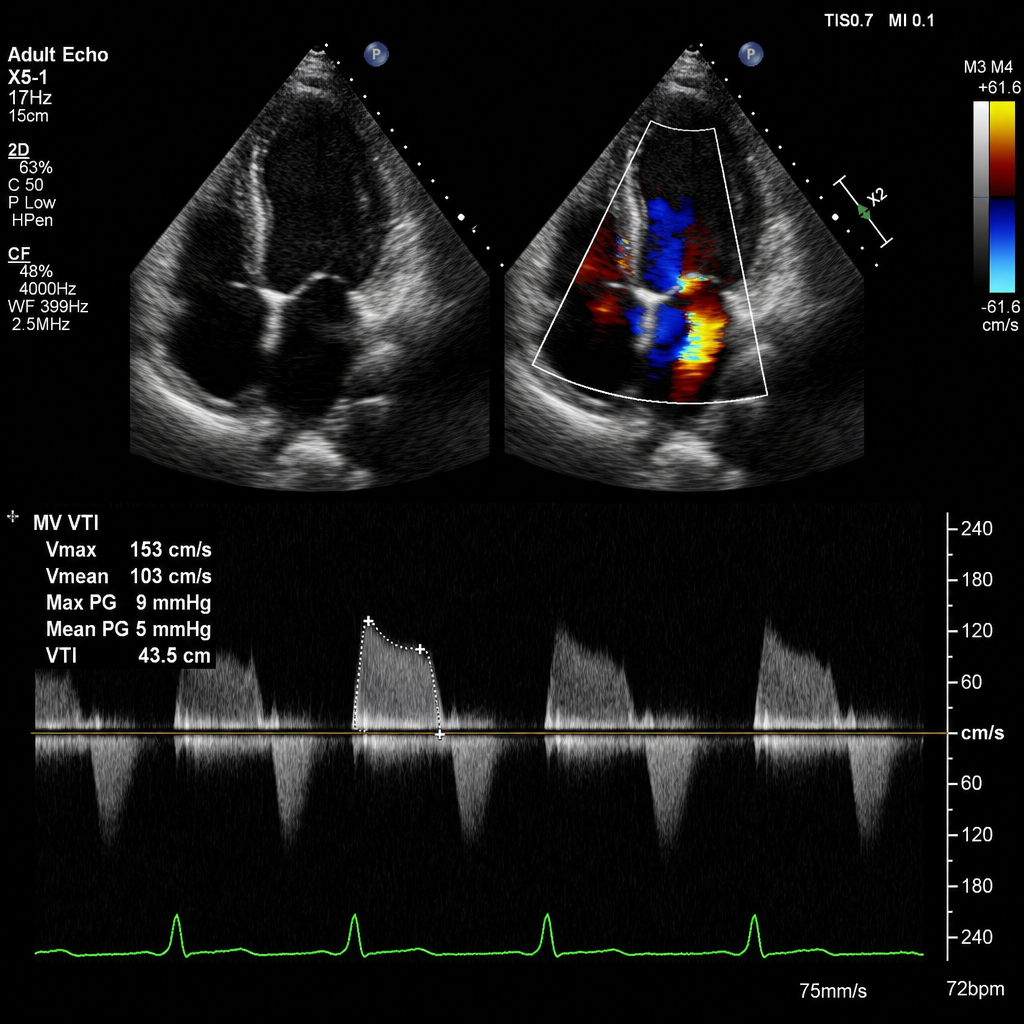
All of the following are true for mitral valve prolapse, except?
A systolic thrill in the left 2nd and 3rd intercostal space may be seen in all of the following conditions, except?
All of the following are true about Right Ventricular Infarcts, except?
A 68-year-old woman presents to the emergency department complaining of chest pain for the past 30 minutes. The pain is retrosternal in location and it radiates to her neck. She has no history of cardiac conditions or similar episodes of chest discomfort, and her past medical history includes hypertension and dyslipidemia. On physical examination, she is diaphoretic and in moderate distress. The blood pressure is 150/90 mm Hg, the heart sounds are normal, and the lungs are clear on auscultation. The ECG is shown in Figure below. Which of the following mechanisms is the most likely cause of her condition?

Hypotension with muffled heart sounds and congested neck veins is characteristic of which condition?
The square root sign on abnormal ventricular filling is characteristic of which condition?
Eight days after undergoing a hysterectomy, a 64-year-old woman complains of chest pain. After 12 hours, which test will most likely support the diagnosis of myocardial infarction?
Which of the following valvular lesions is usually NOT seen in rheumatic heart disease?
Explanation: ### Explanation **Correct Option: A. Aortic dissection** The clinical presentation of sudden-onset "tearing" chest pain radiating to the back, combined with a **widened mediastinum** on chest X-ray, is a classic triad for aortic dissection [1]. While the ECG shows ST-elevation (STEMI), this occurs in approximately 1–5% of cases when the dissection flap extends proximally to involve the **ostium of the coronary arteries** (most commonly the right coronary artery, leading to inferior MI, but can involve the left main coronary artery as seen here). In NEET-PG, the combination of "mediastinal widening" plus "MI patterns" should immediately raise suspicion for a Type A dissection. **Incorrect Options:** * **B. Acute cor pulmonale:** Usually presents with sudden dyspnea, pleuritic chest pain, and ECG signs of right heart strain (S1Q3T3, RBBB), not a widened mediastinum or global anterior STEMI. * **C. Acute myocardial infarction:** While the ECG strongly suggests this, a simple MI does not cause a widened mediastinum. Administering thrombolytics or anticoagulants in this scenario (thinking it is a simple MI) would be fatal if the underlying cause is a dissection [1]. * **D. Acute Pericarditis:** Typically presents with pleuritic pain relieved by leaning forward and diffuse ST-elevation (concave upwards) with PR depression [2]. It does not cause mediastinal widening. **High-Yield Clinical Pearls for NEET-PG:** * **Gold Standard Investigation:** CT Angiography (stable patients) or Transesophageal Echocardiogram (unstable patients). * **Stanford Classification:** Type A involves the ascending aorta (surgical emergency); Type B involves only the descending aorta (medical management) [1]. * **Risk Factors:** Hypertension (most common), Marfan Syndrome, and Bicuspid Aortic Valve [1]. * **Physical Exam:** Look for pulse deficit or blood pressure discrepancy (>20 mmHg) between arms.
Explanation: The clinical presentation of sudden, "tearing" interscapular pain, hypertension, pulse deficits, and a new diastolic murmur (Aortic Regurgitation) is classic for **Aortic Dissection** [1]. The neurological deficits (hemiplegia) suggest involvement of the carotid arteries, while syncope and hypotension indicate potential cardiac tamponade. [1] **1. Why "Inflammation is usually present" is FALSE (Correct Answer):** Aortic dissection is primarily a **non-inflammatory** process. Pathologically, it involves a cleavage of the aortic media. Unlike aortitis (seen in Takayasu or Syphilis), the histological hallmark of dissection is **Cystic Medial Degeneration (CMD)**, characterized by the loss of smooth muscle cells and elastic fibers without a significant inflammatory infiltrate. **2. Analysis of Other Options:** * **Option A:** CMD is indeed the most common histological finding, especially in older hypertensive patients and those with Marfan syndrome. * **Option C:** In patients under 40, aortic dissection is highly associated with connective tissue disorders like **Marfan Syndrome** [1] or **Ehlers-Danlos Syndrome** (Type IV) [1]. * **Option D:** **Beta-blockers** (e.g., Labetalol, Esmolol) are the first-line medical management. They reduce the heart rate and the rate of rise of left ventricular pressure (dP/dt), which limits the propagation of the dissecting hematoma. **Clinical Pearls for NEET-PG:** * **Gold Standard Investigation:** Transesophageal Echocardiogram (TEE) [2] for unstable patients; CT Angiography [2] for stable patients. * **Stanford Classification:** Type A (involves ascending aorta) requires urgent surgery; Type B (descending only) is usually managed medically [1]. * **Right Sternal Border Murmur:** A diastolic murmur heard better at the right sternal border (rather than the left) strongly suggests aortic root dilatation/dissection.
Explanation: Mitral Valve Prolapse (MVP), also known as Barlow’s Syndrome, is the most common cause of isolated mitral regurgitation (MR) in developed countries. However, the statement in Option B is incorrect because the **majority of patients with MVP are asymptomatic** and do not present with clinically significant mitral regurgitation. While MVP is a leading cause of MR, most individuals have a benign course with only a mid-systolic click and no significant murmur [1]. **Analysis of Options:** * **Option A:** MVP can occur sporadically or as a familial condition. In familial cases, it is most commonly transmitted as an **autosomal dominant** trait with variable penetrance. * **Option C:** The hallmark pathological finding is **myxomatous degeneration**, characterized by the proliferation of the spongiosa layer and deposition of glycosaminoglycans, which weakens the chordae tendineae and leaflets. * **Option D:** MVP is highly associated with heritable connective tissue disorders, most notably **Marfan’s Syndrome**, Ehlers-Danlos Syndrome, and Osteogenesis Imperfecta. **High-Yield Clinical Pearls for NEET-PG:** * **Auscultation:** Characterized by a **Mid-systolic click** [1] followed by a late systolic murmur (if MR is present). * **Dynamic Auscultation:** Maneuvers that decrease preload (Standing, Valsalva) make the click/murmur occur **earlier** in systole and often louder. Maneuvers that increase preload (Squatting) delay the click/murmur. * **Complications:** Though rare, complications include severe MR, infective endocarditis, chordal rupture, and sudden cardiac death. * **Treatment:** Asymptomatic patients require only reassurance. Beta-blockers are used for palpitations or chest pain. Mitral valve repair is often preferred over replacement for severe prolapse [2].
Explanation: A systolic thrill in the **left 2nd and 3rd intercostal spaces (ICS)** corresponds to the **pulmonary area**. A thrill is the palpable vibration of a loud murmur (typically Grade 4/6 or higher), indicating high-velocity or turbulent blood flow across the right ventricular outflow tract (RVOT) or the pulmonary valve. **Why Ebstein’s Anomaly is the Correct Answer:** In Ebstein’s anomaly, there is downward displacement of the tricuspid valve leaflets into the right ventricle. This leads to severe **Tricuspid Regurgitation (TR)**. The murmur of TR is best heard at the **lower left sternal border** (4th/5th ICS), not the pulmonary area [1]. Furthermore, the murmur in Ebstein’s is often soft despite significant pathology, and the RVOT flow is typically decreased, making a pulmonary area thrill highly unlikely. **Analysis of Incorrect Options:** * **Pulmonic Stenosis:** This is the classic cause of a systolic thrill in the left 2nd ICS due to high-velocity turbulent flow across a narrowed pulmonary valve. * **Subpulmonic VSD (Supracristal):** Unlike perimembranous VSDs (heard at the 4th ICS), subpulmonic VSDs are located just below the pulmonary valve. The shunt flow is directed into the RVOT, producing a thrill in the left 2nd/3rd ICS. * **Pink Tetralogy of Fallot (TOF):** In "Pink" TOF, the right-to-left shunt is minimal. The predominant finding is significant infundibular pulmonary stenosis, which creates loud turbulence and a palpable thrill in the pulmonary area. **High-Yield Clinical Pearls for NEET-PG:** * **Left 2nd ICS Thrill:** Pulmonic Stenosis, ASD (rarely, due to high flow), Subpulmonic VSD. * **Right 2nd ICS Thrill:** Aortic Stenosis. * **Left 4th ICS Thrill:** Ventricular Septal Defect (Maladie de Roger). * **Ebstein’s Anomaly Triad:** "Sail sign" on CXR (huge right atrium), multiple heart sounds (split S1, S2, S3, S4 - "bizarre rhythm"), and WPW syndrome association.
Explanation: Right Ventricular Infarction (RVI) typically presents as a syndrome of **isolated right-sided heart failure**. The pathophysiology involves a failure of the right ventricle to pump blood into the pulmonary circulation, leading to systemic venous congestion. **Why Orthopnea is the correct answer:** Orthopnea (shortness of breath when lying flat) is a hallmark symptom of **Left Ventricular (LV) failure** [1]. It occurs due to the redistribution of fluid from the lower extremities to the lungs, increasing pulmonary capillary wedge pressure (PCWP). In pure RVI, the lungs are usually "clear" because the failing right heart cannot pump enough blood into the pulmonary vasculature to cause congestion or edema. In fact, PCWP in RVI is typically low or normal. **Analysis of incorrect options (Features of RVI):** * **Hepatomegaly and Ascites:** These are results of systemic venous hypertension. When the RV fails, blood backs up into the Inferior Vena Cava (IVC), leading to hepatic congestion (congestive hepatomegaly) and eventually fluid leakage into the peritoneal cavity (ascites). * **Nocturia:** In the daytime, gravity causes fluid to pool in the legs. At night, when the patient lies flat, venous return increases, improving renal perfusion and leading to increased urine production [1]. **High-Yield Clinical Pearls for NEET-PG:** * **Triad of RVI:** Hypotension, Clear Lungs, and Elevated JVP (Kussmaul’s sign may be present). * **ECG Diagnosis:** ST-elevation in **V4R** (most sensitive lead) in the setting of an Inferior Wall MI. * **Management Contraindication:** Avoid **Nitrates, Diuretics, and Morphine**, as they decrease preload. RVI is "preload dependent." * **Treatment of Choice:** Aggressive **IV Fluid resuscitation** (Normal Saline) to maintain RV filling pressure.
Explanation: ***Coronary plaque rupture*** - The **acute onset** of severe chest pain with **retrosternal location** and radiation to the neck, along with **diaphoresis** and distress, is classic for **acute coronary syndrome (ACS)**. - **Coronary plaque rupture** with subsequent **thrombosis** is the most common pathophysiological mechanism underlying **ST-elevation myocardial infarction (STEMI)** and **non-STEMI**, which fits this clinical presentation. *Aortic inflammation* - **Aortitis** typically presents with **tearing chest pain** that radiates to the back, not the neck, and is often associated with **blood pressure differentials** between arms. - The pain is usually described as **sudden onset** and **ripping** in nature, which differs from the retrosternal chest pain described in this case. *Pericardial inflammation* - **Pericarditis** characteristically presents with **pleuritic chest pain** that worsens with inspiration and improves when sitting forward. - It typically shows **diffuse ST elevation** across multiple leads on ECG, unlike the pattern expected in acute coronary syndrome. *Vasculitis* - **Systemic vasculitis** affecting coronary arteries is rare and typically occurs in the context of **autoimmune conditions** like **polyarteritis nodosa** or **Kawasaki disease**. - It usually presents with **systemic symptoms** such as fever, weight loss, and multi-organ involvement, which are absent in this acute presentation.
Explanation: ### Explanation The triad of **hypotension, muffled heart sounds, and jugular venous distension (congested neck veins)** is known as **Beck’s Triad**, which is the classic clinical hallmark of **Cardiac Tamponade** [1]. **1. Why Cardiac Tamponade is Correct:** In cardiac tamponade, fluid accumulates in the pericardial sac under high pressure. This pressure exceeds the diastolic pressure of the cardiac chambers (starting with the right atrium and ventricle), leading to impaired diastolic filling [1]. * **Hypotension:** Occurs due to decreased stroke volume and cardiac output. * **Muffled Heart Sounds:** The fluid layer acts as an insulator, dampening the transmission of sound from the heart to the chest wall. * **Congested Neck Veins:** Impaired filling of the right heart leads to increased systemic venous pressure. **2. Why the Other Options are Incorrect:** * **Pericardial Effusion:** While this is the precursor to tamponade, a simple effusion without hemodynamic compromise (tamponade) usually does not present with hypotension or the full Beck’s triad. * **Constrictive Pericarditis:** Characterized by a rigid, scarred pericardium [3]. While it causes congested neck veins and a **Kussmaul sign**, heart sounds are typically sharp (pericardial knock) rather than muffled, and hypotension is less acute. * **Acute Congestive Heart Failure:** Presents with congested neck veins and hypotension (in cardiogenic shock) [2], but is typically associated with **pulmonary edema (crackles)** [4] and S3/S4 gallops rather than muffled heart sounds. **3. High-Yield Clinical Pearls for NEET-PG:** * **Pulsus Paradoxus:** An exaggerated drop in systolic BP (>10 mmHg) during inspiration; a key finding in tamponade. * **ECG Findings:** Low voltage QRS and **Electrical Alternans** (alternating QRS amplitude due to the heart "swinging" in fluid) [1]. * **Echocardiography:** The gold standard for diagnosis; shows **early diastolic collapse of the Right Ventricle** [1]. * **Treatment:** Immediate **Pericardiocentesis** [1].
Explanation: ### Explanation **Correct Answer: D. Constrictive pericarditis** The **"Square Root Sign"** (also known as the **Dip-and-Plateau** pattern) is a classic hemodynamic hallmark of **Constrictive Pericarditis**. **Mechanism:** In constrictive pericarditis, the pericardium becomes rigid and non-compliant. During early diastole, the ventricles are empty and the pressure is low, allowing for rapid, vigorous filling. However, as the expanding ventricle hits the rigid "shell" of the pericardium, filling is abruptly halted. * **The "Dip":** Represents the rapid drop in ventricular pressure during early diastole. * **The "Plateau":** Represents the sudden cessation of filling and the subsequent rise/leveling of pressure for the remainder of diastole. --- ### Why the other options are incorrect: * **A. Atrial Septal Defect (ASD):** Characterized by a fixed split S2 and right ventricular volume overload, but does not involve a rigid pericardial barrier. * **B. Mitral Valve Prolapse Syndrome (MVPS):** Associated with a mid-systolic click and late systolic murmur; it does not typically alter the diastolic pressure waveform in this manner. * **C. Dilated Cardiomyopathy:** This is a systolic failure condition. While it may show elevated filling pressures, it lacks the rapid early diastolic suction and abrupt halt seen in constriction. --- ### NEET-PG High-Yield Pearls: * **Kussmaul’s Sign:** Paradoxical rise in JVP on inspiration (Common in Constrictive Pericarditis, absent in Cardiac Tamponade). * **Pericardial Knock:** An early diastolic sound heard shortly after S2, corresponding to the "plateau" phase. * **Imaging:** CT/MRI showing a **thickened, calcified pericardium** (>2mm) is the gold standard for anatomical diagnosis. * **Differential:** Restrictive Cardiomyopathy also shows a dip-and-plateau sign, but Constrictive Pericarditis is distinguished by **ventricular discordance** (interventricular dependence) on echo.
Explanation: The clinical scenario describes a postoperative patient (high-risk for cardiovascular events) presenting with chest pain, likely indicating a **Myocardial Infarction (MI)**. **Why Option C is Correct:** **Technetium-99m (Tc-99m) pyrophosphate** is a "bone-seeking" radiopharmaceutical. In the setting of an acute MI, calcium accumulates within the damaged myocardial cells. The Tc-99m pyrophosphate binds to these calcium deposits, creating a **"hot spot"** on scintigraphy [1]. This test becomes positive approximately 12–24 hours after the infarct and remains positive for about 7–10 days [1]. It is particularly useful when biomarkers are equivocal or when a patient presents late. **Why Other Options are Incorrect:** * **Option A (SGOT/AST):** While SGOT rises in MI, it is highly non-specific as it is also found in the liver and skeletal muscle. In a postoperative patient (hysterectomy), surgical muscle trauma would likely cause a baseline elevation, making it unreliable for diagnosing MI. * **Option B (ESR):** An increased sedimentation rate is a non-specific marker of inflammation. It will be elevated due to the recent major surgery itself, providing no diagnostic value for MI. * **Option D (Thallium 201):** Thallium is an analog of potassium and is taken up by *viable* myocardium [1]. In an MI, the necrotic area will fail to take up the tracer, resulting in a **"cold spot"** (defect), not a hot spot [1]. **NEET-PG High-Yield Pearls:** * **"Hot Spot" Imaging:** Tc-99m Pyrophosphate (labels necrotic/damaged tissue) [1]. * **"Cold Spot" Imaging:** Thallium-201 or Tc-99m Sestamibi (labels viable/perfused tissue) [1]. * **Gold Standard Biomarker:** Cardiac Troponins (I or T) are the preferred diagnostic markers due to high sensitivity and specificity [2]. * **Post-op MI:** Often occurs within the first 48–72 hours; however, any sudden chest pain in a post-surgical elderly patient must be evaluated for MI and Pulmonary Embolism.
Explanation: ### Explanation **Correct Answer: D. Pulmonic stenosis (PS)** **Medical Concept:** Rheumatic Heart Disease (RHD) is a sequela of rheumatic fever caused by an autoimmune response to Group A Streptococcal infection [1]. It primarily affects the valves on the **left side** of the heart due to higher hemodynamic stress and pressure [1]. While the tricuspid valve can be involved, the **pulmonary valve is the least commonly affected** valve in RHD. Isolated rheumatic pulmonic stenosis is virtually non-existent; when pulmonic involvement occurs, it is usually in the form of mild regurgitation secondary to pulmonary hypertension (Graham Steell murmur). **Analysis of Options:** * **Mitral Stenosis (MS):** This is the **most common** valvular lesion in RHD [1]. Rheumatic fever is the leading cause of MS worldwide. * **Tricuspid Stenosis (TS):** Rheumatic etiology is the most common cause of organic TS [2]. It rarely occurs in isolation and is almost always associated with mitral or aortic valve disease [2]. * **Aortic Stenosis (AS):** RHD is a frequent cause of AS, often presenting with concomitant aortic regurgitation or mitral valve disease. **NEET-PG High-Yield Pearls:** * **Order of frequency in RHD:** Mitral > Aortic > Tricuspid > Pulmonic. * **Most common lesion:** Mitral Stenosis (MS). * **Most common mixed lesion:** MS + MR (Mitral Regurgitation). * **Pathognomonic finding:** Aschoff bodies in the myocardium (acute phase). * **Fish-mouth/Button-hole deformity:** Characteristic appearance of the mitral valve in chronic RHD due to commissural fusion. * **Tricuspid involvement:** If the tricuspid valve is involved, the mitral valve is almost always involved as well [2].
Coronary Artery Disease and Angina
Practice Questions
Acute Coronary Syndromes
Practice Questions
Heart Failure
Practice Questions
Cardiac Arrhythmias
Practice Questions
Valvular Heart Diseases
Practice Questions
Cardiomyopathies
Practice Questions
Pericardial Diseases
Practice Questions
Congenital Heart Disease in Adults
Practice Questions
Hypertension and Hypertensive Emergencies
Practice Questions
Pulmonary Hypertension
Practice Questions
Non-invasive Cardiac Diagnostics
Practice Questions
Preventive Cardiology
Practice Questions
Get full access to all questions, explanations, and performance tracking.
Start For Free