Resistant hypertension is when the goal blood pressure is not achieved with:
Which of the following is a supraventricular tachycardia?
In severe aortic stenosis, which of the following is a true finding?
Which drug is used in unstable angina to prevent myocardial infarction?
J waves (Osborn waves) on ECG are seen in all of the following conditions EXCEPT:
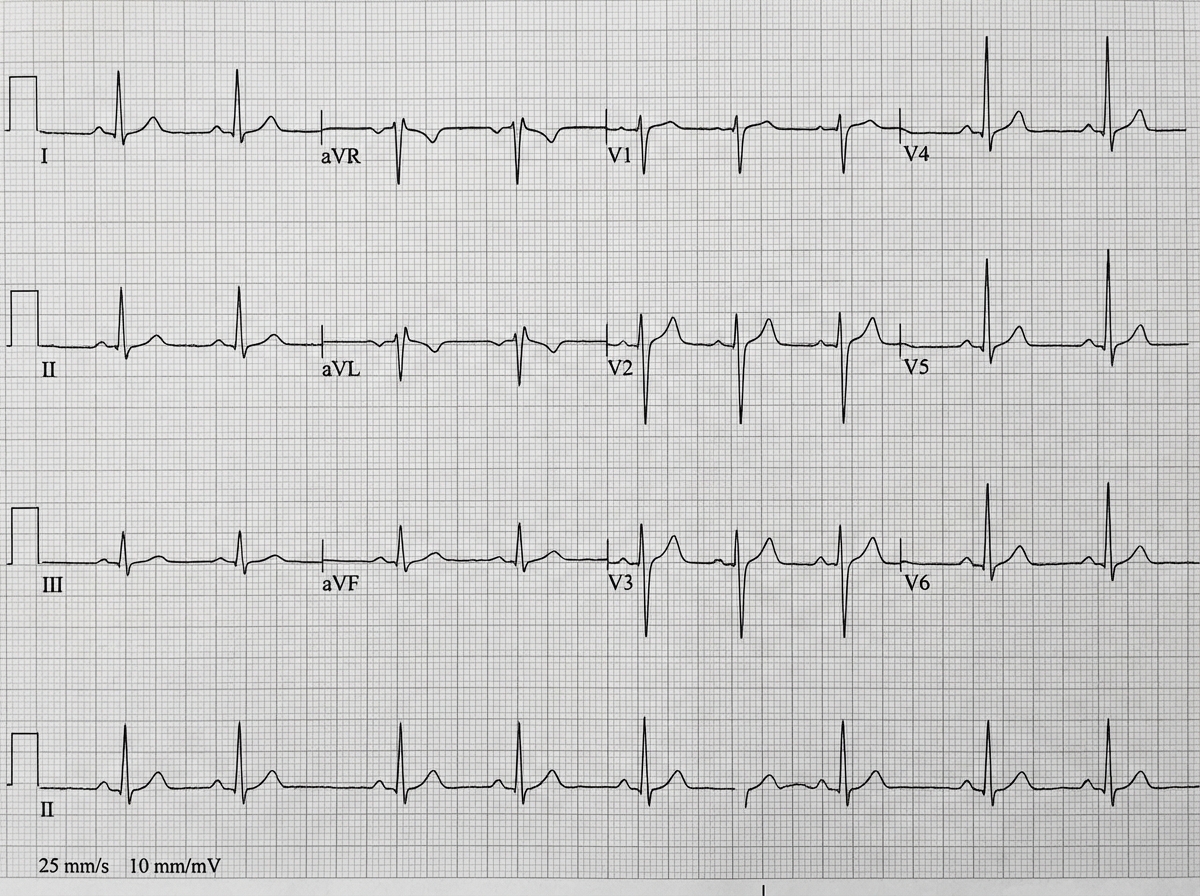
A 36-year-old female presents with a sensation of fast heart rate, slight dizziness, and vague chest fullness. Blood pressure is 110/70. The following rhythm strip is obtained, which shows?

A patient presents 12 hours following a Myocardial infarction. What is the test of choice?
A 37-year-old woman presents with shortness of breath on exertion. She has a past history of rheumatic fever as a child. On cardiac auscultation, there is a loud S1 and a mid-to-late low-pitched diastolic murmur. Which of the following findings is most likely to be seen on the chest X-ray in someone with mitral stenosis?
A 62-year-old man with carcinoma of the lung presented to the emergency department with respiratory distress. His ECG showed electrical alternans. What is the most likely diagnosis?
Which electrolyte imbalance is shown in the following ECG?

Explanation: **Explanation:** **Resistant Hypertension** is defined as blood pressure that remains above the target goal despite the concurrent use of **three antihypertensive agents** of different classes. 1. **Why Option B is correct:** According to standard guidelines (AHA/ACC and JNC), the definition specifically requires three drugs. To meet the criteria, one of these three agents **must be a diuretic**. Therefore, the combination is: **Two antihypertensive medications + One diuretic = Three medications total.** All agents should be prescribed at optimal or maximum tolerated doses. 2. **Why other options are incorrect:** * **Option A & D:** These describe "Refractory Hypertension," which is a more severe phenotype where BP remains uncontrolled despite using five or more antihypertensive agents, including a long-acting thiazide-like diuretic and a mineralocorticoid receptor antagonist (MRA) [1]. * **Option C:** This would imply a total of four drugs (3 + 1), which exceeds the minimum diagnostic threshold for resistant hypertension. **High-Yield Clinical Pearls for NEET-PG:** * **Pseudoresistance:** Before diagnosing resistant HTN, always rule out "White Coat Hypertension," medication non-compliance, and improper BP measurement technique [1]. * **Commonest Cause:** The most common secondary cause of resistant hypertension is **Obstructive Sleep Azpnea (OSA)**, followed by Primary Aldosteronism and Renal Artery Stenosis. * **Drug of Choice:** For patients already on a triple-drug regimen (ACEi/ARB + CCB + Diuretic), the addition of **Spironolactone** (a mineralocorticoid receptor antagonist) is the most effective next step in management. * **Target BP:** For most patients, the goal is <130/80 mmHg.
Explanation: **Explanation** Supraventricular Tachycardia (SVT) is a broad clinical term used to describe tachyarrhythmias that originate from or require structures **above the bifurcation of the Bundle of His** for their maintenance [2]. **Why "All of the Above" is Correct:** The term SVT encompasses several distinct rhythms based on their site of origin and mechanism [4]: * **Atrioventricular Nodal Re-entry Tachycardia (AVNRT):** The most common regular SVT. It involves a functional re-entry circuit within the AV node itself (utilizing "slow" and "fast" pathways) [1]. * **Atrioventricular Re-entry Tachycardia (AVRT):** Involves an anatomical bypass tract (accessory pathway) outside the AV node, such as in Wolff-Parkinson-White (WPW) syndrome [3]. * **Atrial Tachycardia (AT):** Originates from a focal point within the atrial myocardium, independent of the AV node [4]. Since all three options originate above the Bundle of His and result in a narrow-complex tachycardia (unless aberrancy is present), they are all classified as SVTs [3]. **Clinical Pearls for NEET-PG:** 1. **Acute Management:** The first-line treatment for a hemodynamically stable patient with narrow-complex SVT is **Vagal Maneuvers** (e.g., Valsalva, Carotid sinus massage), followed by **IV Adenosine** (drug of choice). 2. **Definitive Treatment:** For recurrent symptomatic SVT, **Radiofrequency Ablation (RFA)** is the treatment of choice. 3. **ECG Finding:** In AVNRT, P-waves are often buried within the QRS complex or appear as a "pseudo-S" wave in lead II or "pseudo-R'" in V1 [1]. 4. **Hemodynamic Instability:** Any tachycardia causing hypotension, altered mentation, or chest pain requires immediate **Synchronized DC Cardioversion.**
Explanation: Explanation: **Correct Answer: C. ST segment changes in ECG** In severe Aortic Stenosis (AS), the left ventricle (LV) must generate massive pressure to overcome the narrowed valve orifice. This leads to compensatory **Left Ventricular Hypertrophy (LVH)**. On an ECG, this manifests as high-voltage QRS complexes accompanied by **ST-segment depression and T-wave inversion** (the "LV strain pattern"). These changes reflect subendocardial ischemia due to increased myocardial oxygen demand and reduced coronary perfusion pressure, even in the absence of coronary artery disease. **Analysis of Incorrect Options:** * **A. Late systolic ejection click:** Ejection clicks occur in *mild-to-moderate* AS when the valve leaflets are still mobile. In **severe** AS, the valve is heavily calcified and immobile, causing the click to disappear [2]. * **B. Heaving with outward apex beat:** While AS causes a "heaving" (sustained) apex beat due to LVH, the apex is typically **not displaced** outward in pure AS. Displacement occurs only when the heart fails and dilates. * **D. Loud S2:** In severe AS, the aortic component of the second heart sound (A2) is **soft or absent** because the leaflets are too rigid to snap shut [1]. **High-Yield NEET-PG Pearls:** * **Classic Triad of AS:** Dyspnea (most common), Angina, and Syncope (SAD). * **Pulse Finding:** *Pulsus Parvus et Tardus* (small volume, slow-rising pulse). * **Auscultation:** A harsh crescendo-decrescendo systolic murmur [1]. The **later the peak** of the murmur, the more severe the stenosis. * **Reverse Splitting:** Severe AS can cause paradoxical splitting of S2.
Explanation: **Explanation:** **Aspirin (Correct Answer):** The primary pathology in unstable angina (UA) is the rupture or erosion of an atherosclerotic plaque, leading to sub-occlusive thrombus formation. Aspirin acts as an irreversible inhibitor of **Cyclooxygenase-1 (COX-1)**, preventing the synthesis of **Thromboxane A2** [1]. This inhibits platelet aggregation and prevents the progression of a partial thrombus to a complete occlusion (ST-Elevation MI) [2]. Clinical trials have proven that Aspirin reduces the risk of myocardial infarction (MI) and death in patients with UA by approximately 50%. **Incorrect Options:** * **Glyceryl trinitrate (GTN):** While GTN is the first-line drug for symptomatic relief of chest pain via venodilation (reducing preload), it **does not** improve mortality or prevent MI. * **Amlodipine:** This is a Calcium Channel Blocker (CCB) used for blood pressure control and vasospastic angina [3]. It does not have anti-platelet properties and is not used as a primary preventive measure for MI in the acute setting [4]. * **Fasudil:** This is a Rho-kinase inhibitor used primarily in the treatment of cerebral vasospasm and pulmonary hypertension; it has no established role in the management of unstable angina. **High-Yield Clinical Pearls for NEET-PG:** * **Dual Antiplatelet Therapy (DAPT):** In UA/NSTEMI, Aspirin is combined with a P2Y12 inhibitor (e.g., Clopidogrel, Ticagrelor) for synergistic effects. * **Loading Dose:** For acute coronary syndromes, the loading dose of Aspirin is **162–325 mg** (non-enteric coated, chewed for faster absorption). * **Contraindication:** Avoid Aspirin in patients with active peptic ulcer disease or known hypersensitivity (Aspirin-exacerbated respiratory disease).
Explanation: ***Hypocalcemia*** - Hypocalcemia causes **prolonged QT interval** on ECG, not **J waves (Osborn waves)**. - The primary ECG finding is **QT prolongation** due to delayed ventricular repolarization, which can predispose to **torsades de pointes**. *Hypothermia* - **J waves (Osborn waves)** are classically seen in **hypothermia**, appearing as positive deflections at the **J point** (junction of QRS and ST segment). - The waves become more prominent as body temperature drops below **32°C (90°F)** and are most pronounced in **leads II, V5, and V6**. *Hypercalcemia* - **Hypercalcemia** can cause **J waves** along with **shortened QT intervals** due to accelerated ventricular repolarization. - Other ECG changes include **widened QRS complexes** and potential **bradycardia** in severe cases. *Subarachnoid hemorrhage (SAH)* - **SAH** can produce **J waves** as part of **neurogenic cardiac effects** due to massive **catecholamine release**. - Other ECG abnormalities include **deep T wave inversions**, **QT prolongation**, and various **arrhythmias** due to autonomic dysfunction.
Explanation: ***Supraventricular tachycardia*** - Presents as **regular narrow-complex tachycardia** with a rate of **150-250 bpm** and absent or retrograde **P waves**, consistent with SVT. - Clinical presentation of **palpitations**, slight dizziness, and **preserved hemodynamics** (normal BP) is typical for SVT in young patients. *Atrial fibrillation* - Characterized by **irregularly irregular rhythm** with absent P waves and **variable RR intervals**, not a regular tachycardia. - Would show **fibrillatory waves** on ECG rather than the regular narrow-complex pattern seen in SVT. *Atrial flutter* - Shows characteristic **sawtooth flutter waves** at a rate of approximately **300 bpm** with regular **2:1 or 3:1 conduction block**. - Produces a more regular ventricular response but with **visible flutter waves** between QRS complexes, unlike SVT. *Ventricular tachycardia* - Presents as **wide-complex tachycardia** (QRS >120 ms) originating from ventricular tissue, not narrow complex. - Often associated with **hemodynamic compromise** and more severe symptoms than described in this stable patient.
Explanation: **Explanation:** The diagnosis of acute myocardial infarction (MI) relies on the detection of a rise and/or fall of cardiac biomarkers [3]. **Cardiac Troponins (I and T)** are the "Gold Standard" and the test of choice due to their high sensitivity and superior myocardial specificity [2]. 1. **Why Cardiac Troponins are correct:** Troponins begin to rise within **3–6 hours** of myocardial injury, peak at **12–24 hours**, and remain elevated for 7–14 days. At the 12-hour mark, Troponins are highly sensitive and are the preferred markers for diagnosing both STEMI and NSTEMI [2]. 2. **Why other options are incorrect:** * **Myoglobin:** This is the earliest marker to rise (1–2 hours), but it lacks cardiac specificity (also found in skeletal muscle) and returns to baseline within 24 hours. It is used for early "rule-out" but not for definitive diagnosis. * **Creatine Phosphokinase (CK-MB):** While specific to the heart, it peaks around 24 hours and returns to normal within 48–72 hours [3]. It is primarily used to detect **re-infarction** because of its short half-life compared to Troponin. * **Lactate Dehydrogenase (LDH):** This is a late marker (rises after 24 hours, peaks at 3–4 days). It is now obsolete in acute settings due to poor specificity [1]. **NEET-PG High-Yield Pearls:** * **Earliest marker:** Myoglobin. * **Most specific marker:** Cardiac Troponin I. * **Marker for Re-infarction:** CK-MB. * **Marker for late diagnosis (>7 days):** Troponin T (remains elevated longer than I). * **False positive Troponin:** Can occur in Chronic Kidney Disease (CKD), Pulmonary Embolism, and Sepsis.
Explanation: The clinical presentation of a young woman with a history of rheumatic fever, a loud S1, and a mid-diastolic murmur is classic for **Mitral Stenosis (MS)**. [1] **1. Why "Straightening of the left heart border" is correct:** In MS, the stenotic valve causes a pressure backup, leading to **Left Atrial Enlargement (LAE)**. On a chest X-ray, the left heart border normally has a concavity between the aortic arch and the left ventricle. In MS, this concavity is filled in (straightened) due to: * Enlargement of the **left atrial appendage**. * Prominence of the **pulmonary artery segment** (due to secondary pulmonary hypertension). [2] This is often the earliest and most characteristic radiological sign of MS. **2. Why the other options are incorrect:** * **A. General enlargement of the heart:** MS is a "small heart" disease. The left ventricle is usually normal or small because it is protected from volume overload. Global cardiomegaly is more typical of dilated cardiomyopathy or multi-valvular disease. [2] * **B. Kerley B lines:** While these occur in MS due to chronic pulmonary venous hypertension and interstitial edema, they represent a more advanced stage of the disease. Straightening of the left border is a more fundamental anatomical finding of the disease process itself. * **C. Attenuation of pulmonary arteries:** In MS, there is actually **cephalization** (redistribution) of pulmonary blood flow and enlargement of central pulmonary arteries due to pulmonary hypertension, not attenuation. [2] **Clinical Pearls for NEET-PG:** * **LAE Signs on CXR:** Double atrial shadow (double density sign), splaying of the carina (widening of the subcarinal angle >90°), and posterior displacement of the esophagus on barium swallow. * **Auscultation:** The interval between S2 and the **Opening Snap (OS)** correlates with severity; a shorter S2-OS interval indicates more severe MS. [1] * **Most common cause:** Rheumatic heart disease remains the leading cause of MS worldwide.
Explanation: ### Explanation **Correct Option: C. Cardiac Tamponade** The clinical presentation of respiratory distress in a patient with lung cancer, combined with the classic ECG finding of **electrical alternans**, is pathognomonic for cardiac tamponade [1]. * **Pathophysiology:** In cardiac tamponade, a large pericardial effusion causes the heart to "swing" back and forth within the fluid-filled pericardial sac [1]. This physical movement changes the heart's axis relative to the ECG electrodes with every beat, resulting in beat-to-beat variations in the amplitude of the QRS complexes (electrical alternans) [1]. * **Clinical Context:** Malignancy (especially lung and breast cancer) is a leading cause of rapidly accumulating pericardial effusions that progress to tamponade [1]. **Why other options are incorrect:** * **A. Pneumothorax:** While it causes respiratory distress and can shift the mediastinum, it does not cause electrical alternans. ECG might show low voltage or T-wave inversions, but not beat-to-beat variation. * **B. Pleural Effusion:** Large effusions cause respiratory distress and "stony dull" percussion notes, but they do not cause the heart to swinging; thus, electrical alternans is absent. * **D. Constrictive Pericarditis:** This is a chronic scarring process. While it shares some clinical features with tamponade (like Kussmaul’s sign), it does not involve a large fluid collection or a swinging heart. **NEET-PG High-Yield Pearls:** 1. **Beck’s Triad:** Hypotension, Jugular Venous Distention (JVD), and Muffled heart sounds (classic for tamponade). 2. **Pulsus Paradoxus:** An inspiratory drop in systolic BP >10 mmHg. 3. **ECG Findings:** Low voltage QRS complexes + Electrical alternans [1]. 4. **CXR:** "Water bottle" or "Money bag" heart appearance [1]. 5. **Treatment:** Immediate ultrasound-guided pericardiocentesis [1].
Explanation: ***Hyperkalemia*** - Classic ECG features include **peaked T-waves**, **widened QRS complexes**, and **prolonged PR intervals** as potassium levels rise. - Severe hyperkalemia can progress to **loss of P-waves** and a characteristic **sine-wave pattern** that can be life-threatening. *Hypokalemia* - Characterized by **flattened T-waves**, **prominent U-waves**, and **ST depression** on ECG. - May also show **prolonged QT intervals** and increased susceptibility to **arrhythmias** like torsades de pointes. *Hyponatremia* - Does not produce **specific ECG changes** as sodium primarily affects neurological function and fluid balance. - Clinical manifestations include **confusion**, **seizures**, and **cerebral edema** rather than cardiac conduction abnormalities. *Hypernatremia* - Also does not cause **characteristic ECG abnormalities** since sodium imbalances primarily affect **osmotic gradients** and cellular hydration. - Symptoms are predominantly **neurological** including altered mental status, restlessness, and in severe cases, coma.
Coronary Artery Disease and Angina
Practice Questions
Acute Coronary Syndromes
Practice Questions
Heart Failure
Practice Questions
Cardiac Arrhythmias
Practice Questions
Valvular Heart Diseases
Practice Questions
Cardiomyopathies
Practice Questions
Pericardial Diseases
Practice Questions
Congenital Heart Disease in Adults
Practice Questions
Hypertension and Hypertensive Emergencies
Practice Questions
Pulmonary Hypertension
Practice Questions
Non-invasive Cardiac Diagnostics
Practice Questions
Preventive Cardiology
Practice Questions
Get full access to all questions, explanations, and performance tracking.
Start For Free