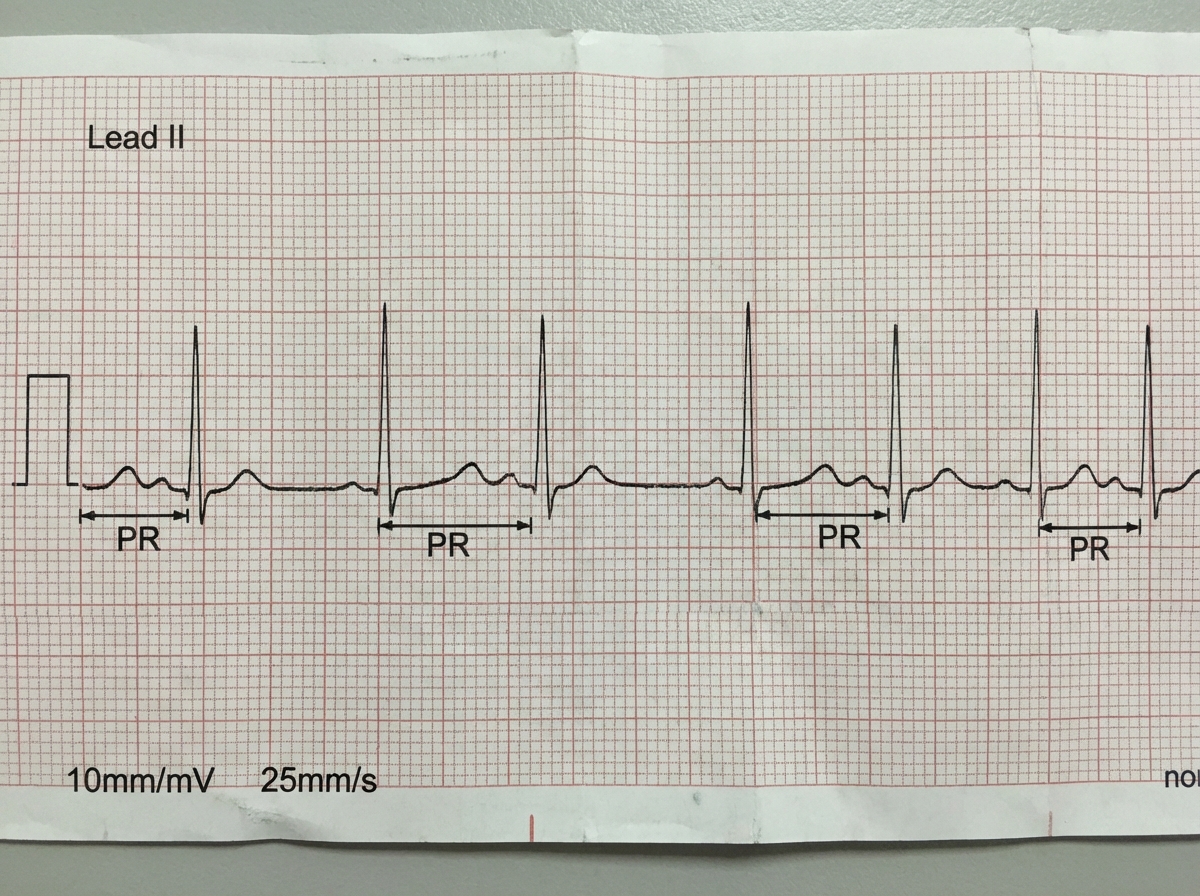
Bradycardia is a feature of which type of myocardial infarction?
The intensity of a murmur increases with sit-up and hand grip in all the following conditions except?
True about Dressler's syndrome is all, except?
What does DASH stand for?
Which of the following is NOT a complication of myocardial infarction?
A 34-year-old male with a history of palpitations presents to the emergency department with a pulse rate of 156/min and a BP of 70/40 mm Hg. The emergency crew has attempted vagal maneuvers and adenosine, to which the rhythm is refractory. What is the next step?
Which electrolyte imbalance is classically associated with a "tombstone" P wave on an ECG?
An axis deviation between -30 and -90 degrees indicates what?
Right axis deviation is seen in all EXCEPT?
A 50-year-old male presented to the ER with new onset chest pain that was progressively increasing in nature and described as tearing pain, persisting for more than 20 minutes. After ECG, the patient was immediately put on thrombolysis therapy. Which vein is accompanied by the artery involved in this case?
Explanation: **Explanation:** **Inferior wall myocardial infarction (MI)** is classically associated with bradycardia due to two primary pathophysiological mechanisms: 1. **Blood Supply to the Nodes:** In approximately 60% of individuals, the **Right Coronary Artery (RCA)** supplies the Sinoatrial (SA) node, and in 90%, it supplies the Atrioventricular (AV) node. Since the RCA is the culprit vessel in most inferior wall MIs, ischemia to these nodes leads to sinus bradycardia or AV blocks [2]. 2. **Bezold-Jarisch Reflex:** The inferior wall of the left ventricle is rich in vagal afferent fibers. Ischemia in this region triggers a parasympathetic reflex, resulting in the clinical triad of bradycardia, hypotension, and vasodilation. **Analysis of Incorrect Options:** * **Anteroseptal MI:** Usually involves the Left Anterior Descending (LAD) artery. This is more commonly associated with **tachycardia** (due to sympathetic activation) or bundle branch blocks rather than sinus bradycardia [1]. * **Lateral wall MI:** Involves the Left Circumflex (LCx) artery. While it can occasionally affect the SA node (in 40% of cases), it is not the classic or most frequent presentation for bradycardia compared to inferior MI. * **Posterior wall MI:** Often occurs alongside inferior or lateral MIs. While it may be associated with bradycardia if the RCA is involved, the primary association taught and tested is with the inferior wall. **High-Yield Facts for NEET-PG:** * **Drug of Choice:** Atropine is the initial treatment for symptomatic bradycardia in inferior MI [2]. * **Right Ventricular MI:** Always look for RV infarction in patients with inferior MI (seen in 40% of cases). Avoid nitrates in these patients as they are preload-dependent. * **ECG Findings:** Look for ST-elevation in leads II, III, and aVF [1].
Explanation: ### Explanation The intensity of a murmur depends on the pressure gradient and the volume of blood flowing across a valve or orifice. Understanding the hemodynamic effects of **Handgrip** and **Sitting up/Squatting** is crucial for NEET-PG. **1. Why HOCM is the Correct Answer:** Handgrip exercise increases **afterload** (systemic vascular resistance). In HOCM, increased afterload increases the left ventricular (LV) volume, which pushes the interventricular septum away from the mitral valve. This reduces the Left Ventricular Outflow Tract (LVOT) obstruction, thereby **decreasing** the intensity of the HOCM murmur. Similarly, sitting up/squatting increases venous return (preload) and afterload, both of which increase LV volume and decrease the murmur. **2. Analysis of Incorrect Options:** * **Mitral Stenosis (MS):** Handgrip increases heart rate and afterload, leading to increased back pressure and flow across the stenotic mitral valve, which **increases** the murmur intensity. * **Aortic Stenosis (AS):** While handgrip (increased afterload) usually decreases AS murmur intensity, the question asks about the combination of maneuvers. Generally, maneuvers that increase systemic resistance or venous return increase flow across stenotic valves. * **Tricuspid Regurgitation (TR):** Handgrip increases systemic resistance, which can indirectly increase right-sided pressures, often leading to an **increase** in the intensity of regurgitant murmurs. **Clinical Pearls for NEET-PG:** * **The "Rule of Two":** HOCM and Mitral Valve Prolapse (MVP) are the only two murmurs that **increase** with Valsalva and Standing (decreased preload) and **decrease** with Squatting and Handgrip (increased preload/afterload). * **Handgrip** is the best bedside maneuver to differentiate AS (decreases) from MR (increases). * **Inspiration** increases all right-sided murmurs (Carvallo's sign).
Explanation: ### Explanation **Dressler’s Syndrome** (also known as Post-Myocardial Infarction Syndrome) is a form of secondary pericarditis. [1] **Why Option B is the Correct Answer (The "Except"):** Dressler’s syndrome is a **late complication** of myocardial infarction (MI). It typically occurs **2 to 10 weeks** after the acute event. It is an immune-mediated (Type III hypersensitivity) reaction to myocardial antigens released during necrosis. In contrast, pericarditis occurring within hours to 3 days post-MI is known as *Peri-infarction Pericarditis*, which is caused by direct inflammatory extension from the necrotic myocardium. **Analysis of Other Options:** * **Option A:** It presents with **substernal chest pain** that is typically pleuritic (worsens with inspiration) and positional (relieved by leaning forward). * **Option C:** Historically, the **early use of anticoagulants** (like heparin or warfarin) in the post-MI period has been associated with an increased risk of hemorrhagic pericardial effusion or hemopericardium in patients developing Dressler’s. * **Option D:** The mainstay of treatment is anti-inflammatory therapy. **High-dose Aspirin** (preferred over other NSAIDs post-MI to avoid interfering with myocardial healing) [1] and **Colchicine** are the drugs of choice. [1] **NEET-PG High-Yield Pearls:** 1. **Triad:** Fever, pleuritic chest pain, and pericardial effusion/friction rub. 2. **Pathogenesis:** Autoimmune (Anti-myocardial antibodies). 3. **ECG Findings:** Diffuse ST-segment elevation with PR-segment depression (except in lead aVR). [1] 4. **Key Distinction:** * *Early (1-3 days):* Peri-infarction pericarditis (localized inflammation). * *Late (2-10 weeks):* Dressler’s syndrome (autoimmune).
Explanation: **Explanation:** The **DASH** diet stands for **Dietary Approaches to Stop Hypertension**. It is a landmark evidence-based dietary pattern promoted by the National Heart, Lung, and Blood Institute (NHLBI) to prevent and control hypertension. **Why Option A is correct:** The DASH diet is specifically designed to lower blood pressure without medication. It emphasizes foods rich in **potassium, calcium, and magnesium**—nutrients that help modulate vascular tone—while limiting sodium, saturated fats, and added sugars. Clinical trials (DASH and DASH-Sodium) proved that this diet significantly reduces both Systolic (SBP) and Diastolic Blood Pressure (DBP) [1]. **Why other options are incorrect:** * **Option B & D:** These are distractors using the "Domestic" prefix; DASH is a clinical dietary intervention, not a domestic safety protocol. * **Option C:** While the DASH diet does improve lipid profiles, its primary clinical indication and the "H" in the acronym specifically refer to **Hypertension**. **High-Yield Clinical Pearls for NEET-PG:** * **Components:** High intake of fruits, vegetables, low-fat dairy, whole grains, poultry, fish, and nuts [1]. * **Sodium Limits:** Standard DASH allows **2,300 mg** of sodium/day; Lower-sodium DASH allows **1,500 mg**/day (comparable to the effect of single-drug therapy). * **BP Reduction:** In hypertensive patients, the DASH diet can reduce SBP by approximately **8–14 mmHg**. * **Synergistic Effect:** The combination of the DASH diet and sodium restriction is more effective than either intervention alone.
Explanation: **Explanation:** The correct answer is **C. Dissection of aorta**. Aortic dissection is a separate clinical entity characterized by a tear in the tunica intima of the aorta. While it is a critical differential diagnosis for myocardial infarction (MI) because it can cause chest pain and even lead to an MI (if the dissection involves the coronary ostia), it is **not a complication** resulting from an MI. **Analysis of Options:** * **A. Pulmonary Embolism:** This is a known complication of MI. It occurs due to deep vein thrombosis (DVT) resulting from prolonged immobilization and stasis in the post-MI period. * **B. Systemic Embolism:** Following an MI (especially anterior wall), the akinetic or dyskinetic ventricular wall can lead to blood stasis and the formation of a **mural thrombus**. If this thrombus dislodges, it causes systemic embolization (e.g., stroke or limb ischemia). * **D. Ventricular Fibrillation (VF):** This is the most common cause of sudden cardiac death in the hyperacute phase of MI. Arrhythmias occur due to electrical instability in the ischemic myocardium [1]. **High-Yield Clinical Pearls for NEET-PG:** * **Dressler Syndrome:** A late post-MI complication (2–10 weeks) characterized by autoimmune pericarditis, fever, and pleural effusion. * **Mechanical Complications:** Usually occur 3–7 days post-MI; these include ventricular free wall rupture (leading to cardiac tamponade), papillary muscle rupture (causing acute mitral regurgitation), and ventricular septal rupture [2]. * **Most common cause of death post-MI:** Pre-hospital is VF; In-hospital is cardiogenic shock [1].
Explanation: ### Explanation The core principle in managing any tachyarrhythmia is assessing **hemodynamic stability**. According to ACLS guidelines, the presence of "red flag" signs—such as hypotension (BP 70/40 mm Hg), altered mental status, signs of shock, ischemic chest pain, or acute heart failure—mandates immediate **Synchronized Cardioversion (DC Shock)** [2]. **Why DC Shock is correct:** In this patient, the BP of 70/40 mm Hg indicates hemodynamic instability. While vagal maneuvers and adenosine are first-line for stable Supraventricular Tachycardia (SVT), they should not delay definitive electrical therapy in an unstable patient [2]. Synchronized cardioversion is the treatment of choice to rapidly restore cardiac output and prevent progression to cardiac arrest. **Why other options are incorrect:** * **A. Repeat Adenosine:** Adenosine is used for stable narrow-complex tachycardias. In an unstable patient, repeating a drug that has already failed is a waste of critical time. * **B. Amiodarone:** This is an anti-arrhythmic used for stable Ventricular Tachycardia or as an adjunct in refractory cases. It is not the primary treatment for unstable patients [4]. * **D. Adrenaline:** This is used in pulseless arrest (VF/pVT/Asystole/PEA) or profound anaphylaxis/sepsis, not as a rhythm controller for tachycardia with a pulse [1]. ### High-Yield Clinical Pearls for NEET-PG: * **Unstable + Pulse:** Synchronized Cardioversion [2]. * **Unstable + No Pulse:** Defibrillation (Unsynchronized) [1]. * **Stable Narrow Complex (SVT):** Vagal maneuvers → Adenosine (6mg → 12mg). * **Stable Wide Complex (VT):** Amiodarone or Procainamide [3]. * **Adenosine Contraindication:** Avoid in patients with asthma (can cause bronchospasm) or WPW syndrome with Atrial Fibrillation.
Explanation: The correct answer is **Hypermagnesemia**. **1. Why Hypermagnesemia is Correct:** Magnesium acts as a natural calcium channel blocker and a potent depressant of the cardiac conduction system [2]. While mild elevations are often asymptomatic, severe hypermagnesemia (typically >10 mEq/L) leads to significant electrophysiological changes. The "tombstone" P wave refers to a **broad, tall, and peaked P wave** (not to be confused with "tombstone ST elevation" seen in MI [3]). As magnesium levels rise further, the P wave eventually flattens and disappears, the PR interval prolongs, and the QRS complex widens, potentially leading to complete heart block or asystole. **2. Why the Other Options are Incorrect:** * **Hypomagnesemia:** Classically associated with a prolonged QT interval, flattened T waves, and the development of **Torsades de Pointes** [4]. It does not cause peaked P waves. * **Hypernatremia:** Sodium imbalances primarily affect neurological status (osmotic shifts) rather than specific ECG morphologies [1]. ECG changes in hypernatremia are rare and non-specific. * **Hypocalcemia:** The hallmark ECG finding is **prolongation of the QT interval**, specifically due to lengthening of the ST segment. It does not typically affect the P wave morphology. **3. NEET-PG High-Yield Pearls:** * **Hypermagnesemia Clinical Triad:** Loss of deep tendon reflexes (first sign) → Respiratory depression → Cardiac arrest. * **Antidote:** Calcium gluconate (antagonizes the membrane effects of magnesium). * **Differential for Peaked P waves:** * **P-pulmonale:** Tall, peaked P waves in Lead II (>2.5mm) due to Right Atrial Enlargement. * **Hypermagnesemia:** "Tombstone" P waves (broad and peaked). * **Hyperkalemia vs. Hypermagnesemia:** Hyperkalemia causes peaked **T waves** [1] and flattened P waves; Hypermagnesemia can cause peaked **P waves**.
Explanation: ### Explanation The cardiac axis represents the net direction of the heart's electrical activity during ventricular depolarization [1]. In a standard 12-lead ECG, the axis is calculated in the frontal plane using the Hexaxial Reference System. **1. Why Left Axis Deviation (LAD) is Correct:** The **normal cardiac axis** ranges from **-30° to +90°** [1]. Left Axis Deviation is defined as an axis between **-30° and -90°**. In this scenario, Lead I shows a positive QRS deflection, while Lead aVF and Lead II show negative deflections. Common causes include Left Anterior Fascicular Block (LAFB), left ventricular hypertrophy, inferior wall MI, and Wolff-Parkinson-White syndrome. **2. Analysis of Incorrect Options:** * **Right Axis Deviation (RAD):** Defined as an axis between **+90° and +180°**. It is commonly seen in right ventricular hypertrophy, pulmonary embolism, and lateral wall MI. * **Extreme Right Axis Deviation (Northwest Axis):** Defined as an axis between **-90° and ±180°**. * **Normal Cardiac Axis:** Ranges from **-30° to +90°** [1]. (Note: Some textbooks use 0° to +90°, but -30° is the standard clinical cutoff to account for physiological variations). **3. High-Yield Clinical Pearls for NEET-PG:** * **The "Thumbs" Rule:** If QRS is UP in Lead I and DOWN in Lead aVF, it is LAD. If QRS is DOWN in Lead I and UP in Lead aVF, it is RAD. * **True LAD:** To differentiate physiological deviation from pathological LAD, look at **Lead II**. If Lead II is negative (rS complex), the axis is more negative than -30°, confirming pathological LAD (e.g., LAFB). * **S1Q3T3 Pattern:** A classic finding in Pulmonary Embolism, often associated with Right Axis Deviation.
Explanation: The standard electrical axis of the heart is determined by the bulk of the ventricular muscle mass. In most congenital cyanotic heart diseases that involve right-sided obstruction or volume overload, **Right Axis Deviation (RAD)** is the expected finding. **1. Why Tricuspid Atresia is the Correct Answer:** Tricuspid Atresia is a unique "high-yield" exception in pediatric cardiology. In this condition, the tricuspid valve fails to develop, leading to an obligatory right-to-left shunt at the atrial level and a **hypoplastic (underdeveloped) right ventricle**. Because the left ventricle must handle both systemic and pulmonary venous return, it undergoes compensatory hypertrophy. This combination of **Left Ventricular Hypertrophy (LVH)** and a small right ventricle results in **Left Axis Deviation (LAD)** on ECG. Finding LAD in a cyanotic infant is a classic diagnostic hallmark for Tricuspid Atresia. **2. Analysis of Other Options:** * **Atrial Septal Defect (ASD):** Causes right ventricular volume overload, leading to RAD and RBBB (Right Bundle Branch Block). * **Pulmonary Atresia:** Typically presents with Right Ventricular Hypertrophy (RVH) due to high pressures, resulting in RAD (unless associated with a hypoplastic RV, but standard pulmonary atresia with VSD follows the RAD pattern). * **Ventricular Septal Defect (VSD):** Large VSDs eventually lead to pulmonary hypertension and RVH (Eisenmenger syndrome), causing RAD. **Clinical Pearls for NEET-PG:** * **Cyanotic Heart Disease + LAD:** Think **Tricuspid Atresia** or **AV Canal Defect (Endocardial Cushion Defect)**. * **ASD Primum vs. Secundum:** ASD primum shows LAD, while ASD secundum (the most common type) shows RAD. * **RAD Criteria:** QRS axis > +90°. Common causes include RVH, Lateral MI, and Left Posterior Fascicular Block (LPFB).
Explanation: The clinical presentation describes a patient with **Acute Coronary Syndrome (ACS)**, specifically a Myocardial Infarction (MI) [3], as evidenced by the decision to perform immediate thrombolysis. In the context of NEET-PG questions, "tearing pain" often hints at aortic dissection; however, the immediate administration of **thrombolysis** based on an ECG confirms the diagnosis of **ST-Elevation Myocardial Infarction (STEMI)** [1][2]. The most commonly involved artery in MI is the **Left Anterior Descending (LAD) artery**, which is the "artery of sudden death." Anatomically, the LAD runs in the anterior interventricular groove. * **Correct Option (A):** The **Great Cardiac Vein** travels alongside the **LAD artery** in the anterior interventricular groove. Therefore, it is the vein accompanying the artery involved in this case. **Why other options are incorrect:** * **B. Small Cardiac Vein:** Accompanies the **Right Marginal Artery** along the lower border of the heart. * **C. Middle Cardiac Vein:** Accompanies the **Posterior Interventricular Artery** (usually a branch of the Right Coronary Artery) in the posterior interventricular groove. * **D. Oblique Vein of Left Atrium (Vein of Marshall):** A small vein on the posterior wall of the left atrium; it does not accompany a major coronary artery involved in STEMI thrombolysis protocols. **High-Yield Clinical Pearls for NEET-PG:** 1. **LAD Artery:** Accompanied by the **Great Cardiac Vein**. 2. **Posterior Interventricular Artery:** Accompanied by the **Middle Cardiac Vein**. 3. **Right Marginal Artery:** Accompanied by the **Small Cardiac Vein**. 4. **Coronary Sinus:** The largest vein of the heart, draining into the Right Atrium. 5. **Thrombolysis Rule:** Only indicated in STEMI (not NSTEMI or Unstable Angina) [1] if PCI cannot be performed within 120 minutes.
Coronary Artery Disease and Angina
Practice Questions
Acute Coronary Syndromes
Practice Questions
Heart Failure
Practice Questions
Cardiac Arrhythmias
Practice Questions
Valvular Heart Diseases
Practice Questions
Cardiomyopathies
Practice Questions
Pericardial Diseases
Practice Questions
Congenital Heart Disease in Adults
Practice Questions
Hypertension and Hypertensive Emergencies
Practice Questions
Pulmonary Hypertension
Practice Questions
Non-invasive Cardiac Diagnostics
Practice Questions
Preventive Cardiology
Practice Questions
Get full access to all questions, explanations, and performance tracking.
Start For Free