Tako-tsubo cardiomyopathy is a type of:
Which of the following is NOT true about Hypertrophic Obstructive Cardiomyopathy?
The most common cause of tricuspid regurgitation is secondary to:
An early systolic murmur may be caused by all of the following, EXCEPT:
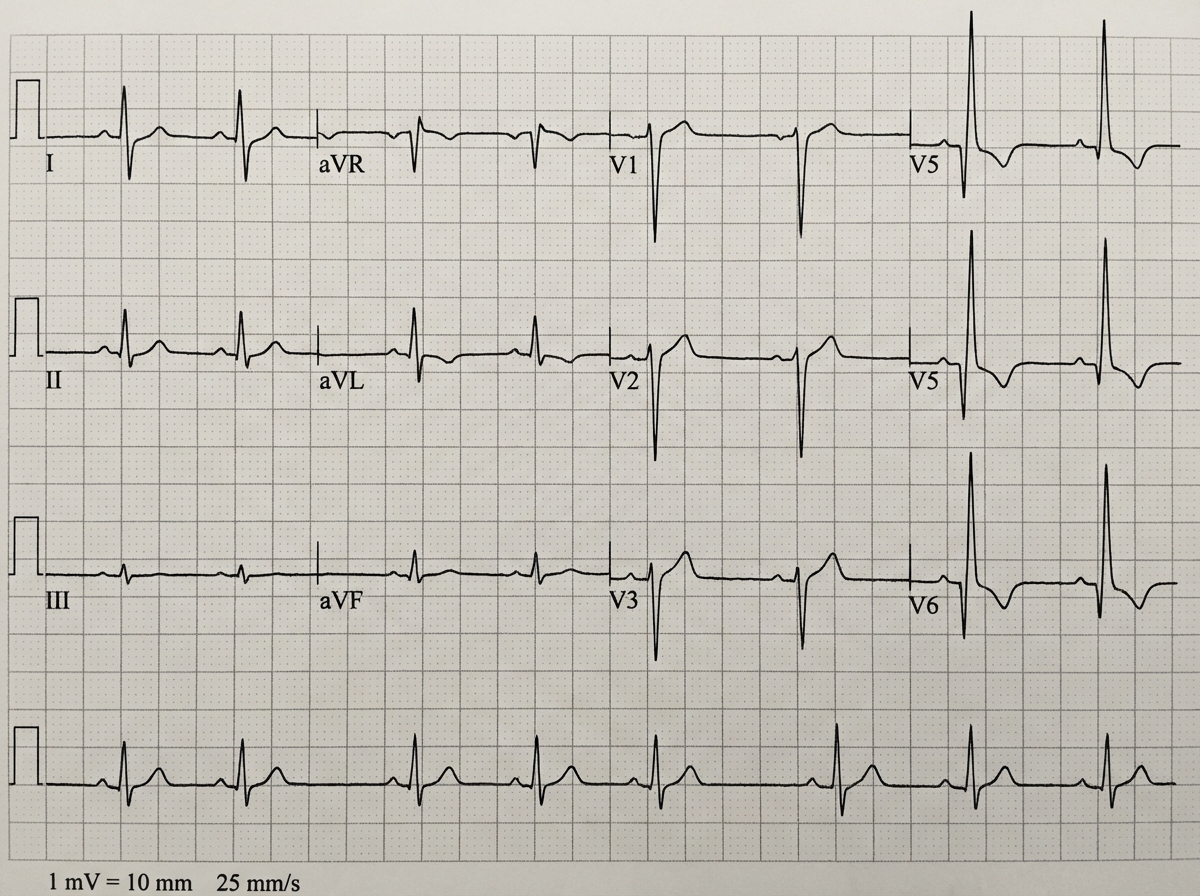
A 36-year-old man presents with the sensation of a racing heart. His blood pressure is 110/70, respiratory rate 14/min, and O2 saturation 98%. ECG is shown. Carotid massage and Valsalva maneuver do not improve the heart rate. Which of the following is the initial therapy of choice?

A 68-year-old male admitted to the ICU for acute exacerbation of COPD develops sudden onset of palpitations. The ECG shows irregular rhythm with varying P wave morphology and varying PR intervals. What is the most likely diagnosis?
A 16-year-old girl presents with chest pain and respiratory distress. On physical examination, she is short of breath, wheezing, and gasping for air. Cardiac auscultation reveals a prominent pansystolic murmur and a prominent third heart sound. Chest X-ray shows marked enlargement of the heart. The patient expired despite intensive supportive measures. Microscopic examination of the myocardium at autopsy discloses aggregates of mononuclear cells arranged around centrally located deposits of eosinophilic collagen. What is the appropriate diagnosis?
Which of the following statements regarding a patient with atrial fibrillation is false?
Reasons for preference of internal jugular vein over external jugular vein for measurement of JVP include all except?
A 60-year-old patient presents with recurrent TIA episodes. Echocardiography shows the candle flame sign. What is the probable etiology?
Explanation: **Explanation:** **Tako-tsubo Cardiomyopathy**, also known as "Broken Heart Syndrome" or "Stress-induced Cardiomyopathy," is characterized by transient systolic dysfunction of the apical and/or mid-segments of the left ventricle. 1. **Why Dilated Cardiomyopathy (DCM) is correct:** In Tako-tsubo, the left ventricle undergoes sudden weakening, leading to **apical ballooning**. This results in a significant increase in end-systolic and end-diastolic volumes with a concomitant drop in ejection fraction. Because the primary pathology involves ventricular chamber enlargement and impaired contraction (systolic dysfunction) without significant wall thickening, it is classified as a transient form of **Dilated Cardiomyopathy** [1]. 2. **Why other options are incorrect:** * **Restrictive Cardiomyopathy:** Characterized by rigid ventricular walls and impaired filling (diastolic dysfunction) with normal or near-normal systolic function. * **Hypertrophic Cardiomyopathy (HCM):** Defined by unexplained ventricular hypertrophy (thickening) and often an asymmetric septal involvement, which is the opposite of the thinning/ballooning seen in Tako-tsubo [2]. * **Toxic Cardiomyopathy:** While catecholamine excess (toxicity) triggers Tako-tsubo, the term "Toxic Cardiomyopathy" usually refers to chronic damage from substances like alcohol, cocaine, or chemotherapy (e.g., Doxorubicin). **High-Yield Clinical Pearls for NEET-PG:** * **Triggers:** Typically preceded by intense emotional or physical stress (e.g., death of a loved one, natural disasters). * **Demographics:** Most common in **post-menopausal women**. * **ECG Findings:** Often mimics an Acute Coronary Syndrome (ST-elevation, T-wave inversion), but **coronary angiography** will show **clean/normal coronaries** [3]. * **Morphology:** The name comes from the Japanese "octopus trap" (Tako-tsubo), which resembles the shape of the ballooned left ventricle on ventriculography. * **Prognosis:** Generally excellent; ventricular function usually recovers within 1–4 weeks with supportive care.
Explanation: **Explanation:** Hypertrophic Obstructive Cardiomyopathy (HOCM) is characterized by a hyperdynamic left ventricle and dynamic outflow obstruction. The correct answer is **A** because **Beta-agonists are contraindicated**, not useful, in HOCM. **1. Why Option A is the correct answer (False statement):** Beta-agonists (like Dobutamine or Isoproterenom) increase myocardial contractility (inotropy) and heart rate (chronotropy). In HOCM, increased contractility worsens the narrowing of the outflow tract, while increased heart rate reduces diastolic filling time. This exacerbates the dynamic obstruction and decreases cardiac output. Conversely, **Beta-blockers** are the first-line treatment as they slow the heart rate and reduce contractility, allowing for better ventricular filling. **2. Analysis of other options:** * **Option B:** Asymmetrical Septal Hypertrophy (ASH) is the hallmark of HOCM, where the interventricular septum is significantly thicker than the posterior wall (Ratio >1.3:1). * **Option C:** Obstruction is "dynamic" because it varies with loading conditions. It is caused by the thickened septum and the **Systolic Anterior Motion (SAM)** of the mitral valve. * **Option D:** A double apical impulse (or "triple" in some cases) occurs due to a forceful atrial contraction against a stiff ventricle (S4) followed by the sustained ventricular apex beat. **Clinical Pearls for NEET-PG:** * **Murmur Dynamics:** The systolic murmur of HOCM **increases** with maneuvers that decrease preload (Valsalva, standing) and **decreases** with maneuvers that increase preload or afterload (Squatting, Handgrip). * **Drug of Choice:** Beta-blockers (Propranolol/Atenolol). Verapamil is an alternative. * **Avoid:** Nitrates, Diuretics, and Digitalis (these worsen the obstruction). * **Genetic Basis:** Most commonly due to mutations in the **Beta-myosin heavy chain** or Myosin-binding protein C [1].
Explanation: Tricuspid Regurgitation (TR) is classified into two types: **Primary (Organic)** and **Secondary (Functional)**. **Why Option B is correct:** The most common cause of TR is **Secondary (Functional) TR**, accounting for over 80% of cases [1]. It occurs not due to a primary valve defect, but because of **dilatation of the right ventricle (RV)** and the tricuspid annulus [1]. This is typically a consequence of pulmonary hypertension (secondary to left-sided heart disease), RV infarction, or cardiomyopathy [1]. The enlargement of the RV causes tethering of the valve leaflets, preventing proper coaptation. **Why other options are incorrect:** * **Option A (Rheumatic Heart Disease):** While a common cause of *primary* TR in developing countries, it rarely occurs in isolation and is almost always associated with mitral or aortic valve involvement [1]. * **Option C (Coronary Artery Disease):** While CAD can cause mitral regurgitation (via papillary muscle dysfunction), it is an uncommon cause of TR unless it leads to significant RV infarction or chronic left-sided heart failure. * **Option D (Endocarditis):** IV drug abuse is the most common cause of *isolated primary* TR, but it is far less frequent than functional TR caused by RV dilatation. **High-Yield Clinical Pearls for NEET-PG:** * **Physical Exam:** Look for a holosystolic murmur at the left lower sternal border that increases with inspiration (**Carvallo’s sign**) [1]. * **Jugular Venous Pulse (JVP):** Characterized by a prominent **'v' wave** and a steep 'y' descent [1]. * **Pulsatile Liver:** Severe TR often presents with a tender, pulsatile liver (congestive hepatomegaly) [1].
Explanation: **Explanation:** The key to answering this question lies in distinguishing between the timing of systolic murmurs. **Aortic Stenosis (AS)** typically produces a **mid-systolic (ejection systolic) murmur** [2]. The murmur begins after the first heart sound (S1), following the period of isovolumetric contraction, peaks in mid-systole as flow velocity across the valve reaches its maximum, and ends before the second heart sound (S2) [1]. Therefore, it is not an early systolic murmur. **Analysis of Options:** * **Small Ventricular Septal Defect (VSD):** In a small VSD (Maladie de Roger), the high pressure gradient between the left and right ventricles exists primarily in early systole. As the muscular septum contracts, the defect may be physically closed or narrowed, causing the murmur to cease before S2. * **Papillary Muscle Dysfunction:** This often leads to acute or transient mitral regurgitation. Because the papillary muscles fail to tension the leaflets early in systole, the regurgitation (and thus the murmur) occurs predominantly in the early-to-mid systolic phase. * **Tricuspid Regurgitation (TR):** While TR is often holosystolic, it can present as an early systolic murmur, particularly in cases of acute TR or when right ventricular pressures are not significantly elevated. **NEET-PG High-Yield Pearls:** * **AS Murmur:** Classically described as "crescendo-decrescendo." The later the peak of the murmur, the more severe the stenosis. * **Innocent Murmurs:** These are almost always mid-systolic; a holosystolic or diastolic murmur is never physiological [2]. * **Handgrip Exercise:** Increases afterload, which decreases the intensity of an AS murmur but increases the intensity of MR and VSD murmurs.
Explanation: ***Adenosine 6-mg rapid IV bolus*** - **Adenosine** is the **first-line pharmacologic treatment** for supraventricular tachycardia (SVT) after failed vagal maneuvers due to its rapid onset and short half-life. - It works by blocking **AV node conduction** temporarily, breaking the re-entrant circuit in **AVNRT** or **AVRT** within seconds of administration. *Verapamil 2.5 to 5 mg IV over 1 to 2 minutes* - While **verapamil** is effective for SVT, it has a **longer half-life** and slower onset compared to adenosine, making it a second-line option. - Risk of **hypotension** and **negative inotropic effects** make it less preferred as initial therapy in hemodynamically stable patients. *Diltiazem 0.25-mg/kg IV over 2 minutes* - **Diltiazem** is another **calcium channel blocker** that can terminate SVT but has slower onset than adenosine. - Like verapamil, it carries risk of **hypotension** and **bradycardia**, making it less ideal as first-line treatment. *Digoxin 0.5 mg IV slowly* - **Digoxin** has a very **slow onset** (hours) and is not appropriate for acute SVT termination. - Its mechanism involves **vagal stimulation** and **AV node depression**, but the delayed effect makes it unsuitable for emergency SVT management.
Explanation: ### Explanation **Multifocal Atrial Tachycardia (MAT)** is the correct diagnosis based on the classic triad of clinical and ECG findings presented: 1. **Clinical Context:** MAT is most commonly associated with severe underlying pulmonary disease, particularly **Acute Exacerbation of COPD**. It is often triggered by hypoxia, hypercapnia, or the use of theophylline/beta-agonists. 2. **ECG Criteria:** The diagnosis requires: * An irregular rhythm (irregularly irregular). * At least **three distinct P-wave morphologies** in the same lead. * Varying PR and PP intervals. * Atrial rate typically >100 bpm. #### Analysis of Incorrect Options: * **A. Atrial Fibrillation:** While also "regularly irregular," AF is characterized by the **absence of discernible P waves** (replaced by fibrillatory waves) [1]. This patient has distinct, albeit varying, P waves. * **B. Ventricular Tachycardia:** This presents as a wide-complex, regular tachycardia. The presence of P waves and an irregular rhythm makes this diagnosis unlikely. * **C. Acute Myocardial Infarction:** While MI can trigger arrhythmias, it typically presents with ST-segment and T-wave changes rather than the specific P-wave morphology variations described. #### NEET-PG High-Yield Pearls: * **Treatment Priority:** The primary treatment for MAT is **treating the underlying cause** (e.g., correcting hypoxia/COPD exacerbation). * **Pharmacotherapy:** If rate control is needed, **Verapamil (Calcium Channel Blocker)** is the drug of choice. * **Contraindication:** **Beta-blockers are generally avoided** in these patients due to the risk of worsening bronchospasm in the setting of COPD. * **Wandering Atrial Pacemaker (WAP):** If the heart rate is <100 bpm with the same P-wave criteria, the diagnosis is WAP.
Explanation: ### Explanation The clinical presentation and histopathological findings are pathognomonic for **Acute Rheumatic Fever (ARF)** leading to pancarditis. **1. Why Rheumatic Heart Disease is correct:** The microscopic description of "aggregates of mononuclear cells arranged around centrally located deposits of eosinophilic collagen" describes **Aschoff bodies**. These are the hallmark lesions of rheumatic carditis. * **Aschoff bodies** consist of a central area of fibrinoid necrosis (eosinophilic collagen) surrounded by lymphocytes, plasma cells, and characteristic **Anitschkow cells** (caterpillar cells)—enlarged macrophages with ribbon-like chromatin. * The clinical signs of heart failure (respiratory distress, cardiomegaly) [1] and a **pansystolic murmur** (indicating acute Mitral Regurgitation due to valvulitis or annular dilation) in a young patient are classic for acute rheumatic pancarditis [1]. **2. Why other options are incorrect:** * **A & C (Bacterial Endocarditis):** While these present with murmurs, the hallmark pathology involves **friable vegetations** (fibrin, inflammatory cells, and bacteria) on valve leaflets, not myocardial Aschoff bodies. * **D (Viral Myocarditis):** This presents with global cardiac dysfunction, but microscopy typically shows diffuse interstitial inflammation and myocyte necrosis/lysis, lacking the specific organized structure of Aschoff bodies. **3. NEET-PG High-Yield Pearls:** * **Aschoff Bodies:** Pathognomonic for Rheumatic Heart Disease; found in all three layers (pancarditis) but most common in the myocardium. * **Anitschkow Cells:** Pathognomonic macrophages found within Aschoff bodies. * **MacCallum Patch:** Subendocardial thickening in the left atrium due to regurgitant jets in ARF. * **Most Common Valve Involved:** Mitral valve (isolated), followed by Mitral + Aortic [1]. * **Jones Criteria:** Used for clinical diagnosis (Major: Joint, Carditis, Nodules, Erythema marginatum, Sydenham chorea) [1].
Explanation: ### Explanation In the clinical management of a patient presenting with **Atrial Fibrillation (AF)**, the primary goals are hemodynamic stabilization, rate/リズム control, and thromboembolic risk assessment. **1. Why "Brain imaging is not done" is the correct (False) statement:** Atrial fibrillation is the leading cause of cardioembolic strokes. While not every stable AF patient requires immediate neuroimaging, it is **routinely indicated** if there is any suspicion of a Transient Ischemic Attack (TIA) or acute stroke [1]. Furthermore, in the context of initiating anticoagulation, a baseline CT/MRI may be necessary to rule out intracranial hemorrhage [1]. Therefore, stating that brain imaging is "not done" is clinically incorrect. **2. Analysis of other options:** * **Troponin I is sent:** This is a standard part of the initial workup. AF can be triggered by an acute myocardial infarction (MI), or conversely, the rapid ventricular rate in AF can cause "demand ischemia," leading to elevated Troponin levels. * **Echocardiogram is done:** This is a **mandatory** investigation [2]. A Transthoracic Echo (TTE) assesses chamber size, valvular morphology (e.g., Mitral Stenosis), and left ventricular function. A Transesophageal Echo (TEE) is the gold standard to rule out a left atrial appendage (LAA) thrombus before cardioversion [1]. **Clinical Pearls for NEET-PG:** * **CHADS₂-VASc Score:** Used to determine the need for long-term anticoagulation in non-valvular AF. * **Holiday Heart Syndrome:** AF triggered by excessive alcohol consumption. * **Treatment of Choice:** For hemodynamically unstable AF, the immediate treatment is **Synchronized DC Cardioversion**. * **Ashman Phenomenon:** A long R-R interval followed by a short R-R interval resulting in an aberrantly conducted QRS complex (usually RBBB morphology).
Explanation: The **Internal Jugular Vein (IJV)** is the preferred clinical vessel for assessing Jugular Venous Pressure (JVP) because it acts as a "manometer" directly reflecting right atrial pressure. [1] ### Why Option B is the Correct Answer **Increased sympathetic activity** is not a reason for preferring the IJV. In fact, the IJV is less influenced by sympathetic tone compared to the External Jugular Vein (EJV). The EJV is prone to **venospasm** mediated by sympathetic activity [2], which can lead to false readings or total collapse of the vein, making it unreliable for pressure estimation. ### Explanation of Incorrect Options (Why they are preferred features of IJV) * **Option A (Direct Continuation):** The right IJV follows a straight, direct anatomical path into the brachiocephalic vein and then the Superior Vena Cava (SVC) and Right Atrium. The EJV enters at an angle, often making the column of blood less representative of central venous pressure. * **Option C (Fascial Planes):** The EJV penetrates several layers of deep fascia. These fascial planes can compress the vein or cause "kinking," which obstructs the free transmission of pressure waves from the heart. * **Option D (Valves):** The EJV contains prominent valves at its proximal portion (where it enters the subclavian vein). These valves can impede the retrograde flow of blood, obscuring the characteristic "a" and "v" waves necessary for JVP analysis. ### NEET-PG High-Yield Pearls * **Right vs. Left:** The **Right IJV** is preferred over the left because the left IJV must cross the midline via the left brachiocephalic vein, which may be compressed by the aortic arch in elderly patients (leading to a false elevation). * **Pulsations:** IJV pulsations are **inward** (descents are more prominent), non-palpable, and vary with respiration and posture. [1] * **Abdominojugular Reflux:** A positive test (persistent rise in JVP >3cm for >15 seconds) is a highly specific sign of right heart failure or elevated pulmonary capillary wedge pressure.
Explanation: ### Explanation The correct answer is **Rheumatic fever during youth**. The **"Candle Flame Sign"** is a classic echocardiographic finding associated with **Mitral Regurgitation (MR)**. It refers to the characteristic appearance of the high-velocity, turbulent regurgitant jet seen on Color Doppler, which resembles the flickering flame of a candle as it shoots back from the left ventricle into the left atrium during systole [1]. **Why Rheumatic Fever is the cause:** Chronic Rheumatic Heart Disease (RHD) is the most common cause of acquired valvular heart disease in developing countries. It leads to fibrotic thickening, commissural fusion, and shortening of the chordae tendineae. This structural damage prevents the mitral leaflets from coapting properly, resulting in significant mitral regurgitation. The patient’s recurrent TIAs (Transient Ischemic Attacks) are likely due to cardioembolism, a common complication of RHD, often secondary to left atrial enlargement or associated atrial fibrillation [1]. **Analysis of Incorrect Options:** * **Option A:** Senile calcification usually affects the aortic valve or the mitral annulus (MAC). While it causes MR, it typically presents as a restricted, low-velocity flow rather than the classic "candle flame" jet. * **Option C:** Hypertension leads to left ventricular hypertrophy and potentially functional MR due to annular dilatation, but it does not produce the specific morphological jet described [1]. * **Option D:** Congenital conditions like Mitral Valve Prolapse (MVP) show a "mid-systolic click" and a different jet morphology (often eccentric) [1]. **NEET-PG High-Yield Pearls:** * **Candle Flame Sign:** Mitral Regurgitation (Color Doppler) [1]. * **Fish-mouth/Button-hole appearance:** Mitral Stenosis (Short axis view). * **Hockey-stick sign:** Diastolic doming of the anterior mitral leaflet in Mitral Stenosis. * **Most common valve involved in RHD:** Mitral > Aortic > Tricuspid.
Coronary Artery Disease and Angina
Practice Questions
Acute Coronary Syndromes
Practice Questions
Heart Failure
Practice Questions
Cardiac Arrhythmias
Practice Questions
Valvular Heart Diseases
Practice Questions
Cardiomyopathies
Practice Questions
Pericardial Diseases
Practice Questions
Congenital Heart Disease in Adults
Practice Questions
Hypertension and Hypertensive Emergencies
Practice Questions
Pulmonary Hypertension
Practice Questions
Non-invasive Cardiac Diagnostics
Practice Questions
Preventive Cardiology
Practice Questions
Get full access to all questions, explanations, and performance tracking.
Start For Free