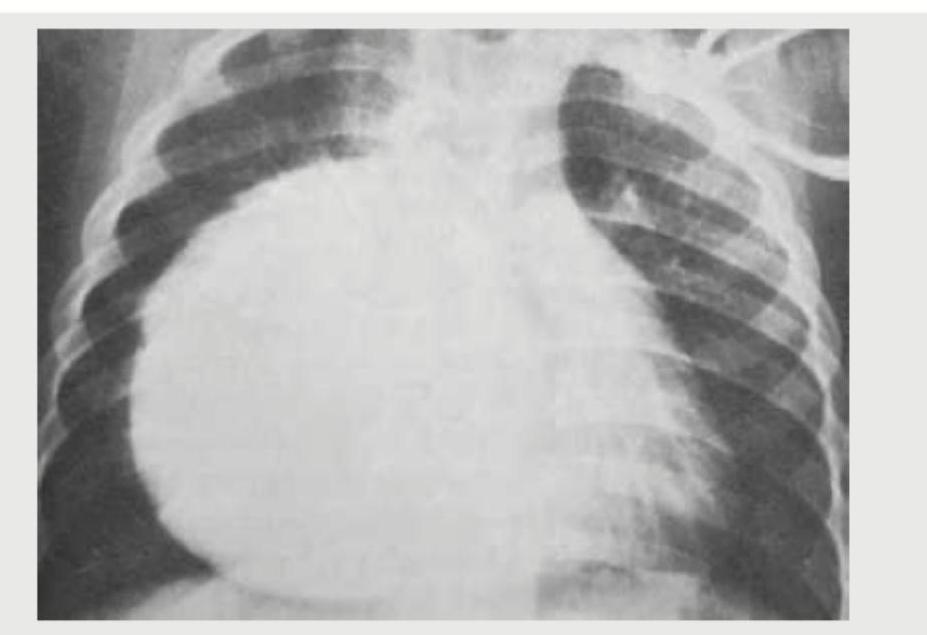
Troponin is a marker for which of the following conditions?
Which of the following is NOT a feature of rheumatic heart disease?
Left ventricular hypertrophy is NOT a feature of which of the following conditions?
A 54-year-old man presents to the emergency room four hours after the onset of severe chest pain radiating to the left arm. Which of the following serum markers would best aid in the evaluation of this individual's chest pain?
Which one of the following is not a cause for restrictive cardiomyopathy?
A 30-year-old man with an undiagnosed cardiac anomaly has been unable to do strenuous exercise throughout his life. Auscultation demonstrates an early diastolic murmur, which has been present since childhood. The patient has never been cyanotic. Which of the following disorders would most likely cause the patient's findings?
What is the best management for a hemodynamically stable patient with ECG showing a broad QRS complex with antidromic tachycardia?
Which sign is characterized by a pansystolic murmur that increases in intensity during deep inspiration?
All of the following are true of atrial fibrillation EXCEPT?
A 64-year-old gentleman presents with severe central chest pain radiating to the left arm for the last 30 minutes. He is profusely sweating and appears to be in agony. Which of the following conditions is he most likely suffering from?
Explanation: **Explanation:** **Troponin** (specifically Cardiac Troponin I and T) is the gold standard biochemical marker for diagnosing **Myocardial Infarction (MI)** [2]. These are regulatory proteins found in the cardiac muscle sarcomere. When myocardial cells undergo necrosis due to ischemia, the cell membrane integrity is lost, causing troponins to leak into the bloodstream [1]. Their high sensitivity and cardio-specificity make them superior to older markers like CK-MB. **Analysis of Options:** * **Myocardial Infarction (Correct):** Troponins rise within 3–6 hours of injury, peak at 12–24 hours, and can remain elevated for up to 7–14 days, making them useful for both acute and late diagnosis [2]. * **Complete Heart Block:** This is an electrical conduction defect (arrhythmia). While it may coexist with an MI, the block itself does not cause the release of cardiac enzymes unless there is associated muscle necrosis. * **Pericardial Effusion:** This involves fluid accumulation in the pericardial sac. It is an anatomical/inflammatory issue, not a primary myocyte necrotic process. * **Myoglobinuria:** This refers to myoglobin in the urine, typically seen in **Rhabdomyolysis** (skeletal muscle breakdown). While myoglobin is also found in the heart, it is non-specific and not synonymous with Troponin. **High-Yield Clinical Pearls for NEET-PG:** * **Troponin I vs. T:** Troponin I is considered more cardio-specific than Troponin T (which can sometimes rise in renal failure or skeletal muscle disease). * **Earliest Marker:** Myoglobin is the earliest marker to rise (1–2 hours), but it lacks specificity. * **Re-infarction:** **CK-MB** is the preferred marker to diagnose a re-infarction within the first week because it returns to baseline quickly (48–72 hours), whereas Troponin remains elevated for much longer [2]. * **Prognosis:** The magnitude of Troponin elevation correlates with the size of the infarct and the risk of mortality.
Explanation: ### Explanation The correct answer is **Janeway’s lesion**. This question tests your ability to differentiate between the clinical features of **Acute Rheumatic Fever (ARF)** and **Infective Endocarditis (IE)**. #### 1. Why Janeway’s lesion is the correct answer: Janeway’s lesions are small, painless, erythematous macules typically found on the palms and soles. They are a classic peripheral manifestation of **Infective Endocarditis**, caused by septic microemboli [2]. They are **not** part of the Jones criteria used to diagnose Rheumatic Heart Disease. #### 2. Why the other options are incorrect: The diagnosis of ARF is based on the **Revised Jones Criteria**. Options A, B, and D are all **Major Criteria** [1]: * **Chorea (Sydenham’s Chorea):** A delayed neurological manifestation characterized by involuntary, purposeless movements and emotional lability [1]. * **Arthritis:** Typically presents as a "migratory polyarthritis" involving large joints (knees, ankles, elbows). It is the most common major manifestation [3]. * **Carditis:** The most serious manifestation, which can involve the endocardium, myocardium, and pericardium (pancarditis), leading to valvular damage (most commonly the Mitral Valve) [1]. #### 3. Clinical Pearls for NEET-PG: * **Jones Criteria Mnemonic (Major):** **JO**ints (Arthritis), **N**odules (Subcutaneous), **E** (Erythema Marginatum), **S**ydenham’s Chorea, and **Heart** (Carditis). * **Janeway vs. Osler:** Remember that **J**aneway lesions are **Non-tender** (painless), while **O**sler nodes are **"Ouch"** (painful/tender). * **Most common valve involved in RHD:** Mitral Valve > Aortic Valve [2]. * **Latent Period:** ARF occurs roughly 2–3 weeks after a Group A Streptococcal (GAS) pharyngitis [1].
Explanation: **Explanation:** The core concept behind this question is understanding which valvular or structural defects impose a pressure or volume load on the **Left Ventricle (LV)**. **Why Isolated Mitral Stenosis (MS) is the correct answer:** In isolated MS, there is an obstruction to blood flow from the Left Atrium (LA) to the LV. This results in a **"protected" left ventricle** [1]. Because the LV receives less blood, it remains normal in size or may even undergo disuse atrophy. The primary burden in MS falls on the Left Atrium (leading to LA enlargement) and the pulmonary vasculature (leading to Right Ventricular Hypertrophy due to pulmonary hypertension), but **never LVH** [1]. **Why the other options are incorrect:** * **Mitral Regurgitation (MR):** Causes volume overload of the LV. The blood leaks back into the LA and then returns to the LV during diastole, leading to **LV dilatation and eccentric hypertrophy**. * **Isolated Ventricular Septal Defect (VSD):** This is a left-to-right shunt. The extra blood volume returns from the lungs to the LA and then to the LV, causing **LV volume overload** and subsequent hypertrophy. * **Aortic Stenosis (AS):** This creates a massive pressure gradient that the LV must overcome to eject blood. This leads to significant **concentric LV hypertrophy**. **NEET-PG High-Yield Pearls:** 1. **MS + LVH:** If a patient with MS shows signs of LVH on ECG, always suspect a co-existing condition like Aortic Stenosis, Aortic Regurgitation, or systemic hypertension. 2. **Apex Beat:** In MS, the apex beat is typically **tapping** in nature (palpable S1), whereas in LVH (like AS), it is **heaving/sustained** [1]. 3. **ECG in MS:** Look for "P-mitrale" (broad, notched P waves) indicating LA enlargement, and Right Axis Deviation.
Explanation: **Explanation:** The clinical presentation of severe chest pain radiating to the left arm in a 54-year-old male is highly suggestive of **Acute Myocardial Infarction (AMI)** [2], [3]. **Why Troponin is the correct answer:** Cardiac Troponins (I and T) are the **gold standard** and most sensitive/specific biomarkers for myocardial injury [4]. In the setting of AMI, Troponins begin to rise within **3–6 hours** of symptom onset, making them highly effective for evaluation at the 4-hour mark. Their high clinical utility stems from their superior cardiac specificity compared to older markers and their ability to remain elevated for 7–14 days. **Analysis of Incorrect Options:** * **CK-MB (Option B):** While CK-MB rises within 4–8 hours, it is less specific than Troponin as it can be elevated in skeletal muscle injury. Its primary utility today is detecting **re-infarction**, as it returns to baseline within 48–72 hours. * **AST (Option A):** This was the first biomarker used for MI (historically), but it lacks specificity as it is found in the liver and red blood cells [1]. It is no longer used in modern cardiac protocols [1]. * **LDH1 (Option C):** LDH levels rise late (peak at 3–4 days) and stay elevated for up to 2 weeks. It is obsolete for acute diagnosis in the ER setting [1]. **High-Yield Clinical Pearls for NEET-PG:** * **Earliest Marker:** Myoglobin is the earliest to rise (1–3 hours) but lacks specificity. * **Most Specific Marker:** Troponin I. * **Marker for Re-infarction:** CK-MB (due to its short half-life). * **Rule of Thumb:** If a patient presents within the "golden hour," markers may be negative; serial sampling (at 0 and 3 hours) is essential.
Explanation: The correct answer is **Alcohol**. Alcohol is a classic cause of **Dilated Cardiomyopathy (DCM)**, not Restrictive Cardiomyopathy (RCM) [1]. Chronic ethanol consumption leads to direct toxic effects on the myocardium and its metabolites (like acetaldehyde), resulting in ventricular chamber enlargement and impaired systolic function (reduced ejection fraction) [1]. **Analysis of Options:** * **Amyloidosis (Option C):** This is the **most common cause** of restrictive cardiomyopathy. Deposition of amyloid fibrils in the myocardial interstitium leads to stiffening of the ventricles, resulting in diastolic dysfunction. * **Hemochromatosis (Option B):** Iron overload leads to deposition in the heart. While it can eventually cause a dilated picture, it characteristically presents initially as a **restrictive** cardiomyopathy. * **Sarcoidosis (Option D):** This is an infiltrative granulomatous disease. Non-caseating granulomas in the myocardium lead to increased wall stiffness and restrictive physiology, often accompanied by conduction blocks. **NEET-PG High-Yield Pearls:** * **RCM Hallmark:** Impaired ventricular filling (diastolic dysfunction) with relatively preserved systolic function and normal wall thickness (initially). * **Kussmaul’s Sign:** Often positive in RCM (paradoxical rise in JVP on inspiration). * **Amyloidosis Clue:** Low voltage ECG in the presence of thickened ventricular walls on Echo is highly suggestive of Cardiac Amyloidosis. * **Endomyocardial Fibrosis (EMF):** The most common cause of RCM worldwide, particularly in tropical regions.
Explanation: ### Explanation **1. Why Bicuspid Aortic Valve (BAV) is Correct:** The clinical presentation of an **early diastolic murmur** (EDM) indicates **Aortic Regurgitation (AR)** [2], [3]. Bicuspid aortic valve is the most common congenital heart anomaly (1-2% of the population). While it often presents with aortic stenosis in older age [1], it frequently causes aortic insufficiency (regurgitation) in young adults due to cusp prolapse or restricted leaflet motion. Since the patient has been symptomatic since childhood but is **acyanotic**, a left-sided valvular lesion like BAV is the most plausible diagnosis. **2. Why the Other Options are Incorrect:** * **Common pattern TGA (Option B):** This is a cyanotic congenital heart disease (Right-to-Left shunt). Patients present with profound neonatal cyanosis and would not reach age 30 undiagnosed without surgical intervention. * **Patent Ductus Arteriosus (Option C):** PDA typically presents with a **continuous "machinery" murmur** heard best at the left infraclavicular area, not an isolated early diastolic murmur. * **Tricuspid Atresia (Option D):** This is a cyanotic "5T" defect. It requires an ASD and VSD for survival and presents with early childhood cyanosis and left axis deviation on ECG. **3. NEET-PG High-Yield Pearls:** * **BAV Associations:** Most common cause of isolated AR in developed countries; strongly associated with **Coarctation of the Aorta** and Turner Syndrome. * **Murmur Characteristics:** AR produces a high-pitched, blowing EDM heard best at the left sternal border (Erb’s point) with the patient leaning forward in expiration [2], [3]. * **Genetic Link:** Often associated with mutations in the *NOTCH1* gene. * **Complications:** Increased risk of infective endocarditis and aortic dissection (due to cystic medial necrosis).
Explanation: **Explanation:** The clinical presentation of a **broad QRS complex tachycardia** in a patient with suspected pre-excitation (WPW syndrome) suggests **Antidromic Atrioventricular Reentrant Tachycardia (AVRT)** [2], [3]. In this rhythm, the impulse travels down the accessory pathway (causing the wide QRS) and returns via the AV node. **1. Why Intravenous Procainamide is correct:** Procainamide is the drug of choice for hemodynamically stable wide-complex tachycardias, especially antidromic AVRT. It works by increasing the refractory period of both the atrium and the **accessory pathway**, effectively slowing or blocking conduction through the bypass tract to terminate the arrhythmia [2]. **2. Why the other options are incorrect:** * **Oral Verapamil & Oral Beta-blockers (A & B):** These are contraindicated in wide-complex tachycardias involving an accessory pathway. AV node blockers (Verapamil, Diltiazem, Beta-blockers, Digoxin, and Adenosine) can paradoxically increase conduction through the accessory pathway by removing the "braking" effect of the AV node, potentially leading to Ventricular Fibrillation [1]. Furthermore, oral medications are inappropriate for acute management. * **Cardioversion (C):** While highly effective, synchronized electrical cardioversion is reserved as the **first-line** treatment for patients who are **hemodynamically unstable** (hypotension, altered mental status, chest pain). This patient is stable. **Clinical Pearls for NEET-PG:** * **Narrow QRS (Orthodromic AVRT):** Impulse goes down AV node $\rightarrow$ Treat like SVT (Adenosine) [2]. * **Wide QRS (Antidromic AVRT):** Impulse goes down Accessory Pathway $\rightarrow$ Avoid AV node blockers; use **Procainamide** or **Amiodarone** [2]. * **WPW + Atrial Fibrillation:** Characterized by an "irregularly irregular" wide complex tachycardia [2]. **Procainamide** is the drug of choice; **DC cardioversion** if unstable. Never use Digoxin or Verapamil.
Explanation: ### Explanation **Correct Answer: A. Carvallo's sign** **Carvallo’s sign** is a clinical finding used to distinguish **Tricuspid Regurgitation (TR)** from Mitral Regurgitation (MR). Both conditions produce a pansystolic murmur; however, the murmur of TR increases in intensity during **deep inspiration** [2]. * **Mechanism:** During inspiration, intrathoracic pressure decreases, leading to increased venous return to the right atrium and ventricle. This increased right-sided stroke volume increases the regurgitant flow across the tricuspid valve, thereby Loudening the murmur. Conversely, left-sided murmurs (like MR) usually decrease or remain unchanged during inspiration as blood is sequestered in the lungs [3]. --- ### Analysis of Incorrect Options * **B. Muller’s sign:** Characterized by visible systolic pulsations of the **uvula**. It is a peripheral sign of chronic, severe **Aortic Regurgitation (AR)** [1]. * **C. Corrigan’s sign:** Also known as "water-hammer pulse," it refers to the rapid upstroke and collapse of the carotid pulsations. It is a classic sign of **Aortic Regurgitation** [1]. * **D. Duroziez sign:** A double bruit (systolic and diastolic) heard over the femoral artery when it is compressed with a stethoscope. It is another peripheral sign of **Aortic Regurgitation**. --- ### NEET-PG High-Yield Pearls * **Rivero-Carvallo's Sign:** This is the full name of the sign. It is highly specific for Tricuspid Regurgitation. * **Right vs. Left:** As a general rule for exams, **Right-sided murmurs increase with inspiration** (R-I-G-H-T: Right, Inspiration, Gets, Higher, Tones), while **Left-sided murmurs increase with expiration** [3]. * **Exceptions:** The only right-sided sound that does *not* increase with inspiration is the **Pulmonary Ejection Click** (it decreases). * **AR Signs:** Remember the "Alphabet of AR" (Corrigan’s, De Musset’s, Quincke’s, Traube’s, Muller’s, Duroziez). These are frequently tested as "all are signs of AR except..." questions [1].
Explanation: Explanation: Atrial Fibrillation (AF) is a supraventricular tachyarrhythmia characterized by rapid, uncoordinated atrial activation and an ineffective atrial contraction [1]. Why Option D is the correct answer (The Exception): Atrial fibrillation is fundamentally a tachyarrhythmia. In AF, the atrial rate typically ranges from 350–600 bpm [2]. While the ventricular rate depends on AV node conduction, it is usually rapid (tachycardia) unless the patient is on AV-nodal blocking drugs or has underlying conduction system disease [4]. Sinus bradycardia refers to a slow rhythm originating from the SA node; in AF, the SA node is overwhelmed and suppressed by multiple re-entrant wavelets, making the coexistence of a normal sinus rhythm (bradycardic or otherwise) impossible during the arrhythmia. Analysis of Incorrect Options: * Option A: Rheumatic Mitral Stenosis is a classic cause of AF due to left atrial enlargement and fibrosis, which alters the electrophysiological properties of the atrial tissue. * Option B: The lack of effective atrial contraction leads to blood stasis, particularly in the left atrial appendage, significantly increasing the risk of thrombus formation and systemic thromboembolism (e.g., ischemic stroke) [3]. * Option C: Because the AV node is bombarded by irregular atrial impulses, the ventricular response is "random," resulting in the hallmark clinical finding of an irregularly irregularly pulse and a pulse deficit. Clinical Pearls for NEET-PG: * ECG Findings: Absence of P waves, presence of fibrillatory (f) waves, and irregular RR intervals. * Ashman Phenomenon: A long RR interval followed by a short RR interval resulting in an aberrantly conducted QRS (usually RBBB morphology). * Treatment: Hemodynamically unstable patients require immediate synchronized cardioversion. Stable patients are managed with rate control (Beta-blockers/CCBs) and anticoagulation based on the CHA₂DS₂-VASc score [3].
Explanation: **Explanation:** The clinical presentation of severe, crushing central chest pain radiating to the left arm, accompanied by autonomic symptoms like profuse sweating (diaphoresis), is the classic "textbook" description of an **Acute Myocardial Infarction (AMI)** [1]. 1. **Why Option C is Correct:** AMI occurs due to a sudden occlusion of a coronary artery, leading to myocardial necrosis [2]. The pain is typically intense, lasts longer than 20 minutes, and is not relieved by rest or nitroglycerin. The presence of **diaphoresis** is a high-yield sign indicating sympathetic overactivity, which strongly correlates with myocardial ischemia rather than non-cardiac causes [3]. 2. **Why Other Options are Incorrect:** * **Stable Angina:** Pain is typically brief (3–15 minutes), predictable, and triggered by exertion or stress. It is characteristically relieved by rest or sublingual nitrates, unlike the pain described here. * **Oesophagitis:** This usually presents as retrosternal "heartburn" or burning pain, often related to posture (lying down) or food intake. While it can mimic cardiac pain, it rarely causes profuse sweating or radiation to the left arm. * **Pleurisy:** This is characterized by **pleuritic chest pain**—sharp, stabbing pain that is strictly aggravated by inspiration, coughing, or movement. It is not typically central or associated with the systemic agony seen in AMI [4]. **NEET-PG High-Yield Pearls:** * **Levine’s Sign:** A clenched fist held over the chest to describe ischemic pain [1]. * **Silent MI:** Common in elderly patients and diabetics (due to autonomic neuropathy) [3]. * **Gold Standard Investigation:** Coronary Angiography; however, the most immediate initial tests are an **ECG** and **Cardiac Troponins (I or T)**. * **Time is Muscle:** Reperfusion therapy (PCI or Thrombolysis) should be initiated as early as possible to salvage myocardium.
Coronary Artery Disease and Angina
Practice Questions
Acute Coronary Syndromes
Practice Questions
Heart Failure
Practice Questions
Cardiac Arrhythmias
Practice Questions
Valvular Heart Diseases
Practice Questions
Cardiomyopathies
Practice Questions
Pericardial Diseases
Practice Questions
Congenital Heart Disease in Adults
Practice Questions
Hypertension and Hypertensive Emergencies
Practice Questions
Pulmonary Hypertension
Practice Questions
Non-invasive Cardiac Diagnostics
Practice Questions
Preventive Cardiology
Practice Questions
Get full access to all questions, explanations, and performance tracking.
Start For Free