Inoue balloon is used in the treatment of which condition?
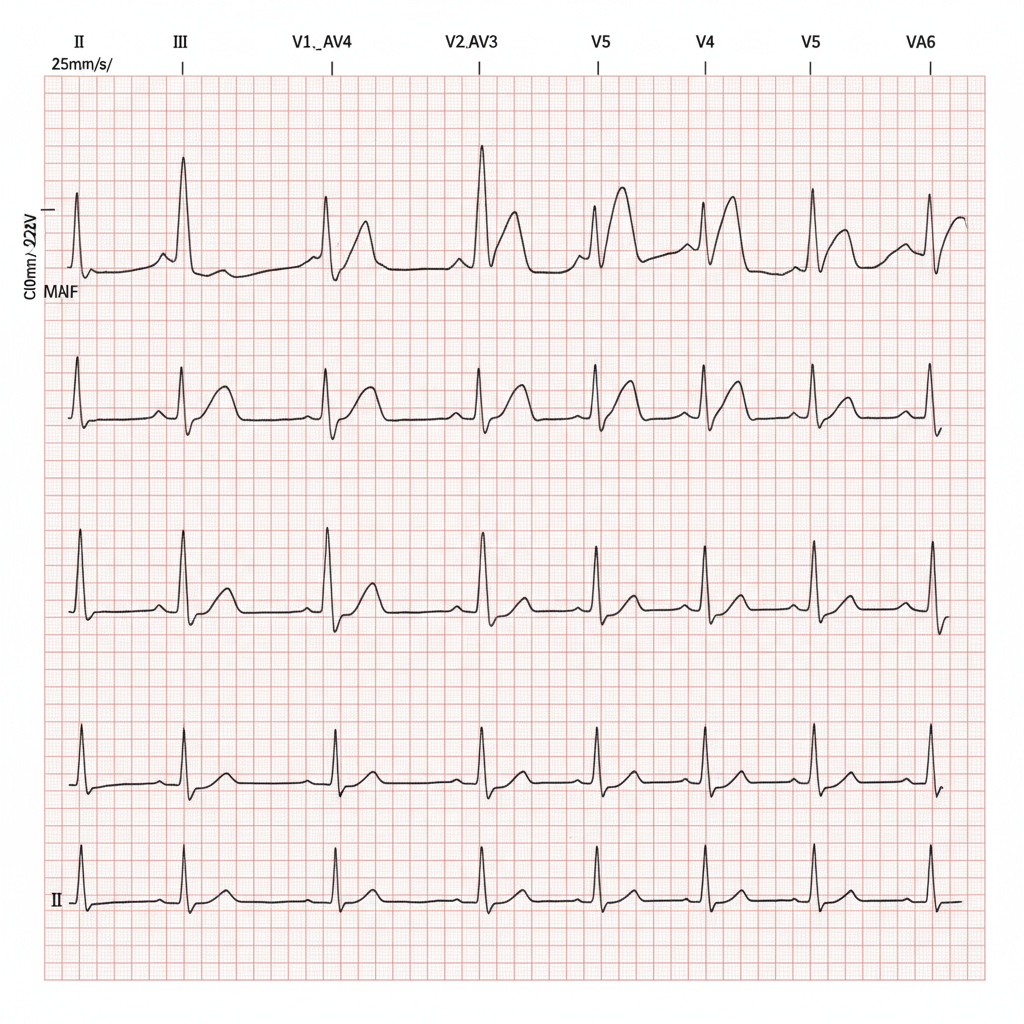
Ventricular ectopic beats are represented by which of the following findings?
What is the most common complication of infective endocarditis?
In a hospital cardiac care unit, there are three patients with different cardiac conditions: a 52-year-old man with dilated cardiomyopathy, an 18-year-old girl with mitral valve prolapse, and a 30-year-old man with infective endocarditis of the mitral valve. Which of the following features do all these patients most likely share?
Which of the following physical signs is seen in a patient with severe aortic stenosis?
Which of the following lesions is not a common cause for vegetation formation in the heart?
A midsystolic click is a characteristic feature of which condition?
A 55-year-old female presented to the ER with sudden onset of shortness of breath along with syncope. Chest X-ray was unremarkable. ECG was done. On examination, some skin lesions were observed. What is the most likely diagnosis in this case?

A 68-year-old man who has had a recent syncopal episode is hospitalized with congestive heart failure. His blood pressure is 160/80 mmHg. His pulse rate is 80 beats per minute, and there is a grade III/IV harsh systolic murmur. An echocardiogram shows a disproportionately thickened ventricular septum and systolic anterior motion of the mitral valve. Which of the following findings would most likely be present in this man?
Which ECG feature is characteristic of acute cor pulmonale, such as that caused by pulmonary embolism?
Explanation: The **Inoue Balloon** is the gold-standard device used for **Percutaneous Transvenous Mitral Commissurotomy (PTMC)**, also known as Balloon Mitral Valvotomy (BMV) [1]. It is specifically designed to treat symptomatic **Mitral Stenosis**, typically of rheumatic origin, provided the valve morphology is favorable (assessed via the Wilkins Score) [1]. **Why it is the correct answer:** The Inoue balloon is a unique, pressure-expandable, multi-stage balloon made of nylon and rubber. It has a "waist" that allows it to be self-centering across the stenotic mitral valve. When inflated, it exerts mechanical force to split the fused commissures, thereby increasing the valve area and relieving the obstruction. **Why other options are incorrect:** * **Atrial Septal Defect (ASD) & Patent Foramen Ovale (PFO):** These are septal defects treated with **occluder devices** (e.g., Amplatzer Septal Occluder) to close the shunt, not balloons to open a valve. * **Mitral Regurgitation:** This is a condition of valvular incompetence [2]. Balloon dilatation would worsen the leak. Treatment usually involves surgical repair/replacement or percutaneous clips (e.g., MitraClip) [2]. **High-Yield Clinical Pearls for NEET-PG:** * **Wilkins Score:** Used to assess suitability for PTMC. It evaluates four parameters: Leaflet mobility, thickening, calcification, and subvalvular thickening. A score **≤ 8** is ideal for the procedure. * **Contraindications for PTMC:** Presence of a left atrial thrombus (risk of stroke) and moderate-to-severe mitral regurgitation [2], [3]. * **Access:** The procedure requires **transseptal puncture** (passing from the right atrium to the left atrium through the fossa ovalis) to reach the mitral valve.
Explanation: Ventricular Ectopic Beats (VEBs), also known as Premature Ventricular Contractions (PVCs), are early beats originating from an ectopic focus in the ventricular myocardium [1]. **1. Why "Irregular RR interval" is correct:** By definition, an ectopic beat is "premature." It occurs earlier than the next expected sinus beat. This prematurity inherently disrupts the regularity of the cardiac cycle, leading to an **irregular RR interval** between the preceding sinus beat and the ectopic beat (the pre-extrasystolic interval). **2. Analysis of Incorrect Options:** * **B. Incomplete compensatory pause:** This is incorrect because VEBs are typically followed by a **complete compensatory pause**. This occurs because the ectopic ventricular impulse does not usually conduct retrogradely to reset the SA node. Therefore, the distance between the sinus beat before and after the VEB is exactly twice the normal RR interval. (Incomplete pauses are characteristic of Atrial Ectopics). * **C. A.V. dissociation:** While A.V. dissociation is a hallmark of Ventricular Tachycardia (VT) [1], a single ventricular ectopic beat is a discrete event, not a sustained dissociation of atria and ventricles. * **D. Presence of fusion beat:** Fusion beats occur when a supraventricular impulse and a ventricular impulse activate the ventricles simultaneously [1]. While they are a key diagnostic feature of **Ventricular Tachycardia**, they are not a standard finding for isolated ventricular ectopics. **High-Yield Clinical Pearls for NEET-PG:** * **ECG Features of VEB:** Wide QRS (>0.12s), T-wave discordant to QRS complex, and absence of a preceding P-wave [1]. * **Bigeminy:** Every second beat is a VEB; **Trigeminy:** Every third beat is a VEB. * **R-on-T Phenomenon:** A VEB falling on the T-wave of the preceding beat can trigger Ventricular Fibrillation [2]. * **Management:** In asymptomatic patients with a normal heart, reassurance is enough. If symptomatic, **Beta-blockers** are the first-line treatment.
Explanation: **Explanation:** Infective Endocarditis (IE) is characterized by the formation of vegetations on heart valves [1]. While systemic complications are frequent, **Myocardial Abscesses** (perivalvular extension) are considered the most common intracardiac complication of IE [3]. **1. Why Myocardial Abscesses are Correct:** The infection often spreads beyond the valve leaflets into the adjacent endocardium and myocardium. This leads to the formation of perivalvular abscesses, particularly in cases involving the aortic valve or prosthetic valves [2]. These abscesses can lead to conduction disturbances (like heart block) and are a primary reason for surgical intervention. **2. Analysis of Incorrect Options:** * **A. Thromboembolism:** While a very common and serious *extracardiac* complication (occurring in up to 25-50% of cases), it is generally ranked second to cardiac-specific complications in terms of overall frequency and morbidity in hospitalized patients [2]. * **B. Mycotic Aneurysm:** This is a rare vascular complication resulting from septic emboli weakening the arterial wall (most commonly in the cerebral circulation). It occurs in only about 3-5% of patients. * **C. Fibrinous Pericarditis:** This is an uncommon complication of IE. Pericarditis in IE usually suggests a localized extension of a myocardial abscess or a secondary immune response, but it is not a "most common" finding. **High-Yield NEET-PG Pearls:** * **Most common cause of death in IE:** Congestive Heart Failure (CHF) due to valvular regurgitation. * **Most common valve involved:** Mitral valve (except in IV drug users, where it is the Tricuspid valve). * **Clinical Sign:** If a patient with IE develops a new-onset conduction delay (prolonged PR interval on ECG), suspect an **Aortic Root Abscess** [1]. * **Duke’s Criteria:** Remember that persistent bacteremia and new valvular regurgitation are Major Criteria [1].
Explanation: The correct answer is **D. Risk of systemic thromboembolism.** ### **Explanation of the Correct Answer** The common denominator among these three distinct cardiac conditions is the predisposition to **systemic thromboembolism**, though the underlying mechanisms differ: 1. **Dilated Cardiomyopathy (DCM):** Characterized by ventricular enlargement and stasis of blood (low-flow state) [3]. This promotes the formation of mural thrombi, which can dislodge and cause systemic emboli (e.g., stroke) [1]. 2. **Mitral Valve Prolapse (MVP):** While generally benign, MVP is associated with an increased risk of platelet-fibrin microthrombi formation on the redundant valve leaflets, which can embolize. 3. **Infective Endocarditis (IE):** The hallmark of IE is the formation of "vegetations" (platelets, fibrin, and bacteria) [2]. These are friable and frequently break off, leading to septic emboli in the systemic circulation. --- ### **Why Other Options are Incorrect** * **A. Decreased compliance:** This is a hallmark of **Restrictive Cardiomyopathy** or Left Ventricular Hypertrophy. In DCM, compliance is often increased (the heart is overly "stretchy" but weak). * **B. Depressed myocardial contractility:** This is the primary pathology in **DCM** (systolic dysfunction) [3]. However, in MVP and early IE, contractility is typically preserved or even hyperdynamic. * **C. Infectious etiology:** Only **Infective Endocarditis** is primarily infectious [2]. DCM is most commonly idiopathic, genetic, or toxic (alcohol) [3], and MVP is usually due to myxomatous degeneration. --- ### **High-Yield NEET-PG Pearls** * **Virchow’s Triad in Cardiology:** Stasis (DCM), Endothelial/Endocardial injury (IE/MVP), and Hypercoagulability are the drivers for thrombus formation. * **DCM Management:** Patients with an Ejection Fraction (EF) <35% are at high risk for thrombi and often require anticoagulation. * **MVP Association:** It is the most common cause of isolated mitral regurgitation in developed countries [2] and is often associated with connective tissue disorders like Marfan Syndrome.
Explanation: **Explanation:** In **Aortic Stenosis (AS)**, the hallmark physical finding is a crescendo-decrescendo systolic ejection murmur [1]. As the stenosis becomes more **severe**, the pressure gradient across the valve takes longer to reach its maximum, causing the murmur to peak later in systole. This **delayed peak of systolic murmur** (late-peaking) is a reliable indicator of severity, often accompanied by a "pulsus parvus et tardus" (weak and delayed carotid upstroke) [1]. **Analysis of Incorrect Options:** * **A. Opening Snap:** This is a high-pitched diastolic sound characteristic of **Mitral Stenosis** [2], caused by the sudden tensing of the chordae tendineae and stenotic valve leaflets. * **B. Diastolic Rumble:** This describes the low-pitched mid-diastolic murmur of **Mitral Stenosis** or the Austin Flint murmur of Aortic Regurgitation [3]. AS produces a systolic, not diastolic, murmur. * **C. Holosystolic Murmur:** This is typical of **Mitral Regurgitation, Tricuspid Regurgitation, or Ventricular Septal Defect (VSD)**, where the pressure gradient remains constant throughout systole. **High-Yield Clinical Pearls for NEET-PG:** * **Triad of Severe AS:** Angina, Syncope, and Dyspnea (SAD). * **Soft/Absent S2:** In severe AS, the aortic component (A2) becomes soft or disappears because the valve leaflets are too calcified to snap shut [1]. * **Paradoxical Splitting of S2:** Occurs in severe AS because the prolonged left ventricular ejection time causes A2 to occur after P2. * **Gallavardin Phenomenon:** The dissociation between the noisy (musical) component of the AS murmur at the apex and the harsh component at the base, often mimicking mitral regurgitation [1].
Explanation: ### Explanation The development of Infective Endocarditis (IE) and vegetation formation requires two primary factors: **high-velocity turbulent blood flow** and a **significant pressure gradient** across the lesion. These factors cause endothelial damage, leading to the deposition of fibrin and platelets (Non-Bacterial Thrombotic Endocarditis), which then serves as a nidus for bacterial colonization. [1] **Why Atrial Septal Defect (ASD) is the Correct Answer:** In a secundum ASD, the pressure gradient between the left and right atrium is very low. The blood flow across the defect is **low-velocity and laminar**, rather than turbulent. Consequently, there is minimal endocardial trauma, making vegetation formation extremely rare. Therefore, isolated ASD is considered a "low-risk" lesion for IE. **Analysis of Incorrect Options:** * **Aortic Stenosis (AS):** High-velocity flow across the narrowed aortic valve creates significant turbulence and endocardial injury, making it a high-risk site for vegetations. * **Mitral Regurgitation (MR):** The high-pressure gradient between the left ventricle and left atrium during systole creates a high-velocity jet. Vegetations typically form on the atrial surface of the mitral leaflets (the low-pressure side of the jet). * **Mitral Stenosis (MS):** While less common than regurgitant lesions, MS involves turbulent flow across a diseased valve, providing a substrate for IE. **High-Yield Clinical Pearls for NEET-PG:** * **Ventricular Septal Defect (VSD):** Unlike ASD, VSD is a **high-risk** lesion because of the large pressure gradient between the ventricles. Vegetations usually form on the right ventricular side of the defect. * **Most Common Valve Involved:** Mitral Valve (overall); Tricuspid Valve (in IV drug users). * **MacCallum’s Patch:** An area of endocardial thickening in the left atrium (due to MR jets) where vegetations often settle. * **Rule of Thumb:** High-pressure gradients = High turbulence = High risk of IE. Low-pressure gradients (ASD) = Low risk.
Explanation: **Explanation:** **1. Correct Answer: Mitral Valve Prolapse (MVP)** The characteristic auscultatory finding in MVP is a **mid-systolic click**, often followed by a late systolic murmur [1]. The click is a non-ejection sound caused by the sudden tensing of the redundant valve leaflets and elongated chordae tendineae as they prolapse into the left atrium during ventricular systole. **2. Analysis of Incorrect Options:** * **Mitral Stenosis (MS):** Characterized by an **Opening Snap** (diastolic sound) occurring shortly after S2, followed by a mid-diastolic rumbling murmur [1], [3]. * **Aortic Regurgitation (AR):** Typically presents with an early diastolic, decrescendo murmur [2]. It does not produce a systolic click. * **Pulmonary Outflow Obstruction (e.g., Pulmonic Stenosis):** Associated with an **early systolic ejection click** (which decreases in intensity with inspiration) and a harsh systolic ejection murmur [1]. **3. High-Yield Clinical Pearls for NEET-PG:** * **Dynamic Auscultation:** This is a favorite topic for examiners. In MVP, maneuvers that **decrease venous return** (e.g., Standing, Valsalva strain phase) cause the click and murmur to occur **earlier** in systole and become longer/louder. Conversely, Squatting (increased preload) moves the click **later** in systole. * **Barlow’s Syndrome:** Another name for MVP, often associated with connective tissue disorders like Marfan or Ehlers-Danlos syndrome. * **Most Common Cause:** MVP is the most common cause of isolated mitral regurgitation in developed countries.
Explanation: ***Sarcoidosis*** - **Cardiac sarcoidosis** can present with **complete heart block** causing **syncope** and **shortness of breath**, with **unremarkable chest X-ray** in isolated cardiac involvement. - **Skin manifestations** like **lupus pernio** or **erythema nodosum** are characteristic features that support the diagnosis. *Carney syndrome* - A rare **genetic disorder** characterized by **cardiac myxomas**, **skin pigmentation**, and **endocrine tumors**. - Syncope would be due to **myxoma obstruction**, not **conduction abnormalities**, and lacks the typical skin lesions of sarcoidosis. *Hypothyroidism* - Causes **bradycardia** and **fatigue** but rarely leads to **complete heart block** or **acute syncope**. - Associated with **myxedematous skin changes** (dry, coarse skin), not the inflammatory skin lesions described. *SLE* - Can cause **pericarditis** and **Libman-Sacks endocarditis** but rarely presents with **isolated heart block**. - **Malar rash** and **discoid lesions** are typical, but the acute presentation with syncope is less characteristic.
Explanation: The clinical presentation—syncope, heart failure, a harsh systolic murmur, **asymmetric septal hypertrophy**, and **systolic anterior motion (SAM)** of the mitral valve—is diagnostic of **Hypertrophic Obstructive Cardiomyopathy (HOCM)**. #### 1. Why Option B is Correct The murmur in HOCM is caused by dynamic left ventricular outflow tract (LVOT) obstruction. The intensity of the murmur depends on the pressure gradient across the LVOT. * **Handgrip exercise** increases **afterload** (systemic vascular resistance). * Increased afterload increases the intraventricular pressure, which helps keep the LVOT open and pushes the septum away from the mitral valve. * This reduces the degree of obstruction, thereby **decreasing the intensity of the murmur**. #### 2. Why Other Options are Incorrect * **Option A (Radiation to the neck):** This is a classic feature of **Aortic Stenosis (AS)** [1]. The murmur of HOCM typically radiates to the lower left sternal border or apex, but not to the carotids. * **Option C (Delayed carotid upstroke):** Also known as *pulsus parvus et tardus*, this is characteristic of **Aortic Stenosis**. In HOCM, the carotid upstroke is typically **brisk** or "bifid" (pulsus bisferiens) due to rapid initial ejection followed by mid-systolic obstruction. * **Option D (Reduced LVEF):** HOCM is characterized by **diastolic dysfunction** with a preserved or even **supranormal ejection fraction** (hyperdynamic left ventricle). Reduced LVEF only occurs in the very late "burnt-out" phase of the disease. #### 3. NEET-PG High-Yield Pearls * **Dynamic Murmur Rules:** * **Increase Murmur:** Valsalva, Standing (Decreased preload/venous return → smaller LV volume → more obstruction). * **Decrease Murmur:** Squatting, Handgrip, Leg Raise (Increased preload/afterload → larger LV volume → less obstruction). * **SAM (Systolic Anterior Motion):** The anterior leaflet of the mitral valve is sucked into the LVOT due to the Venturi effect, causing both obstruction and mitral regurgitation. * **Drug of Choice:** Beta-blockers (first-line) as they increase diastolic filling time and reduce contractility. Avoid Nitrates and Diuretics.
Explanation: **Explanation:** Acute cor pulmonale, most commonly caused by a massive pulmonary embolism (PE), results from a sudden increase in pulmonary vascular resistance. This leads to acute right ventricular (RV) pressure overload and dilatation. 1. **S1Q3T3 Pattern (McGinn-White Sign):** This is the classic "textbook" sign of acute RV strain [1]. It consists of a prominent **S** wave in lead I, a **Q** wave in lead III, and an inverted **T** wave in lead III. While highly specific for RV strain, it is only present in about 15-20% of cases. 2. **Poor R-wave Progression (V1-V4):** As the right ventricle dilates, it displaces the heart and shifts the transition zone. This, combined with RV ischemia or conduction delays, leads to a loss of the normal R-wave height increase across the precordial leads, often mimicking an anterior myocardial infarction. 3. **Atrial Fibrillation:** Acute stretching of the right atrium due to high pressures can trigger supraventricular arrhythmias. Atrial fibrillation and sinus tachycardia (the most common ECG finding in PE) are frequently observed [1]. **Clinical Pearls for NEET-PG:** * **Most Common Finding:** Sinus tachycardia is the most frequent ECG abnormality in PE [1]. * **Most Specific Finding:** S1Q3T3 is specific but not sensitive. * **T-wave Inversions:** Inversions in leads V1-V3 (Right ventricular strain pattern) are actually more common and more suggestive of PE than the S1Q3T3 pattern [1]. * **Right Axis Deviation:** Often accompanies acute cor pulmonale due to the shift in the heart's electrical vector.
Coronary Artery Disease and Angina
Practice Questions
Acute Coronary Syndromes
Practice Questions
Heart Failure
Practice Questions
Cardiac Arrhythmias
Practice Questions
Valvular Heart Diseases
Practice Questions
Cardiomyopathies
Practice Questions
Pericardial Diseases
Practice Questions
Congenital Heart Disease in Adults
Practice Questions
Hypertension and Hypertensive Emergencies
Practice Questions
Pulmonary Hypertension
Practice Questions
Non-invasive Cardiac Diagnostics
Practice Questions
Preventive Cardiology
Practice Questions
Get full access to all questions, explanations, and performance tracking.
Start For Free