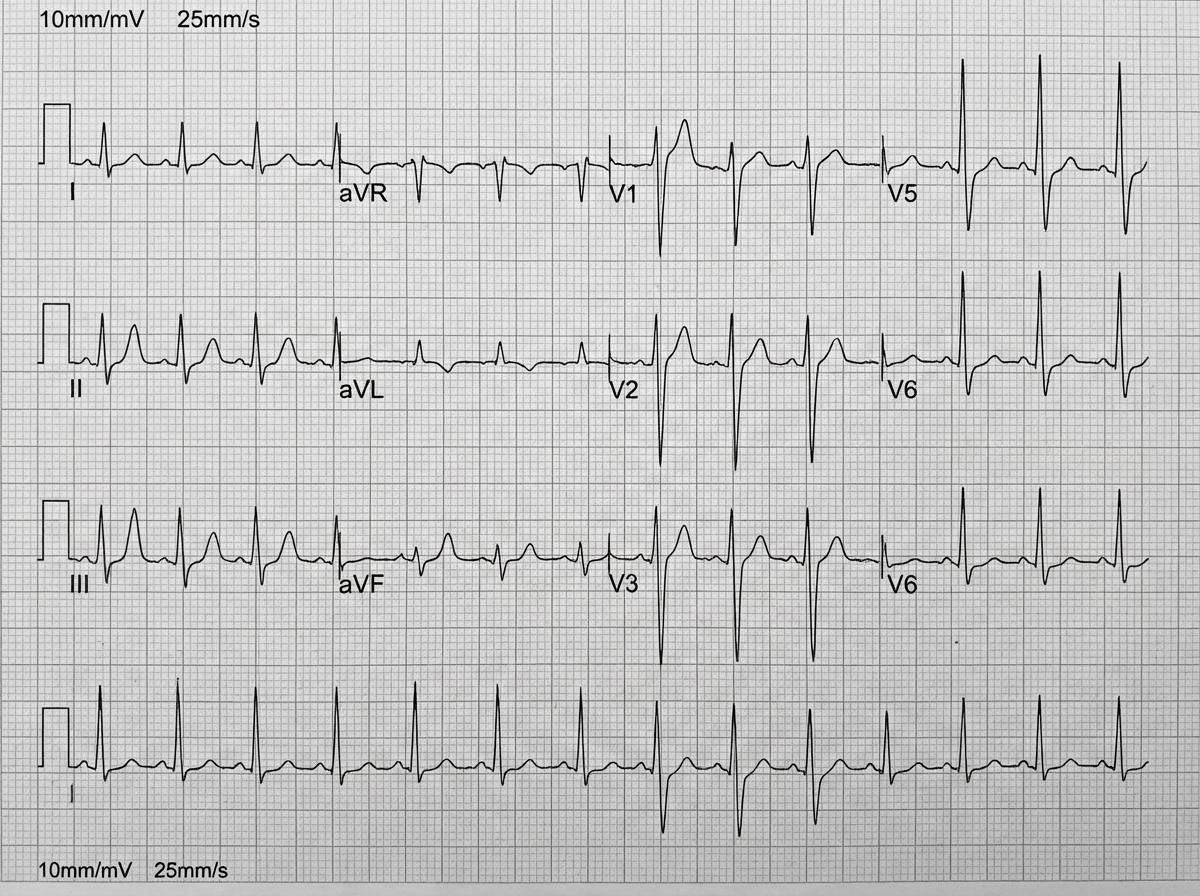
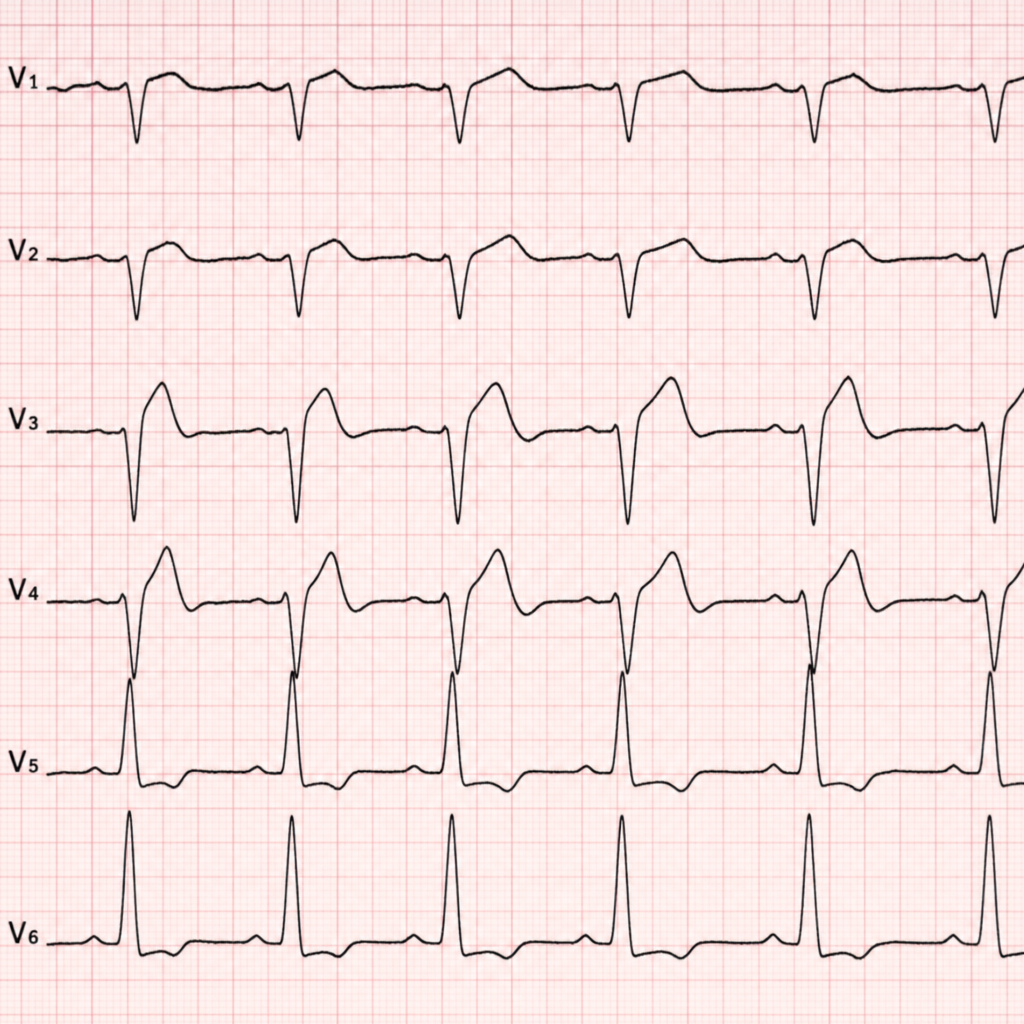
What is the recommended time window for initiating thrombolytic therapy in a patient presenting with myocardial infarction after the onset of chest pain?
What is the most common cause of streptococcal toxic shock syndrome?
A 75-year-old woman with hypertension develops fatigue and dyspnea on exertion. Her blood pressure is 160/60 mm Hg and pulse 80/min. The second heart sound is diminished and there is an early diastolic murmur that radiates from the right sternal border to the apex. Your clinical diagnosis is aortic regurgitation. What is the characteristic arterial pulse finding for this patient?
Congenital long QT syndrome can lead to which of the following complications?
QT prolongation is seen in all, EXCEPT?
All of the following are true about Right Ventricular Infarcts, except?
Which of the following results in broad complex tachycardia?
Besides ECG, what other studies are required to diagnose Brugada syndrome?
Which of the following is an electrocardiographic feature of pulmonary hypertension?
All the following are signs of right-sided congestive cardiac failure except?
Explanation: In the management of ST-Elevation Myocardial Infarction (STEMI), the primary goal is rapid reperfusion [1]. While Primary Percutaneous Coronary Intervention (PCI) is the gold standard, thrombolysis remains a vital alternative when PCI is unavailable. **Explanation of the Correct Answer:** The recommended time window for thrombolysis in STEMI is up to **12 to 24 hours** from the onset of symptoms. While the maximum benefit is achieved within the first 1–3 hours ("The Golden Hour"), clinical guidelines (ACC/AHA) state that fibrinolytic therapy should be administered to patients with symptom onset within the previous 12 hours [1]. However, it can be considered up to **24 hours** if there is evidence of ongoing ischemia (persistent chest pain) and a large area of myocardium at risk, or if PCI is not available. Beyond 24 hours, the risks (primarily intracranial hemorrhage) outweigh the benefits as the infarct is usually completed. **Analysis of Incorrect Options:** * **A & B (6 & 12 hours):** These represent periods of maximal efficacy. While thrombolysis is most effective within these windows [2], the therapy is not strictly "cut off" at 12 hours if ischemia persists. * **C (18 hours):** This is an arbitrary midpoint. Clinical trials (like LATE and EMERAS) specifically looked at the 12–24 hour window to determine late-phase benefits. **High-Yield Clinical Pearls for NEET-PG:** * **Door-to-Needle Time:** Should be **<30 minutes**. * **Door-to-Balloon Time (PCI):** Should be **<90 minutes** (or <120 mins if transferred). * **Absolute Contraindications:** Prior intracranial hemorrhage, known structural cerebrovascular lesion, ischemic stroke within 3 months, active internal bleeding, or suspected aortic dissection. * **Agent of Choice:** Tenecteplase (TNK-tPA) is preferred due to its high fibrin specificity and ease of single-bolus administration.
Explanation: **Explanation:** **Streptococcal Toxic Shock Syndrome (STSS)** is a severe, life-threatening condition characterized by rapid onset of hypotension and multi-organ failure. **Why Streptococcus pyogenes is correct:** The primary causative agent of STSS is **Group A Streptococcus (GAS)**, specifically *Streptococcus pyogenes* [1]. The pathogenesis is driven by **Pyrogenic Exotoxins (SpeA, SpeB, and SpeC)**. These toxins act as **superantigens**, which bypass normal antigen processing and non-specifically bind to the MHC Class II molecules and T-cell receptors [1]. This leads to a massive, systemic release of pro-inflammatory cytokines (cytokine storm), resulting in capillary leak, shock, and tissue destruction (often associated with necrotizing fasciitis) [1]. **Why other options are incorrect:** * **Staphylococcus aureus:** While this is the most common cause of *Staphylococcal* Toxic Shock Syndrome (often associated with tampon use or surgical wounds), it is not the cause of the *Streptococcal* variant. * **Escherichia coli:** A common cause of Gram-negative septic shock via Endotoxin (LPS), but it does not produce the superantigens required for STSS. * **Haemophilus influenzae:** Typically causes respiratory infections or meningitis; it is not associated with the superantigen-mediated pathology of toxic shock. **High-Yield Clinical Pearls for NEET-PG:** * **STSS vs. Staph TSS:** STSS (GAS) is more likely to be associated with **bacteremia** (60% of cases) and **necrotizing fasciitis**, whereas Staph TSS is rarely bacteremic (<5%). * **M-Protein:** The M-protein of *S. pyogenes* is a major virulence factor that helps the bacteria resist phagocytosis. * **Treatment:** Management requires high-dose Penicillin plus **Clindamycin** (which inhibits toxin production) and aggressive surgical debridement if necrotizing fasciitis is present.
Explanation: The clinical presentation of a wide pulse pressure (160/60 mmHg), a diminished S2, and an early diastolic murmur is classic for **Aortic Regurgitation (AR)**. In AR, the left ventricle (LV) receives blood from both the left atrium and the regurgitant flow from the aorta, leading to increased stroke volume [2]. 1. **Why Hyperkinetic Pulse is Correct:** The large stroke volume is ejected rapidly into the arterial system, causing a rapid rise in the pulse (water-hammer or Corrigan’s pulse) [3]. This is followed by a rapid fall due to the regurgitation of blood back into the LV and peripheral runoff. This "bounding" quality is termed a **hyperkinetic pulse**. 2. **Why Incorrect Options are Wrong:** * **Pulsus Tardus (A):** Characterized by a slow-rising, low-amplitude pulse. It is the hallmark of **Aortic Stenosis** [1]. * **Pulsus Paradoxus (B):** An exaggerated drop in systolic BP (>10 mmHg) during inspiration. It is classically seen in **Cardiac Tamponade**, severe asthma, or COPD. * **Bisferiens Pulse (D):** A pulse with two systolic peaks. While it can be seen in severe AR, it is most characteristic of **HOCM** or combined **AS + AR**. **NEET-PG High-Yield Pearls:** * **Right Sternal Border Murmur:** While AR is usually heard at the left sternal border (Erb's point), radiation to the **right sternal border** suggests **Aortic Root Dilatation** (e.g., Marfan syndrome, Aortic Dissection) [2]. * **Peripheral Signs of AR:** Look for Quincke’s pulse (capillary pulsations), De Musset’s sign (head nodding), and Traube’s sign (pistol-shot sounds over femoral arteries) [3]. * **Austin Flint Murmur:** A mid-diastolic rumble at the apex in severe AR, caused by the regurgitant jet displacing the mitral valve leaflet [2].
Explanation: **Explanation:** **Congenital Long QT Syndrome (LQTS)** is a genetic channelopathy characterized by a prolongation of the ventricular action potential, primarily due to mutations in potassium or sodium channels. **Why the correct answer is right:** The hallmark complication of LQTS is a specific form of polymorphic ventricular tachycardia known as **Torsades de Pointes (TdP)** [1], [2]. The prolonged QT interval reflects delayed repolarization, which creates a "vulnerable period" where early after-depolarizations (EADs) can trigger rapid, repetitive ventricular firing [3]. These episodes are often paroxysmal and recurrent; while they may self-terminate (causing syncope), they can also degenerate into ventricular fibrillation, leading to sudden cardiac death [1], [2]. **Why the incorrect options are wrong:** * **A. Complete heart block:** This is a disorder of the AV node or His-Purkinje conduction system, not a primary repolarization defect. * **B. Atrial fibrillation:** While LQTS affects the ventricles, AFib is a supraventricular arrhythmia. Though some overlap exists in rare genetic variants, it is not the classic or most life-threatening complication. * **C. Acute myocardial infarction:** This is typically caused by coronary artery occlusion (atherosclerosis), not an electrical channelopathy. **Clinical Pearls for NEET-PG:** * **Romano-Ward Syndrome:** Autosomal dominant, pure cardiac involvement (most common). * **Jervell and Lange-Nielsen Syndrome:** Autosomal recessive, associated with **sensorineural deafness**. * **Triggers:** LQT1 is often triggered by exercise (swimming); LQT2 by auditory stimuli (alarm clocks); LQT3 occurs during sleep/rest. * **Management:** Beta-blockers (Propranolol/Nadolol) are the first-line treatment; ICDs are used for high-risk patients.
Explanation: **Explanation:** The QT interval represents the total time for ventricular depolarization and repolarization. Prolongation of this interval is clinically significant as it predisposes patients to *Torsades de Pointes*. **Why Digitalis Toxicity is the Correct Answer:** Digitalis (Digoxin) acts by inhibiting the Na+/K+ ATPase pump, which leads to an increase in intracellular calcium. Electrophysiologically, Digoxin **shortens** the action potential duration and the refractory period. Consequently, it causes **QT interval shortening**, not prolongation. Other classic ECG findings in digitalis effect include the "reverse tick" or "scooped-out" ST-segment depression. **Analysis of Incorrect Options:** * **Hypothermia (A):** Characteristically causes prolongation of all ECG intervals (PR, QRS, and QT). It is also associated with the pathognomonic **Osborn waves** (J-waves) at the J-point. * **Hypocalcemia (C):** Low serum calcium levels prolong phase 2 of the ventricular action potential. This leads to a lengthened ST segment and, subsequently, a **prolonged QT interval**. (Note: Hypercalcemia shortens the QT interval). * **Romano-Ward Syndrome (D):** This is the most common form of **Congenital Long QT Syndrome (LQTS)**. It is inherited in an autosomal dominant fashion and is *not* associated with deafness (unlike Jervell and Lange-Nielsen syndrome). **High-Yield Clinical Pearls for NEET-PG:** * **Mnemonic for QT Prolongation:** "ABCDE" – **A**ntiarrhythmics (Class IA, III), **B**iotics (Macrolides, Quinolones), **C**isapride/Antipsychotics, **D**epressants (TCAs), **E**lectrolytes (Hypokalemia, Hypomagnesemia, Hypocalcemia). * **Formula:** The corrected QT (QTc) is most commonly calculated using **Bazett’s Formula**: $QTc = QT / \sqrt{RR}$. * **Management:** For acquired Long QT with Torsades, the treatment of choice is **IV Magnesium Sulfate**.
Explanation: In Right Ventricular Infarction (RVI), the hallmark pathophysiology is **acute right-sided heart failure**. This leads to a sudden backup of pressure into the systemic venous circulation [3]. **1. Why "Normal JVP" is the correct (false) statement:** The most sensitive and characteristic clinical sign of RVI is an **elevated Jugular Venous Pressure (JVP)** [2]. Because the right ventricle fails to pump blood effectively into the pulmonary circulation, blood backs up into the superior vena cava. A normal JVP in a patient with suspected RVI is highly unlikely and should prompt a search for an alternative diagnosis. **2. Explanation of other options:** * **Nocturia:** In right-sided failure, dependent edema accumulates in the lower limbs during the day. At night, when the patient lies supine, this fluid is redistributed, increasing renal perfusion and venous return, leading to increased urine production (nocturia). * **Ascites:** Chronic or severe acute right heart failure leads to systemic venous congestion, causing hepatic congestion and fluid leakage into the peritoneal cavity (ascites) [2]. **3. High-Yield Clinical Pearls for NEET-PG:** * **The Triad of RVI:** Hypotension, Clear Lungs (absence of pulmonary edema), and Elevated JVP. * **Kussmaul’s Sign:** A paradoxical rise in JVP during inspiration is frequently seen in RVI. * **Diagnosis:** The most specific finding is **ST-elevation in lead V4R** (Right-sided ECG). * **Management Contraindication:** Avoid **Nitrates, Diuretics, and Morphine**, as they decrease preload. RVI is "preload dependent." * **Treatment of choice:** Aggressive **IV fluid resuscitation** (Normal Saline) to maintain right ventricular filling pressure [1].
Explanation: ### Explanation The width of a QRS complex in tachycardia is determined by how the ventricles are depolarized. **Broad complex tachycardia (QRS >120ms)** occurs when ventricular activation is slow and asynchronous, typically because the impulse originates below the His bundle or reaches the ventricles via the myocardium rather than the specialized Purkinje system [3]. **1. Why Option A is Correct:** In **Antidromic AVRT** (Atrioventricular Re-entrant Tachycardia), the impulse travels down the **accessory pathway** (bypass tract) and returns to the atria via the AV node. Because the accessory pathway inserts directly into the ventricular myocardium (bypassing the rapid His-Purkinje system), ventricular depolarization is slow and cell-to-cell, resulting in a **wide QRS complex** that is often mistaken for Ventricular Tachycardia (VT) [3]. **2. Why the Other Options are Incorrect:** * **Option B (Orthodromic AVRT):** The impulse travels down the **AV node/His-Purkinje system** and returns via the accessory pathway [1]. Since the ventricles are activated normally, the QRS is **narrow** [1]. * **Option C (AVNRT):** This involves a re-entrant circuit within the AV node itself [2]. Ventricular activation occurs via the normal His-Purkinje system, resulting in a **narrow QRS** [2]. * **Option D (Atrial Fibrillation):** In its standard form, AFib is a **narrow complex** irregular tachycardia. It only becomes broad if there is a co-existing bundle branch block or pre-excitation (WPW) [1]. **Clinical Pearls for NEET-PG:** * **Rule of Thumb:** If the impulse goes **Down** the AV node, the QRS is **Narrow**. If it goes **Down** an Accessory Pathway, the QRS is **Wide** [3]. * **WPW Syndrome:** Antidromic AVRT accounts for only ~5% of tachycardias in WPW; Orthodromic is much more common (~95%). * **Management:** Avoid AV nodal blockers (ABCD: Adenosine, Beta-blockers, Calcium channel blockers, Digoxin) in pre-excited AFib/Antidromic tachycardia as they can paradoxically increase conduction through the accessory pathway, leading to VF.
Explanation: Brugada syndrome is a genetic channelopathy (primarily involving the $SCN5A$ sodium channel gene) that predisposes patients to ventricular arrhythmias and sudden cardiac death. The diagnosis is fundamentally based on a characteristic ECG pattern (Type 1: coved ST-segment elevation $\geq$ 2mm in V1-V2) in the **absence of structural heart disease.** **Why Echocardiography is the correct answer:** The definition of Brugada syndrome requires the exclusion of underlying structural abnormalities that could mimic the ECG pattern or independently cause arrhythmias (e.g., Arrhythmogenic Right Ventricular Cardiomyopathy - ARVC). **Echocardiography** is the mandatory first-line imaging study used to confirm that the heart is structurally normal, thereby fulfilling the diagnostic criteria. **Analysis of Incorrect Options:** * **A. Stress test:** Exercise typically decreases the ST elevation in Brugada patients (as heart rate increases, the ST elevation often diminishes). It is not a diagnostic requirement. * **B. Holter monitor:** While useful for detecting paroxysmal arrhythmias or nocturnal agonal respiration, it cannot confirm the "structurally normal heart" requirement for diagnosis. * **C. Angiogram:** Invasive coronary angiography is generally not required unless there is a high suspicion of coronary artery disease mimicking the ECG changes (Pseudo-Brugada). **High-Yield Clinical Pearls for NEET-PG:** * **Inheritance:** Autosomal Dominant. * **Demographics:** Most common in young males of Southeast Asian descent. * **Triggers:** Fever, sodium channel blockers (e.g., Ajmaline, Flecainide), and alcohol. Fever-induced ECG changes are a classic board presentation. * **Management:** The only proven effective treatment for symptomatic patients or survivors of cardiac arrest is an **Implantable Cardioverter Defibrillator (ICD).** Quinidine can be used as an adjunct for electrical storms.
Explanation: Explanation: Pulmonary hypertension (PH) leads to chronic pressure overload of the right ventricle (RV), resulting in **Right Ventricular Hypertrophy (RVH)** and right atrial enlargement. **Why T wave inversion is correct:** In pulmonary hypertension, the hypertrophied and strained right ventricle undergoes repolarization abnormalities [1]. This manifests as **T wave inversions in the right precordial leads (V1–V3)** and sometimes the inferior leads (II, III, aVF) [1]. This is known as the "Right Ventricular Strain Pattern" and is a hallmark ECG finding of chronic RV pressure overload [1]. **Analysis of Incorrect Options:** * **B. Presence of U wave:** Typically associated with **hypokalemia**, bradycardia, or certain medications (e.g., Digoxin, Class IA antiarrhythmics). It is not a feature of PH. * **C. SI, Q3, T3 pattern:** While this is a classic board-exam finding for right heart strain, it is specifically associated with **Acute Pulmonary Embolism** (acute cor pulmonale) rather than the chronic changes of pulmonary hypertension [1]. It is also relatively insensitive. * **D. PR prolongation:** This represents a first-degree AV block, usually seen in conditions affecting the conduction system (e.g., hyperkalemia, beta-blocker use, or rheumatic fever), not typically PH. **High-Yield NEET-PG Pearls for Pulmonary Hypertension ECG:** 1. **Right Axis Deviation (RAD):** Often > +110°. 2. **P-pulmonale:** Tall, peaked P waves (>2.5 mm) in lead II (Right Atrial Enlargement). 3. **R/S ratio in V1:** > 1 (Dominant R wave in V1 is a classic sign of RVH) [1]. 4. **Right Bundle Branch Block (RBBB):** Often seen due to RV stretching [1].
Explanation: **Explanation:** In Congestive Cardiac Failure (CCF), the clinical manifestations depend on which side of the heart is failing. The fundamental concept is **"backward failure"**: blood backs up into the venous system behind the failing chamber. **Why Cough is the Correct Answer:** Cough is a hallmark sign of **Left-Sided Heart Failure**. When the left ventricle fails, blood backs up into the pulmonary veins and capillaries. This leads to pulmonary congestion and interstitial edema, which irritates the bronchial mucosa, triggering a cough (often worse when lying flat—orthopnea) [1]. In contrast, isolated right-sided failure affects the systemic circulation, not the lungs. **Analysis of Incorrect Options (Signs of Right-Sided Failure):** * **Jugular Venous Engorgement:** The right atrium receives blood from the Superior Vena Cava. Failure of the right heart leads to increased central venous pressure, clinically visible as an elevated Jugular Venous Pressure (JVP). * **Hepatomegaly:** Increased pressure in the Inferior Vena Cava leads to venous congestion of the liver (congestive hepatomegaly), which may be tender and associated with "nutmeg liver" pathology. * **Pedal Edema:** Elevated systemic venous pressure increases hydrostatic pressure in the peripheral capillaries, causing fluid to leak into the interstitium, typically presenting as dependent, pitting edema [1]. **High-Yield Clinical Pearls for NEET-PG:** * **Most common cause of Right Heart Failure:** Left Heart Failure (due to secondary pulmonary hypertension). * **Most common cause of isolated Right Heart Failure:** Cor Pulmonale (due to lung disease like COPD). * **Kussmaul’s Sign:** A paradoxical rise in JVP on inspiration; seen in constrictive pericarditis and sometimes right-sided heart failure. * **NYHA Classification:** Focuses on functional capacity and symptoms (dyspnea/fatigue) rather than physical signs.
Coronary Artery Disease and Angina
Practice Questions
Acute Coronary Syndromes
Practice Questions
Heart Failure
Practice Questions
Cardiac Arrhythmias
Practice Questions
Valvular Heart Diseases
Practice Questions
Cardiomyopathies
Practice Questions
Pericardial Diseases
Practice Questions
Congenital Heart Disease in Adults
Practice Questions
Hypertension and Hypertensive Emergencies
Practice Questions
Pulmonary Hypertension
Practice Questions
Non-invasive Cardiac Diagnostics
Practice Questions
Preventive Cardiology
Practice Questions
Get full access to all questions, explanations, and performance tracking.
Start For Free