Which of the following is NOT included in the modified Jones criteria?
Which of the following is a major criterion for the diagnosis of Rheumatic fever according to the modified Jones criteria?
What is the most common cause of Superior Vena Cava (SVC) syndrome?
In a patient with wide-complex tachycardia, the presence of all of the following in the ECG indicates ventricular tachycardia except?
A study of risk factors for atherogenesis in adults is performed. Which of the following substances is most likely to reduce serum cholesterol?
Which valvular or septal defect is associated with the least chance of infective endocarditis?
Pericardial knock is heard in which condition?
A 70-year-old man with a history of coronary artery disease presents with substernal chest pressure, diaphoresis, and nausea, along with difficulty catching his breath. An electrocardiogram shows septal T-wave inversion. His troponin I is elevated. He has been given aspirin and sublingual nitroglycerin. Blood pressure is 154/78 and heart rate is 72. What is the best next step in management?
S4 gallop is not heard in which of the following conditions?
A patient with known valvular heart disease requires dental extraction. Which of the following is the recommended pretreatment prophylaxis regimen?
Explanation: The **Modified Jones Criteria** are used for the diagnosis of **Acute Rheumatic Fever (ARF)**, a non-suppurative sequela of Group A Streptococcus infection [1]. ### **Explanation of the Correct Answer** **Option A (Prolonged QRS interval)** is the correct answer because it is **not** part of the Jones criteria. In ARF, the characteristic ECG finding included in the Minor Criteria is a **prolonged PR interval** (first-degree AV block), not a prolonged QRS. A prolonged QRS usually indicates bundle branch blocks or ventricular conduction delays, which are not specific to ARF. ### **Analysis of Incorrect Options** The Jones criteria are divided into Major and Minor categories. Options B, C, and D are all **Major Criteria**: * **Carditis (B):** Clinical or subclinical (detected by Echo) involvement of the endocardium, myocardium, or pericardium (pancarditis) [1]. * **Chorea (C):** Also known as Sydenham’s chorea or "St. Vitus' dance," characterized by rapid, purposeless movements [1]. * **Erythema Marginatum (D):** A classic evanescent, non-pruritic, pink ring-like rash with central clearing. ### **NEET-PG High-Yield Pearls** * **Mnemonic for Major Criteria (JONES):** **J**oints (Migratory Polyarthritis), **O** (Heart - Carditis), **N**odules (Subcutaneous), **E**rythema marginatum, **S**ydenham’s chorea. * **Minor Criteria:** Fever, Arthralgia, Elevated ESR/CRP, and **Prolonged PR interval**. * **Diagnosis Requirement:** 2 Major OR 1 Major + 2 Minor criteria, plus evidence of preceding Streptococcal infection (ASO titer/Throat culture) [1]. * **Exception:** Chorea or indolent carditis can be diagnostic of ARF on their own without meeting other criteria [1]. * **Most common valve affected:** Mitral valve (Mitral Regurgitation in acute phase; Mitral Stenosis in chronic phase).
Explanation: The diagnosis of Acute Rheumatic Fever (ARF) is based on the **Modified Jones Criteria**, which requires evidence of a preceding Group A Streptococcal (GAS) infection plus either two major criteria or one major and two minor criteria [1]. ### **Explanation of the Correct Option** **D. Subcutaneous nodules:** These are one of the five **Major Criteria** (mnemonic: **J♥NES**). They are small, painless, firm, mobile lumps usually found over bony prominences or extensor tendons. While they are the least common major manifestation (<10%), they are highly specific for ARF and often associated with severe carditis [1]. ### **Analysis of Incorrect Options** * **A. ASO titre:** This is not a criterion itself; rather, it is the **essential evidence of preceding GAS infection** (along with positive throat culture or Rapid Strep Test) required to apply the Jones criteria [1]. * **B. Past history of Rheumatic fever:** While a history of ARF increases clinical suspicion, it was removed as a formal criterion in later revisions to maintain diagnostic specificity [1]. * **C. Fever:** This is a **Minor Criterion** [1]. Other minor criteria include arthralgia, prolonged PR interval on ECG, and elevated inflammatory markers (ESR/CRP). ### **High-Yield Clinical Pearls for NEET-PG** * **Major Criteria (J♥NES):** **J**oints (Migratory Polyarthritis), **♥** (Carditis), **N**odules (Subcutaneous), **E**rythema marginatum, **S**ydenham’s chorea. * **Joints:** Arthritis must be **migratory** and involve large joints to count as a major criterion in low-risk populations. * **Chorea:** Sydenham’s chorea (St. Vitus' dance) can be a standalone diagnostic finding even without evidence of preceding GAS infection due to its long latent period [1]. * **Exceptions:** In **high-risk populations** (e.g., India), monoarthritis or polyarthralgia can be considered major criteria.
Explanation: **Explanation:** **Superior Vena Cava (SVC) Syndrome** occurs due to the obstruction of blood flow through the SVC. The underlying mechanism is broadly categorized into **extrinsic compression** (pressure from outside the vessel) or **intrinsic obstruction** (thrombosis or invasion). 1. **Why Extrinsic Compression is Correct:** The SVC is a thin-walled, low-pressure vessel located in the tight confines of the middle mediastinum, making it highly susceptible to compression by adjacent structures. Historically, infections like syphilis were common, but today, **malignancy** is the cause in >60-90% of cases [1]. Specifically, **Lung Cancer** (especially Small Cell Lung Cancer) and **Non-Hodgkin Lymphoma** cause SVC syndrome primarily through extrinsic compression by primary tumors or enlarged mediastinal lymph nodes [2]. 2. **Why Other Options are Incorrect:** * **Thrombosis (A):** While the incidence of thrombosis is rising due to the increased use of indwelling central venous catheters and pacemakers, it remains less common than extrinsic compression from malignancy. * **Mediastinal Lymphoma (C):** This is a *specific cause* of extrinsic compression, but it is not the *most common* cause (Lung cancer is more frequent) [1]. * **Teratoma (D):** This is a rare germ cell tumor of the mediastinum and is an infrequent cause of SVC obstruction. **High-Yield Clinical Pearls for NEET-PG:** * **Most Common Cause:** Bronchogenic Carcinoma (Small Cell > Squamous) [1]. * **Most Common Benign Cause:** Fibrosing Mediastinitis (often secondary to Histoplasmosis or TB). * **Clinical Presentation:** Facial puffiness (worse in the morning), "Pemberton’s sign" (facial flushing when arms are raised), and dilated collateral veins on the chest wall [3]. * **Management:** The first step is usually imaging (Contrast-enhanced CT); treatment involves stenting or treating the underlying malignancy (Radiation/Chemo).
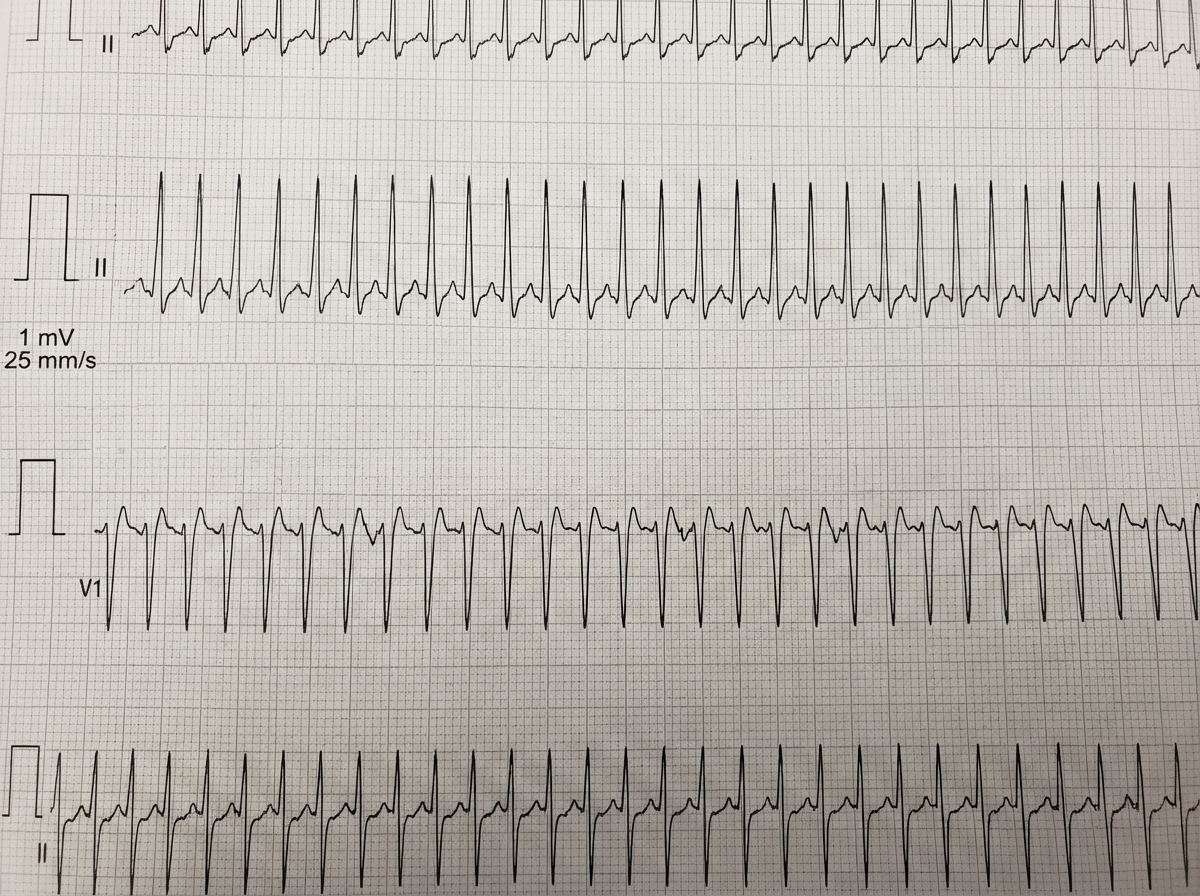
Explanation: In a patient presenting with wide-complex tachycardia (WCT), the primary clinical challenge is differentiating **Ventricular Tachycardia (VT)** from **Supraventricular Tachycardia (SVT) with aberrancy** [1]. ### Why "Typical RBBB Morphology" is the Correct Answer A **typical** bundle branch block pattern (either RBBB or LBBB) suggests that the electrical impulse is originating above the ventricles (SVT) and traveling through the normal conduction system, but is delayed by a pre-existing or rate-dependent block [2]. In contrast, VT originates within the ventricular myocardium, leading to an **atypical** or "bizarre" morphology that does not perfectly mimic a standard RBBB or LBBB [1]. Therefore, a typical RBBB pattern points toward SVT with aberrancy rather than VT. ### Explanation of Incorrect Options (Features of VT) * **Atrioventricular (AV) Dissociation:** This is the "hallmark" of VT. It occurs when the atria and ventricles beat independently [1]. Seeing P-waves that have no fixed relationship with the QRS complexes is 100% specific for VT. * **Fusion Beats:** These occur when a supraventricular impulse and a ventricular impulse "meet" to activate the ventricles simultaneously, creating a hybrid QRS complex [1]. This is a definitive sign of VT. * **Capture Beats:** These are occasional normal-looking (narrow) QRS complexes that occur when a sinoatrial impulse "captures" the ventricles amidst the tachycardia. This proves the underlying rhythm is ventricular. ### High-Yield Clinical Pearls for NEET-PG * **Brugada Criteria:** Used to differentiate WCT. The first step is looking for the absence of an RS complex in all precordial leads (concordance). * **Northwest Axis:** An axis between -90° and 180° ("no man's land") is highly suggestive of VT. * **Hemodynamic Stability:** Never use stability to differentiate VT from SVT. VT can often present with a stable blood pressure initially. * **Rule of Thumb:** In any older patient or patient with a history of Ischemic Heart Disease (IHD), a wide-complex tachycardia should be treated as **VT until proven otherwise.**
Explanation: **Explanation:** The correct answer is **Omega-3 fatty acids (D)**. **Mechanism:** Omega-3 fatty acids (specifically EPA and DHA found in fish oil) are potent agents in lipid management [2]. They primarily reduce serum triglycerides by inhibiting hepatic synthesis of VLDL and increasing fatty acid oxidation. While their effect on LDL-cholesterol is variable, they are well-documented to increase HDL ("good") cholesterol and improve the overall lipid profile, thereby exerting a cardioprotective effect against atherogenesis [2]. **Analysis of Incorrect Options:** * **A. C-reactive protein (CRP):** This is an acute-phase reactant and a marker of systemic inflammation. High-sensitivity CRP (hs-CRP) is a strong predictor of cardiovascular risk, but it does not lower cholesterol; rather, it indicates an increased risk of plaque rupture. * **B. Homocysteine:** Elevated levels (hyperhomocysteinemia) cause endothelial damage and promote thrombosis. It is a known independent risk factor for atherosclerosis, not a lipid-lowering agent. * **C. Lipoprotein(a):** This is a low-density lipoprotein-like particle. High levels of Lp(a) are genetically determined and are strongly associated with an increased risk of coronary artery disease and aortic stenosis. **High-Yield Clinical Pearls for NEET-PG:** * **Friedewald Formula:** LDL = Total Cholesterol – HDL – (Triglycerides/5). Note: This is invalid if TG >400 mg/dL. * **Hypertriglyceridemia:** Omega-3 fatty acids and Fibrates (PPAR-α agonists) are the first-line treatments for severe hypertriglyceridemia to prevent pancreatitis [1], [3]. * **Atherogenic Triad:** High TG, Low HDL, and small dense LDL particles (common in Diabetes Mellitus). * **Lp(a):** It is structurally similar to plasminogen and can inhibit fibrinolysis, making it both pro-atherogenic and pro-thrombotic. [4]
Explanation: **Explanation:** The risk of **Infective Endocarditis (IE)** is primarily determined by the degree of **turbulence** in blood flow and the resulting pressure gradient across a defect. High-velocity jet streams cause endothelial damage, leading to the deposition of fibrin and platelets (Non-Bacterial Thrombotic Endocarditis), which serves as a nidus for bacterial colonization. **Why Small Atrial Septal Defect (ASD) is the correct answer:** In a Secundum ASD, the pressure gradient between the left and right atrium is very low [1]. This results in **low-velocity, laminar flow** rather than turbulent flow. Consequently, there is minimal endocardial trauma, making the risk of IE negligible. In clinical practice, IE prophylaxis is not recommended for isolated ASDs [1]. **Analysis of Incorrect Options:** * **Small Ventricular Septal Defect (VSD):** Despite being "small," the pressure gradient between the high-pressure left ventricle and low-pressure right ventricle is significant. This creates a high-velocity jet that damages the right ventricular endocardium, making it a **high-risk** lesion for IE. * **Mild Mitral Regurgitation (MR):** Any degree of regurgitation creates a high-pressure jet from the ventricle back into the atrium, causing turbulence and increasing IE risk [1]. * **Mild Mitral Stenosis (MS):** While the risk is lower than in MR or VSD, the restricted orifice still creates more turbulence than a simple ASD. **High-Yield Clinical Pearls for NEET-PG:** * **Highest Risk Lesions:** Prosthetic heart valves, previous IE, and Cyanotic Congenital Heart Disease (uncorrected) [1]. * **Negligible Risk Lesions:** Isolated Secundum ASD, 6 months post-repair of VSD/PDA (without residual leak), and Cardiac Pacemakers. * **Commonest Valve involved in IE:** Mitral Valve (overall); Tricuspid Valve (in IV drug users). * **Commonest Organism:** *Staph. aureus* (Acute IE/IVDU); *Strep. viridans* (Subacute IE/Post-dental procedures).
Explanation: **Explanation:** **Constrictive Pericarditis (Correct Answer):** The **pericardial knock** is a high-pitched, early diastolic sound heard shortly after $S_2$. It occurs due to the rigid, non-compliant pericardium characteristic of constrictive pericarditis [1]. During early diastole, there is rapid ventricular filling; however, this filling is abruptly halted when the expanding ventricular volume hits the limit set by the stiff, calcified pericardium. This sudden cessation of ventricular expansion produces the "knock." It occurs earlier than an $S_3$ gallop. **Analysis of Incorrect Options:** * **Cardiac Tamponade:** This is characterized by muffled heart sounds (Beck’s Triad) due to fluid accumulation [3]. There is no "knock" because the fluid prevents the sudden tension of the ventricular wall against a rigid shell. * **Restrictive Cardiomyopathy (RCM):** While clinically similar to constriction, RCM is a disease of the myocardium, not the pericardium [2]. It is more commonly associated with an **$S_3$ gallop** rather than a pericardial knock. * **Acute Pericarditis:** The hallmark auscultatory finding here is a **pericardial friction rub** (scratchy, three-component sound), caused by the inflammation of the pericardial layers. Investigations often show specific ECG changes like ST elevation with upward concavity [4]. **High-Yield Clinical Pearls for NEET-PG:** * **Kussmaul’s Sign:** Paradoxical rise in JVP during inspiration (Seen in Constrictive Pericarditis, NOT in Tamponade). * **Square Root Sign:** Seen on pressure tracings (dip-and-plateau pattern) in Constrictive Pericarditis. * **Chest X-ray:** Pericardial calcification is a classic diagnostic clue for constriction [1]. * **Pulsus Paradoxus:** Characteristically seen in Cardiac Tamponade (drop in SBP >10 mmHg during inspiration).
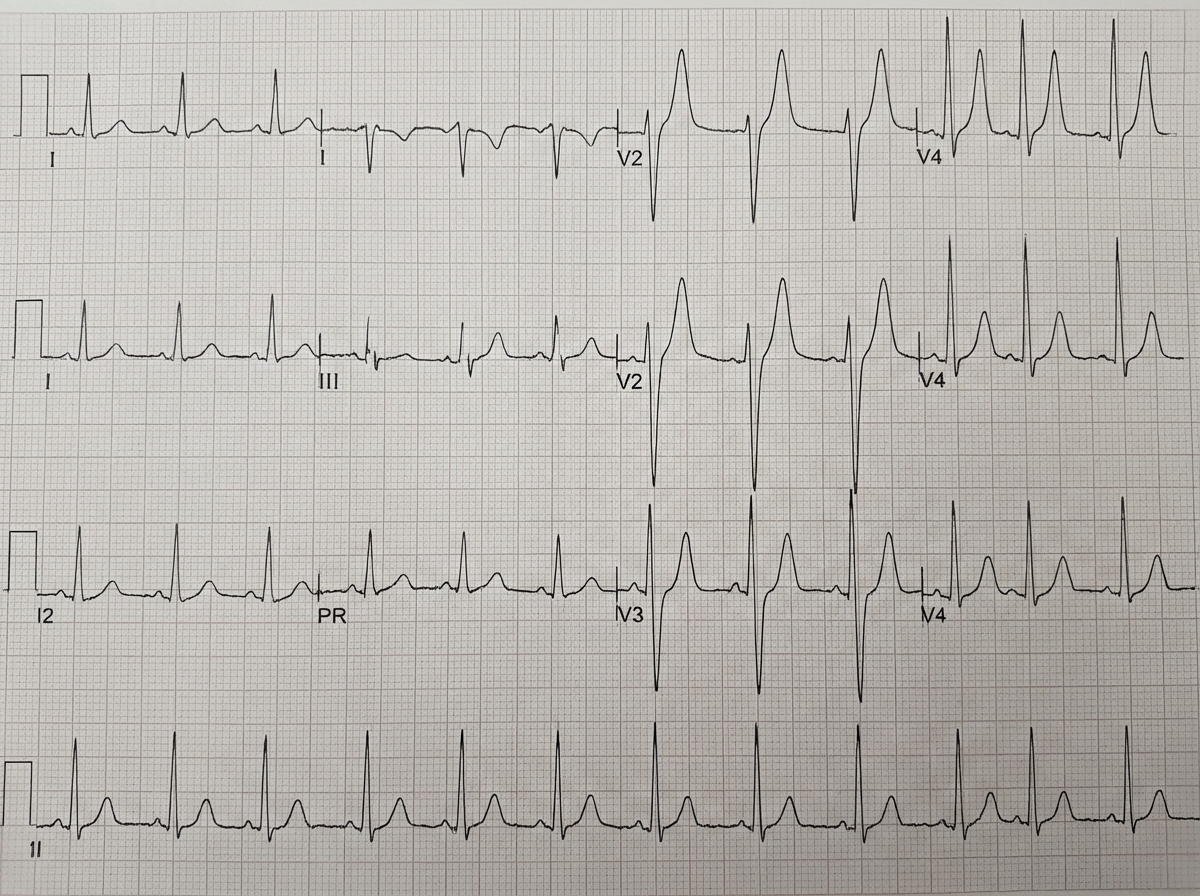
Explanation: ### **Explanation** **Correct Answer: D. Begin intravenous beta-blocker therapy** The patient is presenting with an **NSTEMI** (Non-ST Elevation Myocardial Infarction), evidenced by ischemic symptoms, T-wave inversion (septal), and elevated Troponin I. In NSTEMI management, the primary goal is to reduce myocardial oxygen demand [2]. **Beta-blockers** achieve this by decreasing heart rate, blood pressure, and myocardial contractility [2]. Current guidelines recommend initiating beta-blockers within the first 24 hours for patients with NSTEMI who do not have contraindications (e.g., heart failure, bradycardia, or heart block) [1]. **Why other options are incorrect:** * **A. Emergent cardiac catheterization:** While NSTEMI patients eventually require catheterization (usually within 24–48 hours), "emergent" (immediate) intervention is reserved for patients with hemodynamic instability, refractory chest pain, or life-threatening arrhythmias [1]. This patient is currently stable (BP 154/78). * **B. Intravenous thrombolytic therapy:** Thrombolytics (fibrinolytics) are **contraindicated** in NSTEMI [1]. They are only indicated for STEMI when primary PCI cannot be performed within 120 minutes. In NSTEMI, they may actually increase mortality by causing hemorrhage into the plaque [1]. * **C. Admit and repeat enzymes/ECG:** While the patient will be admitted, this is a passive step. The question asks for the "next step in management," which implies active treatment to stabilize the myocardium. **High-Yield Clinical Pearls for NEET-PG:** * **NSTEMI vs. UA:** Both present without ST-elevation; the presence of elevated cardiac biomarkers (Troponin) distinguishes NSTEMI from Unstable Angina (UA). * **TIMI Score:** Used in NSTEMI to risk-stratify patients and decide between an early invasive vs. conservative strategy. * **Contraindications to Beta-blockers:** Always check for signs of acute heart failure (crackles), hypotension (SBP <90), or heart block before administration [1]. * **Morphine, Oxygen, Nitrates, Aspirin (MONA):** The classic initial bundle, though oxygen is now only recommended if $SaO_2 < 90\%$.
Explanation: ### Explanation The **S4 heart sound (atrial gallop)** occurs during late diastole and coincides with atrial contraction [1]. It is produced when the atrium contracts against a **stiff, non-compliant ventricle**. **Why Ventricular Aneurysm is the Correct Answer:** In a **ventricular aneurysm**, the affected portion of the ventricular wall is scarred, thin, and dyskinetic (bulges outward during systole). Because this area is thin and non-muscular, it lacks the resistance/stiffness required to generate the vibrations of an S4. Instead, ventricular aneurysms are classically associated with an **S3 gallop** due to volume overload or heart failure, but the lack of muscular tension prevents an S4. **Analysis of Incorrect Options:** * **Hypertension & Hypertrophic Cardiomyopathy (HCM):** Both conditions lead to **Left Ventricular Hypertrophy (LVH)**. A thickened, hypertrophied ventricle is stiff and has decreased compliance. Atrial contraction against this resistance produces a prominent S4. * **Mitral Regurgitation (MR):** While acute MR often presents with an S4 due to sudden volume loading of a non-compliant ventricle [2], chronic MR is more commonly associated with an S3. However, in the context of this specific question, an S4 is physiologically *impossible* in a dyskinetic aneurysm, whereas it can occur in MR (especially if associated with hypertension or CAD). **High-Yield Clinical Pearls for NEET-PG:** * **The "Atrial Kick":** S4 cannot occur in **Atrial Fibrillation** because there is no coordinated atrial contraction. * **S4 Timing:** It occurs just before S1 (presystolic) [1]. * **Left vs. Right S4:** A Left-sided S4 is best heard at the apex in the left lateral decubitus position; a Right-sided S4 (seen in Pulmonary HTN or Pulmonary Stenosis) is heard at the left lower sternal border and increases with inspiration. * **HOCM:** S4 is a hallmark finding in Hypertrophic Obstructive Cardiomyopathy due to severe diastolic dysfunction.
Explanation: **Explanation:** The primary goal of antibiotic prophylaxis in patients with valvular heart disease undergoing dental procedures is to prevent **Infective Endocarditis (IE)** [1]. Dental extractions can cause transient bacteremia, most commonly involving *Viridans group streptococci*. **1. Why Amoxicillin 3g is correct:** Amoxicillin is the drug of choice because it is well-absorbed from the gastrointestinal tract and provides high, sustained serum levels. The standard traditional regimen (as per older AHA/BSAC guidelines often tested in exams) is **3g orally one hour before the procedure**. Note: Modern guidelines (AHA 2021) have updated this to 2g, but in the context of standard NEET-PG options, the 3g dose remains the classic "correct" answer for high-dose prophylaxis [2]. **2. Why the other options are incorrect:** * **Option A (Tetracycline):** Tetracyclines are bacteriostatic and are not effective against the common pathogens that cause IE; they have no role in IE prophylaxis. * **Option C (Amoxicillin 1g IM):** The oral route is preferred for its ease and efficacy. 1g is an under-dose for standard prophylaxis. * **Option D (Benzyl penicillin):** While penicillin is effective, it requires parenteral administration and has a shorter half-life than amoxicillin, making it less ideal for outpatient dental prophylaxis. **Clinical Pearls for NEET-PG:** * **High-risk conditions requiring prophylaxis:** Prosthetic heart valves, prior history of IE, unrepaired cyanotic congenital heart disease, and cardiac transplant recipients with valvulopathy [1]. * **Procedures requiring prophylaxis:** Only those involving manipulation of gingival tissue or the periapical region of teeth. * **Penicillin Allergy:** Use **Clindamycin (600mg)**, Azithromycin, or Clarithromycin (500mg).
Coronary Artery Disease and Angina
Practice Questions
Acute Coronary Syndromes
Practice Questions
Heart Failure
Practice Questions
Cardiac Arrhythmias
Practice Questions
Valvular Heart Diseases
Practice Questions
Cardiomyopathies
Practice Questions
Pericardial Diseases
Practice Questions
Congenital Heart Disease in Adults
Practice Questions
Hypertension and Hypertensive Emergencies
Practice Questions
Pulmonary Hypertension
Practice Questions
Non-invasive Cardiac Diagnostics
Practice Questions
Preventive Cardiology
Practice Questions
Get full access to all questions, explanations, and performance tracking.
Start For Free