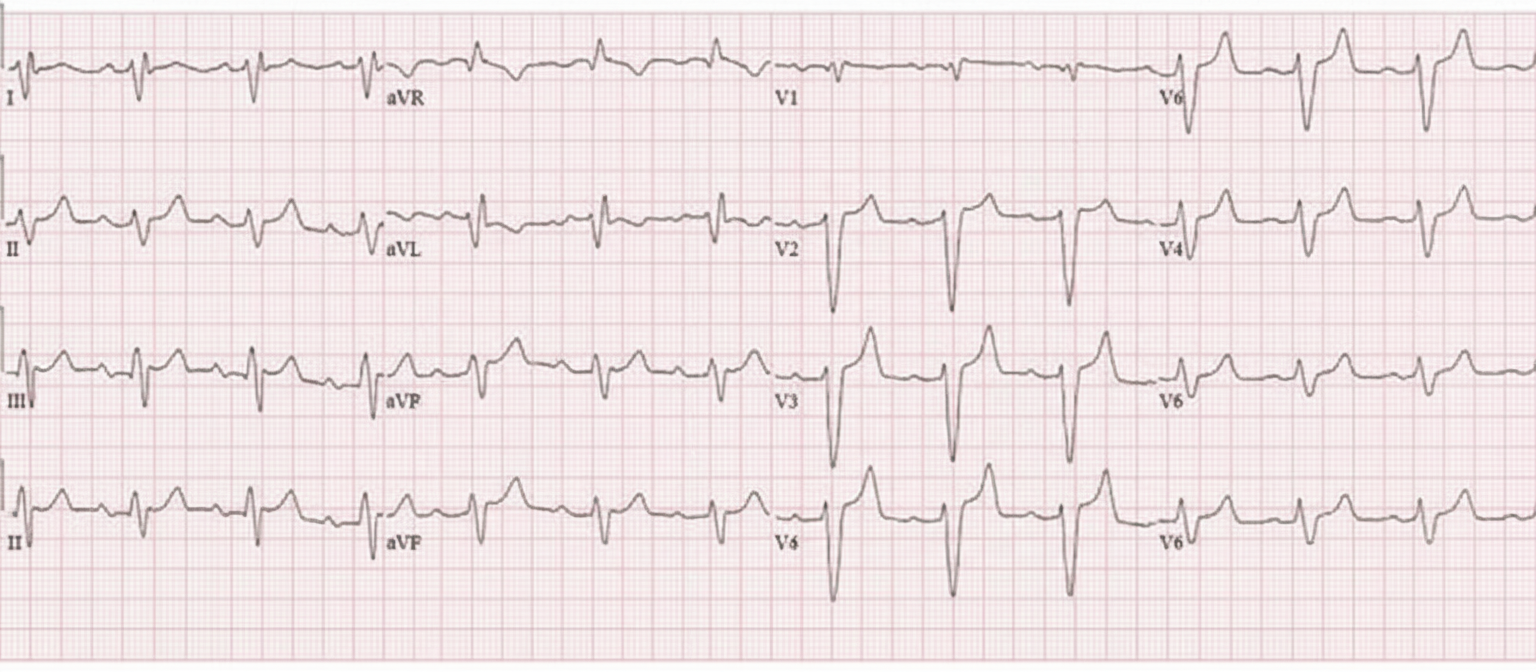
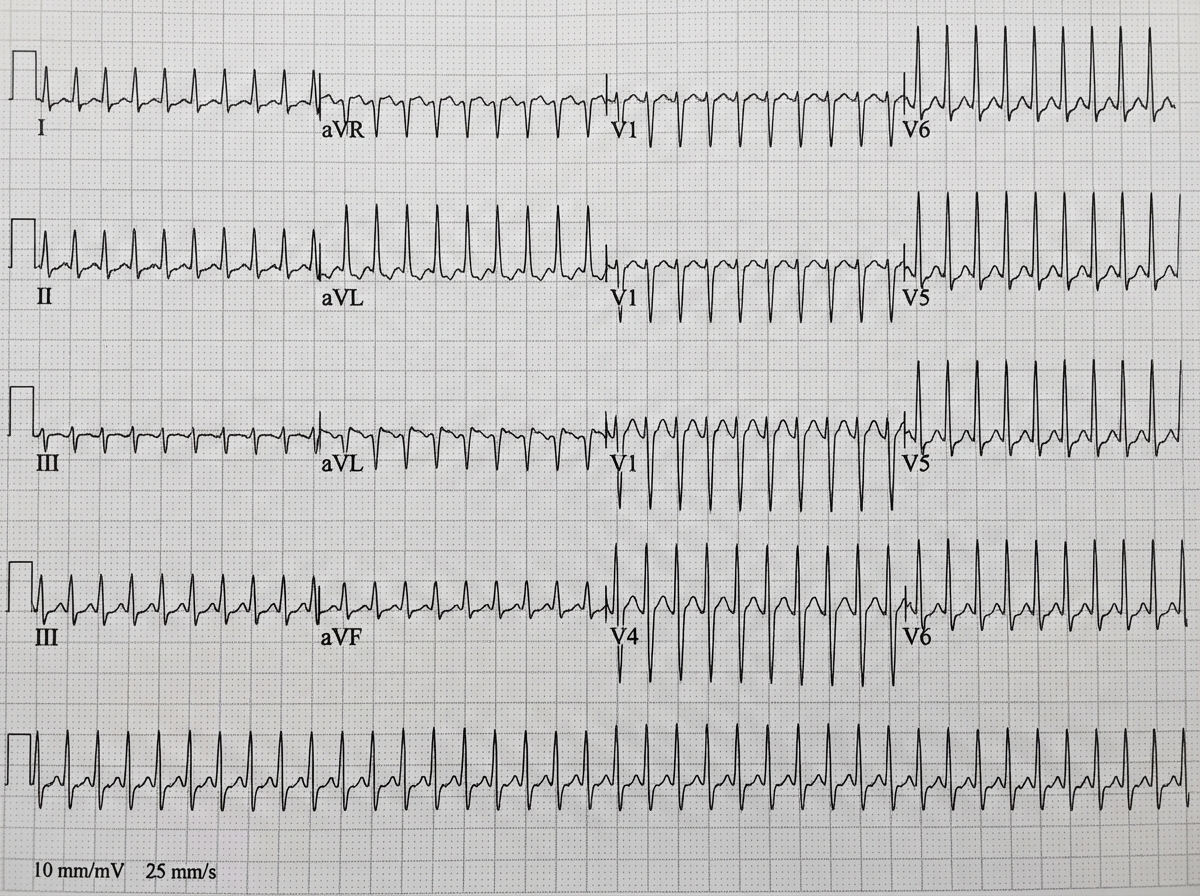
Which of the following is a contraindication to chemical cardioversion?
Gorlin's formula is used to calculate what parameter?
A patient had an inferior wall myocardial infarction and was in shock. What is the most likely reason for the patient being in shock?
All of the following ECG features indicate ventricular tachycardia except?
A young female presents with a history of dyspnea on exertion. On examination, she has wide, fixed split S2 with an ejection systolic murmur in the left second intercostal space. Her EKG shows left atrial deviation. What is the most probable diagnosis?
The ECG of a patient with an artificial pacemaker in the right ventricle shows?
Which of the following diastolic sounds may be heard during cardiac auscultation?
Atrial fibrillation is seen in all of the following conditions EXCEPT:
A 50-year-old man presents with central chest pain. He collapsed while his ECG was being recorded. What is the cause of this ECG?

What is the most common cause of acute bacterial endocarditis?
Explanation: ### Explanation The management of tachyarrhythmias (like atrial fibrillation or flutter) is primarily dictated by the patient's **hemodynamic status**. **Why Hemodynamic Instability is the Correct Answer:** Chemical cardioversion (using drugs like Amiodarone, Flecainide, or Ibutilide) has a delayed onset of action and carries risks of pro-arrhythmia and hypotension [1]. In a **hemodynamically unstable** patient—defined by signs of shock, hypotension, altered mental status, acute heart failure, or ischemic chest pain—there is no time to wait for pharmacological effects [2]. The standard of care is immediate **Synchronized Electrical Cardioversion**. Using drugs in this scenario is contraindicated as it delays definitive treatment and may worsen the patient's clinical state. **Analysis of Incorrect Options:** * **A & B (HR >150 bpm and Symptomatic Palpitations):** These are indications for rhythm or rate control, not contraindications [3]. If the patient is stable despite these symptoms, chemical cardioversion is a valid therapeutic choice. * **C (Hemodynamically stable atrial flutter):** Stability is the primary requirement for attempting chemical cardioversion. In stable patients, pharmacological agents can be used to restore sinus rhythm safely [2]. **NEET-PG High-Yield Pearls:** * **Golden Rule:** "If they are unstable and have a pulse, SHOCK them (Synchronized)." * **Drug of Choice:** Ibutilide is highly effective for chemical cardioversion of atrial flutter. * **Pre-requisite:** Before any cardioversion (chemical or electrical) for AF/A-Flutter of >48 hours duration, ensure adequate anticoagulation or a TEE to rule out an atrial thrombus to prevent embolic stroke. * **Wolff-Parkinson-White (WPW) Alert:** Avoid AV nodal blockers (ABCD: Adenosine, Beta-blockers, CCBs, Digoxin) in AF with WPW; use Procainamide or DC cardioversion instead [3].
Explanation: **Explanation:** **Gorlin’s Formula** is a fundamental hemodynamic equation used in the cardiac catheterization lab to calculate the **valve orifice area** (most commonly the **Aortic Valve Area**). It is based on the principle that the area of a valve is directly proportional to the flow across it and inversely proportional to the square root of the pressure gradient across that valve. * **Why Option A is Correct:** The formula uses two primary variables obtained during catheterization: the **cardiac output** (flow) and the **transvalvular pressure gradient**. For the aortic valve, a calculated area of **<1.0 cm²** typically indicates severe stenosis. * **Why Options B, C, and D are Incorrect:** These options relate to nutrition and anthropometry. **Daily calorie intake** is often estimated using the Harris-Benedict equation; **Body Mass Index (BMI)** is calculated as weight/height² (Quetelet index); and **Basal Metabolic Rate (BMR)** is measured via indirect calorimetry or estimated using various predictive equations. None of these involve hemodynamic pressure gradients. **High-Yield Clinical Pearls for NEET-PG:** 1. **The Formula:** $Area = \frac{Flow}{K \times \sqrt{Pressure\ Gradient}}$ (where K is a constant specific to the valve). 2. **Hakki’s Formula:** A simplified "bedside" version of Gorlin’s formula: $Area = \frac{Cardiac\ Output}{\sqrt{Peak\ to\ Peak\ Gradient}}$. 3. **Limitations:** Gorlin’s formula is "flow-dependent." In low-output states (e.g., heart failure), it may underestimate the valve area, leading to a diagnosis of "pseudo-severe" stenosis. 4. **Gold Standard:** While echocardiography (Continuity Equation) is the non-invasive standard, Gorlin’s formula remains the invasive gold standard during cardiac catheterization.
Explanation: ### Explanation **Why Right Ventricular (RV) Infarction is the Correct Answer:** Inferior wall myocardial infarction (IWMI) is caused by the occlusion of the **Right Coronary Artery (RCA)** in approximately 80% of cases. Since the RCA also supplies the right ventricle via the acute marginal branches, roughly **40% of IWMI patients** have associated RV involvement. RV infarction leads to right-sided heart failure, resulting in decreased preload to the Left Ventricle (LV) [1]. This "pump failure" of the right side causes hypotension and cardiogenic shock despite a relatively preserved LV ejection fraction [1]. **Analysis of Incorrect Options:** * **A. Mitral Regurgitation:** While acute MR (due to papillary muscle rupture) can cause shock after MI, it is more common 2–7 days post-MI and usually presents with pulmonary edema. * **B. Septal Defect:** Ventricular Septal Rupture (VSR) is a mechanical complication occurring 3–5 days post-MI. While it causes shock, it is less statistically common than RV infarction in the immediate setting of IWMI. * **C. Decreased LV Ejection Fraction:** This is the primary cause of shock in **Anterior Wall MI** (due to large muscle mass loss), accounting for more than 70% of shock cases in acute MI [1]. In IWMI, the LV is often relatively spared; the shock is typically "preload dependent" due to RV failure. **NEET-PG High-Yield Pearls:** * **Clinical Triad of RV Infarction:** Hypotension, Clear lung fields (absence of rales), and Elevated JVP (Kussmaul’s sign). * **Diagnosis:** ST-elevation in **V4R** (right-sided chest lead) is the most sensitive indicator [2]. * **Management Gold Standard:** Aggressive **IV fluids** to maintain LV preload. * **Contraindication:** Avoid Nitrates, Diuretics, and Morphine, as they decrease preload and can worsen hypotension in RV infarction.
Explanation: This question tests the ability to differentiate **Ventricular Tachycardia (VT)** from Supraventricular Tachycardia (SVT) with aberrancy. [1] ### **Explanation** The correct answer is **Left Axis Deviation (C)** because it is a non-specific finding. While many cases of VT exhibit a left axis, it is not a diagnostic criterion. In fact, the presence of an **Extreme Axis Deviation** (Northwest axis: -90° to 180°) is highly suggestive of VT, but simple left or right axis deviation can occur in both VT and SVT. [2] ### **Analysis of Options** * **Capture Beats (A):** These occur when a sinoatrial impulse "captures" the ventricle during VT, resulting in a normal-looking QRS complex. This is a hallmark of **AV dissociation**, which is pathognomonic for VT. [1] * **Similar QRS in all leads (B):** This refers to **Precordial Concordance**. If all QRS complexes from V1–V6 are either entirely positive or entirely negative, it strongly indicates VT, as it suggests a single ventricular focus of origin. [1] * **Broad Complex Tachycardia (D):** By definition, VT is a wide-complex tachycardia (QRS >0.12s). While SVT with bundle branch block can also be wide, any broad complex tachycardia should be treated as VT until proven otherwise. [1] ### **High-Yield NEET-PG Pearls** * **Brugada’s Criteria:** Used to differentiate VT from SVT. Key features favoring VT include AV dissociation, Fusion beats, Capture beats, and a QRS width >140ms (RBBB pattern) or >160ms (LBBB pattern). [1] * **Josephson’s Sign:** Notching near the end of the S-wave (indicates VT). * **Gold Standard:** The presence of **AV Dissociation** is the most specific sign for VT. [1] * **Clinical Rule:** In a patient with a prior history of Myocardial Infarction, a wide complex tachycardia is VT in >95% of cases. [1]
Explanation: ### Explanation The clinical presentation of a **wide, fixed split S2** and an **ejection systolic murmur (ESM)** at the left second intercostal space is pathognomonic for an **Atrial Septal Defect (ASD)** [1]. The ESM is produced by increased flow across the pulmonary valve, not the defect itself. Increased flow across the tricuspid valve may also result in a mid-diastolic murmur in cases of a large left-to-right shunt [2]. The differentiating factor in this question is the EKG finding of **Left Axis Deviation (LAD)**. * **Ostium Secundum ASD** (most common type) typically presents with **Right Axis Deviation (RAD)** and RSR' pattern [1]. * **Ostium Primum ASD** (associated with endocardial cushion defects) uniquely presents with **LAD** due to the early activation of the left ventricle and postero-inferior displacement of the AV node and bundle of His. #### Why other options are incorrect: * **Total Anomalous Pulmonary Venous Drainage (TAPVD):** While it causes a wide split S2, the EKG typically shows severe Right Ventricular Hypertrophy and RAD, not LAD. * **Tricuspid Atresia:** This does present with LAD and a cyanotic picture, but it would not feature a wide, fixed split S2 or the classic ESM of increased pulmonary flow. * **VSD with PAH (Eisenmenger Syndrome):** A VSD usually presents with a pansystolic murmur. Once PAH develops, the S2 becomes loud and single (or narrowly split), not wide and fixed. #### NEET-PG High-Yield Pearls: * **Fixed split S2:** Occurs because the phasic changes in systemic venous return during respiration are compensated by reciprocal changes in the shunt flow, keeping the stroke volume of the right ventricle constant. * **EKG in Ostium Primum:** Look for the "Goose-neck deformity" on angiography and **LAD** with **PR interval prolongation** on EKG. * **Most common ASD:** Ostium Secundum [1]. * **ASD associated with Down Syndrome:** Ostium Primum [1].
Explanation: ### Explanation **Correct Answer: A. Right bundle branch block with narrow QRS complex** **Underlying Medical Concept:** In a standard permanent pacemaker (PPM) or temporary pacing, the lead is typically positioned in the **apex of the Right Ventricle (RV)**. When the RV is stimulated first, the electrical impulse must travel across the interventricular septum to reach the Left Ventricle (LV). Because this activation occurs outside the specialized His-Purkinje system, it mimics a **Left Bundle Branch Block (LBBB)** pattern (broad QRS with a dominant S-wave in V1). [1] **Wait—Why is Option A marked correct?** In the context of standard medical examinations like NEET-PG, there is a frequent point of confusion regarding the "expected" vs. "abnormal" ECG. * **The standard expected finding** for RV pacing is a **Broad QRS with LBBB pattern**. * **However**, if the question specifies a **Right Bundle Branch Block (RBBB)** pattern occurring during RV pacing, it is considered a **malposition** or a complication. An RBBB pattern (RSR' in V1) suggests that the lead has inadvertently crossed the septum into the **Left Ventricle** or has perforated the septum. *Note: There appears to be a discrepancy in the provided key. In clinical practice, RV pacing causes LBBB. If the key insists on RBBB, it refers to accidental LV pacing or septal perforation.* **Analysis of Incorrect Options:** * **B & C:** RV pacing *always* results in a **broad QRS complex** (>120ms) because the impulse travels through slow myocyte-to-myocyte conduction rather than the rapid Purkinje fibers. * **D:** A narrow QRS is only possible with **His-bundle pacing**, which is a specialized technique, not standard RV pacing. **High-Yield Clinical Pearls for NEET-PG:** 1. **Standard RV Pacing:** Produces **LBBB pattern** + **Left Axis Deviation** (if at the apex). [1] 2. **RBBB Pattern in Pacemaker:** Red flag! Suggests lead displacement into the LV, coronary sinus pacing, or septal perforation. 3. **Spike:** Look for a vertical "pacemaker spike" immediately preceding the QRS complex. [2] 4. **Magnet Effect:** Placing a magnet over a pacemaker converts it to an asynchronous (fixed-rate) mode, usually at a pre-set "magnet rate."
Explanation: The cardiac cycle is divided into systole (ventricular contraction) and diastole (ventricular relaxation and filling). [4] While S1 and S2 are the primary heart sounds, several additional sounds occur during the diastolic phase. * **S3 (Ventricular Gallop):** Occurs during the **early rapid filling phase** of diastole. [4] It is caused by blood hitting a compliant, dilated ventricle. It is normal in children and athletes but indicates volume overload (e.g., Heart Failure) in older adults. * **S4 (Atrial Gallop):** Occurs during **late diastole** (atrial kick). [3] It is caused by the atria contracting against a stiff, non-compliant ventricle. It is always pathological and seen in conditions like Left Ventricular Hypertrophy (LVH) or restrictive cardiomyopathy. * **Opening Snap (OS):** This is a high-pitched diastolic sound heard shortly after S2. [1] It is the hallmark of **Mitral Stenosis**, caused by the sudden tensing of the stenotic mitral valve leaflets as they open. [1] Since S3, S4, and the Opening Snap all occur between S2 and the subsequent S1, they are classified as diastolic sounds. Therefore, **Option D** is the correct answer. **High-Yield Clinical Pearls for NEET-PG:** 1. **S3 vs. S4:** S3 is heard in "fluid overload" (HF, MR), while S4 is heard in "pressure overload/stiffness" (AS, Hypertension). 2. **The "L-D" Rule:** S3 and S4 are best heard with the **Bell** of the stethoscope (Low-pitched) in the **Left** lateral **Decubitus** position. [2] 3. **Opening Snap Timing:** The shorter the A2-OS interval, the more severe the Mitral Stenosis. [1] 4. **Pericardial Knock:** Another diastolic sound, seen in Constrictive Pericarditis, occurring slightly earlier than an S3.
Explanation: ### Explanation Atrial fibrillation (AF) is primarily driven by **atrial stretch, pressure overload, or inflammation** of the atrial myocardium [1]. **1. Why Ventricular Septal Defect (VSD) is the correct answer:** In VSD, the shunt occurs at the ventricular level. While it leads to left ventricular volume overload and potentially left atrial enlargement over time, the primary pathology involves the ventricles. Unlike atrial-level pathologies, VSD is **not** classically associated with atrial fibrillation. If an arrhythmia occurs in VSD, it is more commonly ventricular or related to conduction blocks. **2. Analysis of Incorrect Options:** * **Mitral Stenosis (MS):** This is the most common valvular cause of AF. Obstruction at the mitral valve leads to significant left atrial pressure overload, dilatation, and fibrosis, creating the perfect substrate for reentry circuits. * **Atrial Septal Defect (ASD):** AF is a common complication in adults with ASD (especially the secundum type) [2]. The left-to-right shunt causes chronic right atrial volume overload and enlargement, triggering supraventricular arrhythmias. * **Constrictive Pericarditis:** The fibrotic and calcified pericardium can involve the epicardium of the atria. This leads to atrial inflammation, elevated atrial pressures due to restricted filling, and subsequent AF in approximately 30% of cases. **Clinical Pearls for NEET-PG:** * **Most common cause of AF (Global):** Hypertension and Coronary Artery Disease. * **Most common valvular cause:** Mitral Stenosis. * **Holiday Heart Syndrome:** AF triggered by acute alcohol consumption. * **ECG Hallmark:** Irregularly irregular rhythm with absent P-waves and presence of f-waves [1]. * **Management Tip:** In VSD, the presence of AF should prompt a search for associated mitral valve disease or advanced heart failure.
Explanation: ***R on T phenomenon*** - A **premature ventricular contraction (PVC)** occurring during the **vulnerable period** of repolarization (T-wave) can trigger **ventricular fibrillation**, causing sudden collapse. - The **R-wave of the PVC** falls on the **T-wave** of the preceding beat, leading to electrical instability and potentially fatal arrhythmias. *Macro-reentrant circuit* - Refers to large **reentrant pathways** involving the **ventricles** or **atria**, typically causing sustained monomorphic ventricular tachycardia. - Would not specifically explain the **timing-dependent** mechanism of collapse during ECG recording as described. *Early after depolarization* - Abnormal **depolarizations** occurring during **phase 2 or 3** of the action potential, associated with **long QT syndrome** and **torsades de pointes**. - Usually occurs in the setting of **prolonged QT interval** or **electrolyte imbalances**, not related to PVC timing on T-wave. *AV nodal re-entry* - A **supraventricular tachycardia** involving **dual pathways** within the **AV node**, causing narrow-complex tachycardia. - Does not cause sudden collapse or involve **ventricular arrhythmias** that would result from R-on-T phenomenon.
Explanation: The classification of Infective Endocarditis (IE) is primarily based on the clinical presentation and the virulence of the causative organism. **Staphylococcus aureus (Option A)** is the most common cause of **acute bacterial endocarditis**. It is a highly virulent organism capable of infecting even healthy, structurally normal heart valves [1]. It typically presents with a rapid onset of high-grade fever, systemic toxicity, and early valvular destruction leading to acute heart failure or embolic phenomena [2]. It is also the most common cause of IE in intravenous drug users (IVDU), often involving the tricuspid valve [1]. **Why other options are incorrect:** * **Streptococcus viridans (Option B):** This is the most common cause of **subacute bacterial endocarditis** [1]. It has lower virulence and typically affects previously damaged or prosthetic valves, following dental procedures. * **Streptococcus intermedius (Option C):** Part of the *Streptococcus anginosus* group, these are more commonly associated with abscess formation (brain or liver) rather than being a primary cause of acute IE. * **Candida albicans (Option D):** This is a common cause of fungal endocarditis, typically seen in immunocompromised patients, those on long-term TPN, or post-cardiac surgery, but it is not the most common cause of the acute bacterial form. **High-Yield Clinical Pearls for NEET-PG:** * **Most common cause of IE overall:** *Staphylococcus aureus* (previously *S. viridans*) [1]. * **Most common cause in IVDU:** *Staphylococcus aureus* (Tricuspid valve) [1]. * **Most common cause in Prosthetic Valve Endocarditis (Early, <1 year):** *Staphylococcus epidermidis*. * **Culture-negative IE:** Most commonly due to prior antibiotic use; otherwise, consider HACEK organisms or *Coxiella burnetii* [2]. * **Duke’s Criteria:** The gold standard for diagnosis (Major: Positive blood cultures and Echo evidence) [3].
Coronary Artery Disease and Angina
Practice Questions
Acute Coronary Syndromes
Practice Questions
Heart Failure
Practice Questions
Cardiac Arrhythmias
Practice Questions
Valvular Heart Diseases
Practice Questions
Cardiomyopathies
Practice Questions
Pericardial Diseases
Practice Questions
Congenital Heart Disease in Adults
Practice Questions
Hypertension and Hypertensive Emergencies
Practice Questions
Pulmonary Hypertension
Practice Questions
Non-invasive Cardiac Diagnostics
Practice Questions
Preventive Cardiology
Practice Questions
Get full access to all questions, explanations, and performance tracking.
Start For Free