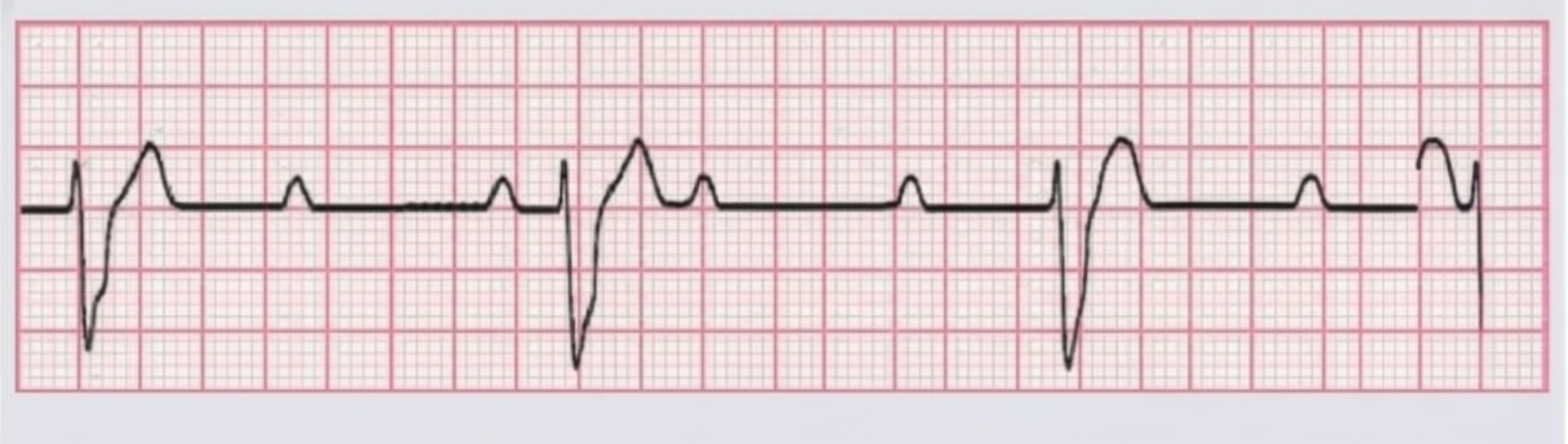
What is diagnostic of a fresh myocardial infarction on ECG?
What is Kussmaul's sign?
Positive hepatojugular reflux is found in which of the following conditions?
Acute aortic regurgitation is seen in all of the following conditions except?
All statements are true regarding non-ST elevation acute coronary syndromes (NSTE-ACS) and ST elevation myocardial infarctions (STEMI) except?
A 27-year-old woman presents with cough, shortness of breath, and palpitations. Her childhood history includes recurrent "pneumonia." She denies sputum production. On examination, she appears anxious, with distended neck veins, a widened split second heart sound with minimal respiratory variation, and a systolic ejection murmur in the pulmonic area. Lung examination reveals bilateral crackles, mild ascites, and pedal edema. EKG shows right axis deviation. What is the next diagnostic step?
What is the most common congenital cardiac anomaly diagnosed in adulthood?
ST segment elevation is seen in which of the following conditions?
Severity of Aortic stenosis is determined by?
Spurious hypertension (false elevation of blood pressure readings) is most commonly associated with which of the following findings?
Explanation: **Explanation:** The hallmark of an acute (fresh) transmural myocardial infarction is **ST-segment elevation** [2]. This occurs due to a "current of injury" resulting from severe, total occlusion of a coronary artery [2]. When the myocardium becomes acutely ischemic and damaged, it remains partially depolarized, creating a voltage gradient between the injured and healthy tissue, which manifests on the ECG as an elevation of the ST segment above the isoelectric line [2]. **Analysis of Options:** * **ST-segment elevation (Correct):** Diagnostic of an acute STEMI (ST-Elevation Myocardial Infarction) [1]. It indicates transmural injury and is the primary trigger for immediate reperfusion therapy (thrombolysis or PCI). * **QT interval prolongation:** This represents delayed ventricular repolarization. While it can be seen in electrolyte imbalances (hypocalcemia) or drug toxicities, it is not diagnostic of an acute MI. * **P mitrale:** This refers to a broad, notched P-wave in Lead II, signifying left atrial enlargement, typically seen in mitral stenosis, not acute ischemia. * **ST-segment depression:** This usually indicates subendocardial ischemia, NSTEMI, or reciprocal changes [1]. While significant, it is not the classic "diagnostic" sign of a fresh transmural infarction. **High-Yield Clinical Pearls for NEET-PG:** * **Evolution of ECG in MI:** Hyperacute T-waves (earliest sign) → ST-elevation → Q-waves (indicates necrosis) → T-wave inversion [1]. * **Pathological Q-waves:** Defined as >0.04s wide or >25% of the R-wave height; they signify a completed or old infarction [1]. * **Reciprocal Changes:** ST-depression in leads opposite to the site of infarction (e.g., ST-depression in II, III, aVF during a lateral wall MI) [1].
Explanation: **Explanation:** **Kussmaul’s sign** is a paradoxical rise in the Jugular Venous Pressure (JVP) during inspiration. **Physiological Basis (The "Why"):** Normally, during inspiration, intrathoracic pressure drops, creating a "suction effect" that increases venous return to the right atrium [2], causing the JVP to **fall** [3]. In Kussmaul’s sign, there is an impairment in right ventricular filling (due to restricted expansion or high filling pressures) [2]. When venous return increases during inspiration, the non-compliant right heart cannot accommodate the extra volume, causing the blood to back up into the jugular veins, leading to a visible **rise** in JVP. **Analysis of Options:** * **Option A (Correct):** Accurately describes the paradoxical rise in JVP during inspiration. * **Option B (Incorrect):** This is the **normal physiological response** (JVP falls during inspiration) [3]. * **Option C & D (Incorrect):** These are unrelated to the clinical definition of Kussmaul’s sign, which specifically refers to venous pressure changes during the respiratory cycle. **High-Yield Clinical Pearls for NEET-PG:** * **Most Common Cause:** Constrictive Pericarditis. * **Other Causes:** Right Ventricular Infarction (highly specific), Restrictive Cardiomyopathy, Tricuspid Stenosis, and Right-sided Heart Failure [1]. * **Important Distinction:** Kussmaul’s sign is **usually absent** in Cardiac Tamponade (unlike Constrictive Pericarditis), because in tamponade, the heart is compressed by fluid but can still respond to the inspiratory drop in intrathoracic pressure. * **Note:** Do not confuse this with **Kussmaul Breathing** (deep, rapid sighing respirations seen in Diabetic Ketoacidosis).
Explanation: Explanation: Hepatojugular Reflux (HJR), also known as the abdominojugular reflux, is a clinical sign elicited by applying firm pressure over the liver (or abdomen) for 10–30 seconds. A positive test is defined by a sustained rise in the Jugular Venous Pressure (JVP) of >3 cm, which persists for at least 15 seconds. Why Tricuspid Regurgitation (TR) is correct: A positive HJR indicates that the right ventricle (RV) is unable to accommodate the increased venous return (preload) displaced from the hepatic sinusoids. In Tricuspid Regurgitation, the RV is often volume-overloaded or failing, and the incompetent valve allows backflow into the right atrium. When abdominal pressure increases venous return, the compromised right heart cannot handle the extra volume, leading to a sustained rise in JVP. Why other options are incorrect: * Left heart failure: While chronic left heart failure can eventually lead to right heart failure (causing a positive HJR), isolated early-stage left heart failure primarily causes pulmonary congestion without necessarily affecting right-sided filling pressures initially. * Decreased afterload: Decreasing afterload (e.g., using vasodilators) generally improves cardiac output and reduces filling pressures, which would make a positive HJR less likely. * Decreased capillary bed pressure: This reflects a state of dehydration or low volume, where JVP would be low and the heart would easily accommodate any minor increase in volumes. NEET-PG High-Yield Pearls: * Most common cause: The most common cause of a positive HJR is Right Ventricular Failure secondary to elevated pulmonary artery wedge pressure. * Constrictive Pericarditis: HJR is typically positive here, helping differentiate it from cardiac tamponade (where HJR is often absent) [1]. * Kussmaul’s Sign vs. HJR: Kussmaul’s sign is a paradoxical rise in JVP during inspiration, whereas HJR is elicited by manual pressure. Both indicate impaired right heart filling.
Explanation: The key to this question lies in distinguishing between conditions that affect the **aortic root/valves** versus those that affect the **mitral valve apparatus**. **Why Acute Myocardial Infarction (MI) is the correct answer:** Acute MI is a classic cause of acute **Mitral Regurgitation (MR)**, not Aortic Regurgitation [1]. This occurs due to papillary muscle rupture (most commonly the posteromedial papillary muscle in an inferior wall MI) or chordae tendineae dysfunction. It does not anatomically involve the aortic valve or the aortic root. **Analysis of Incorrect Options (Causes of Aortic Regurgitation):** * **Bacterial Endocarditis:** A leading cause of **acute AR** [2]. Vegetations can cause rapid destruction or perforation of the valve leaflets, leading to sudden valvular incompetence. * **Marfan’s Syndrome:** While often associated with chronic dilation, it can lead to **acute AR** via **Aortic Dissection**. A Type A dissection can retrograde into the aortic root, causing sudden malcoaptation of the leaflets. * **Ankylosing Spondylitis:** Typically causes **chronic AR** due to aortitis and thickening of the valve cusps. However, in the context of this "except" question, it is a recognized etiology of aortic root pathology, whereas MI is strictly associated with the mitral valve. **NEET-PG High-Yield Pearls:** 1. **Clinical Sign:** Acute AR is a medical emergency. Unlike chronic AR, you will **not** see a wide pulse pressure or "water hammer" pulse because the left ventricle hasn't had time to compensate/dilate [2]. 2. **Auscultation:** The murmur of acute AR is typically **short and soft** (early diastolic) because of the rapid rise in LV end-diastolic pressure [2]. 3. **Drug of Choice:** Nitroprusside and inotropes are used to stabilize; **Beta-blockers are contraindicated** in acute AR as they block the compensatory tachycardia needed to maintain cardiac output.
Explanation: ### Explanation **1. Why Option C is the Correct Answer (The False Statement):** In the context of acute myocardial infarction, cardiogenic shock typically occurs when **$\geq$40% of the left ventricular (LV) mass** is infarcted or non-functional. The threshold of 60% mentioned in the option is clinically inaccurate; by the time 60% of the LV is involved, the mortality rate is near-absolute. Cardiogenic shock is characterized by a low cardiac index and elevated pulmonary capillary wedge pressure, representing the most severe form of pump failure [1]. **2. Analysis of Incorrect Options (True Statements):** * **Option A:** This is **true**. While the incidence of STEMI is declining due to better primary prevention, NSTEMI is rising [2]. This shift is attributed to an aging population with comorbidities like **Diabetes Mellitus** and **Chronic Kidney Disease**, which often present with multi-vessel disease and non-ST elevation events [2]. * **Option B:** This is **true**. Historically, arrhythmias (like VFib) were the leading cause of death. However, with the advent of CCUs and rapid defibrillation, **pump failure (cardiogenic shock)** has emerged as the primary cause of in-hospital mortality [1]. * **Option D:** This is **true**. **Primary PCI** is the gold standard for STEMI (if performed within 90-120 minutes) [3], and early invasive strategies (PCI) are preferred for high-risk NSTE-ACS patients [2]. **3. High-Yield Clinical Pearls for NEET-PG:** * **Killip Classification:** Used to bedside-stage heart failure in MI (Class IV = Cardiogenic Shock). * **Time is Muscle:** For STEMI, the goal is Door-to-Balloon time **<90 minutes**. * **NSTEMI Diagnosis:** Requires elevated cardiac biomarkers (Troponin I or T) *without* persistent ST-elevation on ECG [4]. * **Most common cause of death in pre-hospital phase:** Ventricular Fibrillation. * **Most common cause of death in-hospital:** Cardiogenic Shock [1].
Explanation: ### Explanation The clinical presentation is classic for an **Atrial Septal Defect (ASD)** that has progressed to right-sided heart failure. **Why Echocardiogram is the correct answer:** The patient exhibits the hallmark triad of ASD: 1. **Fixed, wide splitting of the second heart sound (S2):** This occurs due to constant volume overload of the right ventricle, delaying pulmonic valve closure regardless of the respiratory cycle [3]. 2. **Systolic ejection murmur at the pulmonic area:** Caused by increased flow across the pulmonary valve (not the shunt itself) [3]. 3. **Right-sided heart failure:** Evidenced by distended neck veins, ascites, pedal edema, and right axis deviation on EKG [1]. The history of "recurrent pneumonia" in childhood is a classic distractor; these were likely episodes of pulmonary congestion due to increased pulmonary blood flow [1]. An **Echocardiogram** is the gold-standard initial diagnostic tool to visualize the septal defect, assess shunt direction, and evaluate right ventricular overload [1]. **Why other options are incorrect:** * **CT scan of the chest:** While it can show pulmonary congestion, it is not the primary modality for diagnosing structural heart disease or shunts. * **Immunoglobulin levels:** This would be considered if the "recurrent pneumonias" were truly infectious (e.g., Common Variable Immunodeficiency), but the cardiac findings (murmur, fixed S2) point toward a structural heart defect. * **PPD testing:** Used for Tuberculosis screening; it does not explain the cardiac physical findings or the EKG changes. **High-Yield Clinical Pearls for NEET-PG:** * **ASD Type:** *Ostium secundum* is the most common type [3]. * **EKG in ASD:** Look for Right Axis Deviation (RAD), Right Bundle Branch Block (RBBB), or Right Ventricular Hypertrophy (RVH) [2]. * **Eisenmenger Syndrome:** If a left-to-right shunt (like ASD) is left untreated, pulmonary hypertension can develop, eventually reversing the shunt to right-to-left, leading to cyanosis and clubbing [3].
Explanation: ### Explanation **Correct Option: A. Atrial Septal Defect (ASD)** The primary reason **Atrial Septal Defect (ASD)** is the most common congenital heart disease (CHD) diagnosed in adulthood is its **asymptomatic nature** during childhood [1]. Unlike other defects, the pressure gradient between the left and right atria is relatively low, leading to a gradual left-to-right shunt. This volume overload of the right ventricle is well-tolerated for decades. Most patients remain asymptomatic until their 3rd or 4th decade, when they present with exertional dyspnea, fatigue, or palpitations (often due to atrial fibrillation). Among ASDs, the **Secundum type** is the most common variety [1]. **Why other options are incorrect:** * **Ventricular Septal Defect (VSD):** While VSD is the most common CHD at **birth**, most small VSDs close spontaneously in childhood, and large ones cause early heart failure, leading to diagnosis and surgical repair long before adulthood [2]. * **Patent Ductus Arteriosus (PDA):** These are typically detected in infancy due to the characteristic continuous "machinery" murmur and are usually corrected early to prevent pulmonary hypertension [3]. * **Total Anomalous Pulmonary Venous Return (TAPVR):** This is a cyanotic CHD that usually presents with severe respiratory distress or cyanosis in the neonatal period or early infancy; it is incompatible with long-term survival without early surgical intervention. **High-Yield Clinical Pearls for NEET-PG:** * **Most common CHD at birth:** VSD [2]. * **Most common CHD diagnosed in adults:** ASD [1]. * **Auscultation finding in ASD:** Fixed wide splitting of the second heart sound (S2) and a mid-systolic flow murmur at the pulmonary area. * **ECG in Secundum ASD:** Right axis deviation and RSR' pattern in V1 (Partial RBBB). * **Paradoxical Embolism:** ASD is a significant risk factor for systemic emboli (e.g., stroke) originating from deep vein thrombosis.
Explanation: **Explanation:** ST-segment elevation on an ECG represents **transmural myocardial ischemia or injury**, as well as inflammation of the pericardium. While most commonly associated with a Myocardial Infarction (MI), it is a critical finding in several other clinical scenarios. 1. **Acute MI (Option C):** This is the most common cause. It occurs due to a complete coronary artery occlusion, leading to transmural (full-thickness) ischemia. The ST elevation is typically **convex upwards (coved)** and localized to specific vascular territories (e.g., V1-V4 for anterior wall). 2. **Prinzmetal’s Angina (Option A):** Also known as variant angina, this is caused by transient coronary artery vasospasm. Unlike stable angina, it causes transmural ischemia, resulting in **transient ST elevation** that resolves once the spasm subsides or nitroglycerin is administered. 3. **Acute Pericarditis (Option B):** Inflammation of the pericardium affects the underlying epicardium. This leads to **diffuse, concave-upwards ST elevation** across almost all leads (except aVR and V1), often accompanied by **PR-segment depression** (a highly specific sign). Since all three conditions characteristically present with ST-segment elevation, **Option D** is the correct answer. **High-Yield Clinical Pearls for NEET-PG:** * **Concave vs. Convex:** ST elevation in Pericarditis is typically "concave" (smiley face), whereas in MI it is "convex/coved" (sad face/tombstone). * **Reciprocal Changes:** These are seen in Acute MI (ST depression in opposite leads) but are notably **absent** in Pericarditis. * **Other causes of ST Elevation:** Benign Early Repolarization (J-point elevation), Left Ventricular Aneurysm (persistent elevation after MI), and Brugada Syndrome (V1-V2).
Explanation: **Explanation:** The severity of **Aortic Stenosis (AS)** is clinically determined by the degree of pressure overload on the Left Ventricle (LV). **Why ST-T changes are the correct answer:** In chronic, severe AS, the LV must generate massive pressures to overcome the narrowed valve. This leads to significant **concentric LV hypertrophy**. As the muscle wall thickens, the subendocardial blood supply becomes insufficient, leading to **secondary repolarization abnormalities**. On an ECG, this manifests as the **"LV strain pattern"** (ST-segment depression and T-wave inversion in lateral leads). The presence of these ST-T changes is a reliable indicator of significant LV pressure overload and is strongly associated with severe stenosis and a higher risk of symptom onset. [1] **Analysis of Incorrect Options:** * **A. Late ejection systolic murmur:** While the *timing* of the peak (late peaking) suggests severity, the *intensity* of the murmur does not. [1] In very severe AS with heart failure (low-flow, low-gradient), the murmur may actually become soft or disappear ("silent AS"). * **C. LV Hypertrophy with displaced apex:** In AS, hypertrophy is **concentric**, meaning the wall thickens inward. Therefore, the apex beat is typically **heaving** but **not displaced** unless the heart begins to fail and dilate (a late, terminal finding). **High-Yield Clinical Pearls for NEET-PG:** 1. **Classic Triad of AS:** Dyspnea (most common), Angina, and Syncope (SAD). 2. **Pulsus Parvus et Tardus:** A small-volume, slow-rising pulse is a hallmark of severe AS. [1] 3. **Gallavardin Phenomenon:** The dissociation between the noisy systolic murmur at the base and musical sounds at the apex. [1] 4. **Gold Standard Investigation:** Transthoracic Echocardiography (Criteria for severe AS: Valve area <1.0 cm², Mean gradient >40 mmHg, or Jet velocity >4 m/s). [2]
Explanation: An **auscultatory gap** is a period of silence between the systolic and diastolic Korotkoff sounds. It occurs most frequently in elderly patients with hypertension or atherosclerosis. If a clinician does not inflate the cuff high enough to obliterate the radial pulse (the palpatory method), they may miss the true systolic pressure and start listening during the gap. This leads to an **underestimation of systolic BP**. Conversely, if they stop listening too early when the sounds disappear during the gap, they may **overestimate the diastolic BP**. This discrepancy between the actual and measured pressure is a classic cause of spurious readings [1]. **2. Analysis of Incorrect Options:** * **B. Thick, calcified arteries:** This leads to **Pseudohypertension** (Osler’s sign). While this is also a "false" elevation, the question asks for the finding most commonly associated with the *phenomenon* of spurious readings in general clinical practice, often linked to technique errors involving the auscultatory gap. * **C. Use of a small BP cuff:** This causes a "cuff-size artifact." While it falsely elevates BP, it is a mechanical error rather than a clinical finding associated with the patient's vascular dynamics. * **D. Obesity:** Similar to option C, obesity requires a larger cuff. Using a standard cuff on an obese arm causes false elevation, but obesity itself is a risk factor for true hypertension, not a finding that defines spurious readings [1]. **3. High-Yield Clinical Pearls for NEET-PG:** * **Osler’s Maneuver:** Used to detect pseudohypertension. If the radial artery remains palpable even after the cuff is inflated above systolic pressure, the patient is "Osler positive." * **White Coat Hypertension:** Elevated BP in the clinic but normal at home (Ambulatory BP monitoring is the gold standard for diagnosis). * **Masked Hypertension:** Normal BP in the clinic but elevated at home; carries a high cardiovascular risk. * **Rule of Thumb:** To avoid errors from an auscultatory gap, always determine the systolic pressure by **palpation** first before auscultating [1].
Coronary Artery Disease and Angina
Practice Questions
Acute Coronary Syndromes
Practice Questions
Heart Failure
Practice Questions
Cardiac Arrhythmias
Practice Questions
Valvular Heart Diseases
Practice Questions
Cardiomyopathies
Practice Questions
Pericardial Diseases
Practice Questions
Congenital Heart Disease in Adults
Practice Questions
Hypertension and Hypertensive Emergencies
Practice Questions
Pulmonary Hypertension
Practice Questions
Non-invasive Cardiac Diagnostics
Practice Questions
Preventive Cardiology
Practice Questions
Get full access to all questions, explanations, and performance tracking.
Start For Free