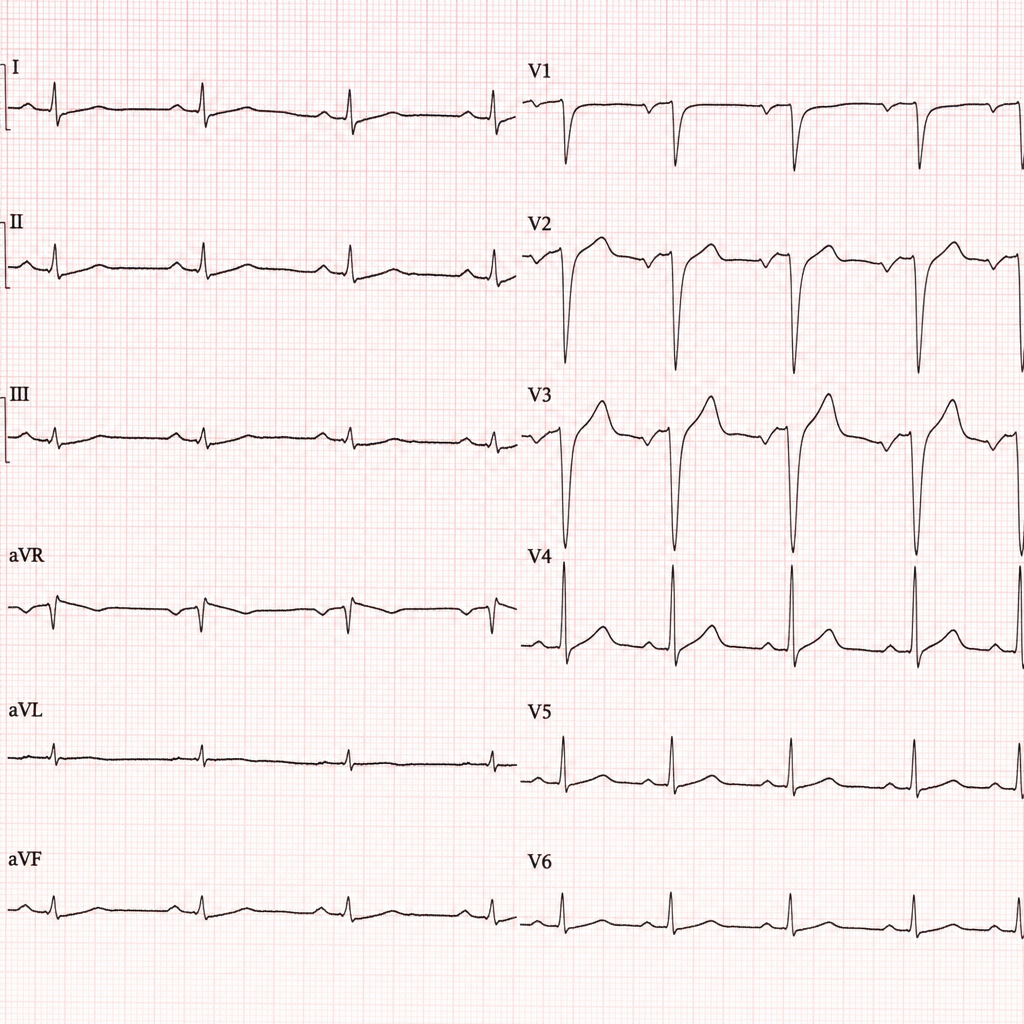
Which biomarker rises earliest in myocardial infarction?
Which of the following is not a modifiable risk factor for atherosclerosis?
All of the following statements about Brugada syndrome are true, EXCEPT:
All of the following electrocardiographic findings may represent manifestations of digitalis intoxication, EXCEPT?
Kussmaul's sign is not seen in which of the following conditions?
Pulsus parvus et tardus is observed in which condition?
Use of Phosphodiesterase Inhibitors for erectile dysfunction is contraindicated in which of the following conditions?
What is the most common cause of left-sided heart failure?
Which of the following statement is incorrect about hypertrophic cardiomyopathy?
Which of the following statements regarding atrioventricular block with atrial tachycardia is true?
Explanation: ### Explanation **Correct Option: C (Myoglobin)** Myoglobin is a low-molecular-weight heme protein found in cardiac and skeletal muscle. Due to its small size and lack of structural binding within the cell, it is released rapidly into the bloodstream following membrane damage. It is the **earliest biomarker** to rise, appearing within **1–3 hours** of the onset of myocardial infarction (MI). While highly sensitive for early detection, it lacks specificity because it also rises in skeletal muscle injury. **Analysis of Incorrect Options:** * **A & D (Troponin I and T):** Cardiac Troponins are the "Gold Standard" for diagnosing MI due to their high specificity [2]. However, they typically begin to rise **3–6 hours** after the onset of chest pain, peaking at 12–24 hours. They remain elevated for 7–10 days (Troponin I) or up to 14 days (Troponin T). * **B (CK-MB):** This isoenzyme begins to rise **4–8 hours** after injury and returns to baseline within 48–72 hours [1]. Its primary clinical utility in modern practice is the detection of **re-infarction**, as Troponins stay elevated for too long to identify a new event. **High-Yield Clinical Pearls for NEET-PG:** * **Earliest Marker:** Myoglobin (1–3 hours). * **Most Specific Marker:** Troponin I (more specific than Troponin T in patients with renal failure). * **Marker for Re-infarction:** CK-MB (due to its short half-life). * **Marker for Late Diagnosis:** Troponin T (stays elevated for up to 2 weeks). * **LDH Flip:** In the past, LDH1 > LDH2 was used for late diagnosis (after 24 hours), but this is now obsolete in clinical practice [1].
Explanation: In the context of NEET-PG and standard cardiovascular guidelines (like the Framingham Risk Score), risk factors for atherosclerosis are categorized into **Non-modifiable** (Age, Male sex, Family history, Genetic abnormalities) and **Modifiable** (Dyslipidemia, Hypertension, Smoking, Diabetes). [1] **Why Obesity is the correct answer here:** While it seems counterintuitive, in many classic medical examinations, **Obesity** is considered an *indirect* or *contributing* factor rather than a primary independent modifiable risk factor. The major modifiable drivers of atherosclerosis are those that directly damage the endothelium or alter lipid metabolism. Obesity exerts its risk primarily by mediating other conditions like Hypertension, Dyslipidemia, and Type 2 Diabetes. Therefore, in a "choose the best option" scenario among these four, obesity is often singled out as the outlier. **Analysis of Incorrect Options:** * **A. Physical Inactivity:** A major modifiable risk factor. Regular exercise improves endothelial function and insulin sensitivity. * **C. Diabetes Mellitus:** A "coronary artery disease equivalent." Hyperglycemia leads to the formation of Advanced Glycation End-products (AGEs), which accelerate atherosclerosis. * **D. Hypertension:** The most common cause of left ventricular hypertrophy and a direct cause of mechanical endothelial injury, promoting plaque formation. [1] **High-Yield Clinical Pearls for NEET-PG:** * **Most important risk factor for Atherosclerosis:** Hyperlipidemia (specifically high LDL). * **Strongest risk factor for Stroke:** Hypertension. * **Strongest risk factor for Peripheral Arterial Disease (PAD) and Buerger's Disease:** Smoking. * **Hyperhomocysteinemia:** An emerging modifiable risk factor (treatable with Vitamin B12/Folate). * **CRP:** A marker of systemic inflammation used to assess "residual inflammatory risk" in atherosclerosis.
Explanation: Brugada Syndrome is an autosomal dominant genetic channelopathy, most commonly involving a mutation in the **SCN5A gene** (sodium channel). It is a leading cause of sudden cardiac death in young individuals with structurally normal hearts. **Why Option D is the Correct Answer (The Exception):** Flecainide is a Class IC antiarrhythmic that blocks sodium channels. In Brugada syndrome, sodium channel blockers **unmask or worsen** the characteristic ECG pattern and can actually **precipitate** fatal arrhythmias. Therefore, Flecainide is used as a *provocative diagnostic test* (the Flecainide challenge) to reveal the Brugada pattern, but it is strictly **contraindicated for treatment**. The only proven effective treatment for preventing sudden death in high-risk patients is an **Implantable Cardioverter Defibrillator (ICD)**. **Analysis of Other Options:** * **Option A:** The hallmark of Brugada is a pseudo-right bundle branch block and **ST-segment elevation in leads V1-V3**. This pattern can be transient and may be triggered by fever or certain drugs. * **Option B:** It is the primary cause of **Sudden Unexpected Nocturnal Death Syndrome (SUNDS)**, particularly prevalent in young Southeast Asian males. * **Option C:** There is a significantly high risk of **polymorphic ventricular tachycardia** and ventricular fibrillation, which often occurs during sleep or rest. **High-Yield Clinical Pearls for NEET-PG:** * **ECG Patterns:** Type 1 (Coved-type ST elevation ≥2mm) is the only diagnostic pattern. * **Inheritance:** Autosomal Dominant; SCN5A gene mutation (loss of function). * **Triggers:** Fever is a major trigger for arrhythmias; aggressive antipyretic therapy is essential. * **Pharmacotherapy:** While ICD is the gold standard, **Quinidine** (Class IA) can be used as an adjunct to reduce arrhythmia frequency because it also blocks Ito channels.
Explanation: Digitalis (Digoxin) has a narrow therapeutic index. Its toxicity increases vagal tone and inhibits the Na+/K+-ATPase pump, leading to increased intracellular calcium. This results in two primary electrophysiological effects: **increased automaticity** (causing ectopic beats) and **decreased conduction** through the AV node [1]. **Why Atrial Flutter is the Correct Answer:** Atrial flutter and Atrial fibrillation are **rarely** caused by digitalis toxicity. In fact, Digoxin is clinically used to *treat* these conditions by slowing the ventricular rate via AV nodal inhibition [1]. If a patient with atrial flutter develops toxicity, the rhythm doesn't change, but the ventricular rate becomes slow and regular due to high-grade AV block [2]. **Analysis of Incorrect Options:** * **Bigeminy (Option A):** Ventricular bigeminy is one of the most common and characteristic signs of digitalis toxicity [1]. Increased intracellular calcium leads to delayed afterdepolarizations (DADs), triggering premature ventricular contractions (PVCs). * **Junctional Tachycardia (Option B):** Digoxin enhances the automaticity of the AV junction. A "non-paroxysmal junctional tachycardia" in a patient on digoxin is a classic hallmark of toxicity. * **Atrial Tachycardia with Block (Option C):** This is considered the **most specific** arrhythmia for digitalis toxicity [2]. It combines increased atrial automaticity (tachycardia) with impaired AV conduction (block) [2]. **High-Yield Clinical Pearls for NEET-PG:** 1. **Most common arrhythmia:** Ventricular premature beats (specifically bigeminy). 2. **Most specific arrhythmia:** Atrial tachycardia with 2:1 or variable AV block [2]. 3. **Classic ECG sign (Non-toxic):** "Reverse Tick" or "Sagging" ST-segment depression (Salvador Dali mustache sign). 4. **Electrolyte trigger:** Hypokalemia exacerbates toxicity because K+ and Digoxin compete for the same binding site on the Na+/K+ pump. 5. **Antidote:** Digoxin-specific antibody fragments (DigiFab).
Explanation: **Explanation:** **Kussmaul’s sign** is the paradoxical rise in Jugular Venous Pressure (JVP) during inspiration. Normally, JVP falls during inspiration due to negative intrathoracic pressure increasing venous return to the right heart. **Why Cardiac Tamponade is the Correct Answer:** In **Cardiac Tamponade**, Kussmaul’s sign is characteristically **absent** [1]. Although the heart is compressed by fluid, the intrapericardial pressure is transmitted equally to all chambers. During inspiration, the negative intrathoracic pressure still allows the heart to expand slightly within the fluid-filled sac, accommodating the increased venous return. Therefore, JVP falls normally. **Analysis of Incorrect Options:** * **Constrictive Pericarditis:** This is the classic cause [2]. A rigid, calcified pericardium prevents the right ventricle from expanding to accommodate inspiratory venous return, forcing the blood back into the jugular veins. * **Restrictive Cardiomyopathy:** Similar to constriction, the non-compliant (stiff) myocardium limits diastolic filling, leading to a rise in JVP during inspiration. * **RV Infarct:** A dysfunctional, "stunned" right ventricle cannot handle the increased preload during inspiration, resulting in venous backup. **NEET-PG High-Yield Pearls:** 1. **The Exception Rule:** Kussmaul’s sign is seen in almost all conditions with impaired right heart filling **EXCEPT** Cardiac Tamponade. 2. **JVP Waveforms:** In Constrictive Pericarditis, you see a prominent **'y' descent** (Friedreich's sign). In Cardiac Tamponade, the **'y' descent is absent or blunted**. 3. **Beck’s Triad (Tamponade):** Hypotension, JVD, and muffled heart sounds. 4. **Pulsus Paradoxus:** Present in Tamponade, but usually absent in Constrictive Pericarditis (unless a co-existing effusion exists).
Explanation: **Explanation:** **Pulsus parvus et tardus** (also known as the "anacrotic pulse") is the hallmark arterial pulse finding in **Severe Aortic Stenosis**. [3] 1. **Mechanism of the Correct Answer:** In Aortic Stenosis (AS), the calcified or narrowed aortic valve creates a fixed obstruction to left ventricular outflow. [1] * **Parvus (Small):** The stroke volume is reduced, leading to a small pulse pressure (low amplitude). * **Tardus (Late/Slow):** The obstruction causes a prolonged ejection time, meaning the arterial pressure rises slowly and the peak is delayed. [3] This is best palpated at the carotid arteries. 2. **Analysis of Incorrect Options:** * **Severe Mitral Stenosis:** Typically presents with a **low-volume pulse** (pulsus parvus) due to reduced preload, but the upstroke is not delayed (not tardus). * **Severe Aortic Regurgitation:** Characterized by a **Water-hammer pulse** (Corrigan’s pulse/Collapsing pulse). [4] This is a "large and fast" pulse (pulsus magnus et celer) due to a wide pulse pressure. [4] * **Severe Mitral Regurgitation:** Usually results in a normal or slightly low-volume pulse. If severe, it may be brisk but is not associated with a delayed upstroke. [2] **High-Yield Clinical Pearls for NEET-PG:** * **Pulsus Alternans:** Pathognomonic for severe Left Ventricular Failure (LVF). * **Pulsus Bisferiens:** Seen in AR + AS (mixed) or HOCM. * **Pulsus Paradoxus:** Defined as a drop in systolic BP >10 mmHg during inspiration; seen in Cardiac Tamponade, Severe Asthma, and COPD. * **Gallavardin Phenomenon:** In AS, the harsh systolic murmur may be heard as a high-pitched musical sound at the apex, mimicking MR. [3]
Explanation: The correct answer is **Unstable/symptomatic angina**. Phosphodiesterase-5 (PDE-5) inhibitors (e.g., Sildenafil, Tadalafil) cause systemic vasodilation by increasing cGMP levels. In patients with unstable angina, this can lead to a significant drop in blood pressure and a reflex increase in heart rate, potentially worsening myocardial ischemia or precipitating a myocardial infarction (MI) [2]. Furthermore, these patients may require sublingual Nitroglycerin; the co-administration of nitrates and PDE-5 inhibitors is strictly contraindicated as it can cause life-threatening refractory hypotension. **Analysis of Incorrect Options:** * **A. Pulmonary arterial hypertension (PAH):** PDE-5 inhibitors are actually a standard treatment for PAH (e.g., Sildenafil/Revatio) because they promote pulmonary vasodilation and reduce pulmonary vascular resistance. * **C. Previous MI > 6 weeks ago:** Patients with a history of MI can safely use PDE-5 inhibitors provided they are currently stable, asymptomatic, and not on nitrate therapy. The high-risk period is generally considered the first 2–6 weeks post-event. * **D. Congestive heart failure (NYHA Class-I):** Patients with mild, stable heart failure (Class I) can generally tolerate these drugs [1]. Contraindications usually apply to severe (Class IV) or unstable heart failure. **High-Yield Clinical Pearls for NEET-PG:** * **The Nitrate Rule:** Avoid PDE-5 inhibitors for 24 hours after Sildenafil/Vardenafil and 48 hours after Tadalafil (due to its longer half-life) if nitrates are needed. * **Other Contraindications:** Recent stroke/MI (within 6 months), resting hypotension (<90/50 mmHg), and hereditary retinal degenerative disorders (e.g., Retinitis Pigmentosa). * **Side Effect:** "Blue-tinted vision" (Cyanopsia) due to cross-inhibition of PDE-6 in the retina.
Explanation: **Explanation:** **1. Why Myocardial Infarction (MI) is Correct:** Left-sided heart failure occurs when the left ventricle (LV) fails to pump blood efficiently to the systemic circulation. **Ischemic Heart Disease (IHD)**, specifically **Myocardial Infarction**, is the leading cause globally. [1] An MI leads to the death of cardiomyocytes and subsequent replacement by non-contractile fibrotic scar tissue. This loss of functional myocardium results in systolic dysfunction (reduced ejection fraction) and ventricular remodeling, eventually culminating in heart failure. [1] **2. Analysis of Incorrect Options:** * **Systemic Hypertension (Option B):** While hypertension is the **second most common cause** and a major risk factor for heart failure, it primarily causes diastolic dysfunction initially (due to LV hypertrophy) before progressing to systolic failure. In modern clinical practice, MI remains the more frequent acute and chronic trigger for LV failure. * **Rheumatic Heart Disease (Option C):** This is a significant cause of valvular heart disease (especially Mitral Stenosis) in developing countries, but it is not the *most common* cause of heart failure overall when compared to the global burden of atherosclerosis. * **Infective Endocarditis (Option D):** This is an acute/subacute cause of heart failure due to valvular destruction (e.g., acute aortic regurgitation), but it is statistically rare compared to ischemic causes. **3. NEET-PG High-Yield Pearls:** * **Most common cause of Right-sided Heart Failure:** Left-sided heart failure (due to increased pulmonary venous pressure). * **Most common cause of Isolated Right-sided Heart Failure:** Cor Pulmonale (secondary to COPD). * **Most common cause of Diastolic Heart Failure:** Systemic Hypertension. * **Framingham Criteria:** Used for the clinical diagnosis of Heart Failure. * **BNP (B-type Natriuretic Peptide):** The best initial lab test to rule out heart failure in an acutely dyspneic patient (high negative predictive value).
Explanation: Hypertrophic Cardiomyopathy (HCM) is a genetic disorder characterized by left ventricular hypertrophy (LVH) without an obvious systemic cause [1]. **Why Option D is Incorrect (The Correct Answer):** In HCM with obstruction (HOCM), the Venturi effect and drag forces pull the mitral valve leaflets toward the septum during systole (Systolic Anterior Motion or SAM). This leads to incomplete coaptation of the leaflets. Because the anterior leaflet is pulled forward, the resulting **mitral regurgitation (MR) is typically directed posteriorly** or posterolaterally into the left atrium. An anteriorly directed jet would suggest intrinsic mitral valve pathology rather than SAM-induced MR. **Analysis of Other Options:** * **Option A:** Asymmetric Septal Hypertrophy (ASH) is the hallmark of HCM. The **interventricular septum** typically shows the maximum degree of hypertrophy compared to the posterior wall (Ratio >1.3:1). * **Option B:** Approximately **one-third (30%)** of HCM patients have resting obstruction (gradient ≥30 mmHg), while another third have provocable obstruction (latent), and the final third are non-obstructive. * **Option C:** HCM is primarily a disease of **diastolic dysfunction** (impaired relaxation). However, the abnormal displacement of the mitral valve (SAM) contributes to the dynamic outflow tract obstruction, which impairs effective stroke volume, mimicking systolic compromise during exertion. **High-Yield Clinical Pearls for NEET-PG:** * **Inheritance:** Autosomal Dominant; most common mutations involve **Beta-myosin heavy chain** and **Myosin-binding protein C** [1]. * **Murmur:** Harsh systolic ejection murmur at the left sternal border [2]. * **Dynamics:** Murmur **increases** with Valsalva/Standing (decreased preload) and **decreases** with Squatting/Handgrip (increased preload/afterload). * **Drug of Choice:** Beta-blockers (first-line) or Verapamil to improve diastolic filling. Digoxin and Nitrates are generally contraindicated.
Explanation: **Explanation:** **Atrial Tachycardia (AT) with AV block** is a classic electrocardiographic hallmark of **Digitalis Toxicity**. 1. **Why Option D is correct:** Digoxin has a dual effect on the heart: * **Increased Automaticity:** It increases intracellular calcium, leading to delayed after-depolarizations (DADs) in the atria, which triggers **Atrial Tachycardia** (typically at a rate of 150–200 bpm). [2] * **Decreased Conduction:** It increases vagal tone and directly inhibits the Na+/K+ ATPase pump in the AV node, leading to **AV block**. [2], [3] * **Potassium Connection:** Hypokalemia (potassium depletion) sensitizes the myocardium to digoxin by allowing more digoxin to bind to the Na+/K+ ATPase pump, thereby precipitating toxicity even at "therapeutic" serum levels. 2. **Why other options are incorrect:** * **Option A:** WPW syndrome is characterized by an accessory pathway (Bundle of Kent) leading to pre-excitation. It typically presents with re-entrant tachycardias (AVRT) or Atrial Fibrillation with a rapid ventricular response, not AV block. [1] * **Option B:** Pacemaker complications usually involve lead displacement, sensing/pacing failures, or pacemaker-mediated tachycardia, but AT with AV block is not a specific complication of the therapy itself. * **Option C:** While isolated premature atrial contractions can occur in normal individuals, the combination of a pathological tachycardia with a conduction block is always considered abnormal and suggests an underlying toxic or organic cause. **High-Yield Clinical Pearls for NEET-PG:** * **Most common arrhythmia in Digoxin toxicity:** Ventricular Bigeminy. * **Most characteristic/specific arrhythmia:** Atrial Tachycardia with 2:1 AV block (also known as "PAT with block"). [3] * **Bidirectional Ventricular Tachycardia** is another highly specific sign of digitalis toxicity. * **Management:** Discontinue digoxin, correct potassium (if low), and administer Digoxin-specific antibody fragments (DigiFab) in life-threatening cases.
Coronary Artery Disease and Angina
Practice Questions
Acute Coronary Syndromes
Practice Questions
Heart Failure
Practice Questions
Cardiac Arrhythmias
Practice Questions
Valvular Heart Diseases
Practice Questions
Cardiomyopathies
Practice Questions
Pericardial Diseases
Practice Questions
Congenital Heart Disease in Adults
Practice Questions
Hypertension and Hypertensive Emergencies
Practice Questions
Pulmonary Hypertension
Practice Questions
Non-invasive Cardiac Diagnostics
Practice Questions
Preventive Cardiology
Practice Questions
Get full access to all questions, explanations, and performance tracking.
Start For Free