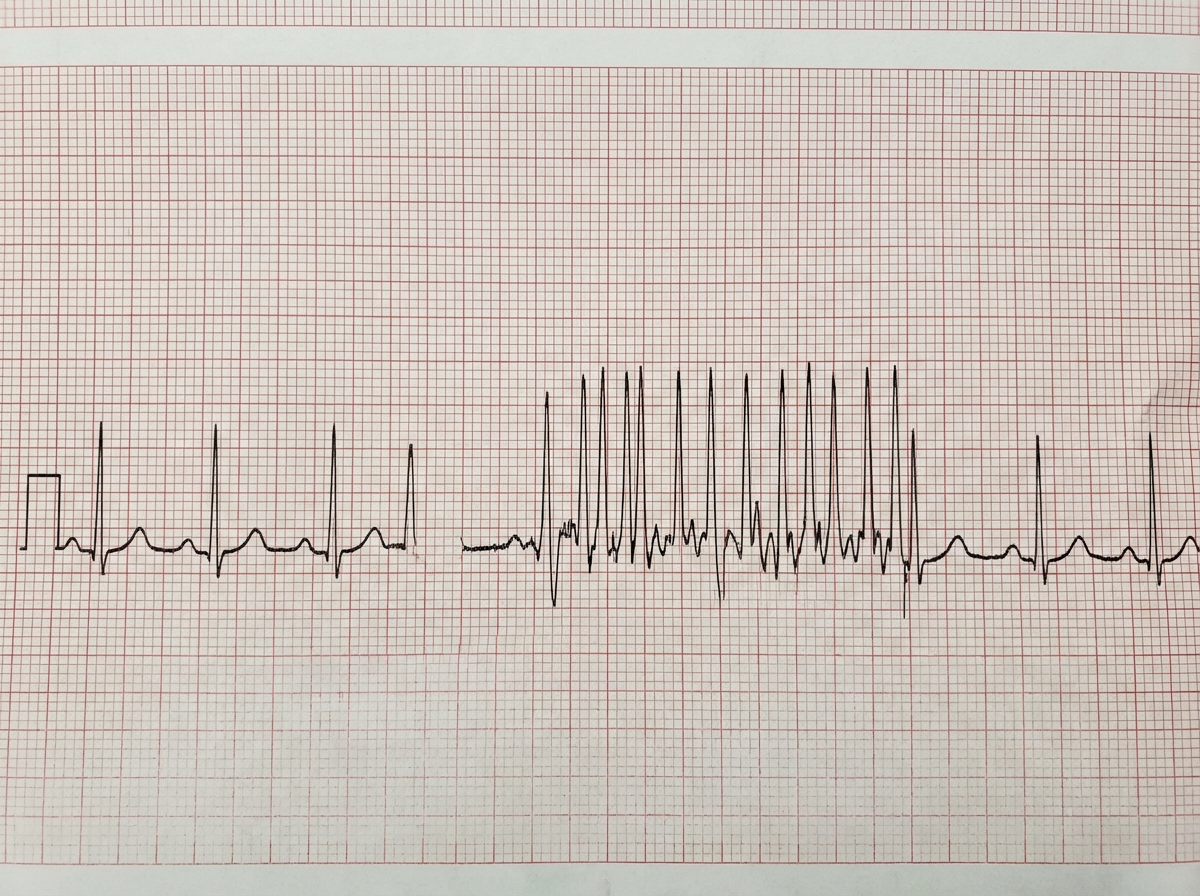
Wellen's syndrome suggests which of the following cardiac conditions?
A patient with mitral regurgitation and atrial fibrillation presents with syncope. On examination, the patient has a heart rate of 55. What is the most probable cause?
"Cannon" waves are seen in which of the following conditions?
Which of the following is least likely to be associated with Infective Endocarditis?
A wide split fixed second heart sound is heard in which of the following conditions?
What is the treatment of choice in patients with congestive heart failure with ejection fraction < 40% and normal fluid levels achieved?
Which of the following conditions is most likely to occur in a patient with the following hemodynamic data: Pressures: RA = 12 mm Hg, RV = 50/12 mm Hg, PA=50/15 mm Hg, PA wedge pressure = 8 mm Hg, Aorta = 80/60 mm Hg, Cardiac Index = 1.4 L/min/m², SVR= 1800 dynes·sec/cm⁵, PVR=500 dynes·sec/cm⁵?
The first heart sound is soft in all of the following conditions, except:
In Marfan's syndrome, aortic aneurysm occurs most commonly in which part of the aorta?
Which of the following statements is NOT true regarding the hepatojugular reflux?
Explanation: **Wellen’s Syndrome** is a clinical-electrocardiographic pattern highly specific for critical stenosis of the **proximal Left Anterior Descending (LAD) artery**. It is considered a pre-infarction stage of **Unstable Angina (UA)**. The underlying pathophysiology involves a sudden occlusion of the LAD followed by spontaneous reperfusion, leading to characteristic T-wave changes. Because the artery is critically narrowed but not permanently occluded, it falls under the spectrum of Acute Coronary Syndrome (specifically UA) [1], carrying a high risk of progressing to an extensive anterior wall myocardial infarction (STEMI) if not managed with urgent coronary intervention. **Analysis of Options:** * **Option A (Stable Angina):** This involves predictable chest pain on exertion due to fixed atherosclerotic plaques [2]. Wellen’s syndrome represents an acute, unstable situation with high risk of imminent infarction. * **Option C (Ludwig’s Angina):** This is a non-cardiac condition. It is a rapidly spreading cellulitis of the submandibular space, usually of odontogenic origin. * **Option D (Prinzmetal Angina):** Also known as variant angina, this is caused by coronary artery vasospasm rather than critical fixed stenosis. It typically presents with transient ST-segment elevation during pain, not the specific T-wave patterns of Wellen’s. **High-Yield Clinical Pearls for NEET-PG:** * **ECG Criteria:** Occurs during a **pain-free interval**. Look for biphasic T-waves (Type A) or deep, symmetrical T-wave inversions (Type B) in leads V2–V3. * **Cardiac Enzymes:** Usually normal or only minimally elevated. * **Management Warning:** Stress tests (Treadmill Test) are **contraindicated** as they can trigger a fatal MI. The definitive treatment is Cardiac Catheterization.
Explanation: The clinical scenario describes a patient with **Mitral Regurgitation (MR)** and **Atrial Fibrillation (AF)** who presents with **syncope and bradycardia (HR 55)**. In clinical practice, Digoxin is frequently used in AF patients for rate control (acting on the AV node) and in MR patients with heart failure for its positive inotropic effects. **1. Why Digitalis Toxicity is the Correct Answer:** Digitalis toxicity classically presents with various arrhythmias. In a patient with pre-existing AF, the most characteristic sign of toxicity is **"Regularization of the Pulse."** Digoxin increases vagal tone and slows conduction through the AV node [1]. In toxic doses, it can cause high-grade or complete AV block [1]. When AF is combined with high-grade AV block, the ventricular rate becomes slow and regular (junctional escape rhythm). This sudden drop in heart rate (bradycardia) leads to decreased cardiac output and **syncope**. **2. Analysis of Incorrect Options:** * **Incomplete Heart Block:** While this causes bradycardia, it is usually a manifestation of an underlying pathology (like Digoxin toxicity or ischemia) rather than the primary diagnosis in this specific drug-related context. * **Stroke:** While AF is a risk factor for embolic stroke, a stroke typically presents with focal neurological deficits rather than isolated bradycardia and syncope. * **Subarachnoid Hemorrhage (SAH):** SAH presents with a "thunderclap headache" and altered consciousness. While it can cause ECG changes (Cushing’s reflex), it is not the most probable cause in a patient managed for MR and AF. **Clinical Pearls for NEET-PG:** * **Most common arrhythmia in Digoxin toxicity:** PVCs (Bigeminy). * **Most characteristic arrhythmia:** Atrial Tachycardia with variable AV block. * **ECG Sign:** "Sagging" ST-segment depression (Salvador Dali mustache sign). * **Electrolyte Trigger:** Hypokalemia predisposes to toxicity (Digoxin competes with K+ at the Na+/K+ ATPase pump).
Explanation: **Explanation:** **Cannon "a" waves** occur due to **atrioventricular (AV) dissociation**. They are giant jugular venous pulsations produced when the right atrium contracts against a **closed tricuspid valve**. In **Complete Heart Block (Option A)**, the atria and ventricles beat independently [1]. Occasionally, the P-wave (atrial contraction) coincides with the QRS complex (ventricular contraction/systole); since the tricuspid valve is closed during ventricular systole, the atrial pressure is reflected backward into the jugular vein, creating the "cannon" wave [3]. **Analysis of Incorrect Options:** * **Left Ventricular Hypertrophy (Option B):** This affects the left side of the heart and does not typically manifest as specific JVP waveform changes unless it leads to right-sided heart failure. * **Mitral Stenosis (Option C):** This leads to a **prominent "a" wave** (due to increased resistance to right ventricular filling if pulmonary hypertension develops), but not a "cannon" wave. * **Atrial Fibrillation (Option D):** Characterized by the **absence of "a" waves** because there is no coordinated atrial contraction [4]. **Clinical Pearls for NEET-PG:** * **Regular Cannon Waves:** Seen in Junctional Rhythm or SVT. * **Irregular Cannon Waves:** Pathognomonic for **Complete Heart Block** [2] or Ventricular Tachycardia (VT). * **Giant/Prominent "a" waves:** Seen in Tricuspid Stenosis, Pulmonary Stenosis, and Right Ventricular Hypertrophy (conditions where the atrium pushes against a restricted opening or stiff ventricle). * **Giant "v" waves:** Characteristic of **Tricuspid Regurgitation**.
Explanation: ### Explanation The risk of developing **Infective Endocarditis (IE)** is primarily determined by the degree of **turbulence** in blood flow and the resulting **pressure gradient** across a cardiac lesion. High-velocity jets cause endothelial damage, leading to the deposition of fibrin and platelets (Non-Bacterial Thrombotic Endocarditis), which serves as a nidus for bacterial colonization. **1. Why Small ASD is the Correct Answer:** An **Atrial Septal Defect (ASD)**, specifically the *ostium secundum* type, is associated with a very low pressure gradient between the left and right atria. The flow is low-velocity and non-turbulent. Consequently, the endocardium remains intact, making IE an extremely rare complication. It is classically taught as the congenital heart disease **least likely** to cause IE. **2. Analysis of Other Options:** * **Small VSD:** Unlike ASDs, small VSDs (Maladie de Roger) create a **high-pressure gradient** between the left and right ventricles. This produces a high-velocity jet that causes significant endothelial trauma on the right ventricular side, making it a **high-risk** lesion for IE. * **Mild Mitral Regurgitation (MR):** Regurgitant lesions create high-velocity turbulence back into the low-pressure atrium. Even mild MR provides a site for vegetation formation on the atrial surface of the mitral valve. * **Mild Mitral Stenosis (MS):** While pure MS is less prone to IE than regurgitant lesions, it still involves turbulent flow across a diseased valve. It carries a higher risk than a simple ASD. **Clinical Pearls for NEET-PG:** * **Highest Risk Lesions:** Prosthetic heart valves, previous IE, and cyanotic congenital heart disease (unrepaired) [1]. * **Negligible Risk Lesions:** Secundum ASD, Ischemic Heart Disease (without MR), and Cardiac Pacemakers. * **Commonest Valve Involved:** Mitral Valve (overall); Tricuspid Valve (in IV drug users). * **Commonest Organism:** *Staphylococcus aureus* (Acute/IVDU); *Viridans streptococci* (Subacute/Post-dental procedure). Diagnosis and assessment of endocardial involvement can be performed by evaluating Duke criteria [1].
Explanation: ### Explanation The second heart sound (S2) consists of two components: **A2** (Aortic valve closure) and **P2** (Pulmonary valve closure). In normal individuals, inspiration increases venous return to the right heart, delaying P2 and causing a "physiological split." **Why Atrial Septal Defect (ASD) is the correct answer:** In ASD, a **wide, fixed split S2** occurs due to two main mechanisms: 1. **Volume Overload:** The left-to-right shunt increases right ventricular (RV) stroke volume, prolonging RV ejection time and delaying P2 (causing the "wide" split). 2. **Phasic Equalization:** During inspiration, the increase in systemic venous return is offset by a reciprocal decrease in the left-to-right shunt across the ASD [1]. This keeps the total RV volume constant throughout the respiratory cycle, eliminating the normal respiratory variation (causing the "fixed" split). **Analysis of Incorrect Options:** * **Normal individuals:** Exhibit a **physiological split** (S2 splits only during inspiration and closes during expiration). * **Left Bundle Branch Block (LBBB):** Causes delayed activation of the left ventricle, leading to A2 occurring after P2. This results in a **paradoxical (reversed) split**, where the split narrows during inspiration and widens during expiration. * **Ventricular Septal Defect (VSD):** Typically presents with a **wide but mobile split** [2]. While RV stroke volume is increased (delaying P2), the respiratory variation remains intact. **High-Yield Clinical Pearls for NEET-PG:** * **ASD Murmur:** The characteristic murmur in ASD is a **midsystolic flow murmur** over the pulmonary area (due to increased flow across the pulmonary valve), NOT the shunt itself. A mid-diastolic murmur can also occur due to increased flow across the tricuspid valve [2]. * **Lutembacher Syndrome:** ASD associated with Mitral Stenosis. * **Fixed Split S2** is the pathognomonic physical finding for ASD (specifically Secundum type). If pulmonary hypertension develops (Eisenmenger syndrome), the split may narrow and P2 becomes loud.
Explanation: ### Explanation The patient described has **Heart Failure with reduced Ejection Fraction (HFrEF)**, defined as an LVEF < 40%. In such patients, the primary goal of therapy is to block the neurohormonal pathways (Renin-Angiotensin-Aldosterone System and the Sympathetic Nervous System) that drive cardiac remodeling and disease progression. **Why Option B is Correct:** The combination of **ACE inhibitors (ACEi)** and **Beta-blockers (BB)** forms the cornerstone of HFrEF management [1]. * **ACE inhibitors** (e.g., Enalapril) reduce mortality, re-admission rates, reduce afterload, and prevent adverse remodeling [1]. * **Beta-blockers** (e.g., Carvedilol, Metoprolol succinate, Bisoprolol) reduce sympathetic overactivity and decrease mortality, showing even greater mortality reduction than ACE inhibitors [1]. The question specifies that **"normal fluid levels" (euvolemia)** have been achieved. This is a critical clinical hint: Beta-blockers should only be initiated or up-titrated once the patient is stable and euvolemic, as they can acutely worsen congestion in decompensated states. **Why Other Options are Incorrect:** * **Option A:** Diuretics are used for symptomatic relief of congestion . Once euvolemia is achieved, they are maintained at the minimum dose required; they do not provide the same mortality benefit as Beta-blockers. * **Option C:** Combining ACEi and ARBs is generally avoided due to the high risk of renal dysfunction and hyperkalemia without significant added benefit. * **Option D:** Calcium Channel Blockers (CCBs), specifically non-dihydropyridines (Verapamil/Diltiazem), are generally **contraindicated** in HFrEF due to their negative inotropic effects. **High-Yield Clinical Pearls for NEET-PG:** * **The "Big Four" Pillars of HFrEF:** ACEi/ARNI + Beta-blocker + MRA (Spironolactone) + SGLT2 inhibitors (Dapagliflozin/Empagliflozin). * **Mortality Benefit:** ACEi, Beta-blockers, MRAs, and SGLT2i all decrease mortality [1]. **Diuretics and Digoxin do NOT reduce mortality** (they only reduce hospitalizations) . * **Beta-blocker Rule:** Never start a Beta-blocker during an acute flare-up of HF; wait for the patient to be "dry" (euvolemic).
Explanation: ### Explanation The key to solving hemodynamic questions in NEET-PG is to analyze the pressures systematically, starting with the **Pulmonary Artery Wedge Pressure (PAWP)** and the **Pulmonary Artery (PA) pressure** [1]. **1. Why Option A is Correct:** The data shows a **low PAWP (8 mm Hg)**, which indicates that the pathology is "pre-left heart." However, there is significant **Pulmonary Hypertension (PA = 50/15 mm Hg)** and **Right Ventricular (RV) strain (RV = 50/12 mm Hg; RA = 12 mm Hg)**. In **Acute Massive Pulmonary Embolism**, the mechanical obstruction in the pulmonary arteries causes a sudden rise in pulmonary vascular resistance (PVR = 500) and PA pressures. Because the blood cannot reach the left atrium efficiently, the PAWP remains low or normal [1]. The resulting RV failure leads to a low **Cardiac Index (1.4)** and systemic hypotension (Aorta = 80/60), triggering a compensatory rise in **Systemic Vascular Resistance (SVR = 1800)**. Thrombolysis is typically indicated in acute massive PE accompanied by cardiogenic shock [2]. **2. Why Other Options are Incorrect:** * **Option B (Cardiogenic Shock):** This is characterized by a **high PAWP** (>15–18 mm Hg) because the primary failure is in the left ventricle, leading to back-pressure into the lungs [3]. * **Option C (Hypovolemic Shock):** All pressures (RA, PA, and PAWP) would be **low** due to decreased intravascular volume [1]. Here, the RA and PA pressures are elevated. * **Option D (Early Septic Shock):** This is a distributive shock characterized by a **high Cardiac Index** (hyperdynamic) and a **very low SVR** (vasodilation). **Clinical Pearls for NEET-PG:** * **Normal PAWP:** 6–12 mm Hg. If PAWP is low/normal but PA pressure is high, think of Pulmonary Embolism or Primary Pulmonary Hypertension [1]. * **RV Pressure Limit:** An acute, previously healthy RV cannot generate a systolic pressure >40–60 mm Hg. A PA systolic pressure of 50 mm Hg is classic for a massive PE in a previously healthy heart [4]. * **SVR Calculation:** $SVR = \frac{(MAP - CVP)}{CO} \times 80$. High SVR is a compensatory mechanism in all shocks except distributive (septic/neurogenic) shock.
Explanation: ### Explanation The **First Heart Sound (S1)** is primarily produced by the closure of the Mitral (M1) and Tricuspid (T1) valves [1]. The intensity of S1 depends on the position of the valve leaflets at the onset of ventricular systole and the rate of pressure rise within the ventricle. **1. Why "Short PR interval" is the correct answer:** In a **Short PR interval** (e.g., WPW syndrome), the time between atrial and ventricular contraction is brief. The ventricles contract while the mitral valve leaflets are still wide apart (deep in the ventricular cavity). This results in the leaflets traveling a greater distance and closing with high velocity, producing a **Loud S1**. Therefore, it is the exception to the "soft S1" conditions. **2. Why the other options are incorrect (Causes of Soft S1):** * **Mitral Regurgitation:** The leaflets often fail to coapt properly, or the rate of pressure rise is altered, leading to a diminished S1 [2]. * **Calcified Valve:** In severe mitral stenosis with a rigid, calcified valve, the leaflets lose their mobility and cannot "snap" shut, resulting in a muffled or soft S1 [3]. * **Ventricular Septal Defect (VSD):** Large shunts can lead to prolonged ventricular filling or altered hemodynamics that soften the closure sound. **3. NEET-PG High-Yield Pearls:** * **Loud S1:** Short PR interval, Mild-to-Moderate Mitral Stenosis (pliable valve), Tachycardia, Hyperdynamic states (Anemia, Pregnancy, Thyrotoxicosis). * **Soft S1:** Long PR interval (1st-degree heart block), Severe/Calcified Mitral Stenosis, Mitral Regurgitation, Obesity/COPD (increased chest wall thickness), Heart Failure. * **Variable S1:** Atrial Fibrillation and Complete Heart Block (AV dissociation).
Explanation: **Explanation:** **1. Why the Ascending Aorta is Correct:** Marfan’s syndrome is an autosomal dominant connective tissue disorder caused by a mutation in the **FBN1 gene**, which encodes **fibrillin-1** [1]. This deficiency leads to **cystic medial necrosis** (degeneration of the elastic fibers in the tunica media). The ascending aorta, particularly the **aortic root (Sinus of Valsalva)**, is the site of the highest hemodynamic stress and wall tension (Laplace’s Law). Because this segment has the highest concentration of elastic lamellae, it is most susceptible to progressive dilation, leading to aneurysm formation and potentially Type A aortic dissection [2]. **2. Why the Other Options are Incorrect:** * **B & D (Descending Aorta and Aortic Arch):** While these segments can be involved in Marfan’s syndrome, they are significantly less common than the ascending aorta. Dilation here usually occurs secondary to an extension of an ascending dissection or in much later stages of the disease [2]. * **C (Abdominal Aorta):** Abdominal aortic aneurysms (AAA) are typically associated with **atherosclerosis** and smoking, rather than genetic connective tissue disorders [1]. In Marfan’s, the pathology is predominantly thoracic. **3. Clinical Pearls for NEET-PG:** * **Most common cause of death:** Aortic root dilatation leading to rupture or dissection. * **Cardiac Murmur:** Aortic Regurgitation (early diastolic murmur) is common due to annular stretching. * **Echocardiography:** The gold standard for serial monitoring of aortic root diameter. * **Surgery Indication:** Prophylactic replacement is usually recommended when the diameter reaches **≥50 mm** (or ≥45 mm if there are additional risk factors). * **Associated Sign:** Look for **Steinberg sign** (thumb sign) and **Walker-Murdoch sign** (wrist sign) on physical exam.
Explanation: ### Explanation The **Hepatojugular Reflux (HJR)**, more accurately termed the **Abdominojugular Reflux**, is a clinical sign used to assess the heart's ability to handle increased venous return. It is elicited by applying firm pressure over the upper abdomen for 10–30 seconds while observing the Jugular Venous Pressure (JVP). #### Why Option B is the Correct Answer (The False Statement) Hepatojugular reflux is primarily a marker of **increased preload** and the inability of the right ventricle (RV) to compensate for an acute increase in venous return [2]. It is **not associated with decreased afterload**. In fact, conditions that increase pulmonary vascular resistance (increased RV afterload) often lead to a positive HJR. A positive test is defined by a sustained rise in JVP (>3 cm) that persists throughout the compression. #### Analysis of Other Options * **Option A (Pulmonary Stenosis):** True. Any condition causing right ventricular outflow obstruction increases the pressure the RV must work against, leading to a positive HJR when the ventricle fails to accommodate extra volume. * **Option C (Tricuspid Regurgitation):** True. In TR, the right atrium is already volume-overloaded. The addition of abdominal venous return further elevates the JVP significantly. * **Option D (Right Heart Failure):** True. This is the most common clinical association. A positive HJR is a highly specific sign for elevated pulmonary capillary wedge pressure (>15 mmHg) and right-sided heart failure [1]. #### High-Yield Clinical Pearls for NEET-PG * **Mechanism:** Compression increases venous return to the right atrium. A healthy RV increases its stroke volume (Frank-Starling law) without a sustained rise in JVP [2]. A failing RV cannot, causing the "backup" seen in the neck. * **Most Common Cause:** Right ventricular failure secondary to elevated pulmonary capillary wedge pressure (Left Heart Failure). * **Kussmaul’s Sign vs. HJR:** While HJR is seen in early heart failure, Kussmaul’s sign (paradoxical rise in JVP during inspiration) is classically associated with **Constrictive Pericarditis** [1]. * **False Negatives:** Can occur in cases of Superior Vena Cava (SVC) obstruction.
Coronary Artery Disease and Angina
Practice Questions
Acute Coronary Syndromes
Practice Questions
Heart Failure
Practice Questions
Cardiac Arrhythmias
Practice Questions
Valvular Heart Diseases
Practice Questions
Cardiomyopathies
Practice Questions
Pericardial Diseases
Practice Questions
Congenital Heart Disease in Adults
Practice Questions
Hypertension and Hypertensive Emergencies
Practice Questions
Pulmonary Hypertension
Practice Questions
Non-invasive Cardiac Diagnostics
Practice Questions
Preventive Cardiology
Practice Questions
Get full access to all questions, explanations, and performance tracking.
Start For Free