At what serum potassium level does a sine wave pattern typically appear on an ECG?
Which of the following is NOT a feature of a complete heart block?
ST elevation and hyperacute T waves in precordial leads V1 to V6 and in lead aVL indicates:
A 46-year-old smoker presents to the emergency department with sharp, left-sided chest pain that is not focal. Physical examination reveals no specific findings. The pain is neither aggravated nor relieved by postural changes or inspiration. An ECG shows anterior ST elevation. What should be the next step in management?
A 59-year-old woman with a 10-year history of type 2 diabetes mellitus presents with bilateral pitting edema of the ankles and feet. She also reports shortness of breath on exertion and orthopnea, using 3 pillows at night to sleep comfortably. A chest X-ray shows pulmonary venous congestion and interstitial edema. Which of the following physiologic mechanisms is most likely the immediate cause of the pulmonary edema?
Fixed splitting of the second heart sound (S2) may be seen in all of the following conditions except?
The treatment of acute myocardial infarction includes which of the following?
A 35-year-old farmer presents with recurrent episodes of chest pain. His elder brother had similar complaints and died suddenly at age 40. The farmer was advised to take nitroglycerin sublingually during pain episodes, but he finds that the intensity of pain increases with nitroglycerin. What is the most probable diagnosis?
A 68-year-old woman with hypertension and dyslipidemia presents with 30 minutes of retrosternal chest pain radiating to her neck. She is diaphoretic and in moderate distress. The ECG shows ST-segment elevation in the inferior leads. Which of the following mechanisms is the most likely cause of her condition?
Cardiovascular causes of digital clubbing include all of the following EXCEPT:
Explanation: ### Explanation Hyperkalemia is a life-threatening electrolyte abnormality that causes progressive changes in cardiac conduction. The correct answer is **> 8 mEq/L** because the "sine wave" pattern represents the final stage of intraventricular conduction delay before cardiac arrest. **The Progression of ECG Changes:** 1. **5.5 – 6.5 mEq/L:** The earliest sign is **tall, peaked T-waves** (narrow base, "tent-shaped") due to rapid repolarization [1]. 2. **6.5 – 8.0 mEq/L:** As potassium rises, the atrial myocardium becomes paralyzed, leading to **loss of P-waves** (atrial standstill) [1]. Simultaneously, the QRS complex begins to widen [1]. 3. **> 8.0 mEq/L:** Extreme widening of the QRS complex causes it to merge with the T-wave. This creates a smooth, undulating, biphasic rhythm known as the **sine wave pattern**. If untreated, this progresses rapidly to ventricular fibrillation or asystole [1]. **Analysis of Incorrect Options:** * **Option A (> 6 mEq/L):** Associated with peaked T-waves and initial PR interval prolongation, but not sine waves. * **Option B (> 7 mEq/L):** Typically characterized by the disappearance of P-waves and significant QRS widening, but the distinct sine wave morphology usually requires higher levels [2]. * **Option D (> 10 mEq/L):** While a sine wave will certainly be present, this level is often incompatible with life; the pattern typically manifests earlier, around the 8–9 mEq/L range. **High-Yield Clinical Pearls for NEET-PG:** * **Treatment Priority:** The first step in management when ECG changes are present is **Calcium Gluconate** (10 ml of 10% solution) to stabilize the myocardial membrane [2]. It does *not* lower serum potassium. * **Pseudohyperkalemia:** Always rule out hemolysis during blood collection or thrombocytosis/leukocytosis if ECG is normal despite high lab values. * **Causative Drugs:** ACE inhibitors, ARBs, Spironolactone, and NSAIDs are common culprits in boards.
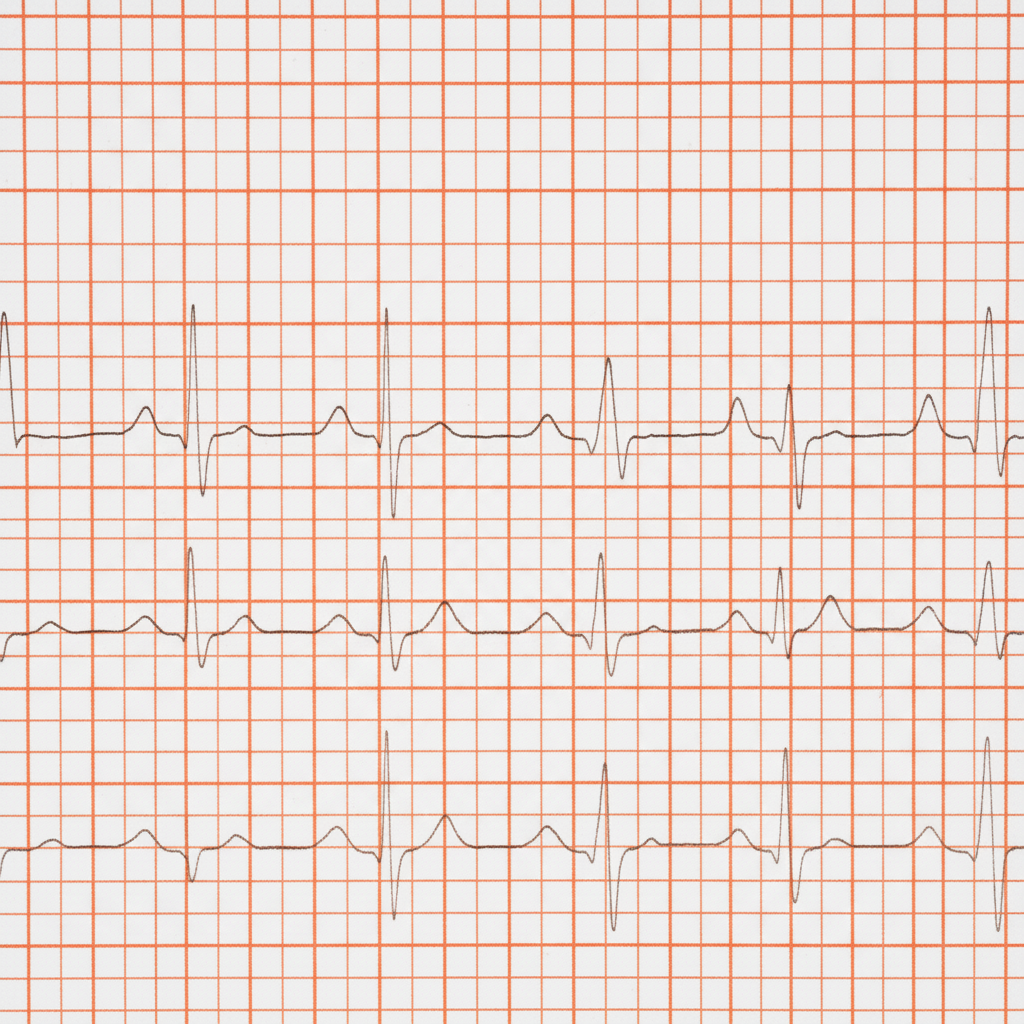
Explanation: In **Complete Heart Block (3rd-degree AV block)**, there is a total dissociation between the atria and the ventricles. The ventricles are driven by a distal subsidiary pacemaker (either nodal or ventricular), which is slow and inherently unstable. [1] ### Why Option D is the Correct Answer In a healthy heart, the heart rate increases during exercise due to sympathetic stimulation of the SA node [3]. However, in complete heart block, the atria and ventricles are electrically disconnected. While the SA node may fire faster during exercise, this impulse cannot reach the ventricles. The subsidiary ventricular pacemaker is **autonomously fixed** and does not respond significantly to sympathetic drive or exercise. Therefore, the ventricular rate remains slow and constant, leading to exercise intolerance. ### Explanation of Incorrect Options * **A. Bradycardia:** This is a hallmark feature. Since the escape rhythm originates below the AV node, the heart rate is typically 30–40 bpm (idioventricular) or 40–60 bpm (junctional). * **B. Cannon 'a' waves:** These occur in the JVP when the right atrium contracts against a closed tricuspid valve (due to AV dissociation). These are "intermittent" in complete heart block. * **C. Varying intensity of S1:** Because the PR interval is constantly changing, the position of the AV valves at the onset of ventricular systole varies. This results in a characteristic "bruit de canon" or variable loudness of the first heart sound. ### High-Yield Clinical Pearls for NEET-PG * **ECG Finding:** PP intervals are constant, RR intervals are constant, but there is no relationship between P waves and QRS complexes. * **Treatment of Choice:** Permanent Pacemaker (PPI) [1]. * **Stokes-Adams Attack:** Sudden syncope due to a transient period of asystole or profound bradycardia in patients with heart block [2]. * **Differential for Cannon Waves:** Also seen in Ventricular Tachycardia (VT) and Junctional rhythms.
Explanation: ### Explanation **1. Why Anterolateral Wall MI is Correct:** The ECG findings described (ST elevation and hyperacute T waves) represent an acute ST-elevation myocardial infarction (STEMI) [1]. To localize the infarct, we look at the specific leads involved: * **V1–V4:** Represent the **Anterior wall** (supplied by the Left Anterior Descending artery - LAD) [2]. * **V5–V6, I, and aVL:** Represent the **Lateral wall** (supplied by the Left Circumflex artery - LCX or diagonal branches of the LAD) [1], [2]. Since the ST elevation spans from **V1 to V6** (Anterior + Lateral) and includes **aVL** (Lateral), it indicates an **Anterolateral wall MI**. This typically suggests a proximal occlusion of the **Left Main Coronary Artery** or a very proximal **LAD**. **2. Why Other Options are Incorrect:** * **Posterior Wall MI:** Characterized by ST *depression* and tall R waves in V1–V3 (reciprocal changes). Diagnosis is confirmed by ST elevation in posterior leads V7–V9. * **Inferior MI:** Characterized by ST elevation in leads **II, III, and aVF** [1]. It usually involves the Right Coronary Artery (RCA). * **Lateral Wall MI:** Isolated lateral MI involves only leads I, aVL, V5, and V6. Since V1–V4 (anterior leads) are also involved here, "Anterolateral" is the more accurate and comprehensive diagnosis. **3. High-Yield Clinical Pearls for NEET-PG:** * **Septal MI:** Leads V1–V2 [2]. * **Anterior MI:** Leads V3–V4 [1], [2]. * **Extensive Anterior MI:** Leads V1–V6, I, and aVL. * **Reciprocal Changes:** Look for ST depression in II, III, and aVF when viewing an Anterolateral MI; this reinforces the diagnosis of STEMI [1]. * **Hyperacute T waves:** These are the *earliest* ECG sign of MI, appearing even before ST elevation.
Explanation: ### Explanation The clinical presentation in this scenario is atypical for a classic ST-elevation myocardial infarction (STEMI). While the ECG shows anterior ST elevation, the patient’s pain is **sharp**, **non-focal**, and notably **not influenced by posture or inspiration** (ruling out classic pericarditis or pleurisy). In cases where the clinical history is inconsistent with the ECG findings, the priority is to differentiate between a true STEMI and "STEMI mimics" (such as early repolarization, pericarditis, or myocarditis). **Why Option D is Correct:** An **Urgent bedside echocardiogram** is the most appropriate next step. In a true STEMI, the occlusion of a coronary artery leads to immediate **Regional Wall Motion Abnormalities (RWMA)** [1]. If the echocardiogram shows normal wall motion despite ST elevation, the diagnosis of an acute MI is highly unlikely, and unnecessary invasive procedures or fibrinolysis can be avoided. **Why Other Options are Incorrect:** * **Option A:** Activating the cath lab is premature. Given the atypical nature of the pain, performing an invasive procedure without confirming the diagnosis carries unnecessary risk. * **Option B:** Troponins take hours to rise [1]. In a suspected STEMI, "time is muscle"; waiting for biomarkers is contraindicated if the diagnosis is certain, but here, an echo provides faster diagnostic clarity than a lab test. * **Option C:** Administering NSAIDs assumes a diagnosis of pericarditis. However, the pain is not positional, and giving NSAIDs in a potential MI can increase the risk of myocardial rupture or worsen heart failure. ### Clinical Pearls for NEET-PG * **RWMA on Echo** is the earliest sign of myocardial ischemia, appearing even before ECG changes or biomarker elevation [1]. * **STEMI Mimics:** Always consider Benign Early Repolarization (BER), Pericarditis, Brugada Syndrome, and Left Ventricular Hypertrophy (LVH) when the history doesn't match the ECG. * **Gold Standard:** While Coronary Angiography is the gold standard for treating STEMI, **Echocardiography** is the best non-invasive tool for bedside diagnostic dilemmas.
Explanation: ### Explanation **Correct Answer: C. Elevated pulmonary capillary pressure** The clinical presentation of bilateral pitting edema, exertional dyspnea, orthopnea [1], and chest X-ray findings (venous congestion) is classic for **Congestive Heart Failure (CHF)**. In patients with long-standing diabetes, this is often due to diabetic cardiomyopathy or ischemic heart disease leading to left ventricular dysfunction. [2] The underlying mechanism of pulmonary edema in CHF is explained by **Starling’s Law**. When the left ventricle fails to pump effectively, there is a "back-up" of pressure into the left atrium and subsequently the pulmonary veins. This increases the **pulmonary capillary hydrostatic pressure**, forcing fluid out of the capillaries and into the interstitial space and alveoli (transudative effusion). **Analysis of Incorrect Options:** * **A & B (Damage to endothelial/epithelial cells):** These mechanisms describe **increased permeability** (exudative) edema, characteristic of **ARDS** (Acute Respiratory Distress Syndrome) or pneumonia. In these cases, the protein content of the edema fluid is high, unlike the pressure-driven transudate seen in heart failure. * **D (Low serum albumin):** While hypoalbuminemia (e.g., in Nephrotic syndrome or Cirrhosis) reduces **plasma oncotic pressure**, leading to systemic edema, it rarely causes significant pulmonary edema in isolation unless there is a concomitant rise in capillary pressure. **High-Yield Clinical Pearls for NEET-PG:** * **Starling Equation:** $Jv = Kf [(Pc - Pi) - \sigma(\pi c - \pi i)]$. In CHF, the primary driver is an increase in $Pc$ (Capillary Hydrostatic Pressure). * **CXR Findings in CHF:** Look for "ABCDE": **A**lveolar edema (Bat-wing opacities), **B**-lines (Kerley B lines), **C**ardiomegaly, **D**iversion (Cephalization of flow), and **E**ffusions. [2] * **Orthopnea** is a highly specific symptom for heart failure, reflecting the redistribution of fluid from the lower extremities to the lungs when lying flat. [1]
Explanation: **Explanation** The second heart sound (S2) consists of two components: **A2** (Aortic closure) and **P2** (Pulmonary closure). Normally, S2 splits during inspiration because increased venous return to the right heart delays P2. **Fixed splitting** occurs when the interval between A2 and P2 remains constant throughout the respiratory cycle. **Why Left Bundle Branch Block (LBBB) is the Correct Answer:** In LBBB, activation of the left ventricle is delayed, causing A2 to occur *after* P2 [1]. This results in **Paradoxical (Reversed) Splitting**. During inspiration, P2 moves closer to the delayed A2, narrowing the split; during expiration, the split widens. Since the split varies with respiration (unlike fixed splitting), LBBB is the correct "except" choice. **Analysis of Incorrect Options:** * **Atrial Septal Defect (ASD):** The classic cause of fixed splitting [2]. The left-to-right shunt increases right ventricular stroke volume, delaying P2. Respiration does not change this volume significantly because the shunt decreases during inspiration as venous return increases, keeping the total RV output constant. * **Pulmonary Stenosis:** Causes a wide split due to delayed P2 (prolonged RV ejection). While typically "wide and mobile," in severe cases or with associated RV failure, the respiratory variation becomes negligible, mimicking a fixed split. * **Pulmonary Embolism:** Acute RV strain and increased pulmonary vascular resistance delay P2. In the setting of right heart failure, the RV cannot increase stroke volume further during inspiration, leading to a wide, fixed split. **High-Yield Clinical Pearls for NEET-PG:** 1. **ASD:** Fixed wide splitting of S2 + Mid-systolic flow murmur + Diastolic flow rumble (Tricuspid). 2. **Paradoxical Splitting:** Seen in LBBB, Aortic Stenosis, and HOCM. 3. **Wide Mobile Splitting:** Seen in RBBB and Mitral Regurgitation (early A2). 4. **P2 Intensity:** Increased in Pulmonary Hypertension; decreased in Tetralogy of Fallot/Pulmonary Stenosis.
Explanation: **Explanation:** The management of Acute Myocardial Infarction (AMI) focuses on immediate reperfusion, prevention of further clot formation, and long-term ventricular remodeling. **1. Aspirin:** This is the first-line antiplatelet therapy [1]. It irreversibly inhibits cyclooxygenase-1 (COX-1), preventing the formation of Thromboxane A2. Administering 300-325 mg of crushed/chewed aspirin immediately reduces mortality in the acute phase. **2. Heparin:** Anticoagulation is essential to maintain the patency of the infarct-related artery and prevent re-occlusion or systemic thromboembolism [1]. Unfractionated Heparin (UFH) or Low Molecular Weight Heparin (LMWH) is used as an adjunct to fibrinolysis or during Primary Percutaneous Coronary Intervention (PCI). **3. ACE Inhibitors:** These are started within the first 24 hours (provided the patient is hemodynamically stable). They prevent "ventricular remodeling"—the structural changes in the heart muscle post-MI—thereby reducing the risk of heart failure and long-term mortality. **Why "All of the above" is correct:** The standard "MONA" (Morphine, Oxygen, Nitrates, Aspirin) regimen has evolved [1]. Current guidelines emphasize the combination of antiplatelets (Aspirin/Clopidogrel), anticoagulants (Heparin), and mortality-reducing drugs like ACE inhibitors and Beta-blockers. **Clinical Pearls for NEET-PG:** * **Mortality Benefit:** Aspirin, Beta-blockers (long-term), ACE inhibitors, and Statins are the primary drugs proven to reduce mortality post-MI. * **Nitrates:** Provide symptomatic relief (preload reduction) but do **not** improve mortality. They are contraindicated in Right Ventricular MI. * **Gold Standard:** Primary PCI is the preferred reperfusion strategy if performed within 120 minutes of first medical contact [2].
Explanation: ### **Explanation** The clinical presentation is classic for **Hypertrophic Obstructive Cardiomyopathy (HOCM)**. The key diagnostic clues are the young age of onset, a strong family history of sudden cardiac death (SCD), and the paradoxical worsening of symptoms with nitroglycerin. [1] **1. Why HOCM is the Correct Answer:** HOCM is an autosomal dominant condition characterized by asymmetrical septal hypertrophy. In the obstructive variant, the thickened septum and systolic anterior motion (SAM) of the mitral valve create a dynamic Left Ventricular Outflow Tract (LVOT) obstruction. [1] * **The Nitroglycerin Paradox:** Nitroglycerin is a vasodilator that reduces preload. In HOCM, decreased preload reduces the left ventricular volume, bringing the hypertrophied septum and mitral valve closer together. This **increases the LVOT obstruction**, worsening the chest pain and potentially causing syncope. This is a classic "red flag" for HOCM. **2. Why Other Options are Incorrect:** * **Subacute Bacterial Endocarditis:** Typically presents with fever, new-onset murmurs, and embolic phenomena (Janeway lesions, Osler nodes), not exertional chest pain worsened by nitrates. * **Degenerative Mitral Regurgitation:** While it causes a systolic murmur, it does not typically cause sudden death in young adults or paradoxical reactions to nitrates. * **Chronic Type A Dissection:** This is a surgical emergency presenting with tearing chest pain radiating to the back. It is not associated with recurrent episodes over years or a specific family history of SCD at age 40. **3. NEET-PG High-Yield Pearls:** * **Murmur Dynamics:** The HOCM murmur (harsh systolic) **increases** with Valsalva and standing (decreased preload) and **decreases** with squatting or handgrip (increased preload/afterload). * **ECG Findings:** Left Ventricular Hypertrophy (LVH) and "dagger-like" Q waves in lateral leads (I, aVL, V5-V6). * **Management:** Beta-blockers or Verapamil are first-line (to increase diastolic filling time). **Avoid** Nitrates, Diuretics, and Digoxin. * **Sudden Death:** Most common cause of SCD in young athletes. [1]
Explanation: **Explanation:** The clinical presentation of retrosternal chest pain radiating to the neck, accompanied by diaphoresis and ST-segment elevation in the inferior leads (II, III, aVF), is diagnostic of an **ST-Elevation Myocardial Infarction (STEMI)** [1], [3]. **1. Why Option A is Correct:** The pathophysiology of a STEMI involves the **rupture or erosion of an unstable atherosclerotic plaque** [2]. This rupture exposes the highly thrombogenic subendothelial matrix to circulating blood, leading to platelet activation, fibrin deposition, and the formation of an **occlusive red thrombus**. This results in a complete cessation of blood flow in a coronary artery (likely the Right Coronary Artery in this inferior MI), causing transmural myocardial ischemia. **2. Why the Other Options are Incorrect:** * **B. Aortic Inflammation:** While conditions like aortitis can occur, they typically present with constitutional symptoms or signs of large-vessel occlusion, not acute ST-elevation. Aortic dissection (a different pathology) presents with tearing pain but is not primarily inflammatory. * **C. Pericardial Inflammation:** Acute pericarditis presents with pleuritic chest pain (relieved by leaning forward) and **diffuse** ST-elevation with PR-segment depression, rather than localized elevation in inferior leads. * **D. Vasculitis:** While Kawasaki disease or Polyarteritis Nodosa can affect coronary arteries, they are rare causes of acute MI in a 68-year-old compared to the high prevalence of atherosclerosis. **Clinical Pearls for NEET-PG:** * **Inferior MI:** Always check for **Right Ventricular MI** (get a V4R lead). Avoid nitrates if RV involvement is suspected due to the risk of severe hypotension. * **Plaque Morphology:** "Vulnerable plaques" usually have a thin fibrous cap and a large lipid core [2]. * **Gold Standard Treatment:** Primary Percutaneous Coronary Intervention (PCI) within 90 minutes of medical contact. [4]
Explanation: Digital clubbing is a clinical sign characterized by the bulbous enlargement of the distal phalanges and loss of the Schamroth window. In cardiology, clubbing is primarily associated with conditions causing **chronic central cyanosis** or **chronic intravascular inflammation** [1]. **Why Aortic Dissection is the Correct Answer:** Aortic dissection is an **acute, life-threatening emergency** involving a tear in the tunica intima of the aorta [2]. Clubbing requires a chronic process (usually months to years) to develop due to the proliferation of connective tissue and vasculature mediated by PDGF (Platelet-Derived Growth Factor) and VEGF. Aortic dissection does not cause chronic hypoxia or persistent digital inflammation, making it unrelated to clubbing. **Analysis of Incorrect Options:** * **Infective Endocarditis (IE):** This is a classic cause of subacute clubbing [1]. It occurs due to chronic inflammation and the formation of micro-emboli that lodge in the distal capillaries, leading to cytokine release and tissue hypertrophy. * **Arteriovenous (AV) Fistulas:** Large systemic AV fistulas can lead to localized or generalized clubbing due to increased peripheral blood flow and venous congestion. * **Tricuspid Atresia:** This is a **cyanotic congenital heart disease (CCHD)** [1], [3]. Any CCHD with a right-to-left shunt (e.g., Tetralogy of Fallot, Eisenmenger syndrome) causes chronic hypoxemia, which is a potent trigger for clubbing. **High-Yield Clinical Pearls for NEET-PG:** * **Differential Clubbing:** Clubbing seen only in the toes (not fingers) is pathognomonic for **PDA with reversal of shunt** (Eisenmenger’s syndrome). * **Unilateral Clubbing:** Often associated with local vascular issues like **axillary artery aneurysms** or brachial AV fistulas. * **Most Common Cardiac Cause:** Cyanotic Congenital Heart Disease [1]. * **Most Common Overall Cause:** Thoracic malignancies (Bronchogenic carcinoma) [1]. Note: COPD *alone* does not typically cause clubbing; if present, look for underlying malignancy or bronchiectasis.
Coronary Artery Disease and Angina
Practice Questions
Acute Coronary Syndromes
Practice Questions
Heart Failure
Practice Questions
Cardiac Arrhythmias
Practice Questions
Valvular Heart Diseases
Practice Questions
Cardiomyopathies
Practice Questions
Pericardial Diseases
Practice Questions
Congenital Heart Disease in Adults
Practice Questions
Hypertension and Hypertensive Emergencies
Practice Questions
Pulmonary Hypertension
Practice Questions
Non-invasive Cardiac Diagnostics
Practice Questions
Preventive Cardiology
Practice Questions
Get full access to all questions, explanations, and performance tracking.
Start For Free