A 74-year-old female with COPD, CHF, and CKD presents with increasing dyspnea and bilateral leg swelling. Examination reveals jugular venous distension, bilateral crackles, and 3+ pitting edema. Laboratory results show markedly elevated BNP and a creatinine level of 2.5. What is the most appropriate initial management for this patient?
A 72-year-old female with atrial fibrillation on warfarin presents with sudden severe abdominal pain. Examination reveals a distended abdomen and decreased bowel sounds. Laboratory results show an INR of 4.5 and hemoglobin of 9.1. Analyze and determine the diagnosis and initial treatment.
A 45-year-old man presents with exertional dyspnea and swelling of his legs. An echocardiogram shows left ventricular hypertrophy and systolic dysfunction. What is the most likely underlying cause?
Which medication is indicated for the long-term management of patients with stable ischemic heart disease to reduce the risk of myocardial infarction?
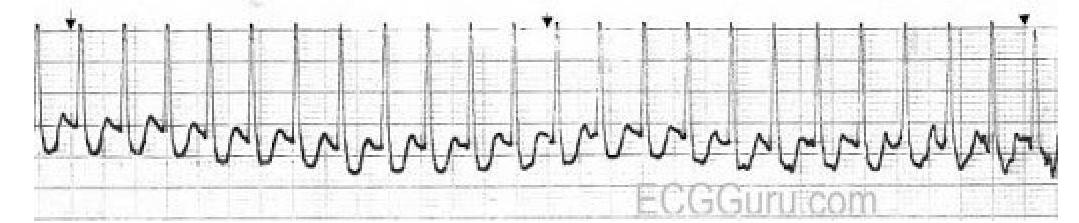
Identify the diagnosis based on the provided ECG image.
Which murmur increases on standing?
Most characteristic cardiovascular defect seen in Rubella-
What is a potential cause of cardiogenic shock other than myocardial infarction (MI)?
Which condition is associated with the ECG pattern known as pseudo P pulmonale?
In ACLS, which drug is recommended for use after unsuccessful defibrillation attempts following ventricular fibrillation?
Explanation: ***Administer IV diuretics with careful monitoring of renal function.*** - The patient's symptoms (dyspnea, bilateral leg swelling, JVD, crackles, pitting edema) and elevated **BNP** are highly suggestive of **acute decompensated heart failure** with significant fluid overload [1]. - While the **elevated creatinine (2.5)** indicates **CKD** and potential worsening renal function (cardiorenal syndrome), **IV diuretics** are critical to reduce fluid overload and improve heart failure symptoms; careful monitoring is essential to balance fluid removal with renal protection [1]. *Initiate non-invasive ventilation (BiPAP) and hold diuretics.* - While **BiPAP** can be beneficial for acute respiratory distress due to heart failure by reducing preload and afterload, it does not address the underlying **fluid overload**. - **Holding diuretics** in a patient with severe fluid overload would worsen the condition and lead to further decompensation. *Switch to oral diuretics and monitor the patient outpatient.* - The patient's severe symptoms and signs of **acute decompensated heart failure** necessitate inpatient management and aggressive treatment. - **Oral diuretics** are typically less potent and have slower onset than IV diuretics, making them inappropriate for initial management of significant decompensation. *Increase fluid intake and provide supportive care.* - Increasing fluid intake would be counterproductive and dangerous in a patient with **pronounced fluid overload** due to heart failure. - While supportive care is important, it must be combined with active measures to remove excess fluid and improve cardiac function.
Explanation: The combination of **sudden severe abdominal pain**, a **distended abdomen**, **decreased bowel sounds**, elevated **INR (4.5)** due to warfarin use, and a drop in **hemoglobin (9.1)** strongly indicates active **gastrointestinal bleeding**. [1] - **Holding warfarin** and administering **vitamin K** are immediate critical steps to reverse anticoagulation and stop the bleeding. *Acute pancreatitis; NPO, IV fluids, pain control* - While pancreatitis can cause severe abdominal pain, the **INR of 4.5** and decreased hemoglobin point more directly to a **bleeding diathesis**, which is not a primary feature of pancreatitis. - The absence of typical pancreatitis risk factors (e.g., gallstones, alcohol abuse) and laboratory findings (e.g., elevated amylase/lipase) makes this less likely. *Perforated peptic ulcer; IV antibiotics, surgical consult* - A perforated ulcer typically presents with **peritoneal signs** (e.g., rebound tenderness, rigidity) and often **free air on imaging**, which are not explicitly mentioned in this scenario. [2] - While INR 4.5 is a bleeding risk, it's not the primary cause of perforation itself, though it could exacerbate a bleed from an ulcer. *Acute mesenteric ischemia; urgent surgical intervention required* - **Acute mesenteric ischemia** can cause severe abdominal pain and distention, especially in patients with atrial fibrillation due to potential **embolic events**. - However, the markedly elevated **INR of 4.5** and significant **hemoglobin drop** make primary **GI bleeding** a more direct and immediate concern than ischemia, as the bleeding is actively worsened by the anticoagulation.
Explanation: ***Ischemic heart disease*** - This condition is characterized by **reduced blood flow** to the heart, leading to **myocardial damage**, which can result in left ventricular hypertrophy and systolic dysfunction. - It can cause exertional dyspnea due to compromised heart function and may manifest as swelling in the legs due to heart failure [1][2]. *Hypertrophic cardiomyopathy* - Typically presents with **diastolic dysfunction** rather than systolic dysfunction, characterized by an **increased wall thickness** without the systolic failure observed here. - Symptoms include **syncope** during exertion but are less likely to cause leg swelling. *Aortic stenosis* - Often leads to **concentric left ventricular hypertrophy**; however, it primarily results in **outflow obstruction**, causing symptoms like chest pain and exertional dyspnea rather than systolic dysfunction directly. - Leg swelling is less common and typically occurs later in the course of heart failure due to aortic stenosis. *Dilated cardiomyopathy* - Characterized primarily by **systolic dysfunction** [2] but typically includes signs of **ballooning** of the ventricles rather than merely hypertrophy. - It often results from a variety of factors including **viral infections** or **alcohol abuse**, rather than just ischemic causes.
Explanation: ***Antiplatelet agents*** - **Antiplatelet agents**, specifically **aspirin**, are crucial for long-term management in stable ischemic heart disease to prevent **thrombus formation** and reduce the risk of **myocardial infarction** and **stroke** [1]. - They inhibit **platelet aggregation**, a key step in the pathophysiology of atherothrombotic events. *Calcium channel blockers* - While effective for **symptomatic relief** of angina by causing **vasodilation** and reducing cardiac oxygen demand, they do not directly reduce the risk of **myocardial infarction** in stable ischemic heart disease [3]. - Their primary role is to improve **quality of life** by decreasing frequency and severity of angina attacks [2]. *Nitrates* - **Nitrates** are used for both acute and chronic relief of angina symptoms through **venodilation** and **coronary vasodilation**, which reduce **preload** and improve myocardial oxygen supply [1]. - However, they do not have a proven role in reducing the long-term risk of **myocardial infarction** or improving mortality outcomes in stable CAD. *Beta-blockers* - **Beta-blockers** are indicated for long-term management to reduce **angina symptoms** and improve outcomes after **myocardial infarction** by decreasing heart rate, blood pressure, and myocardial contractility, thereby reducing **myocardial oxygen demand** [3]. - While they reduce MI recurrence post-MI, their primary role in *stable* ischemic heart disease (without prior MI) is for symptom control rather than primary prevention of initial MI beyond their hemodynamic effects.
Explanation: ***PSVT*** - The ECG shows a **narrow complex tachycardia** with a regular rhythm and a high heart rate, characteristic of **paroxysmal supraventricular tachycardia (PSVT)**. - P waves are often **buried within the QRS complex** or T waves, or may be retrograde, which can be seen as small deflections or changes in the baseline in some leads. *VT* - **Ventricular tachycardia** is characterized by a **wide QRS complex** (>0.12 seconds), which is not observed in this ECG. - While VT can be regular, the primary distinguishing feature is the QRS duration. *AT* - **Atrial tachycardia (AT)** is another form of supraventricular tachycardia, but it typically shows **distinct P waves** with an abnormal morphology, often separate from the T wave, which are not clearly visible or consistently distinct in this tracing. - While it can present with narrow complex tachycardia, the mechanism differs from re-entrant PSVT. *Ventricular fibrillation* - **Ventricular fibrillation** is characterized by **chaotic, irregular electrical activity** with no distinguishable P waves, QRS complexes, or T waves, representing disorganized ventricular depolarization. - The ECG in the image shows a consistent, regular rhythm with identifiable, albeit narrow, QRS complexes.
Explanation: ***HOCM*** - Standing decreases **venous return** and **left ventricular volume**, which reduces the size of the LV outflow tract and thus exacerbates the obstruction in **hypertrophic obstructive cardiomyopathy (HOCM)**, making the murmur louder [1]. - This maneuver is a key diagnostic feature as reduced preload intensifies the dynamic obstruction. *MR* - **Mitral regurgitation (MR)** is typically a volume overload lesion, and standing (which reduces preload) generally causes the murmur to **decrease** in intensity due to less blood volume ejected back into the atrium [3]. - The murmur of MR is usually a holosystolic murmur radiating to the axilla [3]. *MS* - **Mitral stenosis (MS)** is a fixed obstruction to left ventricular filling. Changes in preload (like standing) do not significantly alter the gradient across the mitral valve or the intensity of the murmur [2]. - Its characteristic murmur is a **mid-diastolic rumble** with an opening snap [1]. *VSD* - A **ventricular septal defect (VSD)** murmur is caused by blood flowing from the high-pressure left ventricle to the low-pressure right ventricle. Standing, by reducing systemic vascular resistance, would typically cause the murmur to **decrease** in intensity as less blood shunts left-to-right. - The murmur is usually a **holosystolic murmur** best heard at the lower left sternal border.
Explanation: ***Patent ductus arteriosus*** - **Patent ductus arteriosus (PDA)** is the most characteristic cardiovascular defect associated with congenital rubella syndrome [1]. - The rubella virus can interfere with the normal closure of the **ductus arteriosus** during fetal development [1]. *Coarctation of the aorta* - **Coarctation of the aorta** is a narrowing of the aorta and is not typically linked to congenital rubella syndrome [1]. - It is often associated with syndromes like **Turner syndrome** or bicuspid aortic valve, which are not mentioned here [1]. *Ventricular septal defect* - **Ventricular septal defects (VSDs)** are common congenital heart defects, but they are not specifically characteristic of congenital rubella [1]. - VSDs are more frequently associated with conditions like **Down syndrome** or can occur in isolation [1]. *Pulmonary artery stenosis* - While **pulmonary artery stenosis** can occur as a congenital heart defect, it is less commonly the primary cardiovascular manifestation of congenital rubella syndrome. - **Peripheral pulmonary artery stenosis** can be seen in rubella, but PDA is the most characteristic overarching defect [1].
Explanation: ***Acute mitral regurgitation*** - **Acute mitral regurgitation** is a severe form of valvular heart disease where the mitral valve fails to close properly, leading to a sudden backflow of blood into the left atrium during systole. [1] - This significantly reduces **forward cardiac output** and increases left atrial pressure, which can rapidly lead to pulmonary edema and cardiogenic shock, even in the absence of MI. [1] *Ventricular septal rupture* - While a **ventricular septal rupture** can cause cardiogenic shock, it is typically a **complication of myocardial infarction**, meaning it would fall under MI as the underlying cause. [2] - This condition involves a hole in the septum separating the ventricles, leading to a shunt and increased workload on the right ventricle, causing cardiogenic shock. *Isolated right ventricular shock* - **Isolated right ventricular shock** is often caused by conditions like a **massive pulmonary embolism** or a right ventricular infarction. [2] - While it can lead to shock, it is distinct from general cardiogenic shock which often implies left ventricular dysfunction or severe myocardial compromise, and the question asks for a cause *other than* MI, which can cause right ventricular shock. *None of the options* - This option is incorrect because **acute mitral regurgitation** is a distinct and significant cause of cardiogenic shock, independent of MI. [1]
Explanation: ***Hypercalcemia*** - **Hypercalcemia** can cause a characteristic ECG pattern known as pseudo P pulmonale due to its effects on **myocardial repolarization**. - This condition leads to a **shortened QT interval** which causes the T wave to merge with the P wave, giving the appearance of a tall, peaked P wave. *Hypokalemia* - **Hypokalemia** typically presents with **flattened T waves**, prominent U waves, and ST-segment depression on an ECG [1]. - It can prolong repolarization, which is the opposite effect observed with pseudo P pulmonale [1]. *Hyponatremia* - **Hyponatremia** has a less defined direct effect on ECG patterns compared to other electrolyte imbalances. - Severe hyponatremia may lead to **QRS widening** or **bradycardia**, but not pseudo P pulmonale [1]. *Hypocalcemia* - **Hypocalcemia** characteristically causes **prolongation of the QT interval** on an ECG due to delayed ventricular repolarization [2]. - This is distinct from the shortened QT seen in hypercalcemia that contributes to pseudo P pulmonale.
Explanation: ***Amiodarone*** - **Amiodarone** is a potent **antiarrhythmic drug** recommended for persistent ventricular fibrillation (VF) or pulseless ventricular tachycardia (VT) unresponsive to initial defibrillation and epinephrine [1]. - It works by blocking potassium channels, prolonging the **repolarization phase** of the action potential, thereby stabilizing the myocardial cell membrane. *Dopamine* - **Dopamine** is a **vasopressor** used to improve blood pressure and cardiac output in cases of symptomatic **bradycardia** unresponsive to atropine or in **shock** with significant hypotension. - It is not indicated for the treatment of ventricular fibrillation [2]. *Adenosine* - **Adenosine** is primarily used to terminate **supraventricular tachycardias (SVTs)** by transiently blocking the AV node. - It is contraindicated in ventricular fibrillation because it can worsen the arrhythmia. *Atropine* - **Atropine** is an **anticholinergic drug** used to treat **symptomatic bradycardia** by increasing heart rate. - It has no role in the management of ventricular fibrillation.
Coronary Artery Disease and Angina
Practice Questions
Acute Coronary Syndromes
Practice Questions
Heart Failure
Practice Questions
Cardiac Arrhythmias
Practice Questions
Valvular Heart Diseases
Practice Questions
Cardiomyopathies
Practice Questions
Pericardial Diseases
Practice Questions
Congenital Heart Disease in Adults
Practice Questions
Hypertension and Hypertensive Emergencies
Practice Questions
Pulmonary Hypertension
Practice Questions
Non-invasive Cardiac Diagnostics
Practice Questions
Preventive Cardiology
Practice Questions
Get full access to all questions, explanations, and performance tracking.
Start For Free