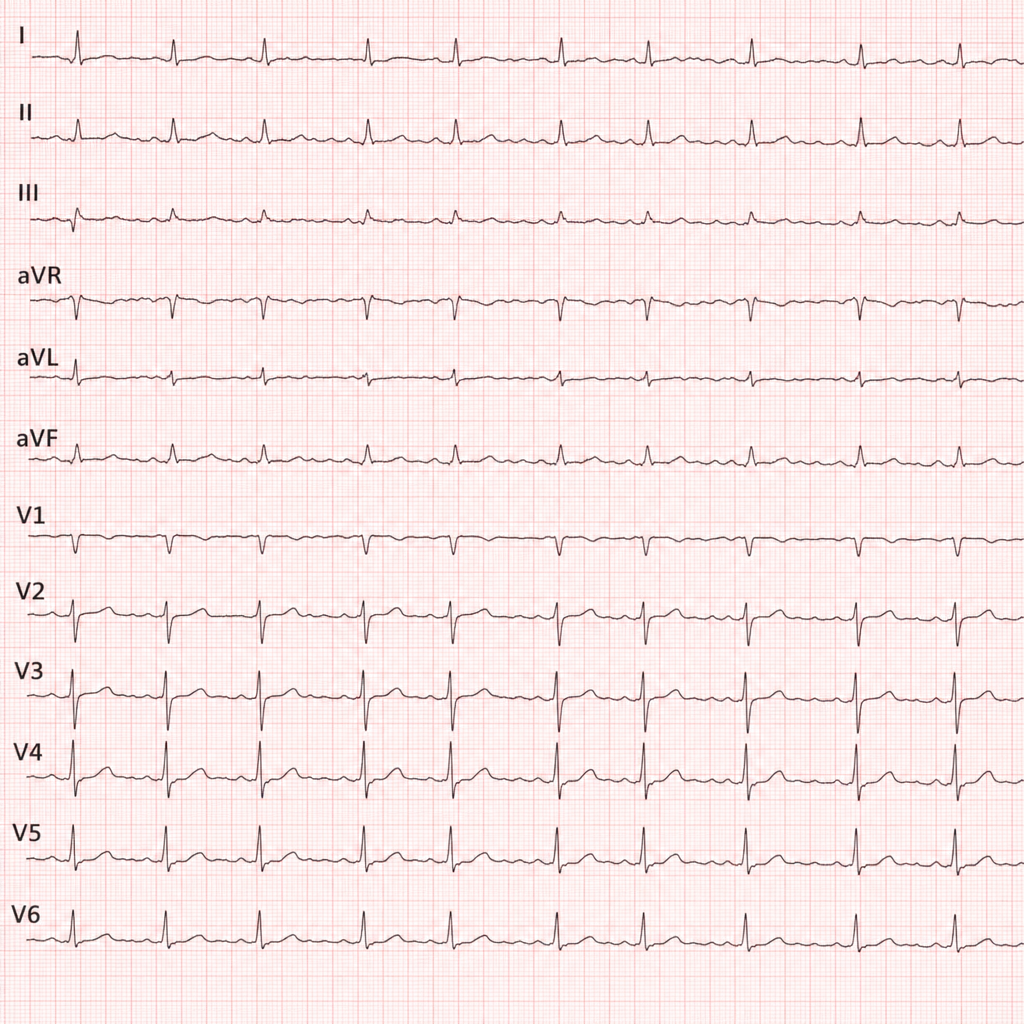
A patient presents with palpitations, chest pain, and irregular pulse. ECG shows irregular RR intervals with no P waves. Diagnosis?
Which of the following is a true statement about varicose veins?
A 55-year-old diabetic presents with chest pain, shortness of breath, and diaphoresis. ECG shows ST elevation. What is the next best step?
A 30-year-old female presents with exertional dyspnea and a loud P2 on auscultation. What is the most likely diagnosis?
Which condition is indicated by 'Q waves' and 'ST elevation' in leads II, III, and aVF?
Which of the following statements about atrial fibrillation is correct?
A 65-year-old female with a history of heart failure presents with new-onset ascites and peripheral edema. What is the most likely underlying cause of her ascites?
A patient with heart failure presents with worsening peripheral edema. Which of the following mechanisms contributes most directly to this finding?
A 65M presents with worsening dyspnea and leg swelling. Physical examination reveals an elevated jugular venous pressure and bilateral lower extremity pitting edema. Most likely cause of his symptoms?
Which of the following is the most common cause of acute dyspnea in elderly adults?
Explanation: Atrial fibrillation - Irregularly irregular RR intervals on ECG, combined with the absence of discernible P waves, are hallmark features of atrial fibrillation [2]. - The symptoms of palpitations and chest pain are common presentations due to the rapid and disorganized atrial electrical activity. Atrial flutter - Characterized by a "sawtooth" pattern of P waves (flutter waves), particularly prominent in leads II, III, aVF, which are absent here [3]. - While it can cause palpitations and an irregular pulse, the RR intervals often show a fixed block ratio, giving it a more regular rhythm unless conducted variably. SVT (Supraventricular Tachycardia) - Typically presents with a narrow QRS complex tachycardia and a regular rhythm, although some forms can be irregular. - P waves are often hidden within the QRS complex or appear retrograde, but the irregular RR intervals with no P waves are not characteristic. Ventricular tachycardia - Characterized by wide QRS complexes (typically >0.12 seconds) due to ventricular origin [1]. - While it causes palpitations and chest pain and can be irregular, the ECG description of no P waves with irregular RR intervals specifically points away from this diagnosis, which usually involves a rapid ventricular rhythm [1].
Explanation: ### Caused by venous valve incompetence - **Varicose veins** result from dysfunctional **venous valves**, leading to **venous reflux** and pooling of blood [1][2]. - This **valvular incompetence** increases pressure in the veins, causing them to dilate, become tortuous, and visible under the skin [2]. ### Do not cause skin changes - This statement is incorrect; chronic **venous insufficiency** due to varicose veins often leads to various **skin changes** [1]. - These can include **stasis dermatitis**, skin discoloration (hyperpigmentation), thickening, and eventually **venous ulcers** [1][2]. ### More common in men - This statement is incorrect; **varicose veins** are generally more common in **women**, particularly those who have been pregnant. - Hormonal factors, pregnancy, and occupations involving prolonged standing contribute to the higher prevalence in women. ### Lead to arterial ulcers - This statement is incorrect; **varicose veins** primarily cause **venous ulcers**, not arterial ulcers [1]. - **Arterial ulcers** are caused by inadequate arterial blood flow, while **venous ulcers** result from chronic venous hypertension and insufficiency [1].
Explanation: ***PCI*** - Percutaneous coronary intervention (PCI) is the **preferred reperfusion strategy** for ST-elevation myocardial infarction (STEMI) if it can be performed within 90 minutes (door-to-balloon time) at a PCI-capable hospital, or within 120 minutes if requiring transfer [1]. - This patient's symptoms (chest pain, shortness of breath, diaphoresis) and **ST elevation on ECG** indicate an acute STEMI, making PCI the most effective and definitive treatment [1]. *Nitroglycerin* - While nitroglycerin can help alleviate chest pain by causing **vasodilation** and reducing cardiac preload and afterload, it does not address the underlying coronary artery occlusion in STEMI. - It is often used as an adjunct, but not as the primary or definitive treatment for **reperfusion** in STEMI. *Thrombolysis* - Thrombolysis is an alternative reperfusion strategy for STEMI, primarily used when **primary PCI is not available** within the recommended timeframes [1]. - Given that PCI is typically available and preferred for STEMI, thrombolysis is considered a second-line option due to higher risks of bleeding and potential for re-occlusion compared to PCI [1]. *Heparin* - Heparin is an **anticoagulant** used in STEMI management to prevent further clot formation and propagation. - It is an important adjunctive therapy, but it does not directly restore blood flow to the ischemic myocardium by dissolving or mechanically removing the occluding thrombus like PCI or thrombolysis.
Explanation: ***Pulmonary hypertension*** - **Exertional dyspnea** is a common symptom due to increased pulmonary vascular resistance leading to right heart strain [1]. - A **loud P2** (second heart sound, pulmonary component) indicates elevated pulmonary artery pressure [1]. *Mitral regurgitation* - Characterized by a **holosystolic murmur** best heard at the apex and radiating to the axilla. - While it can cause dyspnea, a loud P2 is not a primary or specific finding. *Aortic stenosis* - Presents with a **systolic ejection murmur** heard best at the right upper sternal border, radiating to the carotids [2]. - Symptoms include dyspnea, angina, and syncope, but a loud P2 is not typically associated [2]. *Pericarditis* - Typically causes **sharp chest pain** that improves with leaning forward and a **pericardial friction rub**. - Dyspnea may occur but is usually related to pain or tamponade, and a loud P2 is not a characteristic sign.
Explanation: Current ECG leads II, III, and aVF reflect the electrical activity of the inferior wall of the left ventricle [2]. Inferior myocardial infarction is typically indicated by ST elevation and subsequent Q wave formation in these leads [2], [3]. Q waves indicate necrosis (infarction), and ST elevation signifies acute ischemia in the myocardial territory often supplied by the right coronary artery (RCA) [3]. Lateral myocardial infarction typically manifests with changes in leads I, aVL, V5, and V6, which correspond to the lateral ventricular wall [2]. In contrast, an anterior myocardial infarction is characterized by changes, including Q waves and ST elevation, in leads V1, V2, V3, and V4 [1]. Pericarditis typically presents with diffuse ST elevation across multiple leads and does not typically involve the formation of pathological Q waves.
Explanation: ***Discrepancy in pulse rate and heart rate are reliable for diagnosis*** - A disparity between the **apical heart rate** (auscultated at the chest) and the **peripheral pulse rate** (palpated at the wrist), known as a **pulse deficit**, is a characteristic sign of **atrial fibrillation**. [1] - This occurs because some ventricular contractions during atrial fibrillation are too weak to produce a palpable peripheral pulse, especially with a rapid, irregular ventricular response. [1] *Rarely seen in heart with normal morphology* - While atrial fibrillation is often associated with structural heart disease, it can occur in individuals without identifiable cardiac abnormalities, known as **lone atrial fibrillation**, especially in younger patients. [1] - Factors like **hypertension**, obesity, and sleep apnea can precipitate atrial fibrillation even in seemingly normal hearts. *Cardioversion is used for all cases of atrial fibrillation* - **Cardioversion** (electrical or pharmacological) is primarily used for **hemodynamically unstable** patients or stable patients for whom a **rhythm control strategy** is desired. [1] - Many patients, particularly those who are asymptomatic or have chronic atrial fibrillation, are managed with a **rate control strategy** and anticoagulation rather than cardioversion. [1] *Only digoxin used for rate control* - While **digoxin** can be used for **rate control** in atrial fibrillation, particularly in patients with heart failure or sedentary lifestyles, it is not the only agent. - **Beta-blockers** (e.g., metoprolol, atenolol) and **calcium channel blockers** (e.g., diltiazem, verapamil) are also commonly used as first-line agents for rate control in atrial fibrillation, especially if the patient tolerates them. [1]
Explanation: ***Increased right atrial pressure*** - In heart failure, especially **right-sided heart failure**, elevated right atrial pressure leads to increased pressure in the **systemic venous circulation** [1]. - This increased hydrostatic pressure in the **hepatic sinusoids** and peripheral capillaries drives fluid extravasation into the peritoneal cavity (ascites) and interstitial spaces (edema). *Impaired left ventricular function* - While impaired left ventricular function is central to heart failure, it primarily causes **pulmonary congestion** and symptoms like dyspnea [1]. - It does not directly explain **ascites and peripheral edema** as the primary mechanism, which are more characteristic of right-sided failure or elevated systemic venous pressure [1]. *Reduced oncotic pressure due to liver disease* - Reduced oncotic pressure, typically caused by decreased **albumin synthesis** in significant **liver disease**, can lead to ascites and edema. - However, the patient's history of **heart failure** points to a cardiac origin for the fluid retention, not primary liver pathology. *Thrombosis of the portal vein* - **Portal vein thrombosis** causes **portal hypertension**, leading to ascites. - However, it typically does not cause generalized **peripheral edema** as seen here, and the patient's history of heart failure provides a more direct explanation for both ascites and edema.
Explanation: ***Increased capillary hydrostatic pressure*** - In **heart failure**, the heart's inability to effectively pump blood forward leads to a **backup of blood** in the venous system. [1] - This elevated venous pressure is transmitted backward to the capillaries, increasing **capillary hydrostatic pressure**, which significantly promotes the filtration of fluid from the capillaries into the interstitial space, causing edema. [1] *Lymphatic obstruction* - **Lymphatic obstruction** typically results in **lymphedema**, which is initially non-pitting and affects specific areas due to localized lymphatic damage. - While it can cause edema, it is not the primary or most direct mechanism for generalized peripheral edema in typical **heart failure**. *Decreased plasma oncotic pressure* - **Decreased plasma oncotic pressure**, often due to conditions like **liver disease** or **nephrotic syndrome**, reduces the osmotic pull of fluid back into the capillaries. - While it can contribute to edema, this is not the most direct or primary mechanism in heart failure, where fluid retention is predominantly driven by pressure changes. *Increased vascular permeability* - **Increased vascular permeability**, often seen in **inflammation** or **allergic reactions**, allows proteins and fluid to leak out of capillaries, forming exudative edema. - This is rarely the main cause of the widespread, **pitting edema** seen in heart failure, which is transudative and primarily pressure-driven.
Explanation: Right-sided heart failure - **Elevated jugular venous pressure (JVP)** and **bilateral lower extremity pitting edema** are classic signs of fluid overload due to the inability of the right ventricle to effectively pump blood [2], [4]. - **Dyspnea** can occur due to congestion in the lungs (if left-sided failure is also present) or due to increased effort of breathing with significant fluid retention [1], [3]. *Hypothyroidism* - While **hypothyroidism** can cause **non-pitting edema** (myxedema), it does not typically lead to elevated JVP. - The dyspnea in hypothyroidism is often related to respiratory muscle weakness or pleural effusions, not primarily venous congestion. *Chronic kidney disease* - **Chronic kidney disease** can cause **fluid overload** and **edema**, but it typically presents with **pitting edema** and elevated JVP. - However, the primary cause of the fluid retention in CKD is impaired renal excretion, not cardiac pump dysfunction, as in this case. *Liver cirrhosis* - **Liver cirrhosis** can lead to **ascites** and **peripheral edema** due to low albumin and portal hypertension. - Elevate JVP is not a typical feature of cirrhosis unless there is a co-existing cardiac condition.
Explanation: ***Congestive heart failure*** - **Congestive heart failure (CHF)** is a common cause of **acute dyspnea** in elderly adults due to the age-related decline in **cardiac function** and increased prevalence of comorbidities like **hypertension** and **coronary artery disease** [1]. - Symptoms typically include **orthopnea**, **paroxysmal nocturnal dyspnea**, and **peripheral edema**, often with a history of cardiac disease [1], [2]. *Asthma* - While asthma can cause acute dyspnea, it is less common as a *primary new onset* cause of acute dyspnea in the elderly compared to CHF. [2] - Asthma often presents with **wheezing**, **cough**, and a history of allergic reactions or childhood onset [2]. *Pulmonary embolism* - **Pulmonary embolism (PE)** is a serious cause of acute dyspnea but is less common overall than CHF in the elderly population as the *most frequent* cause. - Symptoms often include sudden onset of **dyspnea**, **pleuritic chest pain**, and sometimes **hemoptysis**, along with risk factors like recent surgery or prolonged immobility. *Pneumothorax* - **Pneumothorax** is an acute and severe cause of dyspnea, but it is relatively less common than CHF and typically presents with **sudden unilateral chest pain** and shortness of breath. - It is often associated with pre-existing lung disease (e.g., COPD) or trauma, rather than being a frequent primary cause of acute dyspnea in the general elderly population.
Coronary Artery Disease and Angina
Practice Questions
Acute Coronary Syndromes
Practice Questions
Heart Failure
Practice Questions
Cardiac Arrhythmias
Practice Questions
Valvular Heart Diseases
Practice Questions
Cardiomyopathies
Practice Questions
Pericardial Diseases
Practice Questions
Congenital Heart Disease in Adults
Practice Questions
Hypertension and Hypertensive Emergencies
Practice Questions
Pulmonary Hypertension
Practice Questions
Non-invasive Cardiac Diagnostics
Practice Questions
Preventive Cardiology
Practice Questions
Get full access to all questions, explanations, and performance tracking.
Start For Free