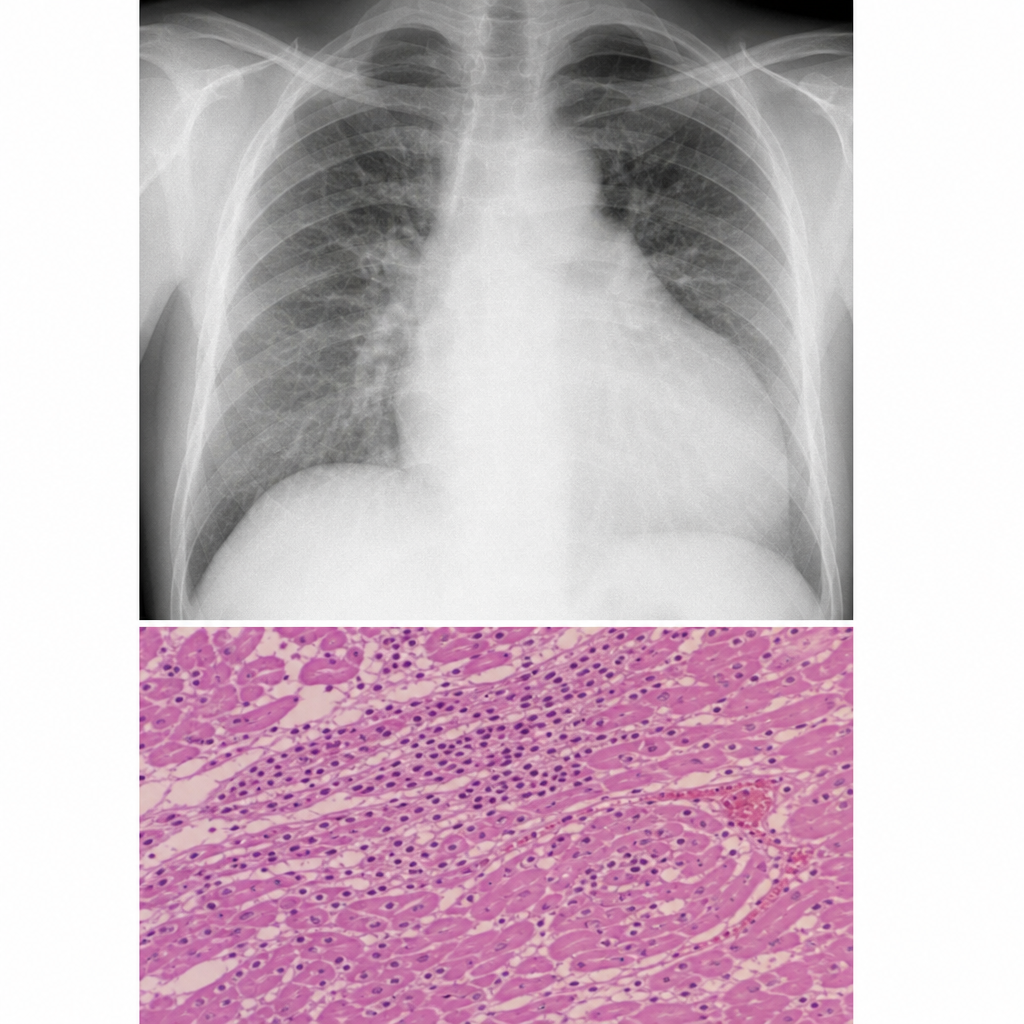
Which ECG change is most specific for acute pericarditis?
A 45-year-old female presents with dyspnea, orthopnea, and bilateral leg edema. Echo shows EF 35%. BNP 850 pg/mL. Which drug class has shown mortality benefit in this condition?
ECG shows a mean axis of 90 degrees. In which of the following would be present the maximum voltage of R wave?
A 50-year-old patient presents with dyspnea, edema, and an elevated JVP. Which condition is most likely?
Which condition is indicated by ST segment elevation in leads V1-V4?
Which finding is typical of hyperkalemia on ECG?
Which condition is suggested by the 'spade-shaped left ventricle' on ECHO?
A 55-year-old male presents to the emergency department with chest pain. An ECG shows ST-segment depression in leads V2 and V3. Troponin levels are elevated. What is the most likely diagnosis?
All of the following are features of hyperkalemia on ECG, EXCEPT:
Which of the following findings is seen in pericardial tamponade?
Explanation: ***PR segment depression*** - **PR segment depression** can be seen in approximately 80% of patients with acute pericarditis and is considered the **most specific ECG marker** [2]. - This finding is due to inflammation of the atria, causing altered atrial repolarization that manifests as depression of the **PR segment** in most leads (except aVR and V1, where it may be elevated). *T wave inversion* - **T wave inversion** typically occurs in later stages of pericarditis, after the resolution of ST-segment elevation [2]. - It is not specific to pericarditis and can be seen in various other conditions, including **myocardial ischemia** or infarction [1]. *Q waves* - The presence of **Q waves** usually indicates a transmural **myocardial infarction** and is not a feature of pericarditis [1]. - Pericarditis primarily affects the pericardium and typically does not cause myocardial necrosis that would result in pathological Q waves [1]. *ST segment elevation* - **ST segment elevation** is common in acute pericarditis, but it is typically generalized (diffuse) and concave upward, unlike the localized and convex upward ST elevation seen in **myocardial infarction** [1], [2]. - While present, its diffuse nature helps differentiate it from MI, but **PR depression** is a more specific marker [2].
Explanation: ***Beta blockers*** - In **heart failure with reduced ejection fraction (HFrEF)**, beta blockers (e.g., carvedilol, metoprolol succinate, bisoprolol) significantly reduce **mortality** and hospitalizations [1]. - They work by blocking the adverse effects of **sympathetic nervous system activation** on the heart, improving cardiac remodeling and function over time. *Calcium channel blockers* - Non-dihydropyridine calcium channel blockers (e.g., verapamil, diltiazem) generally have **negative inotropic effects** and can worsen outcomes in HFrEF. - While some dihydropyridine calcium channel blockers (e.g., amlodipine) are considered safe, they do **not confer a mortality benefit** in this condition. *Alpha blockers* - Alpha blockers like prazosin are primarily used for **hypertension** and **benign prostatic hyperplasia**. - They have **not shown mortality benefit** in heart failure and may even cause symptomatic **hypotension**. *Nitrates* - Nitrates (e.g., isosorbide dinitrate, nitroglycerin) are effective **vasodilators** that reduce preload and afterload, alleviating symptoms like dyspnea [1]. - However, they do not consistently **reduce mortality** when used alone in HFrEF and are often combined with hydralazine for specific populations (e.g., African Americans).
Explanation: aVF - A mean axis of **90 degrees** means the electrical activity of the heart is primarily oriented vertically downwards. [2] - The **aVF lead** is oriented vertically downwards (inferiorly) at **+90 degrees**, so it will best "see" this electrical activity, resulting in the largest R wave. [1] *aVL* - The **aVL lead** is oriented at **-30 degrees**, looking at the lateral wall of the heart. - A 90-degree axis is nearly perpendicular to aVL, meaning the electrical activity would be mostly moving away from or across it, yielding a small or negative deflection. [1] *I* - **Lead I** is oriented horizontally at **0 degrees**, looking at the lateral wall of the heart. - A 90-degree axis is perpendicular to Lead I, so its R wave would be minimal or nonexistent, or an equiphasic complex would be observed. [2] *III* - **Lead III** is oriented at **+120 degrees**, looking at the inferior wall of the heart. - While Lead III is also an inferior lead, a 90-degree axis is not perfectly aligned with it, so the R wave amplitude would be smaller compared to aVF.
Explanation: ***Right heart failure*** - **Dyspnea**, **edema** (often peripheral), and an **elevated jugular venous pressure (JVP)** are classical signs of right heart failure due to systemic venous congestion [1]. - The inability of the right ventricle to pump blood efficiently leads to blood backing up in the systemic circulation [3]. *Left heart failure* - While it can cause dyspnea, left heart failure primarily leads to **pulmonary congestion** (e.g., crackles, orthopnea) and is less directly associated with prominent peripheral edema and elevated JVP as initial prominent symptoms [2]. - An elevated JVP and significant peripheral edema in left heart failure typically indicate progression to **biventricular failure** [1]. *Pneumonia* - Pneumonia typically presents with acute symptoms like **fever, cough with sputum, pleuritic chest pain**, and localized lung findings, rather than chronic dyspnea, edema, and elevated JVP. - It’s an **infectious lung condition**, not primarily a circulatory disorder causing systemic congestion. *Asthma* - Asthma is a **reversible obstructive airway disease** characterized by episodic **wheezing, cough, and shortness of breath** due to bronchospasm [4]. - It does not typically cause edema or an elevated JVP.
Explanation: ***Anterior myocardial infarction*** - **ST segment elevation** in leads **V1-V4** is indicative of an infarction in the **anterior wall** of the left ventricle [1]. - These leads correspond to the distribution of the **left anterior descending (LAD) coronary artery**, which supplies the anterior wall and septum [2]. *Posterior myocardial infarction* - This typically presents with **ST depression** in **V1-V4**, along with tall R waves and prominent T waves in the same leads, due to a reciprocal change. - Definitive diagnosis requires **posterior leads (V7-V9)**, which would show ST elevation. *Lateral myocardial infarction* - Characterized by **ST elevation** in leads **I, aVL, V5, and V6**, reflecting ischemia in the lateral wall of the left ventricle [1]. - These leads are supplied by the **circumflex artery** or a diagonal branch of the LAD. *Inferior myocardial infarction* - Identified by **ST elevation** in leads **II, III, and aVF**, indicating involvement of the inferior wall [1]. - This is typically caused by occlusion of the **right coronary artery (RCA)** or a dominant circumflex artery.
Explanation: ***Peaked T waves*** - **Peaked T waves**, characterized by being tall, narrow, and symmetric, are an early and classic sign of **hyperkalemia** on an ECG [1]. - This occurs due to the effect of high extracellular potassium on myocardial repolarization, specifically shortening the **action potential duration**, which is manifested as altered repolarization on the ECG [1]. *Q waves* - **Q waves** on an ECG are commonly associated with **myocardial infarction** (heart attack), indicating necrotic myocardium. - They are not a typical direct finding of **hyperkalemia**, although other severe ECG changes from hyperkalemia can mimic cardiac ischemia. *Flattened P waves* - **Flattened P waves**, and eventually their disappearance, are characteristic of later stages of **hyperkalemia** as potassium levels rise significantly [1]. - This reflects impaired atrial depolarization (atrial paralysis), but **peaked T waves** are generally an earlier and more specific initial indicator [1]. *ST elevation* - **ST elevation** is primarily a hallmark of **acute myocardial infarction** or **pericarditis**, signifying myocardial injury or inflammation. - While extreme hyperkalemia can lead to a "sine wave" pattern and wide QRS complexes that might superficially resemble ST elevation, it is not a direct or typical finding.
Explanation: ***Hypertrophic cardiomyopathy*** - A **spade-shaped left ventricle** is a classic echocardiographic finding in **hypertrophic cardiomyopathy (HCM)**, specifically apical HCM [3]. - This shape results from focal **hypertrophy of the left ventricular apex**, leading to a distinctive narrowing towards the apex [3]. *Aortic regurgitation* - Causes **left ventricular volume overload** and often leads to **left ventricular dilation**, not typically a spade shape [1]. - **Diastolic retrograde flow** across the aortic valve is the characteristic echocardiographic finding. *Pulmonary embolism* - Primarily affects the **right side of the heart**, leading to **right ventricular dilation** and **dysfunction** [1]. - Does not directly cause a **spade-shaped left ventricle**. *Dilated cardiomyopathy* - Characterized by **enlargement and thinning of all four heart chambers**, particularly the left ventricle [2]. - The left ventricle typically appears globally dilated and spherical, not spade-shaped [2].
Explanation: ***NSTEMI*** - Elevated **troponin levels** confirm myocardial infarction (myocardial cell necrosis), while **ST-segment depression** (and absence of ST elevation) indicates it is a non-ST elevation myocardial infarction [1]. - This condition is characterized by **ischemia** severe enough to cause myocardial damage, but not a complete transmural infarction. *Unstable angina* - Characterized by **chest pain at rest** or with minimal exertion, which is a new onset or worsening pattern of angina [1]. - Unlike NSTEMI, **troponin levels** would not be elevated, indicating no myocardial cell necrosis has occurred yet [1]. *STEMI* - Defined by **ST-segment elevation** in two contiguous leads on an ECG, indicating acute transmural myocardial ischemia [2]. - While troponin levels are elevated in STEMI, the absence of **ST elevation** on the ECG rules out this diagnosis [2]. *Posterior wall MI* - Often diagnosed by **ST-segment depression in leads V1-V3** and prominent R waves in those same leads, which are reciprocal changes for a posterior infarct. - The given information only states ST-segment depression in V2 and V3, and while a posterior MI can present this way, the most direct and overarching diagnosis given the troponin elevation and ST depression is NSTEMI.
Explanation: ***U waves*** - **U waves** are typically associated with **hypokalemia**, not hyperkalemia. They are small deflections immediately following the T wave. - Their presence suggests an abnormality in myocardial repolarization due to low potassium levels. *Shortened QT interval* - A **shortened QT interval** is *not* a typical finding in hyperkalemia; hyperkalemia usually causes a **prolonged PR interval** and QRS widening, which can make QT measurement difficult but does not inherently shorten it. - A shortened QT interval is more commonly seen in conditions like **hypercalcemia** or inherited short QT syndrome. *Peaked T waves* - **Peaked T waves** (also known as "tenting" of the T waves) are one of the earliest and most classic ECG signs of hyperkalemia [1]. - This occurs due to abnormally rapid repolarization of the ventricles. *Wide QRS complex* - As hyperkalemia progresses, the **QRS complex widens** due to a slowing of intraventricular conduction [1]. - This widening can eventually lead to a **sine wave pattern** if not treated, indicating severe hyperkalemia and impending cardiac arrest.
Explanation: ***Pulsus paradoxus*** - This is an **abnormally large decrease** in systolic blood pressure (>10 mmHg) and pulse wave amplitude during inspiration. - It occurs due to compromised ventricular filling caused by **increased pericardial pressure** in tamponade [1]. *Beck's triad* - Beck's triad (hypotension, jugular venous distention, and muffled heart sounds) are **signs/symptoms** of pericardial tamponade, not a finding in the same way pulsus paradoxus is [1]. - This clinical triad points towards the diagnosis but does not describe a physiological finding as specifically as pulsus paradoxus. *Kussmaul sign* - The Kussmaul sign is a paradoxical **increase** in jugular venous pressure (JVP) during inspiration. - While it indicates impaired right ventricular filling, it is classically seen in **constrictive pericarditis** and severe right heart failure, not typically in pericardial tamponade [2]. *All of the options* - This option is incorrect because Kussmaul sign is typically associated with **constrictive pericarditis** rather than pericardial tamponade [2]. - While Beck's triad is characteristic of tamponade, pulsus paradoxus is a specific hemodynamic finding seen in this condition [1].
Coronary Artery Disease and Angina
Practice Questions
Acute Coronary Syndromes
Practice Questions
Heart Failure
Practice Questions
Cardiac Arrhythmias
Practice Questions
Valvular Heart Diseases
Practice Questions
Cardiomyopathies
Practice Questions
Pericardial Diseases
Practice Questions
Congenital Heart Disease in Adults
Practice Questions
Hypertension and Hypertensive Emergencies
Practice Questions
Pulmonary Hypertension
Practice Questions
Non-invasive Cardiac Diagnostics
Practice Questions
Preventive Cardiology
Practice Questions
Get full access to all questions, explanations, and performance tracking.
Start For Free