Pulmonary Plethora is seen in -
A 25-year-old female presented to ER unconscious. Her mother tells you about her having recurrent syncopal episodes. Her BP is 80/60 mm Hg and you order an ECG. Treatment is

Stunning of myocardium without any acute coronary syndrome is:-
A patient presents with palpitations, consciousness, fast pulse, and BP of 80/50 mmHg. After failed vagal maneuver and maximum dose of adenosine, what is the next step in management?
A patient presents with palpitations. On examination the patient was conscious, pulse was fast with BP of 80/50 mmHg. He was subjected to Vagal maneuver and was given intravenous adenosine. The rhythm remains refractory to maximum dose of adenosine. What is the next step in management of this patient?
Deep y descent in JVP is seen in all except:
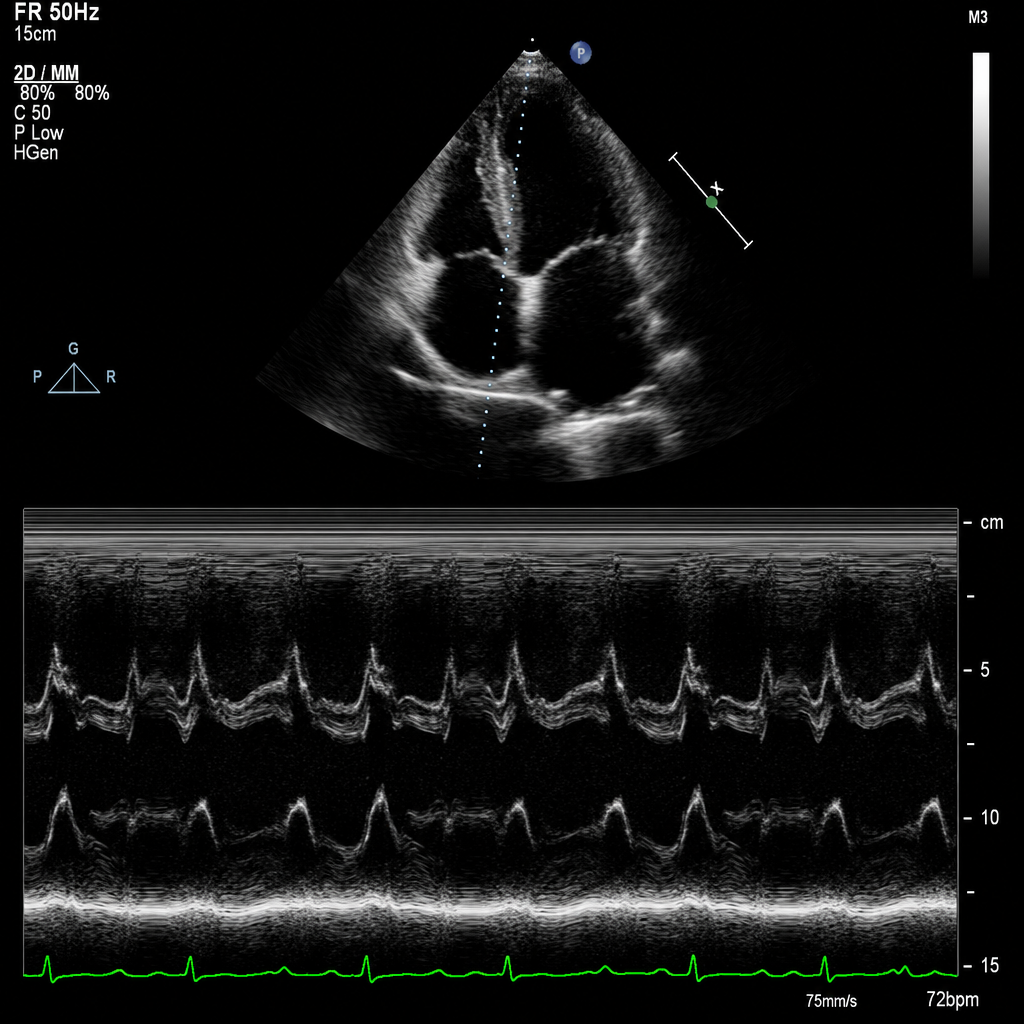
What is indicated by an 'enlarged left atrium' on echocardiography?
Which condition is associated with 'prolonged PR interval' on an ECG?
A 30 year old patient has right upper limb BP of 180/95 mm Hg and left upper limb BP of 130/90 mm Hg. He also has early diastolic murmur in right 2nd intercostal space. Which of the following would be LEAST likely associated with these findings?
Patient shows ST depression, troponin rise 6h post-surgery. Next best step is:
Explanation: ***TAPVC*** - **Total Anomalous Pulmonary Venous Connection (TAPVC)** leads to all pulmonary veins draining into the systemic circulation, causing a left-to-right shunt at the atrial level back into the right atrium. - This persistent shunting results in increased blood flow to the lungs, manifesting as **pulmonary plethora** on chest X-ray due to engorged pulmonary vessels [3]. *Tricuspid Atresia* - **Tricuspid atresia** results in an absence of the tricuspid valve, severely limiting blood flow from the right atrium to the right ventricle. - This condition typically leads to **pulmonary oligemia** (reduced blood flow to the lungs), not pulmonary plethora. *CoA* - **Coarctation of the aorta (CoA)** is a narrowing of the aorta, typically distal to the left subclavian artery [2]. - While it can lead to complications like heart failure, it generally does not directly cause **pulmonary plethora** unless there are associated shunts. *TOF* - **Tetralogy of Fallot (TOF)** is characterized by four defects: ventricular septal defect, pulmonary stenosis, overriding aorta, and right ventricular hypertrophy [1]. - The most significant hemodynamic feature is **pulmonary stenosis**, which reduces blood flow to the lungs, leading to **pulmonary oligemia**, often described as a "boot-shaped" heart on X-ray [1].
Explanation: ***DC shock*** - The ECG shows a **wide complex tachycardia** with alternating morphology in the QRS complex, consistent with **Torsades de Pointes**. - Given the patient's **unconsciousness** and **hypotension (80/60 mmHg)**, she is hemodynamically unstable, making immediate **electrical cardioversion (DC shock)** the treatment of choice irrespective of the cause. *Catheter Ablation* - **Catheter ablation** is an invasive procedure used for definitive treatment of recurrent arrhythmias, often considered in patients who are *hemodynamically stable*. - It is not an acute, emergency treatment for an **unstable patient** in a life-threatening arrhythmia. *Adenosine* - **Adenosine** is primarily used to terminate **supraventricular tachycardias (SVTs)** and can be harmful in wide complex tachycardias, especially if due to ventricular tachycardia or Wolff-Parkinson-White syndrome. - Its use is contraindicated in wide complex tachycardias like Torsades de Pointes, and it would not be effective in an **unstable patient** with Torsades de Pointes. *Radiofrequency ablation* - **Radiofrequency ablation** is a type of catheter ablation, which ablates or destroys abnormal electrical pathways in the heart. - Similar to other ablative therapies, it is a **definitive treatment** for recurrent arrhythmias in *stable patients*, not an emergency measure for an unconscious, hypotensive patient with an acute arrhythmia.
Explanation: ***Takotsubo cardiomyopathy*** - This condition involves **transient systolic dysfunction** of the left ventricle, often triggered by severe emotional or physical stress, mimicking a heart attack but without **coronary artery obstruction**. - The apical and mid-ventricular segments of the left ventricle become akinetic or hypocinetic, causing the heart to take on a shape resembling an octopus trap (**takotsubo**). *Restrictive cardiomyopathy* - This is a condition where the walls of the ventricles become **stiff** and **lose their flexibility**, preventing the heart from filling properly. - It is typically caused by conditions like **amyloidosis** or **sarcoidosis**, leading to impaired diastolic function, not transient stunning. *Subendocardial infarction* - This refers to a **heart attack** that affects only the **inner layer** of the heart muscle (**subendocardium**) due to reduced blood flow [2]. - It is a form of **acute coronary syndrome** where there is irreversible myocardial necrosis, unlike the temporary dysfunction in stunning [1]. *Transmural infarction* - This is a **severe form of heart attack** where the entire thickness of the heart muscle wall is affected, usually due to a **complete blockage of a coronary artery** [2]. - This also represents **acute coronary syndrome** with widespread myocardial necrosis, which is fundamentally different from a reversible stunning of the myocardium [1].
Explanation: ***Cardioversion*** - The patient presents with **symptomatic tachycardia** (palpitations, decreased consciousness, hypotension) refractory to **vagal maneuvers** and **adenosine**, indicating hemodynamic instability. - In such cases, **synchronized cardioversion** is the definitive treatment to restore sinus rhythm promptly and prevent further deterioration [1]. *Amiodarone* - **Amiodarone** is an antiarrhythmic drug used for stable wide complex tachycardia or as a second-line agent for unstable tachycardia after cardioversion. - It is not the immediate next step for an unstable patient who has failed adenosine, as its onset of action is slower than cardioversion [2]. *Repeat adenosine* - The question states that the patient has already received the **maximum dose of adenosine** and it has failed. - Administering more adenosine would be ineffective and delay definitive treatment for a hemodynamically unstable patient. *Defibrillation* - **Defibrillation** is used for **pulseless ventricular tachycardia/fibrillation** where there is no organized electrical activity [1]. - This patient has a pulse and an organized (though fast) rhythm, making synchronized cardioversion the appropriate electrical therapy.
Explanation: ***Cardioversion*** - As the patient is **hemodynamically unstable** (BP 80/50 mmHg) and has a **tachyarrhythmia** refractory to vagal maneuvers and maximal adenosine, **synchronized cardioversion** is the immediate next step. - This intervention provides a rapid and effective way to restore sinus rhythm in unstable supraventricular tachycardias (SVTs). *Repeat adenosine* - Adenosine has a very short half-life and its effects are transient; **repeated doses** beyond the maximal recommended dose are unlikely to be effective and may carry increased risk without benefit in a refractory case [2]. - The patient's **hemodynamic instability** necessitates a more definitive and immediate intervention than further pharmacotherapy. *Amiodarone* - While amiodarone is an **antiarrhythmic drug** used for tachyarrhythmias, it acts more slowly than cardioversion and is typically reserved for **hemodynamically stable** patients or after electrical cardioversion if arrhythmia recurs. - Given the patient's **hypotension**, immediate electrical cardioversion is prioritized over pharmacologic therapy that takes time to act. *Defibrillation* - Defibrillation is used for **pulseless ventricular tachyarrhythmias** (VT/VF) or cardiac arrest, which does not match the clinical scenario described as the patient has a pulse [1]. - This patient is in a **tachycardia with a pulse** and is hemodynamically unstable, requiring synchronized cardioversion rather than unsynchronized defibrillation.
Explanation: **Cardiac tamponade** - In **cardiac tamponade**, the heart’s filling is severely restricted by fluid in the pericardial sac, leading to an **elevated right atrial pressure** that impedes venous return and results in **blunting or absence of the y descent** in the JVP [1]. - The elevated pericardial pressure prevents the right ventricle from expanding during early diastole, which is the physiological basis for the **normal y descent**. *RCM* - **Restrictive cardiomyopathy (RCM)** is characterized by **impaired ventricular filling** during diastole, causing a rapid fall in atrial pressure after tricuspid valve opening, resulting in a **prominent and deep y descent**. - The rapid early diastolic filling during the y descent is abruptly halted as the stiff ventricle is unable to further accommodate blood, leading to a rapid rise in ventricular pressure. *Constrictive pericarditis* - In **constrictive pericarditis**, the rigid pericardium encases the heart, severely **restricting diastolic filling** and causing a rapid early diastolic drop in right atrial pressure, hence a **prominent and deep y descent** [2]. - Despite the rapid initial fall, the y descent is often followed by a rapid rise in pressure (square root sign on ventricular pressure tracing) as the heart reaches the limits of its constrained filling. *Tricuspid regurgitation* - While **tricuspid regurgitation** primarily impacts the **c-v wave** due to backflow into the atrium during ventricular systole, it can also present with an **exaggerated y descent** if there is significant diastolic dysfunction or associated conditions like right heart failure. - However, the most classic JVP finding in severe tricuspid regurgitation is a prominent **regurgitant c-v wave**, not necessarily a deep y descent as a primary feature.
Explanation: ***Chronic mitral regurgitation*** - Long-standing **mitral regurgitation** causes chronic volume overload in the left atrium, leading to its **dilatation** as a compensatory mechanism [1]. - This **atrial enlargement** is a key indicator of the chronicity and significant hemodynamic impact of the valve lesion. *Tricuspid stenosis* - **Tricuspid stenosis** primarily impacts the **right atrium**, causing its enlargement due to obstruction of blood flow into the right ventricle. - It does not directly affect the left atrium, although severe right-sided heart disease can sometimes indirectly influence left-sided filling. *Acute mitral regurgitation* - In **acute mitral regurgitation**, there is insufficient time for the left atrium to remodel and dilate significantly in response to the sudden volume overload [1]. - While left atrial pressure rises dramatically, the atrium itself typically appears **normal in size** or only mildly enlarged. *Pulmonary embolism* - A **pulmonary embolism** primarily affects the **right side of the heart**, leading to sudden increases in **pulmonary artery pressure** and right ventricular strain. - It does not directly cause left atrial enlargement, though severe acute right heart failure can impact left ventricular filling.
Explanation: ***First-degree AV block*** - First-degree AV block is defined by a consistent **prolongation of the PR interval** beyond 0.20 seconds, indicating delayed conduction through the AV node [1]. - While it is generally benign and asymptomatic, it reflects a **delay in electrical impulse transmission** from the atria to the ventricles [1], [3]. *Sinus bradycardia* - This condition is characterized by a **slow heart rate** (typically below 60 beats per minute) originating from the sinus node. - While the heart rate is slow, the **PR interval typically remains normal**, reflecting proper AV nodal conduction. *Second-degree AV block* - Second-degree AV block involves some **P waves not being conducted to the ventricules**, resulting in dropped QRS complexes [1]. - While PR intervals can be prolonged or progressively lengthen (Mobitz I), the key feature is **intermittent dropped beats**, not just blanket prolongation [1]. *Complete heart block* - Also known as third-degree AV block, this is a severe condition where **no atrial impulses are conducted to the ventricles**, leading to complete dissociation [2]. - The P waves and QRS complexes beat independently, meaning there is **no consistent PR interval** to measure as they are completely uncoupled [2].
Explanation: ***Supravalvular aortic Stenosis*** - **Supravalvular aortic stenosis** causes a pressure gradient above the aortic valve, leading to **left ventricular hypertrophy** and potentially differential blood pressures between the upper limbs, but typically with **higher pressures distally** from the stenosis. - The early diastolic murmur in the right 2nd intercostal space is more suggestive of **aortic regurgitation** [2], which is less directly caused by isolated supravalvular stenosis compared to other conditions listed. *Aortic dissection* - **Aortic dissection** can involve the great vessels originating from the aorta, leading to a significant **differential in blood pressure** between the upper limbs due to obstruction of flow to one arm [1]. - An early diastolic murmur, especially in the right 2nd intercostal space, can indicate **aortic regurgitation** [2] if the dissection extends to the aortic root. *Coarctation of aorta* - **Coarctation of the aorta** typically presents with **hypertension in the upper limbs** and lower or absent pulses in the lower limbs, but if the coarctation is pre-subclavian, it can cause a differential in arm blood pressures [1]. - A persistent **early diastolic murmur** can be heard in association with **bicuspid aortic valve**, which often co-exists with coarctation and can lead to aortic regurgitation [2]. *Takayasu arteritis* - **Takayasu arteritis** is a **vasculitis of large arteries**, commonly affecting the aorta and its main branches, which can lead to stenosis or occlusion of vessels supplying one arm, causing a **markedly different blood pressure** between the limbs. - Involvement of the aortic root can also lead to **aortic insufficiency**, manifesting as an early diastolic murmur [2].
Explanation: ***Cardiology consult*** - A cardiology consult is the most appropriate next step given the presence of **ST depression** and a **troponin rise** post-surgery, indicating a likely myocardial infarction (MI). - This allows for prompt comprehensive evaluation, risk stratification, and initiation of specialized cardiac management by an expert. *12-lead ECG* - While a 12-lead ECG is an important diagnostic tool, the patient's existing **ST depression** suggests it has already been performed or noted. - A repeat ECG might be useful for tracking changes, but it doesn't replace the need for expert cardiac evaluation and management. *Echocardiogram* - An echocardiogram can assess **cardiac function**, wall motion abnormalities, and valvular issues, which are relevant in MI. - However, it's a diagnostic test that should be ordered and interpreted in the context of a broader cardiac workup, which a cardiologist can best coordinate. *Start heparin* - **Heparin** is an anticoagulant that may be part of the management for an MI, especially in certain types or for prevention of clot extension. - However, initiating anticoagulation should be done after a thorough assessment of the patient's cardiac status, bleeding risk post-surgery, and in consultation with cardiology, rather than as the immediate next best step.
Coronary Artery Disease and Angina
Practice Questions
Acute Coronary Syndromes
Practice Questions
Heart Failure
Practice Questions
Cardiac Arrhythmias
Practice Questions
Valvular Heart Diseases
Practice Questions
Cardiomyopathies
Practice Questions
Pericardial Diseases
Practice Questions
Congenital Heart Disease in Adults
Practice Questions
Hypertension and Hypertensive Emergencies
Practice Questions
Pulmonary Hypertension
Practice Questions
Non-invasive Cardiac Diagnostics
Practice Questions
Preventive Cardiology
Practice Questions
Get full access to all questions, explanations, and performance tracking.
Start For Free