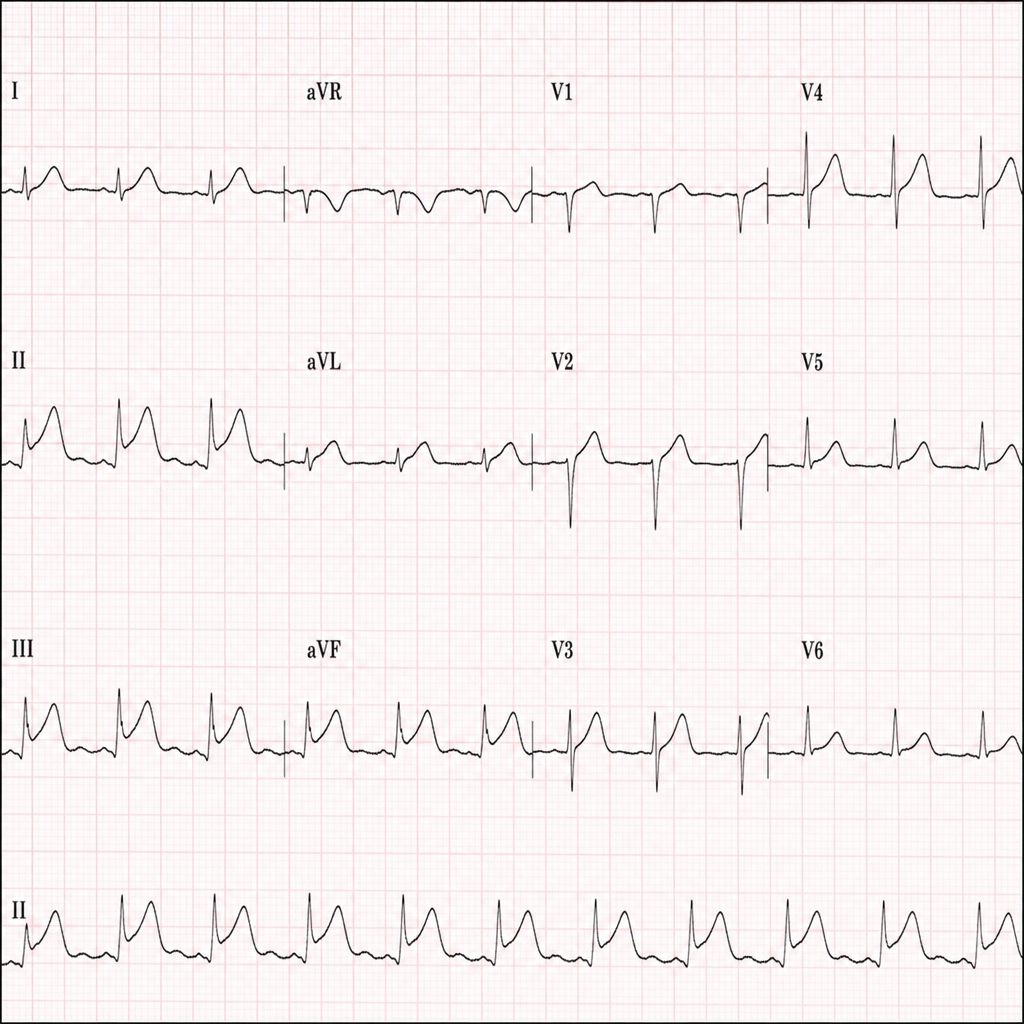
Delta waves in ECG are characteristic of
Most common presentation of cardiac lupus ?
Long-standing obstruction due to enlarged tonsils and adenoids can cause:
A young boy presents to you with history of breathlessness on exertion. You being an intern proceed with auscultation of the patient's chest. Your findings are ejection systolic murmur in the left 2nd intercostal space, S1 is normal and has wide and fixed split S2. You then send the patient for an ECG, what would be the most likely finding in the ECG report?
Lancisi's sign is seen in
Features of Raynaud's disease are all except
What is the mechanism of aortic regurgitation in a case of VSD?
Lutembacher's syndrome comprises of ?
Most common cause of death in aortic stenosis patients is:
After a successful Total Hip Replacement a 59 year old patient developed severe chest pain. Echocardiography revealed reduced wall motion of right ventricle with slow flow across the tricuspid valve. Which of the following is most likely diagnosis?
Explanation: ***Wolf Parkinson White syndrome*** - A **delta wave** is a slurred upstroke at the beginning of the QRS complex, which is characteristic of **pre-excitation** in Wolf-Parkinson-White (WPW) syndrome [1]. - This occurs due to an **accessory pathway (Bundle of Kent)** that bypasses the AV node, leading to early ventricular activation [1]. *Bifascicular disease* - Refers to a conduction abnormality involving two fascicles of the **His-Purkinje system**, typically presenting as a combination of **right bundle branch block (RBBB)** with either left anterior or left posterior fascicular block. - ECG findings for bifascicular block do not include delta waves; instead, they show widened QRS complexes and axis deviations. *Trifascicular disease* - Involves conduction delay or block in all three fascicles of the **His-Purkinje system**, often manifest as alternating **bundle branch block patterns** or varying degrees of AV block. - It does not present with delta waves, but rather with **bradycardia** or episodes of syncope due to severe conduction disturbances. *RBBB* - **Right bundle branch block (RBBB)** is characterized by a widened QRS complex (>0.12s) with an **"M" pattern (RSR')** in leads V1-V3 and broad S waves in lateral leads (I, aVL, V5, V6). - RBBB indicates a delay in conduction through the right bundle branch, but it does not produce a delta wave, which is specific to pre-excitation.
Explanation: ***Pericarditis*** - **Pericarditis** is the most common cardiac manifestation of **systemic lupus erythematosus (SLE)**, affecting a significant proportion of patients. - It often presents as **chest pain** that improves with leaning forward and worsens with lying down, along with a **pericardial friction rub** [3]. *Aortic regurgitation* - While **valvular disease** can occur in lupus, **aortic regurgitation** is less common than pericarditis as the initial or most frequent cardiac presentation. - Valvular involvement, particularly **Libman-Sacks endocarditis**, can sometimes lead to regurgitation, but is itself less common than pericardial involvement [2]. *Libman sacks endocarditis* - **Libman-Sacks endocarditis** involves **non-infectious vegetative lesions** on heart valves, typically the mitral or aortic valves. - Although characteristic of lupus, it is a less frequent presentation compared to **pericarditis** and can lead to valvular dysfunction. *Myocarditis* - **Myocarditis**, or inflammation of the heart muscle, is a less common but more serious cardiac manifestation of SLE [1]. - It can cause **heart failure** and **arrhythmias** but is not the most common initial presentation.
Explanation: Obstructive sleep apnea [1] - Enlarged tonsils and adenoids are a common cause of **upper airway obstruction** during sleep in children and, less commonly, adults. - This obstruction leads to **recurrent episodes of apnea and hypopnea**, characteristic of obstructive sleep apnea [1]. *Pulmonary embolism* - A pulmonary embolism is typically caused by a **blood clot** that travels to the lungs, often originating from deep vein thrombosis. - There is no direct causal link between enlarged tonsils/adenoids and the formation of a pulmonary embolus. *Chronic hypoxemia* - While **obstructive sleep apnea can lead to intermittent hypoxemia**, long-standing obstruction from tonsils and adenoids is not the primary cause of chronic, persistent hypoxemia as an isolated issue. - Chronic hypoxemia typically results from conditions like **severe lung disease (e.g., COPD, cystic fibrosis)** or significant cardiac shunts [2]. *Cor pulmonale* - **Cor pulmonale** (right-sided heart failure) can develop as a *secondary complication* of long-standing, severe obstructive sleep apnea due to chronic hypoxemia and pulmonary hypertension [3]. - However, it is not a direct result of the obstruction itself, but rather a late-stage complication of the resulting physiological changes, and **obstructive sleep apnea** is the more immediate and direct consequence.
Explanation: ***Right axis deviation*** - The clinical presentation of **breathlessness on exertion**, an **ejection systolic murmur in the left 2nd intercostal space**, and a **wide and fixed split S2** are classic signs of an **atrial septal defect (ASD)** [2]. - An ASD leads to a **left-to-right shunt**, causing **volume overload** in the right atrium and right ventricle, which results in **right ventricular hypertrophy** and consequently **right axis deviation** on an ECG [1]. *Left axis deviation* - **Left axis deviation** is typically associated with conditions causing **left ventricular hypertrophy** or conduction defects involving the left bundle branch, which are not directly indicated by the described cardiac findings. - While some complex congenital heart defects can present with left axis deviation, it is not the most common finding with an isolated **atrial septal defect**. *Large p waves* - **Large P waves** (P pulmonale) indicate **right atrial enlargement**, which can occur in an ASD due to volume overload [1]. - However, while right atrial enlargement is common, **right axis deviation** due to right ventricular hypertrophy is a more specific and prominent ECG finding in symptomatic **atrial septal defects**. *Absent p waves* - **Absent P waves** are characteristic of conditions like **atrial fibrillation** or **junctional rhythms**. - These are not typical findings in an isolated **atrial septal defect** and would not explain the other clinical signs.
Explanation: ***TR*** - **Lancisi's sign**, or a prominent **V wave in the jugular venous pulse**, is pathognomonic for **tricuspid regurgitation** [2]. - This sign indicates a rapid increase in **right atrial pressure** during ventricular systole due to backflow of blood from the right ventricle [2]. *AS* - **Aortic stenosis** typically presents with a **delayed and diminished carotid pulse** (pulsus parvus et tardus) and a **systolic ejection murmur**. - It does not involve abnormalities of the jugular venous pulse. *Aortic Regurgitation* - **Aortic regurgitation** is characterized by a **collapsing pulse** (Corrigan's pulse) and a **diastolic decrescendo murmur** [3]. - Jugular venous pulse abnormalities are not primary features of aortic regurgitation. *MS* - **Mitral stenosis** is associated with a **loud S1** sound and a **mid-diastolic murmur**, often with an opening snap [1]. - While it can cause pulmonary hypertension and subsequently right-sided heart failure leading to elevated JVP, it doesn't specifically cause a prominent V wave (Lancisi's sign).
Explanation: ***Commonly unilateral*** - Raynaud's **disease** (primary Raynaud's) typically presents with **bilateral and symmetrical** involvement of the digits. - **Unilateral** or asymmetric involvement is more characteristic of **Raynaud's phenomenon** (secondary Raynaud's), which is associated with underlying conditions like scleroderma. *Repeated attacks occur* - Raynaud's disease is defined by **recurrent, episodic attacks** of vasospasm in response to cold or stress. - These attacks are a hallmark of the condition, distinguishing it from transient episodes. *Peripheral pulses are normally felt* - In primary Raynaud's disease, the underlying arterial structure is healthy, so **large vessel peripheral pulses** remain palpable between attacks. - Absence of peripheral pulses would suggest an **obstructive arterial disease** or secondary Raynaud's phenomenon. *Common in young females* - Raynaud's disease primarily affects **young women**, with onset typically occurring between the ages of 15 and 30. - This demographic predisposition is a well-established epidemiological feature of the condition.
Explanation: ***Prolapse of right coronary leaflet*** - In certain types of **ventricular septal defects (VSDs)**, particularly infracristal or supracristal defects, the lack of support for the **aortic valve cusps**, especially the right coronary leaflet, can lead to its **prolapse**. - This **prolapse** into the VSD creates an incomplete coaptation of the aortic valve leaflets, resulting in **aortic regurgitation**. *Congenital defect* - While VSD is a **congenital heart defect**, aortic regurgitation itself is not typically a direct, primary congenital defect associated with VSD. - Instead, the VSD indirectly *causes* the aortic regurgitation through secondary mechanisms such as leaflet prolapse or distortion. *Changes in the pressure gradient due to left to right shunt* - A left-to-right shunt causes increased pulmonary blood flow and can lead to **pulmonary hypertension**, but it does not directly explain the mechanism of **aortic valve insufficiency**. - While pressure changes are present, they do not cause the mechanical distortion or prolapse of the aortic valve leaflet that leads to regurgitation. *Eisenmengerization* - **Eisenmenger syndrome** is a late complication of large left-to-right shunts where pulmonary vascular disease leads to **reversal of the shunt (right-to-left)**. - This condition does not directly cause aortic regurgitation but rather primarily affects **pulmonary artery pressure** and flow dynamics.
Explanation: ***Atrial septal defect with mitral stenosis*** - **Lutembacher's syndrome** is classically defined as the combination of a **congenital atrial septal defect (ASD)** and acquired **mitral stenosis (MS)**. [1] - The ASD allows for shunting of blood from the left to the right atrium, while the stenotic mitral valve impedes blood flow from the left atrium to the left ventricle. [1]*Complete common atrioventricular canal* - A **complete atrioventricular (AV) canal defect** involves a large defect in both atrial and ventricular septa, with a common AV valve, which is distinct from Lutembacher's syndrome. - This condition is also known as a **complete endocardial cushion defect**.*Ventricular septal defect with aortic stenosis* - This combination describes two separate cardiac anomalies: a **ventricular septal defect (VSD)** and **aortic stenosis**. - While both can occur, they do not constitute Lutembacher's syndrome, which specifically involves an ASD and mitral stenosis.*Ruptured sinus of valsalva aneurysm* - A **ruptured sinus of Valsalva aneurysm** typically causes a sudden onset of chest pain, dyspnea, and a continuous murmur due to a shunt from the aorta into a cardiac chamber, usually the right ventricle. - This condition is unrelated to the atrial and mitral valve pathology seen in Lutembacher's syndrome.
Explanation: ***Sudden cardiac death*** - **Sudden cardiac death** is a significant risk in patients with severe **aortic stenosis**, even before the onset of classic symptoms such as angina, syncope, or heart failure. - The mechanisms often involve ventricular arrhythmias due to **myocardial fibrosis**, hypertrophy, and increased wall stress stemming from the outflow obstruction. *Pulmonary edema* - While patients with severe **aortic stenosis** can develop **pulmonary edema** due to left ventricular failure, it is typically a marker of advanced disease and usually precedes or is associated with other symptoms. - **Sudden cardiac death** can occur without prior severe pulmonary edema, making it the most common immediate cause of death. *Cerebral embolism* - **Paradoxical embolism** can occur in patients with **aortic stenosis** if they also have a **patent foramen ovale** and right-to-left shunting, or if infective endocarditis is present, but it is not the most common cause of death. - Atheroembolization from a calcified aortic valve is also a possibility but ranks lower than sudden cardiac death. *Atrial flutter* - **Atrial arrhythmias** like **atrial flutter** can occur in **aortic stenosis** due to atrial dilation and fibrosis, which can lead to rapid ventricular rates and worsen symptoms. - However, **atrial flutter** itself is usually not a direct cause of death; rather, it can precipitate heart failure or contribute to stroke risk, but **sudden cardiac death** due to ventricular arrhythmias is more prevalent.
Explanation: ***Pulmonary embolism*** - A **pulmonary embolism** is a common and serious complication following **total hip replacement surgery** due to increased risk of deep vein thrombosis [1]. - The echocardiographic findings of **reduced right ventricular wall motion** with **slow flow across the tricuspid valve** are classic signs of acute right ventricular strain due to increased pulmonary artery pressure caused by a pulmonary embolism [2]. *Right ventricular infarction* - While RV infarction can cause chest pain and RV dysfunction, it is less common in this clinical context and typically associated with **inferior myocardial infarction** affecting the right coronary artery [1]. - The combination of recent surgery and RV strain points away from primary infarction as the most likely cause. *Dilated cardiomyopathy* - **Dilated cardiomyopathy** is a chronic condition characterized by dilation and impaired contraction of one or both ventricles, usually presenting with progressive heart failure symptoms. - It would not typically manifest as acute severe chest pain and isolated RV dysfunction suddenly after surgery in a patient without prior history. *Aortic dissection* - **Aortic dissection** presents with sudden, severe, tearing chest or back pain, often with pulse deficits or signs of malperfusion [1]. - While it causes chest pain, the echocardiographic findings of isolated right ventricular dysfunction are not characteristic of aortic dissection.
Coronary Artery Disease and Angina
Practice Questions
Acute Coronary Syndromes
Practice Questions
Heart Failure
Practice Questions
Cardiac Arrhythmias
Practice Questions
Valvular Heart Diseases
Practice Questions
Cardiomyopathies
Practice Questions
Pericardial Diseases
Practice Questions
Congenital Heart Disease in Adults
Practice Questions
Hypertension and Hypertensive Emergencies
Practice Questions
Pulmonary Hypertension
Practice Questions
Non-invasive Cardiac Diagnostics
Practice Questions
Preventive Cardiology
Practice Questions
Get full access to all questions, explanations, and performance tracking.
Start For Free