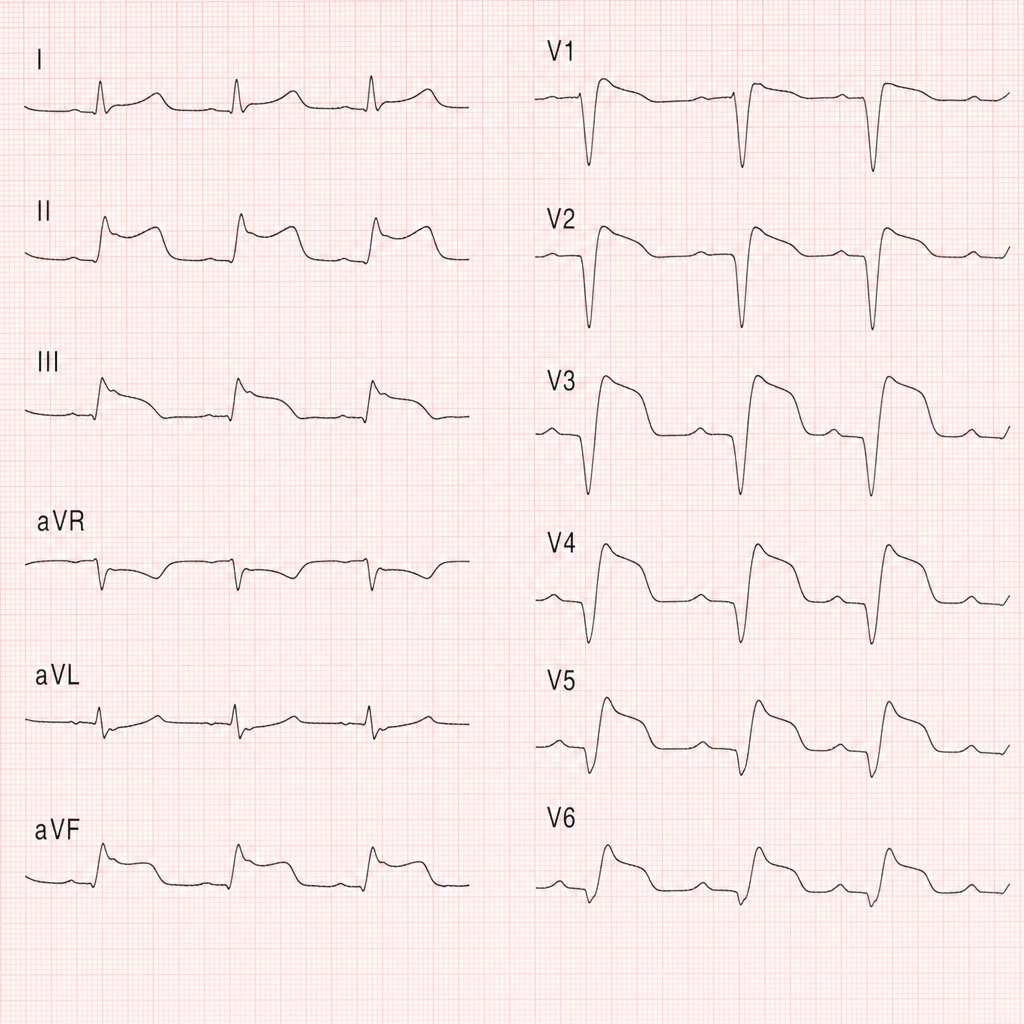
Loud S1 is caused by which of the following conditions?
Echocardiography can detect pericardial effusion as little as:
What is typically seen in Cardiac Chagas disease (CCF)?
A 52-year-old woman presents with exertional fatigue and ascites. She is noted to have a rapid, irregular pulse rate. The chest X-ray reveals a small heart with calcification seen on the lateral view. The 12-lead ECG demonstrates low QRS voltage. What is the clinical diagnosis?
All of the following are typical auscultatory findings in mitral stenosis except:
In Coronary Artery Disease, what is the recommended cholesterol level (mg/dL)?
A 60-year-old female presents with epigastric pain, nausea, and vomiting, a heart rate of 50, and pronounced first-degree AV block on ER cardiac monitor. Blood pressure is 130/80. The coronary artery most likely to be involved in this process is the
A 47-year-old man presents with edema, ascites, and hepatosplenomegaly. Examination of his neck veins reveals elevated venous pressure with a deep y descent. Chest x-ray shows a normal heart size. Which of the following etiologies is not a possible explanation for this syndrome?
Coronary artery disease is associated with all EXCEPT?
A 50-year-old construction worker has a persistently elevated BP of 160/100 mmHg despite adding a thiazide diuretic to his antihypertensive regimen. Physical examination is normal, electrolytes are normal, and he denies taking any over-the-counter medications. What is the next most helpful diagnostic step for this patient?
Explanation: The intensity of the first heart sound (S1) is primarily determined by the position of the Atrioventricular (AV) valves (Mitral and Tricuspid) at the onset of ventricular systole. **Why Short PR Interval is Correct:** In a **Short PR interval** (e.g., WPW syndrome or tachycardia), the time between atrial and ventricular contraction is brief. The mitral valve leaflets are still wide open and deep in the ventricular cavity when ventricular systole begins. The leaflets must travel a long distance to close, slamming shut with high velocity and force, which produces a **Loud S1**. **Analysis of Incorrect Options:** * **Calcified Mitral Valve:** For a valve to produce a loud sound, it must be mobile. Severe calcification (as seen in long-standing Mitral Stenosis) stiffens the leaflets, reducing their mobility and resulting in a **Soft S1** [1]. * **Mitral Regurgitation:** In chronic MR, the leaflets often fail to appose properly or are structurally damaged, leading to a **Soft S1**. * **Bradycardia:** A slow heart rate allows for a long diastole. The leaflets have ample time to float back toward a semi-closed position before systole begins, resulting in a **Soft S1**. **High-Yield Clinical Pearls for NEET-PG:** * **Loud S1 Causes:** Mitral Stenosis (mobile valve), Tachycardia, Short PR interval, and Hyperdynamic states (Anemia, Pregnancy, Exercise) [2]. * **Soft S1 Causes:** Mitral Regurgitation, Long PR interval (1st-degree AV block), Calcified Mitral Valve, and Obesity/COPD (due to sound attenuation) [1]. * **Variable S1:** Classically seen in **Atrial Fibrillation** and **Complete Heart Block** (due to varying PR intervals).
Explanation: ### Explanation **Correct Option: A (15 ml)** Echocardiography (Transthoracic Echocardiogram - TTE) is the gold standard and the most sensitive non-invasive tool for detecting pericardial effusion [1]. It can identify as little as **15–50 ml** of fluid in the pericardial sac. On an echo, this appears as an "echo-free space" between the visceral and parietal pericardium. Small effusions are typically first visualized posteriorly in the supine position due to gravity. **Analysis of Incorrect Options:** * **Option B (100 ml):** While 100 ml is easily detectable by echo, it is not the *minimum* threshold. Pericardial effusions may be small, sometimes even less than 100 ml [1]. At this volume, the effusion usually begins to distribute circumferentially around the heart. * **Option C & D (150 ml and 200 ml):** These volumes are significant and often represent the threshold for detection on a **Chest X-ray**. A Chest X-ray typically requires at least **200 ml** of fluid to show a "Water-bottle" or "Money-bag" heart (cardiomegaly with clear lung fields) [1]. **High-Yield Clinical Pearls for NEET-PG:** * **Grading on Echo:** * *Small:* <10 mm echo-free space (posterior). * *Moderate:* 10–20 mm (circumferential). * *Large:* >20 mm. * **Electrical Alternans:** A pathognomonic ECG finding in large effusions caused by the "swinging heart" motion [1]. * **Beck’s Triad (Cardiac Tamponade):** Hypotension, Jugular Venous Distension (JVD), and muffled heart sounds. * **Ewart’s Sign:** Dullness to percussion and bronchial breath sounds below the left scapula due to compression of the left lung base by a large pericardial sac.
Explanation: **Explanation:** **Cardiac Chagas Disease (Chronic Chagasic Cardiomyopathy)** is a leading cause of infectious myocarditis and progressive congestive heart failure (CHF) in endemic regions. **Why Oliguria is the correct answer:** In the chronic phase of Chagas disease, patients develop dilated cardiomyopathy characterized by biventricular failure [1]. As the heart's pumping efficiency declines, there is a significant reduction in **cardiac output**. This leads to decreased renal perfusion, which triggers the Renin-Angiotensin-Aldosterone System (RAAS) and increases Antidiuretic Hormone (ADH) secretion. The kidneys respond by conserving sodium and water to maintain blood pressure, resulting in **Oliguria** (decreased urine output) [1]. This is a hallmark of advanced heart failure and low-output states. **Analysis of Incorrect Options:** * **B. Polyuria:** This is the opposite of what occurs in heart failure. Polyuria is typically seen in conditions like Diabetes Mellitus, Diabetes Insipidus, or the recovery phase of Acute Tubular Necrosis. * **C. Oliguria during the day and polyuria during the night:** While "Nocturia" (increased nighttime urination) is common in early heart failure due to the redistribution of edema fluid when recumbent, the primary clinical sign of worsening Cardiac Chagas (CCF) is a persistent reduction in total output (Oliguria). * **D. Anuria:** This refers to a total lack of urine output (<100ml/day), usually seen in complete renal failure or total urinary tract obstruction, rather than typical chronic heart failure. **High-Yield Clinical Pearls for NEET-PG:** * **Etiology:** Caused by the protozoan *Trypanosoma cruzi* (Vector: Reduviid/Kissing bug). * **ECG Findings:** The most characteristic finding is **Right Bundle Branch Block (RBBB)** often associated with Left Anterior Fascicular Block (LAFB). * **Hallmark Lesion:** Apical aneurysms (thinned out apex) are a classic echocardiographic finding. * **GI Involvement:** "Mega-syndromes" (Megaesophagus and Megacolon) due to destruction of the myenteric plexus.
Explanation: ### Explanation **Correct Option: B. Constrictive Pericarditis** The clinical triad of **exertional fatigue** (low cardiac output), **ascites** (right-sided heart failure), and a **small heart with pericardial calcification** on lateral X-ray is pathognomonic for Constrictive Pericarditis (CP) [1]. * **Pathophysiology:** Chronic inflammation leads to a rigid, fibrotic, and often calcified pericardium. This restricts diastolic filling of all chambers, leading to elevated systemic venous pressures (ascites, hepatomegaly) and reduced stroke volume (fatigue) [1]. * **ECG Findings:** Low QRS voltage is a classic finding due to the insulating effect of the thickened/calcified pericardium. The "rapid, irregular pulse" suggests **Atrial Fibrillation**, which occurs in ~30% of CP cases due to elevated atrial pressures. **Why other options are incorrect:** * **A. Rheumatic pancarditis:** Typically presents with cardiomegaly (due to myocarditis/valvular regurgitation) and signs of acute inflammation (fever, elevated ESR), not isolated pericardial calcification. * **C. Restrictive cardiomyopathy (RCM):** This is the closest differential. However, RCM usually presents with a **normal or enlarged heart** on X-ray and **lacks pericardial calcification** [2]. Calcification is the "gold standard" differentiator favoring CP. * **D. Acute cor-pulmonale:** Usually results from massive pulmonary embolism. It presents with acute right heart strain, prominent pulmonary arteries, and right axis deviation on ECG, rather than chronic calcification and low voltage. **High-Yield Pearls for NEET-PG:** * **X-ray Gold Standard:** Pericardial calcification is best seen on the **lateral view** [1]. * **Kussmaul’s Sign:** Paradoxical rise in JVP during inspiration (common in CP). * **Pericardial Knock:** A high-pitched sound heard in early diastole due to sudden cessation of ventricular filling. * **Treatment:** Surgical pericardiectomy is the definitive management.
Explanation: ### Explanation **Mitral Stenosis (MS)** is characterized by the narrowing of the mitral valve orifice, leading to an obstruction of blood flow from the left atrium to the left ventricle [1]. #### Why "Reversed Splitting of S2" is the Correct Answer **Reversed (paradoxical) splitting** occurs when the aortic valve (A2) closes *after* the pulmonary valve (P2). This is typically seen in conditions that delay left ventricular emptying (e.g., Left Bundle Branch Block, Aortic Stenosis). In Mitral Stenosis, the left ventricle actually fills and empties faster because it is "underfilled" due to the proximal obstruction. Therefore, MS does not cause reversed splitting. If the S2 is affected in MS, it is usually due to pulmonary hypertension, which results in a **loud P2** and a **narrowly split S2** [1]. #### Analysis of Incorrect Options (Typical Findings in MS) * **A. Loud S1:** In early-to-moderate MS, the mitral leaflets are wide apart at the end of diastole. The elevated left atrial pressure slams them shut with great force, creating a "tapping" loud S1 [1]. (Note: S1 becomes soft if the valve is heavily calcified). * **B. Opening Snap (OS):** This high-pitched sound occurs shortly after S2 due to the sudden tensing of the chordae tendineae and stenotic valve leaflets as they "snap" open [2]. A shorter S2-OS interval indicates more severe stenosis [2]. * **C. Mid-diastolic murmur with presystolic accentuation:** The murmur is caused by turbulent flow across the narrowed valve [3]. Presystolic accentuation occurs due to **atrial contraction** (atrial kick) forcing blood through the valve just before S1. #### High-Yield Clinical Pearls for NEET-PG * **Auscultatory Triad of MS:** Loud S1, Opening Snap, and Mid-diastolic rumbling murmur [1]. * **Presystolic accentuation** disappears if the patient develops **Atrial Fibrillation** (as there is no coordinated atrial contraction). * **Graham Steell Murmur:** A high-pitched decrescendo diastolic murmur of pulmonary regurgitation, heard in severe MS with secondary pulmonary hypertension. * **Severity Marker:** The closer the Opening Snap is to S2 (short S2-OS interval), the more severe the Mitral Stenosis [2].
Explanation: **Explanation:** In the context of Coronary Artery Disease (CAD) and cardiovascular risk management, the primary goal is to maintain lipid profiles within ranges that prevent the progression of atherosclerosis [1]. According to the **NCEP (National Cholesterol Education Program) ATP III guidelines** and the **American Heart Association (AHA)**, a **Total Cholesterol level of <200 mg/dL** is classified as "Desirable." **Why Option A is correct:** A total cholesterol level below 200 mg/dL is associated with a lower risk of major adverse cardiovascular events (MACE). For patients with established CAD, the focus often shifts to specific fractions (like LDL), but the baseline target for total cholesterol remains under 200 mg/dL to ensure overall metabolic stability [1]. **Why the other options are incorrect:** * **Options B, C, and D (220, 250, 280 mg/dL):** These values fall into the "Borderline High" (200–239 mg/dL) or "High" (≥240 mg/dL) categories. Elevated levels significantly increase the risk of plaque rupture and myocardial infarction in CAD patients [1]. **High-Yield Clinical Pearls for NEET-PG:** * **LDL (The "Bad" Cholesterol):** This is the primary target of therapy in CAD [2]. For high-risk patients (established CAD), the goal is typically **<70 mg/dL** (or even <55 mg/dL in very high-risk cases per recent ESC guidelines). * **HDL (The "Good" Cholesterol):** Levels **<40 mg/dL** in men and **<50 mg/dL** in women are considered a major risk factor for CAD. * **Triglycerides:** Normal levels are **<150 mg/dL**. * **Statins:** These are the first-line agents for achieving these targets due to their pleiotropic effects (plaque stabilization and anti-inflammatory properties) [2].
Explanation: The clinical presentation of epigastric pain, nausea, and vomiting in an elderly patient should always raise suspicion of an **Inferior Wall Myocardial Infarction (IWMI)**. In this case, the presence of **bradycardia (HR 50)** and **first-degree AV block** strongly points toward the **Right Coronary Artery (RCA)** as the culprit vessel. [1] **Why Right Coronary Artery (RCA) is correct:** 1. **Anatomy:** The RCA supplies the inferior wall of the left ventricle in 85% of individuals (Right Dominance). 2. **Conduction System:** The RCA provides the blood supply to the **SA node** (in 60% of people) and the **AV node** (in 90% of people). Ischemia to these nodes leads to sinus bradycardia and various degrees of heart block. 3. **Vagal Stimulation:** Inferior MIs often trigger the Bezold-Jarisch reflex, increasing vagal tone, which results in the classic triad of bradycardia, hypotension, and nausea/vomiting. [1] **Why other options are incorrect:** * **Left Anterior Descending (LAD):** This artery supplies the anterior wall and the bundle branches. LAD occlusion typically causes Anterior MI, which presents with tachycardia (due to sympathetic surge) or high-grade blocks (like RBBB or Mobitz II) rather than simple nodal bradycardia. * **Left Main:** Occlusion usually results in massive anterolateral infarction and cardiogenic shock, often being fatal ("widow-maker"). **High-Yield Clinical Pearls for NEET-PG:** * **Right Ventricular MI:** Frequently accompanies RCA-related Inferior MI. Look for the triad of hypotension, clear lung fields, and elevated JVP. * **Treatment Tip:** In RCA/Inferior MI with bradycardia, **Atropine** is the initial drug of choice. Avoid Nitrates if RV infarction is suspected, as they can cause profound hypotension. [2] * **ECG Leads:** Inferior MI is seen in leads **II, III, and aVF**. [3]
Explanation: ### Explanation The clinical presentation of edema, ascites, hepatosplenomegaly, elevated JVP with a **prominent (deep) 'y' descent**, and a **normal heart size** on chest X-ray is classic for **Constrictive Pericarditis (CP)** [1]. **1. Why Rheumatic Fever is the Correct Answer:** Rheumatic fever primarily affects the endocardium (valves) and myocardium. While it can cause pericarditis during the acute phase (pancarditis), it **virtually never** leads to chronic constrictive pericarditis. Instead, rheumatic heart disease typically results in valvular dysfunction and cardiomegaly, which contradicts the "normal heart size" finding in this vignette. **2. Analysis of Incorrect Options (Causes of CP):** * **Tuberculosis (Option B):** Globally, TB remains a leading cause of constrictive pericarditis, especially in developing countries like India [1]. It often presents with pericardial thickening and calcification. * **Idiopathic/Unknown Cause (Option C):** In developed nations, the most common cause of CP is idiopathic (likely post-viral), where the pericardium becomes fibrotic without a clear preceding event [1]. * **Previous Acute Pericarditis (Option D):** Any cause of acute pericarditis (viral, bacterial, or uremic) can progress to a chronic constrictive state over months or years. **3. NEET-PG High-Yield Pearls:** * **Friedreich’s Sign:** The deep, rapid 'y' descent in JVP seen in CP (representing rapid ventricular filling). * **Kussmaul’s Sign:** Paradoxical rise in JVP during inspiration (common in CP, rare in cardiac tamponade). * **Pericardial Knock:** A high-pitched sound heard in early diastole due to the sudden cessation of ventricular filling by the rigid pericardium. * **Imaging:** CT/MRI is the gold standard to visualize pericardial thickening (>3mm); Chest X-ray may show a "eggshell" calcification of the pericardium.
Explanation: **Explanation:** The correct answer is **Alcohol**. In the context of coronary artery disease (CAD), moderate alcohol consumption is traditionally considered a "protective" factor rather than a risk factor. **1. Why Alcohol is the correct answer:** Moderate alcohol intake (especially red wine containing resveratrol) is associated with increased levels of HDL ("good" cholesterol), reduced platelet aggregation, and improved insulin sensitivity. Unlike smoking or poor hygiene, it does not promote atherosclerosis [1]; instead, it has a J-shaped relationship with cardiovascular mortality, where moderate intake may lower risk compared to abstinence. However, heavy consumption leads to alcoholic cardiomyopathy and arrhythmias. **2. Why the other options are incorrect (Risk Factors for CAD):** * **Chlamydia pneumoniae:** This is a known infectious trigger. Chronic infection leads to systemic inflammation and the presence of the organism within atherosclerotic plaques [1], contributing to plaque instability. * **Poor dental hygiene:** Periodontal disease is a recognized non-traditional risk factor. Chronic gingivitis leads to the release of inflammatory cytokines (like CRP and IL-6) and transient bacteremia, both of which accelerate atherosclerosis. * **Smoking:** This is a major modifiable risk factor [1]. It causes endothelial dysfunction, increases LDL oxidation, and promotes a pro-thrombotic state. **Clinical Pearls for NEET-PG:** * **Non-traditional risk factors for CAD:** Hyperhomocysteinemia, increased Lipoprotein (a), Pro-inflammatory states (RA, SLE), and Chronic Kidney Disease (CKD). * **Inflammatory Marker:** High-sensitivity C-reactive protein (hs-CRP) is the best predictor of cardiovascular events in patients with normal lipid profiles. * **Most common cause of CAD:** Atherosclerosis [1]. * **Most important modifiable risk factor:** Hypertension (though smoking is the most preventable) [1].
Explanation: The patient presents with **Resistant Hypertension**, defined as blood pressure that remains above goal despite the concurrent use of three antihypertensive agents of different classes (ideally including a diuretic). However, before embarking on an expensive and invasive workup for secondary causes, the most critical first step is to exclude **Pseudoresistance**. **1. Why "Check pill count" is correct:** Non-adherence to medication is the most common cause of apparent resistant hypertension [1]. In clinical practice, evaluating adherence via history, pill counts, or pharmacy records is mandatory before diagnosing true resistant hypertension. This patient is a construction worker, a demographic that may face challenges with medication timing or consistency due to a demanding work environment. **2. Why the other options are incorrect:** * **Renal Doppler (B):** Used to screen for Renal Artery Stenosis. While a common secondary cause, it is only indicated after confirming adherence and if there is clinical suspicion (e.g., abdominal bruits, flash pulmonary edema, or rise in creatinine after ACE inhibitors). * **MRI Aorta (C):** Used to diagnose Coarctation of the Aorta. This typically presents in younger patients with BP discrepancies between upper and lower limbs; it is unlikely in a 50-year-old with a normal physical exam. * **CT Adrenal Glands (D):** Used to look for an adenoma in Primary Hyperaldosteronism. However, this patient has **normal electrolytes** (no hypokalemia), making this a lower priority than checking adherence. **Clinical Pearls for NEET-PG:** * **Definition of Resistant HTN:** BP >140/90 mmHg on 3 drugs (including a diuretic) OR BP controlled but requiring 4 or more drugs. * **White Coat Hypertension:** Always rule this out using Ambulatory Blood Pressure Monitoring (ABPM) before labeling a patient as "resistant." * **Commonest Secondary Cause:** Obstructive Sleep Apnea (OSA) is now considered the most frequent secondary cause of resistant hypertension. * **Medical Adherence:** Always the "next best step" when a patient fails to respond to a standard regimen [1].
Coronary Artery Disease and Angina
Practice Questions
Acute Coronary Syndromes
Practice Questions
Heart Failure
Practice Questions
Cardiac Arrhythmias
Practice Questions
Valvular Heart Diseases
Practice Questions
Cardiomyopathies
Practice Questions
Pericardial Diseases
Practice Questions
Congenital Heart Disease in Adults
Practice Questions
Hypertension and Hypertensive Emergencies
Practice Questions
Pulmonary Hypertension
Practice Questions
Non-invasive Cardiac Diagnostics
Practice Questions
Preventive Cardiology
Practice Questions
Get full access to all questions, explanations, and performance tracking.
Start For Free