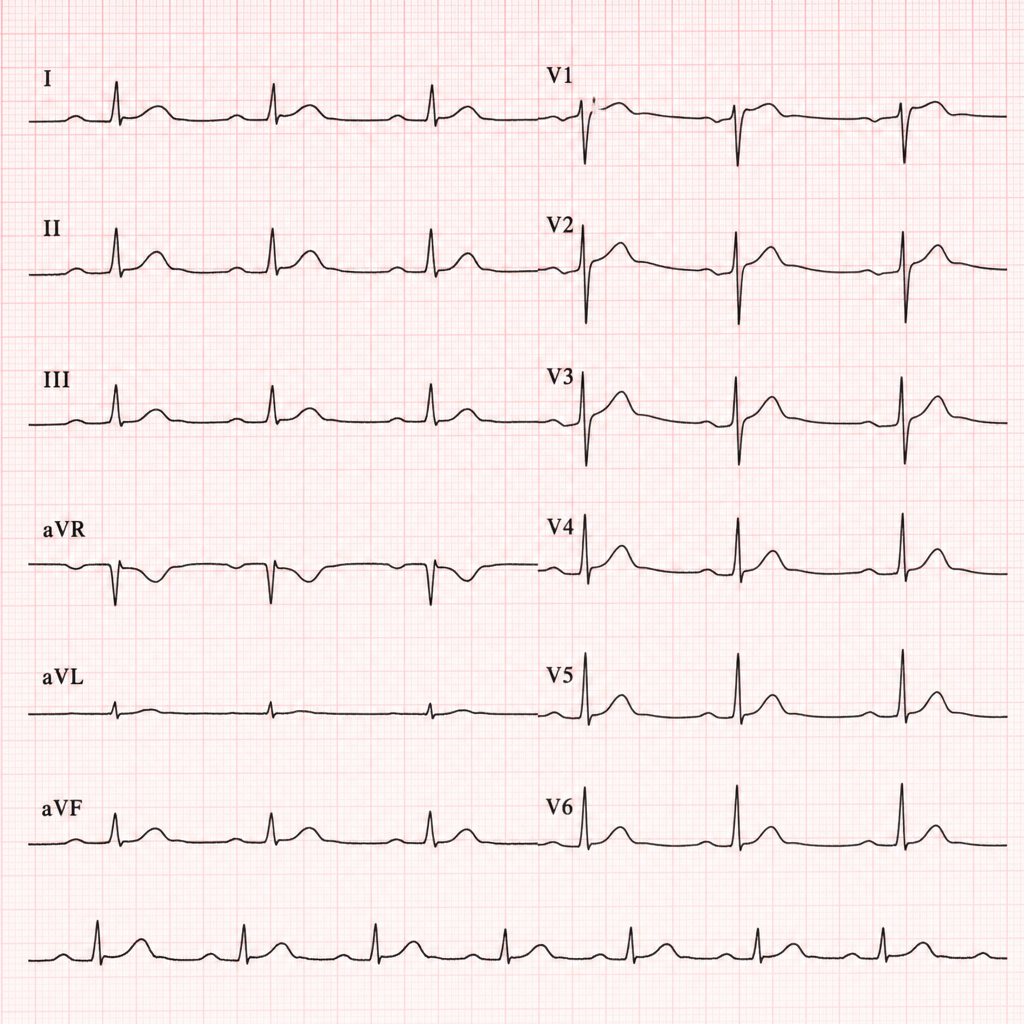
A 40-year-old male is admitted with acute inferior wall myocardial infarction. Half an hour later, his BP is 80/50 mmHg and heart rate is 40/min with sinus rhythm. What is the most appropriate next step in the management of this patient?
A 73-year-old man with a history of hypertension and osteoarthritis, treated with metoprolol and naproxen respectively, presents with a 6-week history of gradually increasing dyspnea. He experiences occasional nocturnal dyspnea relieved by sitting up but denies peripheral edema. His vital signs are BP 148/94 mmHg, HR 96 bpm, and RR 16 bpm, with an O2 saturation of 92%. Physical examination reveals jugular venous distension of 7 cm, mild basilar crackles without wheezing, a sustained apex impulse, an S4 gallop, and no murmurs. Peripheral edema is absent. ECG shows stable left ventricular hypertrophy without Q waves. Chest x-ray reveals increased interstitial markings and cephalization of pulmonary vessels, with a boot-shaped cardiac silhouette but no definite cardiomegaly. Echocardiogram demonstrates left ventricular hypertrophy and an LV ejection fraction of 55%. What is the likely pathogenesis of this patient's dyspnea?
Bacterial endocarditis is rarely seen in which of the following conditions?
A 70-year-old man with a prior anterior myocardial infarction presents for routine evaluation. He feels well and has no symptoms. He is taking metoprolol 100 mg bid, aspirin 81 mg od, enalapril 10 mg bid, and simvastatin 40 mg od for secondary prevention. Select the characteristic ECG finding for this patient.
Which of the following statements regarding bicuspid aortic valves (BAV) is FALSE?
Dicrotic pulse differs from pulse bisferiens in which characteristic?
Which of the following is NOT an ECG finding in Wolff-Parkinson-White syndrome?
Inverted T waves are seen in which of the following conditions?
All of the following may be seen in a patient with cardiac tamponade, except?
Following an attack of myocardial infarction, what indicates the mortality and morbidity of the patient?
Explanation: ### Explanation **Correct Answer: C. Intravenous administration of atropine sulfate** **Why it is correct:** This patient presents with **symptomatic bradycardia** (HR 40/min, BP 80/50 mmHg) following an **inferior wall myocardial infarction (IWMI)**. In the setting of IWMI, bradycardia is frequently caused by increased vagal tone (Bezold-Jarisch reflex) or ischemia of the SA node (supplied by the RCA in 60% of cases). The initial management of symptomatic bradycardia, as per ACLS guidelines, is **Atropine (0.5 mg to 1.0 mg IV)**. Atropine acts as a parasympatholytic agent, blocking the vagal influence on the heart, thereby increasing the heart rate and improving cardiac output and blood pressure [1]. **Why the other options are incorrect:** * **Option A (Normal Saline):** While fluid resuscitation is the treatment of choice for Right Ventricular Infarction (often associated with IWMI), the primary issue here is a profound heart rate of 40/min. Correcting the bradycardia is the priority to stabilize hemodynamics. * **Option B (Temporary Pacemaker):** This is indicated if the patient is unresponsive to atropine or has high-grade AV blocks (Mobitz II or 3rd-degree block) [2]. It is not the "immediate next step" before pharmacological trials. * **Option D (Isoprenaline):** While it increases heart rate, isoprenaline significantly increases myocardial oxygen demand and can worsen ischemia or induce arrhythmias in the setting of an acute MI. It is generally avoided. **Clinical Pearls for NEET-PG:** 1. **Bezold-Jarisch Reflex:** A triad of bradycardia, hypotension, and apnea triggered by chemoreceptors in the LV wall, common in IWMI. 2. **Conduction Blocks in MI:** * **IWMI:** Usually causes narrow-complex, transient AV blocks (nodal) that respond well to Atropine [2]. * **AWMI:** Usually causes wide-complex, permanent AV blocks (infranodal) due to septal necrosis; these often require pacing [1]. 3. **Drug of Choice:** Atropine is the first-line drug for symptomatic sinus bradycardia in the ER [1].
Explanation: This patient presents with classic signs of **Heart Failure with Preserved Ejection Fraction (HFpEF)**, formerly known as diastolic heart failure. ### **Pathogenesis of the Correct Answer** The patient has long-standing hypertension, evidenced by LV hypertrophy (ECG/Echo) and an S4 gallop (atrial contraction against a stiff ventricle). In HFpEF, the Left Ventricular Ejection Fraction (LVEF) remains normal (≥50%), but the ventricle is stiff and non-compliant [1]. This leads to **impaired diastolic relaxation and filling**, causing an increase in Left Ventricular End-Diastolic Pressure (LVEDP) [1]. This pressure is transmitted backward into the pulmonary vasculature, leading to pulmonary congestion (crackles, cephalization on CXR) and dyspnea, despite a normal pump function [1]. ### **Why Other Options are Incorrect** * **Option A:** High-output heart failure occurs in states like severe anemia, thyrotoxicosis, or AV fistulas. This patient’s presentation and history of hypertension point toward pressure-overload hypertrophy rather than a hypermetabolic state. * **Option B:** While CAD can cause dyspnea, the presence of LV hypertrophy, S4, and clear signs of congestion on CXR in the setting of a normal EF specifically defines the clinical syndrome of HFpEF. * **Option D:** Interstitial lung disease (ILD) would not explain jugular venous distension, an S4 gallop, or the "cephalization" seen on CXR, which is a specific sign of pulmonary venous hypertension. ### **NEET-PG High-Yield Pearls** * **HFpEF Triad:** Signs/Symptoms of HF + Normal/Near-normal LVEF (≥50%) + Evidence of diastolic dysfunction (LVH, increased LA size) [1]. * **S4 Gallop:** A hallmark of stiff ventricles (concentric hypertrophy); it is never heard in atrial fibrillation. * **NSAIDs & Heart Failure:** Note the use of Naproxen; NSAIDs can exacerbate HF by causing sodium retention and increasing systemic vascular resistance. * **CXR Sign:** "Cephalization" refers to the redistribution of blood flow to the upper lobes, an early sign of pulmonary venous congestion.
Explanation: **Explanation:** The risk of **Infective Endocarditis (IE)** is primarily determined by the presence of high-velocity turbulent blood flow, which causes endothelial damage and creates a nidus for platelet-fibrin deposition (non-bacterial thrombotic endocarditis). **Why Secundum ASD is the Correct Answer:** In a Secundum Atrial Septal Defect, the pressure gradient between the left and right atria is relatively low [1]. This results in **low-velocity, laminar flow** across the defect rather than high-velocity turbulence. Consequently, there is minimal endocardial trauma, making the development of vegetations extremely rare. Therefore, Secundum ASD is the only common congenital heart disease that does not typically require IE prophylaxis (unless repaired with prosthetic material) [2]. **Analysis of Incorrect Options:** * **VSD (Option A):** Characterized by a high-pressure gradient between the ventricles, leading to high-velocity jets [1]. * **PDA (Option B):** Involves a high-pressure shunt from the aorta to the pulmonary artery, causing significant turbulence [3]. * **MVP (Option C):** Especially when accompanied by mitral regurgitation, the turbulent backflow of blood significantly increases the risk of IE [4]. **NEET-PG High-Yield Pearls:** * **Highest Risk Conditions:** Prosthetic heart valves [2], previous history of IE, and cyanotic congenital heart disease (e.g., Tetralogy of Fallot). * **Lowest Risk Conditions:** Secundum ASD, Ischemic Heart Disease, and Cardiac Pacemakers. * **Commonest Site of Vegetation in VSD:** On the right ventricular side of the defect (due to the jet effect). * **Commonest Organism:** *Staphylococcus aureus* (Acute IE/IV drug users) and *Viridans streptococci* (Subacute IE).
Explanation: ### Explanation **Correct Answer: A. Prolonged PR interval** The correct answer is derived from the patient's current medication profile. The patient is taking **Metoprolol 100 mg BID**, which is a high-dose beta-blocker. Beta-blockers act as negative dromotropes by slowing conduction through the **Atrioventricular (AV) node** [1]. On an ECG, AV nodal conduction delay is manifested as a **prolonged PR interval** (>0.20 seconds), which represents a first-degree heart block. Given the patient is asymptomatic and on high-dose beta-blockade for secondary prevention post-MI, this is a common and expected pharmacological finding. **Analysis of Incorrect Options:** * **B. Broad-notched P wave in lead II:** This is known as *P-mitrale*, characteristic of Left Atrial Enlargement (LAE). While chronic heart failure post-MI can lead to LAE, it is not a direct pharmacological effect of his current medications. * **C. Short QT interval:** This is typically seen in hypercalcemia or digoxin toxicity. Beta-blockers and ischemia do not cause a short QT; in fact, some antiarrhythmics and electrolyte imbalances (hypokalemia) prolong the QT interval. * **D. Short PR interval:** This is characteristic of pre-excitation syndromes like Wolff-Parkinson-White (WPW) syndrome, where an accessory pathway bypasses the AV node. Beta-blockers increase the PR interval, they do not shorten it [1]. **High-Yield Clinical Pearls for NEET-PG:** * **Beta-blocker overdose:** Treatment of choice is **Glucagon** (increases cAMP bypassing the beta-receptor). * **Post-MI Secondary Prevention:** The "Big Four" medications are Aspirin (Antiplatelet), Statins, ACE inhibitors (prevent remodeling), and Beta-blockers (reduce mortality) [2]. * **ECG Changes:** Always correlate ECG findings with the drug history. Digoxin can cause "reverse tick" ST-segment depression, while Class Ia/III antiarrhythmics prolong the QTc.
Explanation: ### Explanation **1. Why Option C is the Correct (False) Statement:** While Bicuspid Aortic Valve (BAV) is indeed associated with aortic root dilatation and aneurysm formation (aortopathy), the statement that there is "no increased risk of rupture or dissection" is **incorrect**. Patients with BAV have a significantly higher risk of **aortic dissection** (approximately 5 to 9 times higher than the general population) and rupture [1]. This is due to intrinsic abnormalities in the aortic media (cystic medial necrosis) and altered hemodynamics caused by eccentric blood flow through the bicuspid orifice. **2. Analysis of Incorrect Options:** * **Option A:** This is **true**. BAV is the most common congenital heart disease, affecting **1–2%** of the general population, with a male-to-female predominance of 3:1. * **Option B:** This is **true**. Due to increased mechanical stress, BAVs undergo calcification and fibrosis much earlier [2]. Patients typically present with symptomatic aortic stenosis in their **40s to 60s**, whereas those with tricuspid valves usually present in their 70s or 80s. * **Option D:** This is **true**. There is a strong association between BAV and **Coarctation of the Aorta**. Approximately 50–80% of patients with coarctation have a BAV. **3. High-Yield Clinical Pearls for NEET-PG:** * **Inheritance:** Often autosomal dominant with incomplete penetrance (NOTCH1 mutations). * **Screening:** First-degree relatives of BAV patients should undergo screening echocardiography. * **Auscultation:** Characterized by an **early systolic ejection click** (best heard at the apex) followed by a crescendo-decrescendo murmur. * **Complications:** Early-onset Aortic Stenosis (most common), Aortic Regurgitation, Infective Endocarditis, and Aortic Dissection [3].
Explanation: ### Explanation The key to distinguishing between these two double-peaked pulses lies in the **timing** of the peaks relative to the cardiac cycle. [1] **1. Why the Correct Answer is Right:** A **Dicrotic pulse** is characterized by two palpable peaks: the first occurs in **systole** (percussion wave) and the second occurs in **diastole** (exaggerated dicrotic wave) [1]. It occurs due to a low stroke volume and high systemic vascular resistance. The second peak happens after the closure of the aortic valve (dicrotic notch), making it a systolic-diastolic phenomenon [1]. **2. Analysis of Incorrect Options:** * **Option A:** **Pulsus Bisferiens** is classically seen in HOCM (and Aortic Regurgitation). Dicrotic pulse is typically seen in conditions with low cardiac output and high peripheral resistance, such as severe Congestive Heart Failure (CHF) or Dilated Cardiomyopathy. * **Option B:** Dicrotic pulse indicates **low stroke volume**, not high [1]. High stroke volume (hyperdynamic state) is associated with conditions like Aortic Regurgitation or Patent Ductus Arteriosus (PDA) [1]. * **Option D:** This describes **Pulsus Bisferiens**. In bisferiens, both peaks (percussion and tidal waves) occur during **systole**, before the second heart sound (S2). **3. NEET-PG High-Yield Pearls:** * **Pulsus Bisferiens:** Two systolic peaks. Seen in: AR, AS + AR, and HOCM. * **Dicrotic Pulse:** One systolic + one diastolic peak. Seen in: Severe Heart Failure, Cardiac Tamponade, and Febrile states (Typhoid) [1]. * **Pulsus Alternans:** Alternating strong and weak beats. Pathognomonic for **Left Ventricular Failure**. * **Pulsus Paradoxus:** An exaggerated fall in systolic BP (>10 mmHg) during inspiration. Seen in: Cardiac Tamponade, Severe Asthma/COPD, and Constrictive Pericarditis.
Explanation: **Explanation:** Wolff-Parkinson-White (WPW) syndrome is a pre-excitation syndrome caused by an accessory pathway (the **Bundle of Kent**) that bypasses the AV node [1]. This allows electrical impulses to reach the ventricles earlier than usual [1]. **1. Why "Narrow QRS complexes" is the correct answer:** In WPW, the QRS complex is **wide (>120ms)**, not narrow [1]. This occurs because the ventricle is activated via two fronts: early activation through the accessory pathway (causing the slurred start) and subsequent activation through the normal His-Purkinje system [1]. This "fusion" of electrical signals results in a widened, distorted QRS complex. **2. Analysis of incorrect options:** * **Short PR interval (<0.12s):** This is a hallmark of WPW [1]. Because the accessory pathway lacks the physiological delay of the AV node, the time from atrial to ventricular depolarization is shortened [1]. * **Slurred and tall QRS (Delta wave):** The delta wave represents the initial slow, intramyocardial conduction through the accessory pathway [1]. It is the most characteristic finding of WPW. * **Normal QT interval:** While the QRS is widened, the repolarization (T-wave) usually adjusts such that the overall QT interval remains within normal limits [1], unless there is secondary repolarization abnormality. **Clinical Pearls for NEET-PG:** * **The WPW Triad:** Short PR interval + Delta wave + Wide QRS [1]. * **Pseudo-infarction pattern:** Delta waves can sometimes mimic Q-waves, leading to a false diagnosis of myocardial infarction. * **Treatment:** **Radiofrequency ablation** of the accessory pathway is the definitive treatment. * **Contraindication:** Avoid "ABCD" (Atrioventricular nodal blockers) in WPW with Atrial Fibrillation: **A**denosine, **B**eta-blockers, **C**alcium channel blockers, and **D**igoxin, as they can paradoxically increase conduction through the accessory pathway, leading to Ventricular Fibrillation [2].
Explanation: **Explanation:** **Wellens Syndrome** is a clinical manifestation of critical stenosis of the **proximal Left Anterior Descending (LAD) artery**. It is a "pre-infarction" state where the patient is currently pain-free but at high risk for a massive anterior wall MI. The hallmark ECG finding is deeply and symmetrically **inverted T waves** (Type B) or biphasic T waves (Type A) in the precordial leads (V2–V3) [1]. **Analysis of Options:** * **Hyperkalemia (A):** Characterized by **Tall, tented (peaked) T waves** with a narrow base [2]. As potassium levels rise further, it leads to PR prolongation, loss of P waves, and QRS widening (sine wave pattern) [2]. * **Hyperthermia (B):** Typically causes sinus tachycardia. While extreme physiological stress can cause non-specific ST-T changes, it is not a classic cause of T-wave inversion. * **Coronary Syndrome (D):** While "Acute Coronary Syndrome" (ACS) can cause T-wave inversions, the option is too broad. Wellens Syndrome is the *specific* eponymous condition defined by these characteristic T-wave changes in a stable patient, making it the most precise answer in a competitive exam context. **High-Yield Clinical Pearls for NEET-PG:** * **Wellens Criteria:** History of angina, normal/minimally elevated cardiac enzymes, no precordial Q-waves, and characteristic T-wave changes in V2-V3. * **Contraindication:** Do **NOT** perform a Stress Test in suspected Wellens Syndrome, as it can precipitate a fatal MI. These patients require urgent coronary angiography. * **Differential for Deep T-wave Inversion:** Wellens Syndrome, CNS injury (Cerebral T-waves), Hypertrophic Cardiomyopathy (Apical variant), and Massive Pulmonary Embolism (S1Q3T3).
Explanation: ### Explanation In **Cardiac Tamponade**, the accumulation of fluid in the pericardial space leads to increased intrapericardial pressure, which impairs diastolic filling of all cardiac chambers [1]. **1. Why Kussmaul’s sign is the correct answer:** Kussmaul’s sign is the paradoxical rise in Jugular Venous Pressure (JVP) during inspiration. It occurs when the right ventricle cannot accommodate the increased venous return during inspiration, typically due to a rigid, non-compliant pericardium. It is a hallmark of **Constrictive Pericarditis**, not Cardiac Tamponade [2]. In tamponade, the intrapericardial pressure is high, but the pericardium is still somewhat compliant, allowing the JVP to fall normally during inspiration. **2. Analysis of incorrect options:** * **Pulsus Paradoxus:** This is a classic finding in tamponade, defined as an inspiratory drop in systolic blood pressure >10 mmHg. It occurs due to exaggerated ventricular interdependence within a fixed space. * **Electrical Alternans:** This ECG finding (alternating amplitude of QRS complexes) is caused by the heart physically "swinging" back and forth in the large pericardial effusion [1]. * **RV Diastolic Collapse:** On echocardiography, this is a highly specific sign of tamponade [1]. Since the RV is a low-pressure chamber, it collapses when the intrapericardial pressure exceeds the RV diastolic pressure. ### High-Yield Clinical Pearls for NEET-PG: * **Beck’s Triad:** Hypotension, Muffled heart sounds, and Elevated JVP (classic for acute tamponade). * **JVP Waveform:** In tamponade, there is a **prominent 'x' descent** but an **absent/diminished 'y' descent** (distinguishing it from Constrictive Pericarditis, where 'y' is prominent). * **Management:** The definitive treatment is urgent **pericardiocentesis**. * **Exception:** Kussmaul’s sign can rarely be seen in tamponade if it is associated with underlying constrictive disease (Effusive-constrictive pericarditis).
Explanation: The **Left Ventricular Ejection Fraction (LVEF)** is the single most important predictor of long-term mortality and morbidity following an acute myocardial infarction (MI). 1. **Why LVEF is the Correct Answer:** LVEF is a direct measure of the heart's systolic function and reflects the extent of myocardial damage (infarct size). A reduced LVEF (typically <40%) indicates significant ventricular dysfunction, which predisposes the patient to congestive heart failure and sudden cardiac death due to ventricular arrhythmias [1], [3]. Clinical trials have consistently shown that as LVEF decreases, the risk of post-MI complications and death increases proportionally. 2. **Why Other Options are Incorrect:** * **Ventricular Extrasystole (PVCs):** While common post-MI, isolated PVCs are not reliable independent predictors of long-term mortality unless they occur in the setting of a low LVEF [1]. * **Duration of Syncope:** Syncope may occur during an MI (due to arrhythmias or profound hypotension), but its duration does not correlate linearly with long-term prognosis or the extent of myocardial necrosis [2]. * **Percentage of Narrowness:** While coronary anatomy is important for deciding intervention (PCI/CABG), the *functional* outcome (how much muscle survived) is more critical for survival than the degree of stenosis in a vessel that has already caused an infarct. **High-Yield Clinical Pearls for NEET-PG:** * **Killip Classification:** Used to clinically risk-stratify patients with acute MI based on the severity of heart failure (Killip IV = Cardiogenic shock, highest mortality). * **Gold Standard:** Echocardiography is the most common initial tool to assess LVEF post-MI [1]. * **Sudden Cardiac Death (SCD):** Patients with LVEF ≤35% post-MI are at high risk for SCD and are often candidates for an Implantable Cardioverter Defibrillator (ICD).
Coronary Artery Disease and Angina
Practice Questions
Acute Coronary Syndromes
Practice Questions
Heart Failure
Practice Questions
Cardiac Arrhythmias
Practice Questions
Valvular Heart Diseases
Practice Questions
Cardiomyopathies
Practice Questions
Pericardial Diseases
Practice Questions
Congenital Heart Disease in Adults
Practice Questions
Hypertension and Hypertensive Emergencies
Practice Questions
Pulmonary Hypertension
Practice Questions
Non-invasive Cardiac Diagnostics
Practice Questions
Preventive Cardiology
Practice Questions
Get full access to all questions, explanations, and performance tracking.
Start For Free