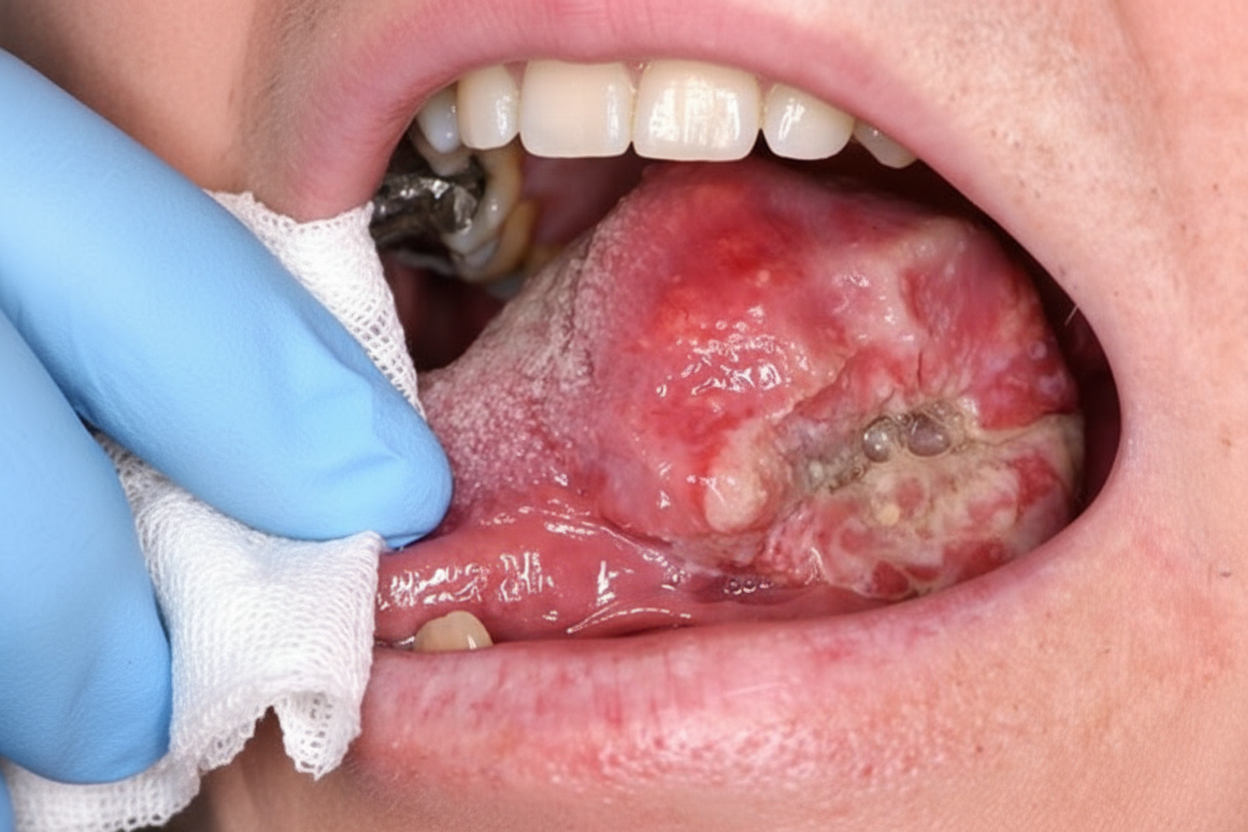
Which of the following statements is false regarding plunging ranula?
According to Eversole theory, which of the following is NOT a tumor arising from reserve cells of the intercalated ducts of salivary glands?
Noma is:
Ludwig's angina is defined as:
A palatal abscess most commonly results from an infection of which of the following teeth?
Leukoplakia with the worst prognosis is typically found on which of the following locations?
What percentage of sublingual salivary gland tumors is malignant?
Mixed parotid tumor arises from which tissue types?
A sialography report of a 46-year-old female is provided. Based on the findings, what is the most likely diagnosis?

What is the characteristic ENT manifestation of Peutz-Jeghers syndrome with benign intestinal polyps?
Explanation: ### Explanation A **Plunging Ranula** is a mucus extravasation cyst that arises from the sublingual gland and herniates through or around the **mylohyoid muscle** into the submandibular space. **Why Option B is the correct (False) statement:** While a CT scan or MRI can help visualize the extent of the lesion (showing the characteristic "tail sign"), the **diagnosis of a plunging ranula is primarily clinical**. In doubtful cases, the most definitive and cost-effective diagnostic tool is **Fine Needle Aspiration Cytology (FNAC)**. The aspirate typically shows high amylase and protein content, confirming its origin from salivary tissue. Therefore, stating that the diagnosis is "made by CT scan" is technically false in a clinical examination context. **Analysis of other options:** * **Option A (True):** It originates from the **sublingual gland** but presents as a swelling in the **submandibular** region, involving both anatomical spaces. * **Option C (True):** The definitive treatment is **surgical excision**. This must include the removal of the offending **sublingual gland** along with the cyst to prevent recurrence. Simple aspiration or marsupialization has a high failure rate. * **Option D (True):** It often presents as a **dumb-bell shaped mass**, with one portion above the mylohyoid (intraoral) and the larger "plunging" portion below it in the neck. **High-Yield Clinical Pearls for NEET-PG:** * **Anatomical Landmark:** The **mylohyoid muscle** is the key structure that a plunging ranula "perforates" or wraps around. * **Radiological Sign:** The **"Tail Sign"** on CT/MRI is pathognomonic, representing the extension of the cyst from the sublingual space into the submandibular space. * **Most Common Source:** Always the **sublingual gland**, never the submandibular gland itself. * **Differential Diagnosis:** Often confused with a cystic hygroma or dermoid cyst.
Explanation: ### Explanation The **Eversole Theory** (also known as the Bicellular Theory of Salivary Gland Neoplasia) proposes that salivary gland tumors arise from two types of "reserve cells": **Excretory duct reserve cells** and **Intercalated duct reserve cells**. #### Why Mucoepidermoid Carcinoma is the Correct Answer: According to this theory, **Mucoepidermoid Carcinoma** and **Squamous Cell Carcinoma** arise from the **Excretory duct reserve cells**. These cells are responsible for giving rise to squamous and mucin-producing columnar cells. Since the question asks for tumors *not* arising from the intercalated duct, Mucoepidermoid Carcinoma is the correct choice. #### Analysis of Incorrect Options: The **Intercalated duct reserve cells** are pluripotent and give rise to the acini, intercalated ducts, and myoepithelial cells. Tumors arising from these cells include: * **Pleomorphic Adenoma (Option A):** Arises from the intercalated duct cells and myoepithelial cells. * **Warthin’s Tumor (Option B):** Historically associated with the intercalated duct/ductal epithelium (though its pathogenesis is unique due to lymphoid stroma). * **Acinic Cell Carcinoma (Option D):** Arises from the intercalated duct cells that differentiate toward acinar cells. * *Other examples include Adenoid Cystic Carcinoma and Oncocytoma.* #### High-Yield Clinical Pearls for NEET-PG: * **Most common salivary gland tumor:** Pleomorphic Adenoma (Parotid is the most common site). * **Most common malignant salivary gland tumor:** Mucoepidermoid Carcinoma (in both adults and children). * **Most common site for minor salivary gland tumors:** Hard palate. * **Warthin’s Tumor:** Also known as Papillary Cystadenoma Lymphomatosum; strongly associated with smoking and shows "Hot spots" on Technetium-99m pertechnetate scan. * **Adenoid Cystic Carcinoma:** Characterized by perineural invasion and a "Swiss cheese" appearance on histology.
Explanation: **Explanation:** **Noma**, also known as **Cancrum oris**, is a devastating, rapidly progressing gangrenous infection of the mouth and face. It typically affects malnourished children (ages 2–6) in developing countries, often following a debilitating illness like measles or leukemia. * **Why Option D is correct:** Noma is synonymous with Cancrum oris. It is caused by a polymicrobial infection, primarily involving anaerobes like *Fusobacterium necrophorum* and *Prevotella intermedia*. It starts as a small intraoral ulcer on the gingiva and rapidly spreads to destroy the soft tissues and bones of the face, leading to severe disfigurement or death. * **Why other options are incorrect:** * **A. Pyogenic granuloma:** This is a benign, reactive vascular lesion (not an infection) that presents as a red, bleeding nodule on the gingiva, often associated with local irritation or hormonal changes (e.g., pregnancy tumor). * **B. Fibrous dysplasia:** This is a genetic bone disorder where normal bone is replaced by fibrous connective tissue, leading to expansion and weakening of the bone (e.g., "ground-glass" appearance on X-ray). * **C. Vincent’s disease:** Also known as Acute Necrotizing Ulcerative Gingivitis (ANUG) or "Trench Mouth." While it involves similar bacteria, it is limited to the gingiva. Noma is often considered a severe, systemic extension of Vincent’s disease in immunocompromised hosts. **High-Yield Clinical Pearls for NEET-PG:** * **Risk Factors:** Malnutrition (Protein-Energy Malnutrition), poor oral hygiene, and recent viral infections (Measles is the most common precursor). * **Microbiology:** *Fusobacterium necrophorum* is the key pathogen. * **Treatment:** High-dose antibiotics (Penicillin/Metronidazole), nutritional rehabilitation, and delayed reconstructive surgery. * **Key Feature:** It crosses anatomical barriers (muscles and bones) without regard for tissue planes.
Explanation: ### Explanation **Ludwig’s Angina** is a rapidly spreading, life-threatening **cellulitis** (not an abscess) involving the **submandibular space**. The term "angina" is derived from the Greek word *ankhon*, meaning "strangling," referring to the severe airway compromise it causes. #### Why Option C is Correct: The submandibular space is divided by the mylohyoid muscle into the **sublingual** and **submaxillary** compartments. Ludwig’s angina is specifically defined as a bilateral infection involving three spaces: **submental, sublingual, and submaxillary**. It typically originates from an odontogenic source, most commonly the **2nd or 3rd mandibular molars**, as their roots lie below the mylohyoid line, allowing infection to spread directly into the submaxillary space. #### Why Other Options are Incorrect: * **Options A & B:** Unstable and Prinzmetal’s angina are **cardiac conditions** related to myocardial ischemia and coronary artery vasospasm, respectively. They have no relation to the head and neck infection described. * **Option D:** Infection of the retropharyngeal space refers to a **Retropharyngeal Abscess**, which presents with dysphagia and a bulge in the posterior pharyngeal wall, rather than the "woody" submandibular swelling seen in Ludwig’s. #### High-Yield Clinical Pearls for NEET-PG: * **Hallmark Signs:** Brawny (woody) edema of the neck, upward and backward displacement of the tongue (causing airway obstruction), and absence of fluctuance (it is a cellulitis). * **Microbiology:** Usually polymicrobial (Streptococci, Staphylococci, and anaerobes). * **Most Common Cause:** Dental infection (80% of cases). * **Management Priority:** The first priority is **securing the airway** (often via tracheostomy, as intubation may be difficult). This is followed by IV antibiotics and surgical incision/drainage if conservative treatment fails.
Explanation: ### Explanation The location of a dental abscess depends on the relationship between the tooth root apex and the surrounding muscle attachments. A **palatal abscess** occurs when the infection perforates the palatal cortical plate of the maxillary bone rather than the labial/buccal plate. **Why Maxillary Lateral Incisors are correct:** The roots of the **maxillary lateral incisors** are anatomically tilted distally and palatally. Their apices lie closer to the palatal cortical plate. Consequently, when an apical infection occurs, the pus follows the path of least resistance through the thinner palatal bone, resulting in a subperiosteal abscess on the hard palate. **Analysis of Incorrect Options:** * **Maxillary Central Incisors:** These teeth have roots that are generally positioned closer to the labial (front) cortical plate. Therefore, infections typically present as swelling in the labial vestibule or the upper lip. * **Maxillary Canines:** These have the longest roots in the maxillary arch. Their apices are usually covered by thick labial bone (the canine eminence). Infections here typically point labially, often involving the **canine space**, leading to swelling near the ala of the nose and lower eyelid. * **Maxillary Premolars:** While the palatal root of the first maxillary premolar can occasionally cause a palatal abscess, it is much more common for these teeth to drain into the maxillary sinus or the buccal vestibule. **Clinical Pearls for NEET-PG:** * **Palatal Abscess:** Most commonly associated with the **Maxillary Lateral Incisor** or the **Palatal root of Maxillary Molars**. * **Space Infections:** If an infection from a maxillary tooth spreads superiorly, it can lead to **Orbital Cellulitis** or **Cavernous Sinus Thrombosis** via the ophthalmic veins (retrograde spread). * **Rule of Thumb:** Most maxillary teeth drain labially/buccally; the lateral incisor is the classic exception favoring the palate.
Explanation: **Explanation:** Leukoplakia is a clinical term for a white patch or plaque that cannot be characterized clinically or pathologically as any other disease. While most leukoplakias are benign, the risk of malignant transformation varies significantly based on the anatomical site. **1. Why Floor of Mouth is Correct:** The **floor of the mouth** and the **ventrolateral surface of the tongue** are considered "high-risk" sites. Leukoplakia in these areas has the highest rate of malignant transformation (up to 40-50% in some studies). This is attributed to the thin, non-keratinized epithelium in these regions, which allows carcinogens (from tobacco and alcohol) dissolved in saliva to pool and penetrate the mucosal barrier more effectively. **2. Analysis of Incorrect Options:** * **Dorsum of tongue (A):** While the tongue is a common site for oral cancer, the dorsum is heavily keratinized and less susceptible to malignant change compared to the ventrolateral surface or the floor of the mouth. * **Buccal mucosa (C):** This is the most common site for leukoplakia (often associated with tobacco chewing), but it has a relatively lower rate of malignant transformation compared to the floor of the mouth. * **Palate (D):** Leukoplakia here is often associated with "reverse smoking" (Nicotina palati). While significant, it generally carries a lower risk profile than the sublingual region. **Clinical Pearls for NEET-PG:** * **Most common site for Leukoplakia:** Buccal mucosa. * **Site with highest malignant potential:** Floor of mouth > Ventrolateral tongue > Soft palate complex. * **Morphological risk:** **Speckled leukoplakia** (Erythroleukoplakia) has a much higher risk of malignancy than homogenous leukoplakia. * **Biopsy Rule:** Any leukoplakia persisting for more than 2-3 weeks after removing inciting factors must undergo biopsy to rule out dysplasia or CIS.
Explanation: ### Explanation The correct answer is **85%**. **1. Underlying Medical Concept:** In salivary gland pathology, there is an inverse relationship between the **size of the gland** and the **likelihood of malignancy**. While the parotid gland is the most common site for tumors, the majority (80%) are benign. Conversely, the sublingual gland is the least common site for tumors, but when a mass occurs there, it is highly likely to be malignant. Statistically, approximately **80–85%** of sublingual gland tumors are malignant, with **Adenoid Cystic Carcinoma** being the most common histological type. **2. Analysis of Options:** * **A (80%):** While some older texts cite 80%, current standard ENT textbooks (like Scott-Brown and Cummings) and high-yield NEET-PG resources specify **85%** as the definitive figure for sublingual malignancy. * **B (85%):** **Correct.** This is the widely accepted statistical value for malignancy in the sublingual gland. * **C & D (90% & 95%):** These percentages are too high. While sublingual tumors are "mostly" malignant, they do not reach the 90-95% threshold in clinical prevalence. **3. High-Yield Clinical Pearls for NEET-PG:** * **The Rule of 80s (Parotid):** 80% of salivary tumors are in the Parotid; 80% of those are Benign; 80% of those are Pleomorphic Adenomas. * **Malignancy Rates by Site:** * **Parotid:** ~20-25% malignant. * **Submandibular:** ~40-50% malignant. * **Sublingual:** ~80-85% malignant. * **Minor Salivary Glands:** ~50-80% malignant (Site-dependent; the palate is the most common site). * **Most Common Malignancy:** Mucoepidermoid carcinoma is the most common overall salivary malignancy, but **Adenoid Cystic Carcinoma** is the most common in the sublingual and minor salivary glands.
Explanation: ### Explanation **Pleomorphic Adenoma**, commonly known as a **Mixed Parotid Tumor**, is the most common benign tumor of the salivary glands. **1. Why Option B is Correct:** The term "mixed" refers to the tumor's dual histological origin. It arises from a single germ layer (ectoderm) but undergoes divergent differentiation into two distinct components: * **Epithelial/Myoepithelial component:** Forms ducts, acini, tubules, or sheets of cells. * **Mesenchymal-like (Stromal) component:** The myoepithelial cells undergo metaplasia to produce a background that can appear **myxoid** (loose connective tissue), **chondroid** (cartilage-like), or even **osteoid** (bone-like). Because both epithelial and connective tissue-like elements are present under the microscope, it is classified as a mixed tumor. **2. Why Other Options are Incorrect:** * **Option A:** While the tumor originates from epithelial/myoepithelial cells, labeling it as purely epithelial ignores the characteristic stroma that defines its "pleomorphic" (many forms) nature. * **Option C:** Purely mesenchymal tumors (like lipomas or hemangiomas) do not contain the glandular epithelial structures seen in pleomorphic adenomas. **3. NEET-PG High-Yield Pearls:** * **Most Common Site:** Superficial lobe of the Parotid gland (Tail of the parotid). * **Clinical Presentation:** A painless, slow-growing, firm, mobile mass. * **Risk of Malignancy:** 3–5% (Carcinoma ex pleomorphic adenoma); risk increases with the duration of the tumor. * **Surgical Management:** **Superficial Parotidectomy** is the treatment of choice. Enucleation is avoided due to the presence of "pseudopods" (microscopic finger-like projections) through the capsule, which leads to high recurrence rates if not widely excised.
Explanation: ***Sjogren syndrome*** - Classic sialographic findings include **punctate** and **globular sialectasias** creating a characteristic **"snowstorm"** or **"cherry blossom"** pattern due to acinar destruction. - Typically affects **middle-aged females** and is associated with **autoimmune sicca syndrome** causing dry mouth and eyes. *Sialolithiasis* - Sialography would show a **filling defect** or **calculus shadow** within the ductal system, not the diffuse pattern seen in Sjögren syndrome. - Usually presents with **unilateral pain** and **swelling** during meals, particularly affecting the submandibular gland. *Normal parotid appearance* - Normal sialogram shows **smooth ductal outlines** with normal branching pattern and no evidence of sialectasias or strictures. - Would not demonstrate the **punctate** or **globular** changes characteristic of autoimmune salivary gland disease. *None of the above* - The sialographic findings described are pathognomonic for **Sjögren syndrome** in the appropriate clinical context. - The **punctate/globular sialectasias** pattern is a well-established diagnostic criterion for this **autoimmune condition**.
Explanation: **Explanation:** **Peutz-Jeghers Syndrome (PJS)** is an autosomal dominant disorder characterized by the mutation of the **STK11 (LKB1)** gene on chromosome 19. The hallmark of this condition is the association of gastrointestinal hamartomatous polyps with distinctive mucocutaneous pigmentation. **Why Option B is Correct:** The characteristic ENT manifestation is **melanocytic hyperpigmentation** (lentigines). These appear as dark brown to bluish-black macules typically located around the mouth (**perioral**), on the lips, and specifically on the **buccal mucosa**. While skin lesions may fade after puberty, the buccal mucosal pigmentation is pathognomonic as it tends to persist throughout life, serving as a vital clinical marker for diagnosis. **Why Other Options are Incorrect:** * **A. Vocal polyp:** These are usually related to vocal abuse or smoking and have no association with PJS. * **C. Nasal polyps:** While PJS involves intestinal polyps, it does not typically manifest with sinonasal polyposis (which is more common in Samter’s triad or Cystic Fibrosis). * **D. Sensorineural hearing loss:** This is not a feature of PJS; it is associated with syndromes like Alport, Usher, or Waardenburg. **High-Yield Clinical Pearls for NEET-PG:** * **Inheritance:** Autosomal Dominant (STK11 gene). * **Polyp Type:** Hamartomatous (most common in the small intestine/jejunum). * **Complications:** Intussusception (most common), GI bleeding, and a significantly increased risk of visceral malignancies (pancreas, breast, ovary, and colon). * **Mnemonic:** **P**igmentation, **P**olyps, **P**ancreatic cancer risk (**P**eutz-Jeghers).
Stomatitis
Practice Questions
Oral Ulcers
Practice Questions
Oral Leukoplakia
Practice Questions
Oral Cancers
Practice Questions
Sialadenitis
Practice Questions
Sialolithiasis
Practice Questions
Salivary Gland Tumors
Practice Questions
Ranula
Practice Questions
Xerostomia
Practice Questions
Sjögren's Syndrome
Practice Questions
Oral Manifestations of Systemic Diseases
Practice Questions
Temporomandibular Joint Disorders
Practice Questions
Get full access to all questions, explanations, and performance tracking.
Start For Free