Which syndrome is associated with anosmia?
Tapir nose is a complication of which of the following conditions?
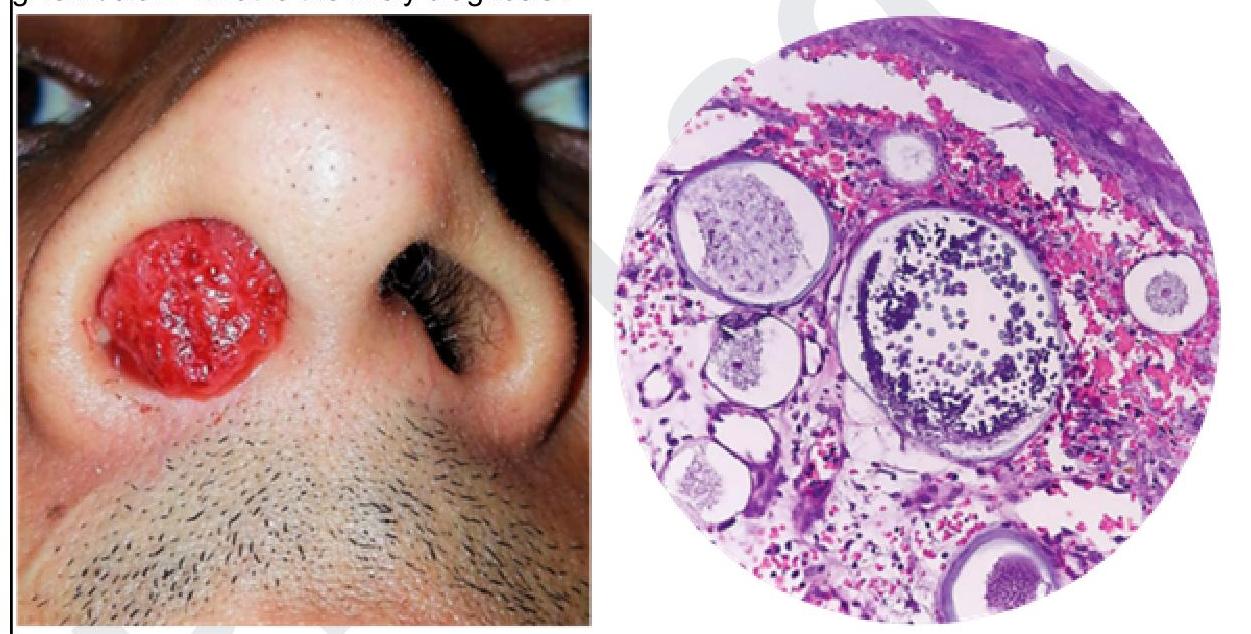
In rhinosporidiosis, which of the following statements is true?
A 45-year-old man presents with breathing difficulties and signs of airway obstruction on physical examination. A CT scan reveals a nasal polyp obstructing the airway. Drainage from which of the following structures is also likely to be obstructed?
What is the most common site of osteoma?
Which is the most commonly involved paranasal sinus in fibrous dysplasia?
What is the most common site of carcinoma of the paranasal sinuses?
A patient presented to ENT OPD with complaints of headache and nasal stuffiness. On CT scan, heterogeneous opacification involving multiple sinuses along with bone erosion was noticed. What would be the most likely diagnosis?
A 16-year-old girl presented with a history of nasal obstruction for the last 2 months. A CT scan was performed, revealing the following findings. What is the most likely diagnosis?

What is the characteristic feature of an ethmoidal polyp?
Explanation: ### Explanation **Kallmann Syndrome (Correct Answer)** Kallmann syndrome is a genetic condition characterized by the failure of **gonadotropin-releasing hormone (GnRH)** neurons to migrate from the olfactory placode to the hypothalamus. This results in the dual clinical presentation of: 1. **Hypogonadotropic Hypogonadism:** Due to GnRH deficiency (delayed puberty, infertility). 2. **Anosmia or Hyposmia:** Due to the failure of the olfactory bulbs to develop (olfactory bulb hypoplasia/aplasia). It is most commonly inherited as an X-linked recessive trait (KAL1 gene mutation). **Incorrect Options** * **Goldenhar Syndrome (Oculo-Auriculo-Vertebral Dysplasia):** This is a developmental anomaly involving the first and second branchial arches. It typically presents with hemifacial microsomia, preauricular tags, microtia, and epibulbar dermoids. It is not associated with olfactory dysfunction. * **Prader-Willi Syndrome:** This is a genetic disorder caused by the loss of function of specific genes on chromosome 15 (paternal origin). It presents with hyperphagia, obesity, intellectual disability, and hypogonadism, but **anosmia is not a feature**. **High-Yield Clinical Pearls for NEET-PG** * **MRI Finding:** In Kallmann syndrome, MRI of the brain typically shows **absent or hypoplastic olfactory bulbs and sulci**. * **Associated Features:** Patients may also present with color blindness, sensorineural hearing loss, or renal agenesis. * **Differential Diagnosis:** Unlike Kallmann syndrome, **Klinefelter syndrome (47, XXY)** presents with hypergonadotropic hypogonadism (elevated FSH/LH) and normal smell. * **Foster Kennedy Syndrome:** Another high-yield ENT/Ophtha topic involving anosmia (ipsilateral anosmia, ipsilateral optic atrophy, and contralateral papilledema due to a frontal lobe tumor).
Explanation: **Explanation:** **Rhinoscleroma** is a chronic granulomatous disease caused by **Klebsiella rhinoscleromatis** (Frisch bacillus). The disease typically progresses through three stages: Catarrhal, Proliferative (Granulomatous), and Cicatricial (Fibrotic). The **"Tapir Nose"** appearance occurs during the **proliferative stage**. In this phase, there is significant granulomatous infiltration of the nasal skin, subcutaneous tissues, and the upper lip. This leads to a woody, painless swelling and broadening of the nose, mimicking the snout of a Tapir. **Analysis of Incorrect Options:** * **Atrophic Rhinitis:** Characterized by "roomy" nasal cavities, foul-smelling crusts (ozaena), and atrophy of the turbinates. It does not cause external granulomatous swelling. * **Rhinosporidiosis:** Caused by *Rhinosporidium seeberi*, it typically presents as a leafy, strawberry-like polypoid mass that is highly vascular and bleeds on touch. It does not typically produce the "Tapir nose" deformity. * **Syphilis:** Congenital syphilis is associated with a **"Saddle nose"** deformity (destruction of the nasal bridge/septum), not the hypertrophic Tapir nose. **High-Yield Clinical Pearls for NEET-PG:** * **Microscopy:** Look for **Mikulicz cells** (large foamy macrophages containing bacilli) and **Russell bodies** (eosinophilic hyaline inclusions in plasma cells). * **Drug of Choice:** Streptomycin and Tetracycline are traditionally used; Ciprofloxacin is also effective. * **Biopsy:** This is the definitive diagnostic gold standard. * **Hebra Nose:** Another term sometimes used synonymously with the external deformity of Rhinoscleroma.
Explanation: **Explanation:** Rhinosporidiosis is a chronic granulomatous infection caused by **Rhinosporidium seeberi**. Although historically classified as a fungus, it is now known to be an aquatic protistan parasite (Mesomycetozoea). **1. Why Option C is Correct:** The primary treatment for rhinosporidiosis is **wide surgical excision** (usually via endonasal or endoscopic approach) with **cauterization of the base**. Cautery is crucial to prevent recurrence, which is common due to the spillage of endospores during surgery. Medical therapy (like Dapsone) is only an adjunct used to prevent recurrence by arresting the maturation of sporangia. **2. Why Other Options are Incorrect:** * **Option A:** While it forms a granuloma, *R. seeberi* is **not a fungus**. It is a water-borne parasite. This is a common "trap" in exams. * **Option B:** The mass is typically **strawberry-like** (leafy, polypoid, and friable) with a **vascular, reddish/pink appearance**. The surface is studded with tiny white dots, which represent mature sporangia containing endospores. Greyish masses are more characteristic of simple ethmoidal polyps. * **Option D:** Radiotherapy has no role in the management of this infectious/parasitic condition; it is reserved for malignancies. **High-Yield Clinical Pearls for NEET-PG:** * **Epidemiology:** Most common in South India (Tamil Nadu, Kerala) and Sri Lanka; associated with bathing in stagnant pond water. * **Histopathology:** Characterized by large, thick-walled **sporangia** containing thousands of **endospores** (visible on H&E, PAS, or GMS stains). * **Site:** The **nasal septum** and inferior turbinate are the most common sites. * **Transmission:** Transepithelial infection via traumatized epithelium.
Explanation: **Explanation:** The correct answer is **B. Maxillary sinus**. The clinical scenario describes a nasal polyp causing airway obstruction. In clinical practice, the most common type of nasal polyp is the **Antrochoanal polyp**. These polyps originate from the mucosa of the **maxillary sinus** (specifically near the accessory ostium). They grow to fill the maxillary antrum, exit through the natural or accessory ostium into the middle meatus, and then extend posteriorly toward the choana, obstructing the airway. Because the polyp physically occupies the ostium of the maxillary sinus as it exits, it directly leads to the obstruction of drainage from that specific sinus. **Analysis of Incorrect Options:** * **A. Sphenoid sinus:** This sinus drains into the sphenoethmoidal recess, located far posterior and superior to the typical path of an antrochoanal or ethmoidal polyp. * **C. Ethmoidal sinus:** While ethmoidal polyps (multiple/bilateral) originate here, the question implies a single obstructing mass. Even in ethmoidal polyposis, the primary drainage of the maxillary sinus (via the middle meatus) is more frequently compromised by the bulk of the polypoid tissue. * **D. Frontal sinus:** This drains into the frontal recess of the middle meatus. While it can be obstructed by large polyps, the maxillary sinus is the primary site of origin for the classic solitary obstructing polyp (Antrochoanal). **NEET-PG High-Yield Pearls:** * **Antrochoanal Polyp (Killian’s Polyp):** Usually solitary, unilateral, and seen in children/young adults. It has three parts: Antral, Nasal, and Choanal. * **Radiology:** On CT, it appears as a soft tissue mass filling the maxillary sinus and extending into the nasopharynx through the widened ostium (**"Dumbbell shape"**). * **Treatment of Choice:** Functional Endoscopic Sinus Surgery (FESS). Simple polypectomy has a high recurrence rate.
Explanation: **Explanation:** **Osteoma** is the most common benign tumor of the paranasal sinuses. It is a slow-growing, encapsulated, and highly differentiated bony tumor. **Why Frontal Sinus is Correct:** The **frontal sinus** is the most common site for osteomas, accounting for approximately **75-80%** of cases. Within the frontal sinus, they most frequently arise from the fronto-ethmoidal suture line. While most are asymptomatic and discovered incidentally on imaging, they can cause symptoms if they obstruct the frontal sinus ostium, leading to secondary frontal sinusitis or a mucocele. **Analysis of Incorrect Options:** * **Ethmoidal Sinus:** This is the second most common site. Although frequent, it lags significantly behind the frontal sinus in incidence. * **Maxillary Sinus:** Osteomas in the maxillary sinus are relatively rare. Most benign masses in the maxillary sinus are more likely to be polyps or retention cysts. * **Sphenoid Sinus:** This is the least common site for an osteoma. Due to its deep location, an osteoma here can be clinically significant if it compresses the optic nerve or internal carotid artery. **NEET-PG High-Yield Pearls:** * **Gardner’s Syndrome:** If a patient presents with multiple osteomas (especially of the mandible), consider Gardner’s Syndrome (Triad: Colonic polyposis, Osteomas, and Soft tissue tumors/Epidermoid cysts). * **Radiology:** On X-ray or CT, they appear as a characteristic "ivory-hard," well-circumscribed, densely radiopaque mass. * **Management:** Asymptomatic small osteomas are managed by observation. Surgical excision (e.g., Lynch-Howarth or endoscopic approach) is indicated only if the tumor is symptomatic, enlarging, or causing obstruction.
Explanation: **Explanation:** **Fibrous dysplasia** is a benign, non-neoplastic bone disorder where normal bone is replaced by cellular fibrous tissue and disorganized bony trabeculae (classically described as "Chinese letter" or "alphabet soup" patterns on histology). 1. **Why Maxillary Sinus is Correct:** In the craniofacial region, fibrous dysplasia most frequently involves the **maxilla** and the **mandible**. When specifically considering the paranasal sinuses, the **maxillary sinus** is the most commonly affected site. It typically presents as a painless, slow-growing swelling causing facial asymmetry. Radiologically, it shows a characteristic **"ground-glass appearance"** with ill-defined borders that blend into normal bone. 2. **Why Other Options are Incorrect:** * **Ethmoid, Frontal, and Sphenoid Sinuses:** While these sinuses can be involved (especially in the polyostotic form or as an extension of skull base disease), they are statistically less common primary sites compared to the maxilla. The frontal bone is the second most common site in the cranium, but the maxillary sinus remains the top answer for sinus involvement. **Clinical Pearls for NEET-PG:** * **Monostotic vs. Polyostotic:** Monostotic (70%) involves one bone; Polyostotic involves multiple bones. * **McCune-Albright Syndrome:** Polyostotic fibrous dysplasia + Café-au-lait spots (Coast of Maine borders) + Precocious puberty. * **Jaffe-Lichtenstein Syndrome:** Polyostotic fibrous dysplasia + Café-au-lait spots (without endocrine involvement). * **Management:** Observation for asymptomatic cases; surgical "contouring" or debulking after skeletal maturity for cosmetic/functional issues. **Radiotherapy is contraindicated** as it increases the risk of malignant transformation to osteosarcoma.
Explanation: **Explanation:** The **Maxillary sinus** is the most common site for malignancies of the paranasal sinuses, accounting for approximately **80% of all cases**. Among these, **Squamous Cell Carcinoma (SCC)** is the most frequent histological subtype (about 80%), followed by adenoid cystic carcinoma and adenocarcinoma. * **Why Maxillary is Correct:** Due to its large surface area and constant exposure to inhaled carcinogens and chronic inflammatory stimuli, the maxillary antrum is the primary site for sinus neoplasia. Most patients present in advanced stages (T3 or T4) because the sinus is a "silent" cavity where tumors can grow significantly before causing obstructive symptoms or facial swelling. * **Why others are Incorrect:** * **Ethmoid Sinus:** This is the second most common site (approx. 15-20%). Notably, **Adenocarcinoma** of the ethmoid sinus is strongly associated with occupational exposure to **wood dust**. * **Frontal and Sphenoid Sinuses:** These are extremely rare sites for primary carcinoma, each accounting for less than 1-2% of cases. **High-Yield Clinical Pearls for NEET-PG:** 1. **Ohngren’s Line:** An imaginary line connecting the medial canthus of the eye to the angle of the mandible. Tumors situated **posterosuperior** to this line have a poorer prognosis due to early involvement of the orbit, ethmoids, and infratemporal fossa. 2. **Dutton's/Lederman’s Classification:** Uses two horizontal lines (passing through the floor of the orbit and floor of the antrum) to divide the area into infrastructure, mesostructure, and suprastructure. 3. **Risk Factors:** Exposure to nickel, isopropyl alcohol, and thorium dioxide (Thorotrast) are linked to maxillary SCC.
Explanation: ### **Explanation** The clinical presentation and CT findings are classic for **Allergic Fungal Rhinosinusitis (AFRS)**. **1. Why Allergic Fungal Rhinosinusitis (AFRS) is correct:** AFRS is a non-invasive hypersensitivity response to fungal antigens (usually *Aspergillus* or *Dematiaceous* fungi). * **Heterogeneous Opacification:** On CT, the "double density" sign is characteristic. This represents thick, tenacious "allergic mucin" containing fungal hyphae and eosinophils. The high density is due to calcium and magnesium salts deposited by the fungi. * **Bone Erosion:** While AFRS is non-invasive, the accumulating mucin creates pressure necrosis, leading to the expansion and thinning (erosion) of sinus walls, often involving multiple sinuses (pansinusitis). **2. Why other options are incorrect:** * **Acute/Chronic Bacterial Rhinosinusitis:** These typically show air-fluid levels or mucosal thickening. While chronic cases can show sclerosis of bone, they rarely cause the expansive bone erosion or the characteristic heterogeneous "double density" seen in fungal cases. * **Invasive Fungal Rhinosinusitis:** This is a medical emergency usually seen in immunocompromised patients (e.g., uncontrolled diabetes). While it causes bone destruction, it is characterized by rapid tissue necrosis and vascular invasion rather than the slow, expansive heterogeneous opacification seen here. **3. NEET-PG High-Yield Pearls:** * **Bent and Kuhn Criteria:** Used for diagnosing AFRS (includes Type I hypersensitivity, nasal polyposis, characteristic CT findings, eosinophilic mucin, and positive fungal stain). * **MRI Findings:** AFRS shows a characteristic **"Void signal"** (hypointensity) on T2-weighted images due to high metal content and low water content in the mucin. * **Treatment:** Functional Endoscopic Sinus Surgery (FESS) to clear mucin, followed by long-term **topical/systemic steroids** to prevent recurrence. Antifungals are generally not required as it is an allergic, not infectious, process.
Explanation: ***Antrochoanal polyp*** - CT scan typically shows a **smooth, soft tissue mass** originating from the **maxillary sinus** extending through the **accessory ostium** with a characteristic **dumbbell appearance** into the choana and nasopharynx. - Common in **adolescent females** presenting with **unilateral nasal obstruction**, which matches this clinical presentation perfectly. *Juvenile Nasopharyngeal Angiofibroma* - This condition occurs **exclusively in adolescent males** due to hormonal influences, making it impossible in a 16-year-old girl. - CT shows a **highly vascular mass** in the nasopharynx with **epistaxis** as a prominent symptom, which is not mentioned here. *Nasopharyngeal carcinoma* - Typically occurs in **older adults** (40-60 years) and is rare in adolescents, especially without associated symptoms like **hearing loss** or **cranial nerve palsies**. - CT shows **irregular, infiltrative masses** with **cervical lymphadenopathy**, unlike the smooth appearance of antrochoanal polyps. *Adenoid hypertrophy* - More common in **younger children** (3-7 years) and typically causes **bilateral nasal obstruction** rather than unilateral symptoms. - CT shows **symmetric enlargement** of adenoid tissue in the nasopharynx without the characteristic **maxillary sinus origin** seen in antrochoanal polyps.
Explanation: **Explanation:** Ethmoidal polyps are non-neoplastic edematous projections of the ethmoidal sinus mucosa. The correct answer is **C (It is recurrent)** because these polyps are multifactorial in origin, often linked to chronic mucosal inflammation, allergy, or aspirin sensitivity (Sampter’s Triad). Even after surgical removal (FESS), the underlying mucosal tendency remains, leading to a high rate of recurrence unless the systemic cause is managed. **Analysis of Options:** * **A. It is due to infection:** While chronic rhinosinusitis can coexist, ethmoidal polyps are primarily **allergic or inflammatory** in nature. In contrast, Antrochoanal polyps are more frequently associated with infection. * **B. It is typically single:** Ethmoidal polyps are characteristically **multiple, bilateral, and grape-like** in appearance. A single, unilateral polyp is more likely to be an Antrochoanal polyp or a neoplasm. * **D. It occurs primarily in children:** These polyps are most common in **adults**. If multiple nasal polyps are found in a child, the clinician must immediately rule out **Cystic Fibrosis**. **High-Yield Clinical Pearls for NEET-PG:** * **Appearance:** Pale, translucent, mobile, and insensitive to touch (unlike the inferior turbinate). * **Sampter’s Triad:** Nasal polyposis, Bronchial asthma, and Aspirin intolerance. * **Kartagener’s Syndrome:** Often presents with nasal polyposis, bronchiectasis, and situs inversus. * **Treatment of Choice:** Medical management (steroids) initially; Functional Endoscopic Sinus Surgery (FESS) for refractory cases.
Rhinitis
Practice Questions
Acute Rhinosinusitis
Practice Questions
Chronic Rhinosinusitis
Practice Questions
Nasal Polyposis
Practice Questions
Allergic Fungal Sinusitis
Practice Questions
Deviated Nasal Septum
Practice Questions
Epistaxis
Practice Questions
Nasal Trauma
Practice Questions
Choanal Atresia
Practice Questions
CSF Rhinorrhea
Practice Questions
Tumors of the Nose and Paranasal Sinuses
Practice Questions
Complications of Sinusitis
Practice Questions
Get full access to all questions, explanations, and performance tracking.
Start For Free