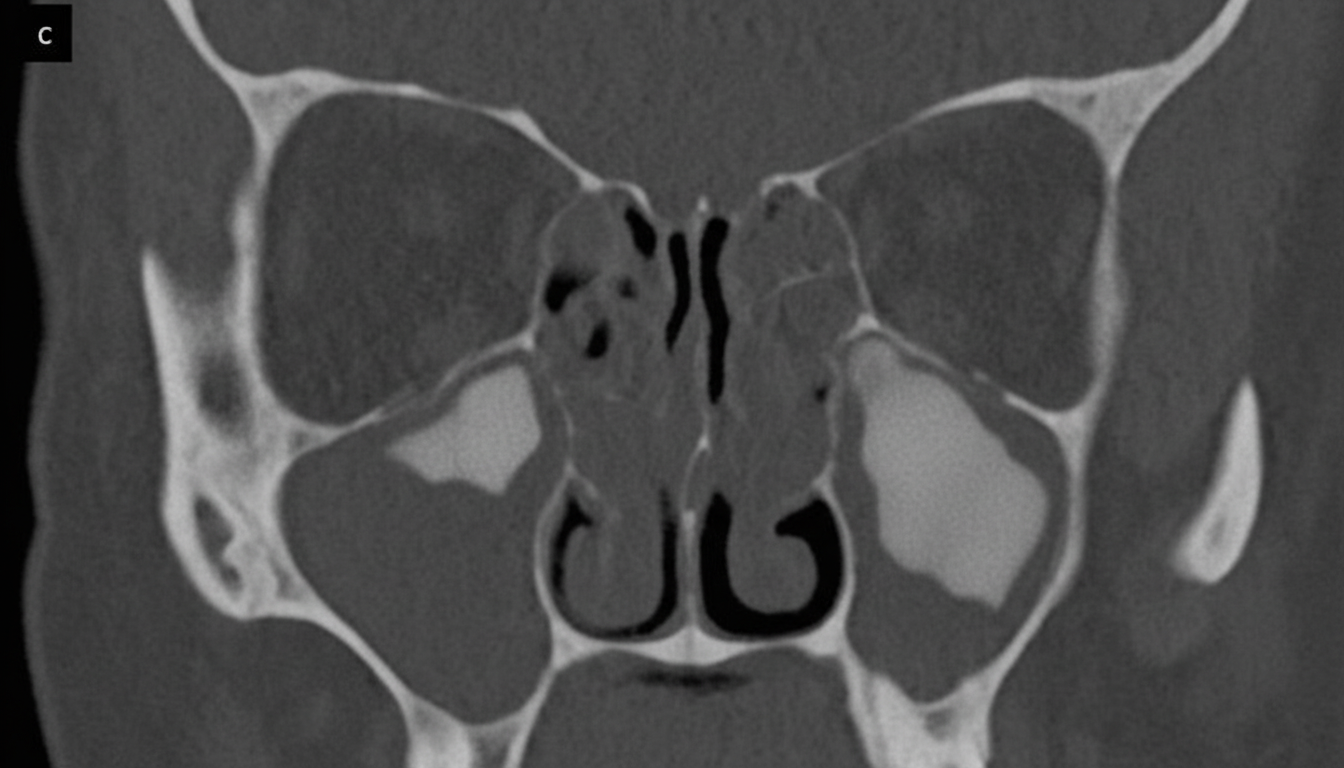
Which paranasal sinus is most commonly involved in a patient presenting with symptoms of a toothache and sinusitis?
A 7-year-old child presents with unilateral nasal obstruction and foul-smelling nasal discharge. What is the most likely diagnosis?
Regarding nasal syphilis, which of the following statements is true?
What is the treatment of choice for nasal synechiae?
Which of the following statements regarding paranasal sinuses is true?
Kiesselbach's plexus is situated on which part of the nasal cavity?
What is the treatment of choice for antrochoanal polyp?
An 18-year-old girl presented with multiple nasal polypi in both nostrils, nasal obstruction, and sinusitis. CT scan shows dense shadows in the sinuses. Histopathology did not show fungal invasion of tissues. Which of the following treatments is NOT indicated?
What is the commonest cause of unilateral mucopurulent rhinorrhea in a child?
What is the best X-ray view to visualize the maxillary sinus?
Explanation: **Explanation:** The **Maxillary sinus** is the correct answer due to its unique anatomical relationship with the oral cavity. The floor of the maxillary sinus is formed by the alveolar process of the maxilla, which lies in close proximity to the roots of the maxillary teeth (specifically the **2nd premolar and 1st and 2nd molars**). 1. **Referred Pain:** Because the maxillary sinus and the upper teeth share a common nerve supply via the **Superior Alveolar Nerve** (a branch of the Maxillary nerve, V2), inflammation within the sinus (sinusitis) can be perceived as a toothache. 2. **Odontogenic Sinusitis:** Approximately 10–12% of maxillary sinusitis cases are "odontogenic," meaning they are caused by dental infections, periapical abscesses, or complications from dental extractions. **Analysis of Incorrect Options:** * **Ethmoid Sinus:** Primarily presents with pain at the bridge of the nose or medial canthus of the eye. * **Frontal Sinus:** Typically presents with a "frontal headache" or pain above the eyebrows, often showing a characteristic "office headache" pattern (worse in the morning, better in the evening). * **Sphenoid Sinus:** Pain is usually referred to the vertex (top of the head), occiput, or retro-orbital region. **High-Yield Clinical Pearls for NEET-PG:** * **First sinus to develop:** Ethmoid (present at birth). * **Largest paranasal sinus:** Maxillary (Antrum of Highmore). * **Most common sinus involved in adult sinusitis:** Maxillary sinus. * **Most common sinus involved in childhood sinusitis:** Ethmoid sinus. * **Drainage:** The maxillary sinus drains into the **middle meatus** via the hiatus semilunaris. Its drainage is physiologically disadvantaged because the ostium is located superiorly on its medial wall.
Explanation: **Explanation:** The clinical presentation of **unilateral nasal obstruction** accompanied by **foul-smelling, purulent, or blood-stained nasal discharge** in a child is a classic "spotter" for a **Nasal Foreign Body (FB)** until proven otherwise. Children often insert small objects (beads, seeds, button batteries) into the nose, which leads to local inflammation, secondary bacterial infection, and the characteristic malodorous discharge. **Analysis of Options:** * **Foreign Body (Correct):** The hallmark triad is a pediatric patient, unilateral symptoms, and foul odor. * **Rhinophyma:** This is a hypertrophy of the sebaceous glands of the nose, typically seen in elderly males as a complication of acne rosacea. It presents as a bulbous, "potato-like" nose, not with discharge. * **Rhinosporidiosis:** Caused by *Rhinosporidium seeberi*, it presents as a friable, leafy, strawberry-like polypoid mass that bleeds on touch. It is usually associated with history of bathing in stagnant water and is not typically characterized by a foul odor unless heavily infected. * **Angiofibroma (JNA):** This is a benign but aggressive tumor seen almost exclusively in **adolescent males**. It presents with painless, profuse, recurrent epistaxis and progressive nasal obstruction, rather than foul-smelling discharge. **Clinical Pearls for NEET-PG:** * **Button Batteries:** These are surgical emergencies due to the risk of liquefactive necrosis and septal perforation within hours. **Do not** use saline drops as they increase conductivity. * **Living Foreign Bodies (Magots):** Caused by *Lucilia sericata* (Green bottle fly). Treatment involves instilling 25% chloroform to stun the larvae before manual removal. * **Radiology:** Most nasal FBs are radiolucent; X-rays are primarily useful for metallic objects or batteries.
Explanation: **Explanation:** Nasal syphilis is a manifestation of infection by *Treponema pallidum*. Understanding its presentation across different stages is crucial for NEET-PG. **Why Option D is Correct:** In the context of clinical practice and epidemiological prevalence, **Secondary Syphilis** is the most common stage associated with nasal involvement. It typically presents as persistent rhinitis with mucous patches and generalized lymphadenopathy. While primary syphilis (chancre) is rare in the nose, secondary and tertiary stages are more frequently documented in ENT clinics. **Analysis of Incorrect Options:** * **Option A & B:** These are characteristic of **Tertiary Syphilis**. In this stage, a "gumma" (granulomatous lesion) forms, which predilects the **bony part** of the nasal septum. This leads to necrosis, resulting in a large septal perforation and the classic **Saddle Nose Deformity** due to the collapse of the nasal bridge. * **Option C:** While "snuffles" (purulent, blood-stained nasal discharge) is indeed a hallmark of **Congenital Syphilis** in newborns, it is a specific pediatric manifestation rather than a general rule for nasal syphilis across all age groups. **High-Yield Clinical Pearls for NEET-PG:** * **Septal Perforation:** Syphilis typically involves the **bony septum**, whereas Tuberculosis (Lupus Vulgaris) involves the **cartilaginous septum**. * **Congenital Syphilis Triad (Hutchinson’s):** Interstitial keratitis, sensorineural hearing loss (8th nerve deafness), and notched incisors. * **Diagnosis:** VDRL/RPR for screening; FTA-ABS (Treponemal test) for confirmation. * **Treatment:** Penicillin G remains the drug of choice.
Explanation: **Explanation:** **Nasal synechiae** (adhesions) are abnormal bridges of tissue connecting the nasal septum to the turbinates. They most commonly occur as a complication of nasal surgery (e.g., septoplasty or turbinate reduction) or trauma, where opposing raw mucosal surfaces heal together. **1. Why Surgical Removal is the Correct Answer:** The definitive treatment for established nasal synechiae is **surgical excision (adhesiolysis)**. The adhesions must be physically divided, usually with cold instruments or lasers, to restore the patency of the nasal airway. However, simple excision alone has a high recurrence rate because the raw surfaces tend to fuse again during healing. Therefore, surgery is almost always followed by the placement of a physical barrier (like a silastic splint or medicated sponge) to keep the surfaces apart. **2. Analysis of Incorrect Options:** * **Topical Mitomycin C (Option B):** While Mitomycin C (an anti-fibrotic agent) is often used **adjunctively** after surgery to prevent fibroblast proliferation and recurrence, it cannot "dissolve" or treat an existing fibrous adhesion on its own. * **Nasal Stent (Option C):** Similar to Mitomycin, a stent or splint is a **preventative measure** used post-operatively. A stent cannot treat synechiae unless the adhesions are first surgically removed. * **None of the above (Option D):** Incorrect, as surgical intervention is the standard of care. **Clinical Pearls for NEET-PG:** * **Most common site:** Between the inferior turbinate and the nasal septum. * **Prevention:** The most effective way to prevent synechiae is meticulous surgical technique and the use of **silastic nasal splints** post-operatively. * **Symptoms:** Patients typically present with nasal obstruction and occasionally crusting or sinusitis due to impaired mucociliary clearance.
Explanation: ### Explanation **1. Why Option B is Correct:** The maxillary sinus (Antrum of Highmore) and the upper teeth share a common nerve supply via the **Superior Alveolar Nerves** (branches of the Maxillary Nerve, V2). Specifically, the **Middle Superior Alveolar Nerve** supplies both the mucous membrane of the maxillary sinus and the **upper premolar teeth**. This shared innervation is clinically significant because dental infections can cause secondary maxillary sinusitis, and conversely, sinusitis can present as referred pain to the upper teeth. **2. Why the Other Options are Incorrect:** * **Option A:** At birth, the maxillary sinus is a small, rudimentary slit-like cavity. It undergoes two main growth spurts (at 3 and 7 years) and reaches adult size only after the eruption of permanent teeth (around 12–15 years). * **Option C:** While the frontal, maxillary, and anterior ethmoidal sinuses drain into the **middle meatus**, the **sphenoid sinus** drains into the **sphenoethmoidal recess** (located above the superior turbinate). * **Option D:** The sphenoidal sinuses are primarily supplied by the **posterior ethmoidal nerves** and the orbital branches of the pterygopalatine ganglion, not the anterior ethmoidal nerves (which supply the frontal and anterior ethmoidal cells). **3. High-Yield Clinical Pearls for NEET-PG:** * **First sinus to develop:** Maxillary sinus (appears at 3rd month of fetal life). * **First sinus to be radiologically visible:** Ethmoid sinus (present at birth). * **Last sinus to develop:** Frontal sinus (visible on X-ray around age 6–7). * **Drainage Site Summary:** * *Sphenoethmoidal Recess:* Sphenoid sinus. * *Superior Meatus:* Posterior ethmoid sinus. * *Middle Meatus:* Frontal, Maxillary, Anterior, and Middle ethmoid sinuses. * *Inferior Meatus:* Nasolacrimal duct (only structure here).
Explanation: **Explanation:** **Kiesselbach’s Plexus** (also known as Little’s area) is a highly vascularized region located on the **anteroinferior part of the nasal septum**, which forms the **medial wall of the nasal cavity**. This area is the most common site for epistaxis (nosebleeds), accounting for approximately 90% of cases. The plexus is formed by the anastomosis of four (sometimes five) major arteries: 1. **Anterior Ethmoidal Artery** (from Internal Carotid) 2. **Sphenopalatine Artery** (from External Carotid) 3. **Greater Palatine Artery** (from External Carotid) 4. **Superior Labial Artery** (from External Carotid) **Analysis of Incorrect Options:** * **Option A:** The medial wall of the middle ear contains structures like the promontory and the oval window, not a vascular plexus related to the nose. * **Option B:** The lateral wall of the nasopharynx contains the opening of the Eustachian tube and the Fossa of Rosenmüller (common site for Nasopharyngeal Carcinoma). * **Option D:** The laryngeal aspect of the epiglottis is part of the upper airway and is not involved in nasal vascularity. **Clinical Pearls for NEET-PG:** * **Woodruff’s Plexus:** Located on the lateral wall of the nasal cavity posteriorly (near the sphenopalatine foramen); it is the most common site for **posterior epistaxis** in elderly patients. * **First-line treatment** for bleeding from Kiesselbach’s plexus is Trotter’s method (pinching the nose and leaning forward) or chemical cautery with Silver Nitrate. * **Artery of Epistaxis:** The Sphenopalatine artery is clinically referred to as the "Artery of Epistaxis."
Explanation: **Explanation:** An **Antrochoanal Polyp (Killian’s Polyp)** is a solitary polyp that arises from the mucosa of the maxillary sinus (usually near the accessory ostium), passes through the natural or accessory ostium into the middle meatus, and extends posteriorly into the choana and nasopharynx. **Why Endoscopic Removal is the Treatment of Choice:** Functional Endoscopic Sinus Surgery (FESS) is the gold standard. It allows for the precise identification of the polyp’s stalk and its point of origin within the maxillary sinus. By widening the natural ostium (middle meatal antrostomy), the surgeon can ensure complete removal of the antral portion, which is crucial to **prevent recurrence**. It is minimally invasive, preserves sinus physiology, and has lower morbidity compared to open procedures. **Analysis of Incorrect Options:** * **Caldwell-Luc Operation:** Historically used to remove the antral part of the polyp via the canine fossa. While effective for preventing recurrence, it is now reserved for recurrent cases or when endoscopic access is impossible, as it carries risks of infraorbital nerve injury and dental damage. * **Intranasal Polypectomy:** This involves simple avulsion of the nasal part of the polyp. It is considered inadequate because it fails to remove the antral base, leading to a very high recurrence rate. **High-Yield Clinical Pearls for NEET-PG:** * **Origin:** Most commonly from the posterior/lateral wall or floor of the **maxillary sinus**. * **Components:** It has three parts—Antral, Nasal, and Choanal. * **Radiology:** On X-ray (Water’s view) or CT, it appears as a hazy maxillary sinus with a soft tissue mass extending into the nasopharynx. * **Differential Diagnosis:** Must be differentiated from a juvenile nasopharyngeal angiofibroma (JNA) in adolescent males; however, AC polyps are typically avascular and do not bleed on touch.
Explanation: ### Explanation The clinical presentation described—bilateral nasal polyposis, sinusitis, and dense (hyperdense) shadows on CT scan in a young patient, specifically **without fungal invasion** on histopathology—is classic for **Allergic Fungal Rhinosinusitis (AFRS)**. #### 1. Why Amphotericin B is NOT indicated (Correct Answer) AFRS is a **Type I and Type IV hypersensitivity reaction** to fungal antigens (commonly *Aspergillus* or *Dematiaceous* fungi) present in the sinus mucus. Crucially, it is a **non-invasive** fungal disease. * **Amphotericin B** is a potent systemic antifungal used for **invasive** fungal infections (like Mucormycosis or Invasive Aspergillosis) where fungi penetrate the tissue and blood vessels. * Since there is no tissue invasion in AFRS, systemic antifungals like Amphotericin B have no role and carry significant toxicity. #### 2. Why other options are indicated * **Surgical removal (C):** Functional Endoscopic Sinus Surgery (FESS) is the primary treatment to remove the "allergic mucin" (peanut-butter-like discharge) and polyps to reduce the antigenic load. * **Intranasal corticosteroids (B):** These are the mainstay of post-operative management to prevent recurrence by suppressing the inflammatory/allergic response. * **Anti-histamines (D):** Since AFRS is an allergic phenomenon often associated with atopy and asthma, antihistamines help manage the underlying systemic allergy. #### Clinical Pearls for NEET-PG * **Bent and Kuhn Criteria:** Used for diagnosing AFRS. Key features include nasal polyposis, Type I hypersensitivity (IgE), characteristic CT findings, and **presence of fungal hyphae in mucus but NOT in tissue.** * **CT Finding:** "Double Density" sign (central hyperdensity due to metal ions like manganese/iron produced by fungi). * **Histopathology:** Shows "Allergic Mucin" containing Charcot-Leyden crystals and eosinophils. * **Treatment Gold Standard:** Surgery followed by long-term topical/systemic steroids.
Explanation: ### Explanation **Correct Option: A. Foreign body** In the pediatric population, **unilateral** nasal discharge is considered a **foreign body (FB) until proven otherwise**. When a child inserts an inanimate object (like a bead, button battery, or seed) into the nasal cavity, it triggers a local inflammatory response. Over time, this leads to secondary bacterial infection, resulting in the classic presentation of **unilateral, foul-smelling, mucopurulent, or blood-stained nasal discharge**. **Analysis of Incorrect Options:** * **B. Adenoids:** Adenoid hypertrophy typically causes **bilateral** nasal obstruction and discharge. While it is a common pediatric condition, it rarely presents unilaterally. * **C. Deviated Nasal Septum (DNS):** DNS primarily causes mechanical airway obstruction. While it may lead to stasis of secretions, it does not typically present with acute mucopurulent rhinorrhea unless associated with secondary sinusitis. * **D. Inadequately treated acute frontal sinusitis:** Frontal sinusitis is rare in young children as the frontal sinuses do not begin to develop significantly until age 6–7 and are not fully pneumatized until adolescence. Furthermore, sinusitis is more commonly bilateral or associated with generalized URIs. **Clinical Pearls for NEET-PG:** * **The "Gold Standard" Rule:** Any child with unilateral foul-smelling nasal discharge must undergo a thorough nasal examination to rule out a foreign body. * **Rhinolith:** A long-retained foreign body can act as a nucleus for the deposition of calcium and magnesium salts, forming a "nasal stone" or **rhinolith**. * **Button Batteries:** These are surgical emergencies. They can cause liquefactive necrosis and septal perforation within hours due to electrical current and chemical leakage. * **Management:** Most FBs can be removed using a **Jobson-Horne probe** or a curved hook. Avoid using forceps for smooth, round objects as they may push the FB into the nasopharynx, risking aspiration.
Explanation: **Explanation:** The **Water’s view (Occipitomental view)** is the gold standard radiographic projection for visualizing the **maxillary sinuses**. In this position, the patient’s chin is tilted up against the film, which displaces the dense petrous part of the temporal bone downwards, preventing it from overlapping and obscuring the maxillary antrum. This provides a clear, unobstructed view of the sinus floor and walls, making it ideal for detecting sinusitis, air-fluid levels, or fractures of the orbital floor (blow-out fractures). **Analysis of Incorrect Options:** * **Caldwell’s view (Occipitofrontal view):** This is the best view for the **frontal and ethmoid sinuses**. In this view, the petrous bone lies over the lower part of the orbit and the maxillary sinus, making the latter difficult to evaluate. * **Lateral view:** This is primarily used to visualize the **sphenoid sinus**, the nasopharynx (for adenoids), and the anterior/posterior walls of the frontal sinuses. * **Occlusal anterior view:** This is a dental radiograph used to visualize the floor of the mouth or the palate; it is not used for paranasal sinus evaluation. **High-Yield Clinical Pearls for NEET-PG:** * **Best view for Sphenoid Sinus:** Lateral view or Open-mouth Water’s view. * **Best view for Ethmoid Sinus:** Caldwell’s view. * **Best view for Frontal Sinus:** Caldwell’s view. * **Gold Standard Investigation:** While X-rays are common screening tools, **Non-Contrast CT (NCCT) of the Paranasal Sinuses** is the investigation of choice for chronic sinusitis and preoperative planning (FESS).
Rhinitis
Practice Questions
Acute Rhinosinusitis
Practice Questions
Chronic Rhinosinusitis
Practice Questions
Nasal Polyposis
Practice Questions
Allergic Fungal Sinusitis
Practice Questions
Deviated Nasal Septum
Practice Questions
Epistaxis
Practice Questions
Nasal Trauma
Practice Questions
Choanal Atresia
Practice Questions
CSF Rhinorrhea
Practice Questions
Tumors of the Nose and Paranasal Sinuses
Practice Questions
Complications of Sinusitis
Practice Questions
Get full access to all questions, explanations, and performance tracking.
Start For Free