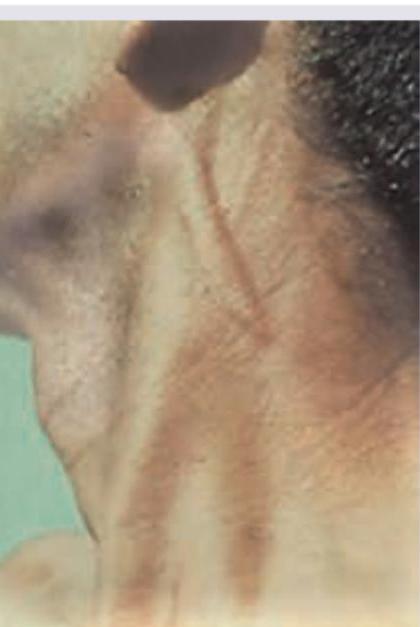
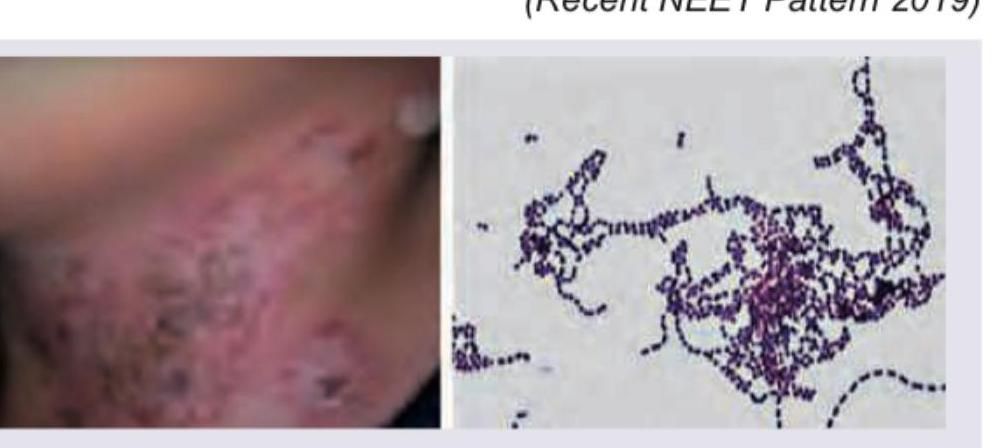
A 6-year-old child presents with lesions on the face, covered with honey-colored crusts, and pruritus is present. The possible cause is:
Erythema chronicum migrans is associated with which of the following conditions?
A 30-year-old male patient has a large, spreading, and exuberant ulcer with bright red granulation tissue over the glans penis, with no lymphadenopathy. What is the most likely causative organism?
Apple jelly nodules are characteristic of which condition?
Which is the most common type of cutaneous tuberculosis?
Which of the following statements is true regarding the primary chancre of syphilis?
A 35-year-old woman presents with hypopigmented and anesthetic patches on her arms, and a positive skin smear for acid-fast bacilli. What is the most likely diagnosis?
Explanation: ***Impetigo*** - **Impetigo** is a common bacterial skin infection, particularly in children, characterized by the classic **honey-colored crusts** and **pruritus (itching)**. - It is typically caused by *Staphylococcus aureus* or *Streptococcus pyogenes* and often affects the face, especially around the nose and mouth. *Herpes* - Herpes simplex virus (HSV) infections manifest as **vesicles (blisters) on an erythematous base** that can rupture and form shallow ulcers, but typically do not present with honey-colored crusts. - Herpes lesions are often painful and can recur in the same location. *Chickenpox* - Chickenpox (varicella) is a viral infection characterized by a **pruritic rash of macules, papules, vesicles, and crusts** appearing in various stages across the body, not primarily honey-colored crusts on the face. - Lesions typically resolve within 1-2 weeks, leaving no scarring unless scratched and secondarily infected. *Molluscum contagiosum* - Molluscum contagiosum presents as **small, flesh-colored, dome-shaped papules with a central umbilication**, caused by a poxvirus. - These lesions are usually asymptomatic or mildly itchy and do not typically form honey-colored crusts.
Explanation: ***Lyme disease*** - **Erythema chronicum migrans** (ECM) is the characteristic expanding annular rash seen in the early localized stage of **Lyme disease**. - It results from infection with **Borrelia burgdorferi**, transmitted by **Ixodes ticks**. *Glucagonoma* - This is a pancreatic neuroendocrine tumor that secretes **glucagon**. - It is classically associated with **necrolytic migratory erythema**, a distinct rash, not erythema chronicum migrans. *Gastrinoma* - A gastrinoma is a tumor that secretes **gastrin**, leading to **Zollinger-Ellison syndrome**, characterized by severe peptic ulcer disease. - It is not associated with skin rashes like erythema chronicum migrans. *Phaeochromocytoma* - This is a tumor of the adrenal medulla that secretes **catecholamines**, causing symptoms like hypertension, palpitations, and headaches. - It does not present with erythema chronicum migrans or other characteristic skin rashes.
Explanation: ***Klebsiella granulomatis*** - This organism causes **donovanosis (granuloma inguinale)**, characterized by exuberant, beefy-red **granulation tissue** and ulcers, often on the genitalia. - The absence of **lymphadenopathy** is a key feature differentiating it from other venereal ulcers, as the infection remains largely localized. - Previously known as *Calymmatobacterium granulomatis*, the organism was reclassified as Klebsiella granulomatis in 1999. *Treponema pallidum* - Causes **syphilis**, which typically presents as a **chancre**—a firm, painless ulcer with an indurated base and clean borders, often accompanied by regional **lymphadenopathy**. - The ulcer in this case is described as large, spreading, and exuberant with bright red granulation tissue, which is not characteristic of a syphilitic chancre. *Herpes simplex virus type 1* - HSV-1 can cause genital herpes, but it typically presents as **multiple, painful vesicular lesions** that may progress to shallow ulcers. - The description of a single, large, spreading, and exuberant ulcer with bright red granulation tissue does not fit the typical presentation of herpetic lesions. *Herpes simplex virus type 2* - HSV-2 is the most common cause of **genital herpes**, manifesting as **painful vesicles** and subsequent shallow ulcers, often recurrent. - This presentation would involve vesicular lesions and pain, which are not described, and the ulcer type is inconsistent with classic HSV-2 lesions.
Explanation: ***Correct: Lupus vulgaris*** **Apple-jelly nodules** are the pathognomonic sign of lupus vulgaris, a form of cutaneous tuberculosis. This characteristic appearance is revealed when suspected lesions are compressed with a **diascope (glass slide)**, demonstrating the underlying **granulomatous inflammation** with tuberculoid histology. *Incorrect: Cutaneous anaphylaxis* Cutaneous anaphylaxis presents with **rapid-onset urticaria (hives)** and angioedema, often with systemic symptoms like bronchospasm and hypotension. It does not produce slow-growing, persistent nodules or demonstrate the apple-jelly phenomenon on diascopy. *Incorrect: Erythroderma* Erythroderma is characterized by **diffuse erythema and scaling** affecting more than 90% of the body surface area. This widespread inflammatory condition does not form localized nodular lesions or exhibit the apple-jelly sign on diascopy. *Incorrect: Erythema nodosum* Erythema nodosum presents as **tender, erythematous, subcutaneous nodules**, typically on the lower extremities, representing panniculitis (inflammation of subcutaneous fat). These nodules are deep, painful, and do not blanch to reveal an apple-jelly appearance on diascopy.
Explanation: ***Lupus vulgaris*** - This is the most common and persistent form of **cutaneous tuberculosis** in developed countries. - It often presents as **reddish-brown plaques** that expand peripherally, commonly affecting the head and neck. *Scrofuloderma* - This form typically arises from direct extension of tuberculosis from an underlying **lymph node** or bone abscess to the skin. - It presents as **cold abscesses** or ulcers with undermined edges and draining sinuses. *T.B. verruca cutis* - This is a **hyperkeratotic, warty lesion** that results from exogenous inoculation of *Mycobacterium tuberculosis* into the skin of an individual with high immunity. - It is often seen in pathologists or veterinarians who come into contact with infected tissues. *Erythema induratum* - Also known as **Bazin's disease**, it presents as recurrent, tender, **subcutaneous nodules** and plaques, typically on the calves. - It is usually associated with a systemic tuberculous focus and is considered a form of **panniculitis**.
Explanation: ***All of the options*** - This is the correct answer because **all three statements accurately describe the primary chancre of syphilis**. - The primary chancre is characteristically a **painless, indurated ulcer** with a clean base, appearing at the site of *Treponema pallidum* inoculation (typically 10-90 days after exposure). - It is accompanied by **painless, bilateral regional lymphadenopathy** developing 1-2 weeks after the chancre appears - the nodes are firm, discrete, and non-tender. - The chancre may have a **serous exudate** on its surface and is highly infectious, containing numerous spirochetes. - The combination of all these features is pathognomonic for **primary syphilis** and helps differentiate it from other genital ulcers (e.g., painful ulcers in herpes, tender adenopathy in chancroid). **Why not the individual options?** - While each statement is medically accurate, selecting only one option would be incomplete. - The question asks which statement is "true" - since all three are true, the most complete answer is "All of the options." - In clinical practice, recognizing the full constellation of features (painless ulcer + painless adenopathy + potential exudate) is essential for accurate diagnosis.
Explanation: ***Leprosy*** - The presence of **hypopigmented and anesthetic patches** is pathognomonic for leprosy, indicating nerve involvement - A **positive skin smear for acid-fast bacilli** directly confirms the presence of *Mycobacterium leprae*, the causative agent - This combination of anesthesia with skin lesions and AFB positivity is diagnostic *Psoriasis* - Psoriasis presents with **red, scaly plaques** with well-demarcated borders, typically on extensor surfaces - Does not cause **anesthesia** and is not associated with acid-fast bacilli - Auspitz sign may be present (pinpoint bleeding on scale removal) *Vitiligo* - Causes **complete depigmentation (white patches)** due to melanocyte destruction, not hypopigmentation - Patches are **not anesthetic** - sensation remains intact - An **autoimmune condition** with no involvement of acid-fast bacilli *Pityriasis versicolor* - A **superficial fungal infection** (Malassezia species) causing hypo- or hyperpigmented patches with fine scaling - Patches are **not anesthetic** and maintain normal sensation - **Skin smear shows yeast and hyphae** ("spaghetti and meatballs" appearance), not acid-fast bacilli
Impetigo
Practice Questions
Folliculitis, Furuncles, and Carbuncles
Practice Questions
Ecthyma
Practice Questions
Erysipelas and Cellulitis
Practice Questions
Staphylococcal Scalded Skin Syndrome
Practice Questions
Necrotizing Fasciitis
Practice Questions
Cutaneous Tuberculosis
Practice Questions
Leprosy
Practice Questions
Lyme Disease
Practice Questions
Syphilis
Practice Questions
Antibiotic Resistance in Dermatology
Practice Questions
Prophylaxis and Management
Practice Questions
Get full access to all questions, explanations, and performance tracking.
Start For Free