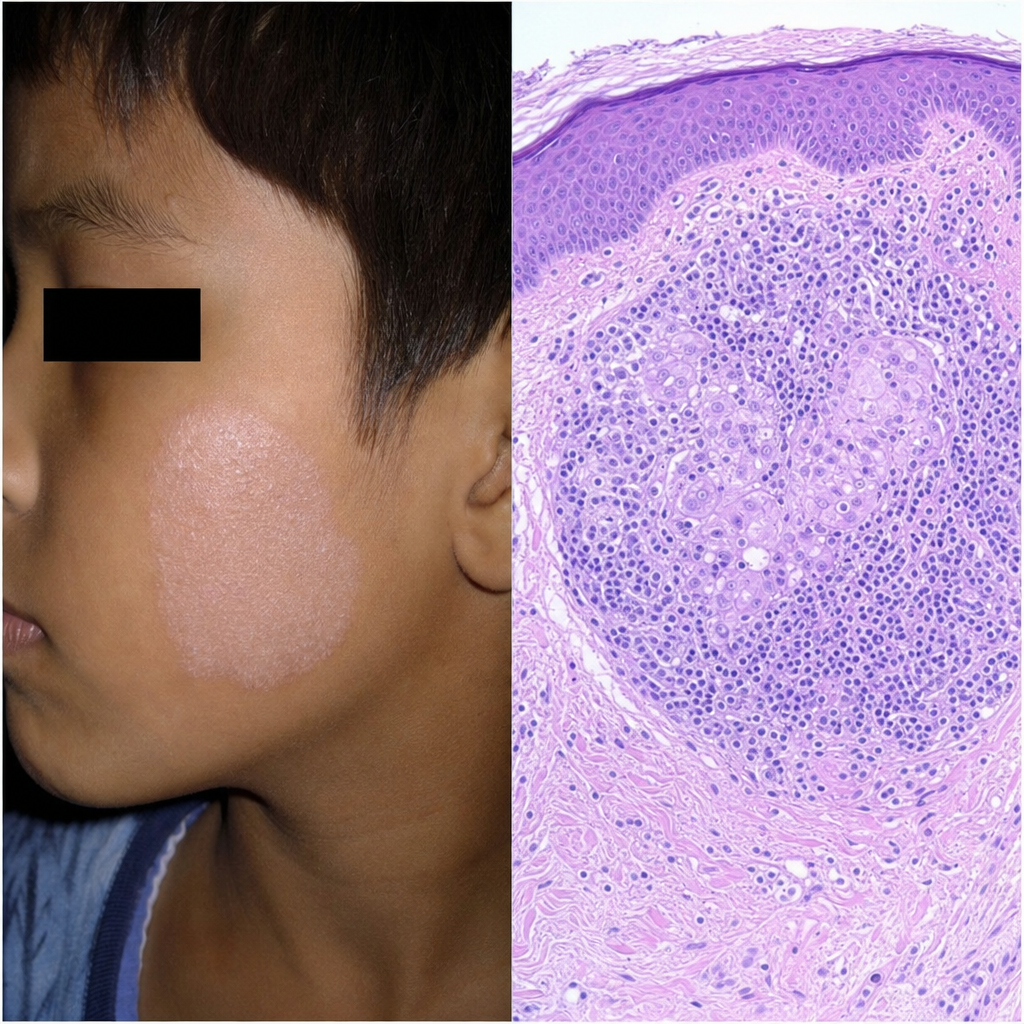
Which one of the following statements is correct regarding leprosy?
With reference to lepromin test, which one of the following statements is correct?
Painless genital ulcer is found in which one of the following genital infections?
A 45-year-old man presents with a 3-month history of progressive, painless ulcerative lesions on his penis and scrotum. He has no systemic symptoms. Laboratory tests show negative HIV, negative VDRL and TPHA, and negative HSV PCR. Biopsy shows pseudoepitheliomatous hyperplasia with plasma cells and macrophages containing intracytoplasmic organisms. What is the most likely diagnosis?
Which lymphogranuloma venereum complication is characterized by fusion of inguinal and femoral lymphadenopathy, separated by Poupart's ligament?
Which of the following best describes the appearance of a syphilitic chancre?
A man presents with a rash on his flank with itching for the past 2 weeks. The patient has tried several over-the-counter medications, including lotrimin and hydrocortisone, without any improvement. In physical examination, the rash is seen on his palms and the sole of one foot, but no oral lesions are found. What is the likely diagnosis?
Not a cutaneous manifestation of tuberculosis:
Apple jelly nodule on diascopy is a feature of:
A patient was diagnosed to have single skin lesion of Leprosy without any AFB positive bacteria from the scrapings. What should be the treatment of this patient according to latest guidelines?
Explanation: ***Type 2 Leprosy Reaction is an immune complex mediated syndrome also known as erythema nodosum leprosum*** - **Type 2 Leprosy Reaction (ENL)** is indeed an **immune complex-mediated hypersensitivity reaction** seen in cases of **multibacillary leprosy**, primarily **lepromatous leprosy** patients undergoing treatment. - It presents with painful, tender, red subcutaneous nodules, often associated with fever, malaise, arthralgia, and neuritis due to the deposition of **antigen-antibody complexes**. *Nose is the last site of involvement in lepromatous leprosy* - The **nose** is actually one of the **earliest sites of involvement** in **lepromatous leprosy** due to the preference of *Mycobacterium leprae* for cooler tissues. - Initial nasal involvement can lead to nasal stuffiness, epistaxis, and, in advanced stages, destruction of cartilage leading to a **saddle nose deformity**. *Type 1 Leprosy Reaction is also called erythema nodosum leprosum* - **Erythema Nodosum Leprosum (ENL)** is **Type 2 Leprosy Reaction**, not Type 1. - **Type 1 Leprosy Reaction** (also known as **reversal reaction**) is a **delayed-type hypersensitivity reaction** that typically occurs in borderline forms of leprosy, characterized by inflammation of existing skin lesions and nerves. *'Lion face' appearance is seen in tuberculoid leprosy* - The **"lion face" appearance (leontiasis)** is a characteristic feature of **advanced lepromatous leprosy**, not tuberculoid leprosy. - It results from diffuse skin infiltration, thickening of facial skin, and nodule formation, leading to coarse, pendulous folds and a distorted facial appearance.
Explanation: ***Lepromin test is strongly positive in tuberculoid leprosy*** - In **tuberculoid leprosy**, the immune system mounts a strong cell-mediated response against *Mycobacterium leprae*, leading to a strongly positive lepromin reaction. - A positive lepromin test indicates a good host immune response and is associated with the **paucibacillary** forms of the disease. *It can be used as a diagnostic test* - The lepromin test is not a diagnostic tool for leprosy; it primarily assesses the host's **cell-mediated immunity** to *Mycobacterium leprae* antigens. - Diagnosis of leprosy relies on **clinical signs**, **skin smears** for acid-fast bacilli, and histopathological examination, not the lepromin test. *Its interpretation is done within 24 hours* - The lepromin test interpretation involves two phases: the **Fernandez reaction** (early reaction at 24-48 hours) and the **Mitsuda reaction** (late reaction at 3-4 weeks). - The most significant and commonly referred result, the **Mitsuda reaction**, is read at **3 to 4 weeks** after injection. *It is not affected by BCG vaccine* - The **BCG vaccine**, which is used to prevent tuberculosis, can induce some cross-reactivity and lead to a positive lepromin test in individuals who have received it. - This cross-reactivity can sometimes confound the interpretation of the lepromin test, as both mycobacteria share common antigens.
Explanation: ***Granuloma inguinale*** - Presents as a **painless, slowly progressive ulcerative lesion** that bleeds easily. - Caused by *Klebsiella granulomatis*, it starts as a papule and then becomes a **beefy red, granulation tissue-like ulcer**. *Lymphogranuloma venerum* - Initially presents with a **small, painless papule or vesicle** that often goes unnoticed. - The most prominent clinical feature is **regional lymphadenopathy (buboes)**, which can be painful and suppurate. *Chancroid* - Characterized by **painful, deep, irregular ulcers** with ragged undermined borders. - These ulcers are typically **soft** and can be accompanied by painful inguinal lymphadenopathy. *Herpes simplex* - Causes **multiple, painful vesicular lesions** that quickly erode into ulcers. - These lesions often recur and are associated with **burning or itching sensations** before eruption.
Explanation: ***Granuloma inguinale (Donovanosis)*** - The presence of **painless, progressive ulcerative lesions** on the genitalia, coupled with **pseudoepitheliomatous hyperplasia** and intracellular organisms (Donovan bodies) within macrophages on biopsy, is highly characteristic of Granuloma inguinale. - The negative results for HIV, VDRL/TPHA, and HSV PCR rule out other common causes of genital ulcers, reinforcing this diagnosis. *Lymphogranuloma venereum* - Typically presents with a **transient, painless papule or ulcer**, followed by painful inguinal lymphadenopathy and **bubo formation**. This patient has progressive, painless ulcers without prominent lymphadenopathy. - Histology would show **stellate abscesses** and granulomas with a mixed inflammatory infiltrate, not pseudoepitheliomatous hyperplasia with intracellular organisms. *Tertiary syphilis* - Characterized by **gummas**, which are granulomatous lesions that can ulcerate, but these usually develop years after primary infection and are typically associated with positive VDRL/TPHA tests. - The **negative VDRL and TPHA** in this case effectively rule out active syphilis at any stage. *Squamous cell carcinoma* - While it can present as a progressive ulcerative lesion, **pseudoepitheliomatous hyperplasia** is a reactive process, not true malignancy; the presence of **intracytoplasmic organisms** on biopsy points away from a neoplastic process. - A biopsy for squamous cell carcinoma would show malignant epithelial cells with invasive growth, not macrophages with intracellular bacteria.
Explanation: ***Groove sign*** - The **groove sign** is a classic but rare complication seen in **lymphogranuloma venereum (LGV)**, characterized by separation of enlarged inguinal and femoral lymph node groups by the **inguinal ligament (Poupart's ligament)**. - This pathognomonic sign occurs when matted lymph nodes both above and below the inguinal ligament create a groove-like depression, forming the characteristic "groove of Poupart." - Seen in approximately 10-20% of LGV cases with inguinal syndrome. *Bubo* - A **bubo** is a swollen, inflamed lymph node commonly seen in **lymphogranuloma venereum** during the secondary (inguinal) stage. - While LGV causes buboes, the groove sign specifically refers to the anatomical pattern of lymphadenopathy separated by the inguinal ligament, not just any bubo. *Pseudobuboes* - **Pseudobuboes** are subcutaneous granulomatous lesions that mimic lymph node swelling but are not true lymphadenopathy. - These can occur in LGV but represent extension of infection into subcutaneous tissue rather than the specific pattern of inguinal-femoral node separation. *Phagedenic ulceration* - **Phagedenic ulceration** refers to rapidly spreading, destructive ulceration that can occur as a complication of genital ulcer diseases. - While this can occur in severe LGV, it describes the primary lesion progression, not the characteristic lymphadenopathy pattern of the groove sign.
Explanation: ***Painless, clean-based ulcer with indurated edges*** - A **syphilitic chancre** is typically a **painless ulcer**, which is a key diagnostic feature distinguishing it from other genital lesions. - It has a characteristic **clean base** and **firm, raised (indurated) edges** due to the inflammatory infiltrate. *Painful, purulent ulcer with ragged edges* - This description is more indicative of a **chancroid**, caused by *Haemophilus ducreyi*, which presents with **painful, ragged-edged ulcers** that often have a purulent base. - Chancroids typically cause **tender inguinal lymphadenopathy**, unlike the firm, non-tender lymphadenopathy associated with primary syphilis. *Vesicular lesions in clusters* - This appearance is characteristic of **genital herpes**, caused by the **herpes simplex virus (HSV)**. - Herpes lesions begin as painful vesicles that rupture to form ulcers, often recurring in the same area. *Papular lesions with central umbilication* - These lesions are typical of **molluscum contagiosum**, a viral infection. - Molluscum lesions are flesh-colored, dome-shaped papules with a distinctive **central umbilication** or dimple.
Explanation: ***Secondary syphilis*** - The rash presenting on the **palms and soles** is highly characteristic of **secondary syphilis**, which helps differentiate it from many other dermatological conditions. - The lack of improvement with antifungal (Lotrimin) and corticosteroid (hydrocortisone) treatments further supports a diagnosis other than a fungal infection or inflammatory dermatitis. *Tinea corporis* - This fungal infection typically presents as an **annular (ring-shaped) rash** with central clearing and well-demarcated borders, often on the trunk or limbs. - It would likely show some improvement, even if partial, with **Lotrimin (an antifungal medication)**, which is not the case here. *Pityriasis rosea* - This condition is characterized by an initial **"herald patch"** followed by smaller, oval, pinkish-red patches that often align along skin cleavage lines in a **"Christmas tree" pattern** on the trunk. - It typically spares the palms and soles, which are involved in this patient's presentation. *Contact dermatitis* - This is an inflammatory skin reaction due to contact with an allergen or irritant, presenting as **pruritic (itchy) erythematous (red) patches, possibly with vesicles or bullae**, limited to exposed areas. - While hydrocortisone might offer some relief, the presentation on palms and soles without clear exposure and the lack of response to treatment make it less likely.
Explanation: ***Erythema migrans*** - This **bullseye-shaped rash** is the hallmark cutaneous manifestation of **Lyme disease**, caused by *Borrelia burgdorferi*, not tuberculosis. - Its presence indicates exposure to **ticks** carrying the spirochete and is a distinct entity from mycobacterial infections. *Exanthematous lesion* - While not a specific term for TB, some forms of tuberculosis can present with a morbilliform or **exanthematous rash**, especially during disseminating or paradoxical reactions. - These are non-specific skin rashes that can occur in response to various infections, including but not exclusively tuberculosis. *Scrofuloderma* - This is a direct extension of tuberculosis from an underlying infected structure, such as a **lymph node (scrofula)** or bone, to the overlying skin. - It presents as **ulcers** or sinuses with undermining edges discharging pus, and is a definitive cutaneous manifestation of localized TB. *Lupus vulgaris* - This is a **chronic, progressive form of cutaneous tuberculosis** characterized by reddish-brown plaques with an "apple-jelly" color on diascopy. - It typically affects the face and neck and is caused by **hematogenous or lymphatic spread** from an internal TB focus in a patient with moderate to high immunity.
Explanation: ***Lupus vulgaris*** - An **apple jelly nodule** on diascopy is a classic clinical sign of **lupus vulgaris**, a severe form of cutaneous tuberculosis. - Diascopy reveals the characteristic yellowish-brown discoloration due to **tuberculous granulomas** in the dermis. *Aspergillosis* - This is a fungal infection that typically affects the **respiratory tract** and less commonly the skin, especially in immunocompromised individuals. - Skin lesions in aspergillosis are usually **necrotic ulcers** or plaques, not apple jelly nodules on diascopy. *Erysipelas* - This is a **superficial bacterial infection** of the skin and subcutaneous tissue, typically caused by *Streptococcus pyogenes*. - It presents as a bright red, swollen, raised lesion with a **distinct border**, and does not produce apple jelly nodules. *Rhinoscleroma* - This is a chronic, progressive granulomatous disease affecting the **upper respiratory tract**, caused by *Klebsiella rhinoscleromatis*. - It leads to **hard, nodular masses** in the nose and pharynx, often described as ligneous, but does not present as apple jelly nodules on diascopy.
Explanation: ***(Rifampicin + Dapsone) for 6 months*** - This regimen is the standard **Multi-Drug Therapy (MDT)** for **paucibacillary (PB) leprosy**, which is characterized by a **single skin lesion** and **negative acid-fast bacilli (AFB)** on scrapings. - The 6-month duration is effective in eradicating the infection with high cure rates and low relapse rates. * (Rifampicin + Dapsone) for 12 months* - This 12-month regimen is unnecessarily prolonged for paucibacillary leprosy, increasing the risk of side effects and reducing patient adherence without additional clinical benefit compared to the 6-month regimen. - While Rifampicin and Dapsone are correct drugs for PB leprosy, the duration is not aligned with current WHO guidelines for this specific presentation. * (Rifampicin + Dapsone + Clofazamine) for 6 months* - The addition of **Clofazamine** makes this the regimen for **multibacillary (MB) leprosy**, which presents with multiple skin lesions or positive AFB smears. - This patient's presentation of a **single lesion** and **negative AFB** clearly indicates paucibacillary leprosy, for which Clofazamine is not typically included. * (Rifampicin + Dapsone + Clofazamine) for 12 months* - This is the standard regimen for **multibacillary (MB) leprosy**, due to the presence of Clofazamine and the 12-month duration. - It is not appropriate for a patient with a **single, AFB-negative lesion**, as this presentation denotes paucibacillary leprosy requiring a shorter, two-drug treatment.
Impetigo
Practice Questions
Folliculitis, Furuncles, and Carbuncles
Practice Questions
Ecthyma
Practice Questions
Erysipelas and Cellulitis
Practice Questions
Staphylococcal Scalded Skin Syndrome
Practice Questions
Necrotizing Fasciitis
Practice Questions
Cutaneous Tuberculosis
Practice Questions
Leprosy
Practice Questions
Lyme Disease
Practice Questions
Syphilis
Practice Questions
Antibiotic Resistance in Dermatology
Practice Questions
Prophylaxis and Management
Practice Questions
Get full access to all questions, explanations, and performance tracking.
Start For Free