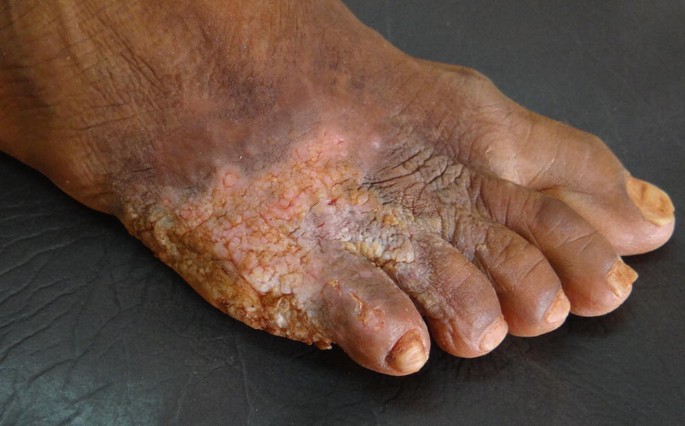
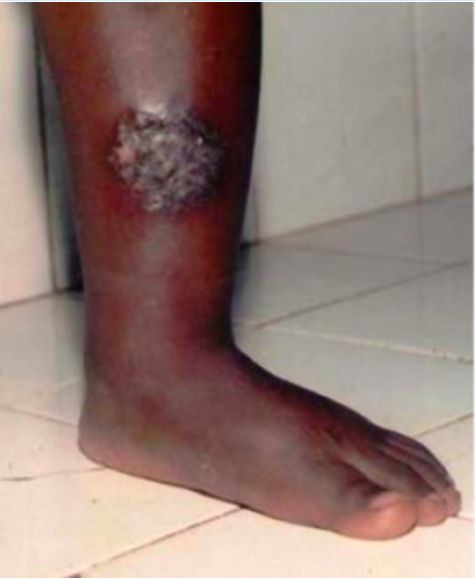
Which of the following statements regarding Botryomycosis is FALSE?
Which of the following statements about leprosy classification is true?
Which of the following is NOT true of erysipelas?
A 12-year-old child with intellectual disability presents with multiple, painful, shiny white discharging lesions around the anus. What is the most probable diagnosis?
A 65-year-old woman has developed thick, erythematous nodules on her ears and nose with significant associated sensory loss. The nodules have grown slowly over many years. Biopsy of the lesions shows dermal granulomas with giant cells but no acid-fast bacteria. Cultures on blood agar and Lowenstein-Jensen medium show no growth. What is the most likely diagnosis?
Erythrasma is caused by which bacterium?
Which of the following statements about impetigo is FALSE?
Which condition is caused by Corynebacterium minutissimum?
Symmetrical multiple lesions are seen in which type of leprosy?
Follman's balanitis is caused by?
Explanation: ### **Explanation: Botryomycosis** Botryomycosis is a rare, chronic, granulomatous bacterial infection that clinically mimics fungal infections (like actinomycosis or eumycetoma) but is caused by non-filamentous bacteria. **1. Why Option B is the Correct Answer (The False Statement):** Botryomycosis primarily affects the **integumentary system (skin and subcutaneous tissue)** in approximately 75% of cases. While a visceral form exists (affecting lungs, liver, or brain), it is much less common and typically occurs in severely immunocompromised patients. Therefore, stating that it "mainly" affects the viscera is incorrect. **2. Analysis of Other Options:** * **Option A (Chronic granulomatous disease):** This is **true**. Histologically, it is characterized by a granulomatous inflammatory response surrounding bacterial grains (Splendore-Hoeppli phenomenon). * **Option C (Staphylococcus aureus):** This is **true**. *Staphylococcus aureus* is the most common causative agent (40% of cases), followed by *Pseudomonas aeruginosa*, *E. coli*, and *Proteus*. * **Option D (Sinuses and purulent discharge):** This is **true**. The clinical hallmark is the presence of nodules, abscesses, and multiple draining sinuses that discharge pus containing "grains" (clusters of bacteria). **3. NEET-PG Clinical Pearls:** * **The "Grains":** Unlike Actinomycosis (which has sulfur granules), Botryomycosis grains are composed of masses of **true bacteria** held together by a polysaccharide matrix. * **Splendore-Hoeppli Phenomenon:** An eosinophilic, glassy material surrounding the bacterial colonies seen on H&E stain; it represents an antigen-antibody complex. * **Predisposing Factors:** Often linked to trauma, foreign bodies, or altered host immunity (e.g., Diabetes, HIV). * **Treatment:** Long-term culture-specific antibiotics and occasionally surgical debridement.
Explanation: **Explanation:** The classification of leprosy is crucial for determining the duration and regimen of Multi-Drug Therapy (MDT). The WHO classifies leprosy based on clinical features and the **Bacterial Index (BI)**, which is calculated using the Ridley Logarithmic Scale. **1. Why Option B is Correct:** According to the WHO classification, **Paucibacillary (PB) leprosy** is defined as having a Bacterial Index of **less than 2** at all sites. Conversely, Multibacillary (MB) leprosy is defined by a BI of 2 or more. Clinically, PB leprosy usually presents with 1–5 skin lesions and involvement of only one nerve trunk, while MB leprosy involves >5 lesions or multiple nerves. **2. Why the Other Options are Incorrect:** * **Option A:** A Bacterial Index of **2+** does not refer to the number of sites. It means that, on average, **1 to 10 bacilli** are seen per high-power field (100x oil immersion) across the examined slides. * **Option C & D:** For routine classification and slit-skin smears (SSS), the standard practice involves taking samples from **four sites**: both earlobes and two active lesions. Seven sites were historically used in research settings but are not the standard for routine WHO classification. **High-Yield Clinical Pearls for NEET-PG:** * **Bacterial Index (BI):** Measures the density of bacilli (live + dead). A BI of 6+ is the maximum (1000+ bacilli/field). * **Morphological Index (MI):** Measures the percentage of **solidly staining (viable)** bacilli. It is a sensitive indicator of treatment response. * **MDT Duration:** PB leprosy is treated for **6 months**, while MB leprosy is treated for **12 months**. * **Drug of Choice:** Dapsone, Rifampicin, and Clofazimine are the cornerstones of MB treatment.
Explanation: **Explanation:** **Erysipelas** is a distinct superficial form of cellulitis with prominent lymphatic involvement. 1. **Why Option D is the Correct Answer:** Erysipelas is **not** more common in the tropics; it is actually more prevalent in **temperate climates**. In contrast, other pyodermas like impetigo are more frequently seen in tropical, humid environments. This makes Option D the false statement and thus the correct answer. 2. **Analysis of Other Options:** * **Option A (Streptococcal infection):** This is true. The primary causative agent is **Group A Beta-hemolytic Streptococci** (*Streptococcus pyogenes*). Unlike cellulitis, *Staphylococcus aureus* is a rare cause of erysipelas. * **Option B (Contagious and infectious):** This is true. It is an acute infectious process that can spread through autoinoculation or direct contact, especially if there is a break in the skin barrier (e.g., tinea pedis, fissures). * **Option C (Margins are raised):** This is a hallmark feature. Because the infection is superficial (upper dermis), it presents with a **sharply demarcated, raised, and indurated border** (Milian’s ear sign). This distinguishes it from cellulitis, which has ill-defined, non-raised borders. **Clinical Pearls for NEET-PG:** * **Classic Appearance:** "St. Anthony’s Fire" – characterized by a fiery red, painful, shiny, and edematous plaque. * **Milian’s Ear Sign:** Involvement of the pinna (ear) suggests erysipelas because the ear lacks deep subcutaneous tissue, making cellulitis impossible at that site. * **Treatment of Choice:** Parenteral or oral **Penicillin** remains the gold standard. * **Predisposing Factor:** Chronic lymphedema is the most significant risk factor for recurrent erysipelas.
Explanation: **Explanation:** The clinical presentation of multiple, painful, shiny white discharging lesions in the perianal region of a child is highly suggestive of **Condyloma Lata**, a hallmark of **Secondary Syphilis**. **Why Syphilitic Condyloma is correct:** Condyloma lata are hypertrophic, papular lesions found in moist intertriginous areas (like the anus or axilla). They are characterized by a "flat-topped," "moist," or "shiny white" appearance due to maceration and are highly infectious, teeming with *Treponema pallidum*. In a child with intellectual disability, this presentation should raise immediate suspicion of sexual abuse leading to an acquired sexually transmitted infection. **Why other options are incorrect:** * **Lupus Vulgaris:** This is a chronic form of cutaneous tuberculosis characterized by "apple-jelly nodules" on diascopy. It typically presents on the face and neck, not as acute discharging perianal lesions. * **Carcinoma:** Squamous cell carcinoma of the anus usually presents as a hard, indurated, non-healing ulcer or mass in older adults, rather than multiple moist lesions in a child. * **Hemorrhoids:** These are vascular cushions. While they can cause pain and bleeding, they do not present as "shiny white discharging" infectious papules. **NEET-PG High-Yield Pearls:** * **Condyloma Lata vs. Condyloma Acuminata:** Lata is flat-topped and moist (Secondary Syphilis); Acuminata is cauliflower-like and warty (HPV 6, 11). * **Dark-field Microscopy:** The gold standard for immediate diagnosis of Condyloma Lata, showing motile spirochetes. * **Screening:** Always perform a VDRL/RPR test. In pediatric cases, a thorough social evaluation for potential abuse is mandatory.
Explanation: ### Explanation **Correct Answer: D. Tuberculoid leprosy** The diagnosis is based on the clinical triad of **slow-growing erythematous nodules**, **significant sensory loss**, and specific histopathological findings. In **Tuberculoid Leprosy (TT)**, the host's cell-mediated immunity (CMI) is high. This strong immune response results in well-formed **dermal granulomas** with giant cells that effectively clear the bacilli. Consequently, Acid-Fast Bacilli (AFB) are typically absent on skin smears or biopsies (paucibacillary). *Mycobacterium leprae* is an obligate intracellular organism that **cannot be cultured** on artificial media like Blood agar or Lowenstein-Jensen (LJ) medium, which aligns with the negative culture results. **Why other options are incorrect:** * **Cutaneous leishmaniasis:** While it presents with nodules/ulcers, it does not typically cause sensory loss. Diagnosis is confirmed by finding LD bodies on a smear. * **Onchocerciasis:** Presents with subcutaneous nodules (onchocercomata) and "hanging groin," but is not associated with localized sensory loss or the specific granulomatous pattern of leprosy. * **Rhinoscleroma:** Caused by *Klebsiella rhinoscleromatis*, it involves the nose but presents with "Mikulicz cells" and can be grown on standard culture media. It does not cause sensory loss. **High-Yield Clinical Pearls for NEET-PG:** * **Culture:** *M. leprae* is the only human bacterial pathogen that has never been cultured in vitro. It is grown in the **footpads of mice** or **nine-banded armadillos**. * **Lepromin Test:** Strongly positive in Tuberculoid (TT) leprosy (high CMI) and negative in Lepromatous (LL) leprosy (low CMI). * **Histology:** TT shows granulomas following the neurovascular bundles; LL shows "Grenz zone" (a clear subepidermal band) and Macrophages filled with bacilli (Virchow cells). * **Nerve Involvement:** Sensory loss is a hallmark of Leprosy; the **Greater Auricular Nerve** is often palpated when ear lesions are present.
Explanation: **Explanation:** **Erythrasma** is a common, chronic, superficial bacterial infection of the skin folds (intertriginous areas). 1. **Why Option A is correct:** The causative agent is **Corynebacterium minutissimum**, a Gram-positive, non-spore-forming, aerobic/facultative anaerobic bacillus. It thrives in warm, humid environments and invades the upper third of the stratum corneum. The characteristic clinical feature is a well-demarcated, reddish-brown, scaly patch, typically found in the axillae, groin, or toe webs. 2. **Why the other options are incorrect:** * **B. C. diphtheriae:** The primary agent of respiratory diphtheria; it can cause cutaneous diphtheria (punched-out ulcers), but not erythrasma. * **C. C. ulcerans:** Primarily causes skin ulcers and pharyngitis; it is a zoonotic pathogen often transmitted via raw milk or infected animals. * **D. C. vaginale:** Now reclassified as *Gardnerella vaginalis*, it is the primary organism associated with bacterial vaginosis, not skin fold infections. **High-Yield Clinical Pearls for NEET-PG:** * **Wood’s Lamp Examination:** This is the gold standard for bedside diagnosis. Erythrasma shows a characteristic **Coral-red fluorescence** due to the production of **Coproporphyrin III** by the bacteria. * **Differential Diagnosis:** Often confused with Tinea cruris (which has central clearing and active borders) or Intertrigo. * **Treatment of Choice:** Topical **Clindamycin** or Erythromycin is preferred. For extensive cases, oral Macrolides (Erythromycin or Clarithromycin) are effective.
Explanation: ### Explanation **1. Why Option C is the Correct (False) Statement:** Impetigo is a **superficial** bacterial infection of the skin, specifically involving the **epidermis** (subcorneal layer). Because the infection does not penetrate the basement membrane or involve the dermis, it **heals without scarring**. Any residual changes are usually limited to temporary post-inflammatory hyperpigmentation. If an infection deepens to involve the dermis (becoming Ecthyma), it will result in scarring. **2. Analysis of Incorrect Options:** * **Option A:** This is **True**. *Staphylococcus aureus* is currently the most common cause of both bullous and non-bullous impetigo worldwide. *Streptococcus pyogenes* (Group A Beta-hemolytic Strep) is the second most common cause, often seen in non-bullous cases. * **Option B:** This is **True**. Non-bullous impetigo caused by "nephritogenic" strains of *S. pyogenes* can lead to **Post-Streptococcal Glomerulonephritis (PSGN)**. Notably, unlike pharyngitis, skin infections do **not** predispose to Rheumatic Fever. * **Option D:** This is incorrect because Option C is a false statement. **3. High-Yield Clinical Pearls for NEET-PG:** * **Non-bullous Impetigo (Impetigo Contagiosa):** Characterized by "honey-colored crusts." Most common form. * **Bullous Impetigo:** Always caused by *S. aureus*. It is mediated by **Exfoliative Toxin A**, which targets **Desmoglein-1** (similar to Pemphigus Foliaceus). * **Ecthyma:** Often described as a "deep form of impetigo" that produces "punched-out ulcers" and **does** result in scarring. * **Treatment:** Topical Mupirocin is the drug of choice for localized lesions. Systemic antibiotics (e.g., Cloxacillin or Amoxicillin-Clavulanate) are used for extensive cases.
Explanation: **Explanation:** **Erythrasma** is a superficial bacterial infection caused by **Corynebacterium minutissimum**, a Gram-positive, non-spore-forming bacillus. It typically presents as well-demarcated, reddish-brown, scaly patches in intertriginous areas (axilla, groin, and toe webs). The hallmark of this condition is the production of **coproporphyrin III** by the bacteria, which results in a characteristic **coral-red fluorescence** under Wood’s lamp examination. **Analysis of Incorrect Options:** * **A. Erysipelas:** A superficial cutaneous cellulitis with prominent lymphatic involvement, primarily caused by **Group A Beta-hemolytic Streptococci** (*S. pyogenes*). It presents as a bright red, edematous, "orange-peel" (peau d'orange) plaque with sharply defined borders. * **C. Erysipeloid disease:** An occupational zoonotic infection (common in fishermen and butchers) caused by **Erysipelothrix rhusiopathiae**. It typically presents as a violaceous, painful lesion on the hands. * **D. Scrum pox:** A form of **Herpes Simplex Virus (HSV-1)** infection spread through skin-to-skin contact, commonly seen among rugby players (also known as Herpes gladiatorum). **High-Yield Clinical Pearls for NEET-PG:** * **Wood’s Lamp:** Coral-red fluorescence is the pathognomonic diagnostic feature for Erythrasma. * **Treatment of Choice:** Topical Fusidic acid or Clindamycin for localized cases; Oral **Erythromycin** or Clarithromycin for extensive involvement. * **Differential Diagnosis:** Often confused with Tinea cruris (which has a central clearing and active border) or Intertrigo (candidal). Erythrasma lacks the satellite lesions seen in Candidiasis.
Explanation: **Explanation:** The distribution and number of lesions in leprosy are determined by the host's **Cell-Mediated Immunity (CMI)**. 1. **Why Lepromatous (LL) is correct:** In Lepromatous Leprosy, the host has **minimal or absent CMI** against *Mycobacterium leprae*. This allows for uncontrolled hematogenous spread of the bacilli, resulting in **numerous, small, and symmetrically distributed** lesions. These lesions are typically macules, papules, or nodules (lepromas) with ill-defined borders and a shiny surface. 2. **Why other options are incorrect:** * **Tubercular (TT):** Characterized by **strong CMI**, which limits the disease. Lesions are typically **solitary or very few (1-3)** and are **asymmetrical** with well-defined margins and complete anesthesia. * **Borderline (BT/BB/BL):** These represent the unstable middle of the spectrum. While Borderline Lepromatous (BL) can show many lesions, they are usually **asymmetrical** compared to the "mirror-image" symmetry seen in polar LL. * **Neuritic:** This is a pure neural form involving peripheral nerves without any visible skin lesions. **High-Yield Clinical Pearls for NEET-PG:** * **Symmetry Rule:** The closer a patient is to the Lepromatous pole (LL), the more symmetrical and numerous the lesions become. * **Leonine Facies:** Seen in LL due to diffuse infiltration of the face and loss of eyebrows (**Madarosis**). * **Grenz Zone:** A characteristic histological feature of LL where a clear band of dermis separates the epidermis from the underlying lepromatous infiltrate. * **Bacteriological Index (BI):** Highest in LL (strongly positive), while TT is typically paucibacillary (BI = 0).
Explanation: **Explanation:** **Follman’s Balanitis** (also known as *Balanitis Syphilitica Follman*) is a rare, primary manifestation of **Syphilis**, caused by the spirochete ***Treponema pallidum***. Unlike the classic hard chancre, this condition presents as a diffuse, indurated, and painless inflammation of the glans penis. Because the correct causative agent (*T. pallidum*) is not listed among the options, **Option D (None of the above)** is the correct choice. **Analysis of Options:** * **Trichomonas (A):** *Trichomonas vaginalis* typically causes a frothy, malodorous discharge and "strawberry cervix" in females. In males, it may cause non-gonococcal urethritis or mild balanoposthitis, but it is not the cause of Follman’s balanitis. * **Candida (B):** *Candida albicans* is the most common cause of fungal balanitis, characterized by pruritus, erythematous satellite lesions, and a curd-like white discharge. * **Haemophilus ducreyi (C):** This is the causative agent of **Chancroid**, which presents as painful, soft ulcers with ragged edges and associated painful inguinal lymphadenopathy (buboes). **High-Yield Clinical Pearls for NEET-PG:** * **Clinical Presentation:** Follman’s balanitis is a "chancre redux" variant where the glans appears red, swollen, and "meaty" without a focal ulcer. * **Diagnosis:** Dark-field microscopy of serous exudate from the glans will reveal motile spirochetes. * **Other Balanitis Types to Remember:** * **Zoon’s Balanitis:** Plasma cell infiltration; presents as "cayenne pepper" spots. * **Circinate Balanitis:** Associated with Reactive Arthritis (Reiter’s Syndrome). * **Balanitis Xerotica Obliterans (BXO):** A form of Lichen Sclerosus; presents as white, atrophic patches and can lead to phimosis.
Impetigo
Practice Questions
Folliculitis, Furuncles, and Carbuncles
Practice Questions
Ecthyma
Practice Questions
Erysipelas and Cellulitis
Practice Questions
Staphylococcal Scalded Skin Syndrome
Practice Questions
Necrotizing Fasciitis
Practice Questions
Cutaneous Tuberculosis
Practice Questions
Leprosy
Practice Questions
Lyme Disease
Practice Questions
Syphilis
Practice Questions
Antibiotic Resistance in Dermatology
Practice Questions
Prophylaxis and Management
Practice Questions
Get full access to all questions, explanations, and performance tracking.
Start For Free