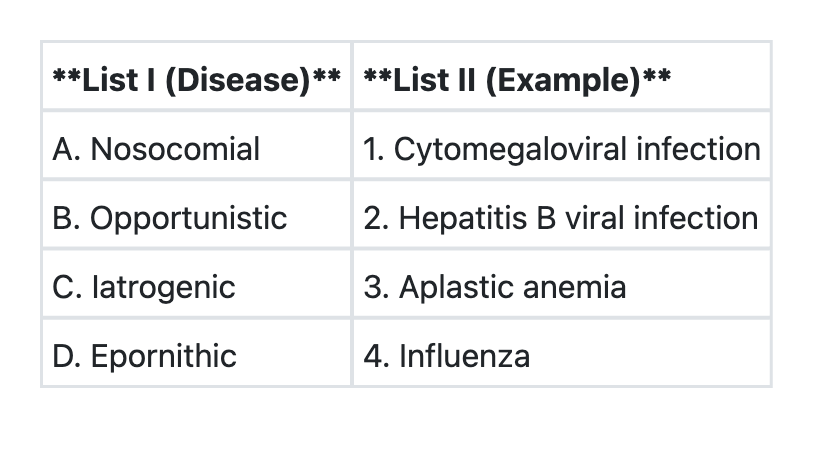
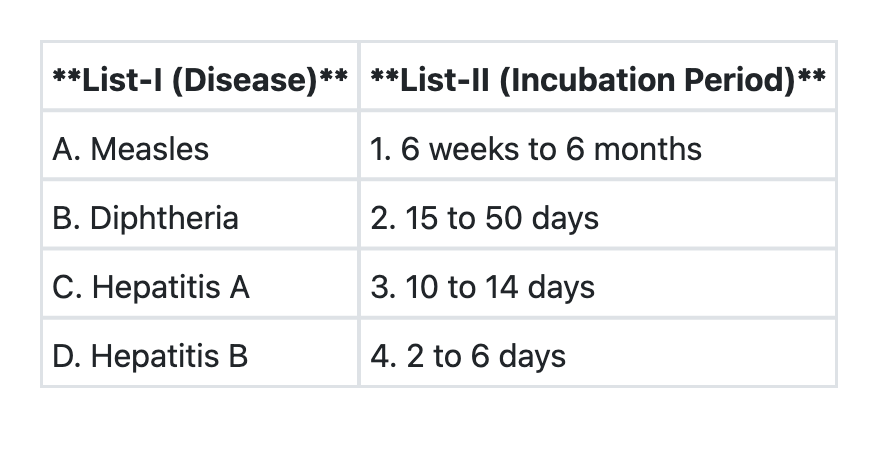
Influenza pandemics typically show which type of epidemiological trend?
The book "Airs, Water and Places", considered a treatise on social medicine and hygiene, is a work of which of the following authors?
What does 'lead time' refer to in the context of disease screening and diagnosis?
In which aspect is a case-control study superior to a cohort study?
All of the following are true about DOTS except:
Which of the following types of bias can be reduced by allowing equal interview time?
Which of the following is an example of multipurpose screening?
Which of the following statements about incidence is true?
Which indicator is used in the Revised National Tuberculosis Control Programme (RNTCP) to measure the impact of control measures?
Change in the incidence of an infectious disease is best judged in relation to past incidence as reflected in monthly records. Mild incidence will be considered if:
Explanation: ### Explanation **Correct Answer: B. Cyclical** **Why Cyclical is correct:** In epidemiology, a **cyclical trend** refers to the occurrence of a disease in periodic waves or cycles spanning several years. Influenza pandemics are the classic example of this trend. They occur at irregular intervals (typically every 10–40 years) due to **Antigenic Shift**. This major genetic change results in a completely new subtype of the Hemagglutinin or Neuraminidase proteins, to which the global population has no immunity, leading to a worldwide pandemic. **Why other options are incorrect:** * **A. Secular:** This refers to long-term changes (decades or centuries) in the occurrence of a disease, such as the gradual decline of Tuberculosis or the rise of lifestyle diseases like Diabetes. While pandemics happen over decades, the "wave-like" recurrence makes them cyclical. * **C. Seasonal:** This refers to fluctuations within a single year based on environmental factors. While **seasonal influenza** (epidemics) occurs every winter in temperate climates due to **Antigenic Drift**, the question specifically asks for **pandemics**, which follow a multi-year cyclical pattern. **NEET-PG High-Yield Pearls:** * **Antigenic Shift:** Major change $\rightarrow$ New subtype $\rightarrow$ **Pandemic** (Cyclical trend). * **Antigenic Drift:** Minor change (point mutations) $\rightarrow$ Same subtype $\rightarrow$ **Epidemic** (Seasonal trend). * **Other Cyclical Examples:** Measles (pre-vaccination era, every 2–3 years) and Rubella (every 6–9 years). * **Secular Trend Example:** The steady increase in Coronary Heart Disease over the last 50 years.
Explanation: **Explanation:** The correct answer is **Hippocrates (Option A)**. Often referred to as the "Father of Medicine," Hippocrates was the first to transition medicine from a realm of superstition to one of scientific observation. In his classic treatise, **"Airs, Waters and Places,"** he proposed that human health is influenced by environmental factors rather than divine punishment. This work is considered the foundation of epidemiology and social medicine, as it emphasized the relationship between disease and the environment (climate, water quality, and geography). **Analysis of Incorrect Options:** * **John Snow (Option B):** Known as the "Father of Modern Epidemiology." He is famous for his work on the 1854 cholera outbreak in London (Broad Street Pump) and for demonstrating that cholera is water-borne. * **John Simon (Option C):** He was the first Chief Medical Officer of the UK and a pioneer in public health administration and sanitary reforms during the 19th century. * **John M. Last (Option D):** A modern epidemiologist famous for defining the "Iceberg Phenomenon of Disease" and editing the "Dictionary of Epidemiology." **High-Yield Clinical Pearls for NEET-PG:** * **Hippocrates:** Also credited with the "Hippocratic Oath" and the "Humoral Theory" (Blood, Phlegm, Yellow Bile, Black Bile). * **First Epidemiologist:** Hippocrates is regarded as the first epidemiologist in history. * **James Lind:** Conducted the first clinical trial (Scurvy/Citrus fruits). * **Edward Jenner:** Developed the first vaccine (Smallpox). * **William Farr:** Known as the "Father of Vital Statistics."
Explanation: ### Explanation **Lead time** is a fundamental concept in screening epidemiology. It represents the period of time by which a diagnosis is advanced through the use of a screening test compared to the time it would have been diagnosed based on the appearance of clinical symptoms. **1. Why Option B is Correct:** The "first possible point of detection" is the moment a screening test can identify the disease (during the subclinical phase). The "usual time of diagnosis" is when the patient would typically seek medical attention due to symptoms. By detecting the disease earlier, we gain "lead time." It is important to note that lead time does not necessarily improve the prognosis; it may simply increase the duration a patient is aware they have the disease (**Lead Time Bias**). **2. Analysis of Incorrect Options:** * **Option A:** This describes the total duration of the preclinical phase, but lead time specifically relates to the intervention of a screening test. * **Option C:** This refers to the **Biological Pre-clinical Phase**, where the disease has started but is not yet detectable by any known tests. * **Option D:** This describes the **Screenable Period** or the window of opportunity before a "critical point" (after which treatment becomes ineffective). **3. NEET-PG Clinical Pearls:** * **Lead Time Bias:** An error in evaluating screening programs where survival appears longer simply because the disease was diagnosed earlier, not because the patient lived longer. * **Length Bias:** Screening tends to detect slowly progressing cases (better prognosis) rather than rapidly progressing ones. * **Screening vs. Case Finding:** Screening is testing asymptomatic individuals; case finding is testing patients who have sought care for unrelated reasons.
Explanation: ### Explanation **Correct Option: C. Shorter study duration** **Why it is correct:** A **Case-Control study** is retrospective in nature. It begins with the identification of "cases" (those with the disease) and "controls" (those without), then looks backward in time to assess exposure. Since the outcome has already occurred at the start of the study, data collection is rapid and inexpensive. In contrast, a **Cohort study** is typically prospective; it starts with healthy individuals and follows them over a long period to see who develops the disease, making it time-consuming and costly. **Why other options are incorrect:** * **A. Reduced likelihood of bias:** Case-control studies are actually *more* prone to bias, particularly **Recall Bias** (patients with the disease remember exposures differently) and **Selection Bias**. Cohort studies are generally more robust. * **B. Greater accuracy:** Cohort studies provide more accurate data regarding the temporal relationship between exposure and outcome (incidence), whereas case-control studies are better suited for generating hypotheses. * **D. Ability to calculate relative risk:** This is a classic NEET-PG trap. Case-control studies cannot calculate **Relative Risk (RR)** because they do not measure incidence. They can only estimate risk using the **Odds Ratio (OR)**. RR is calculated in Cohort studies. **High-Yield Clinical Pearls for NEET-PG:** * **Case-Control Study:** Best for **rare diseases** and diseases with long latency periods. * **Cohort Study:** Best for **rare exposures** and determining the incidence of a disease. * **Mnemonic for RR vs. OR:** **C**ohort = **R**elative **R**isk (both have 'R'); Case-C**o**ntrol = **O**dds Ratio (both have 'O'). * **Nested Case-Control Study:** A hybrid design that is more cost-effective than a full cohort study but reduces selection/recall bias compared to a standard case-control study.
Explanation: **Explanation** The question asks to identify the false statement regarding **DOTS (Directly Observed Treatment, Short-course)**, the core strategy of the National Tuberculosis Elimination Program (NTEP). **Why "None" is the correct answer:** In this specific question structure, "None" implies that all the provided statements (C and D) are actually **true** regarding the DOTS strategy. Therefore, there is no "incorrect" statement among the choices. **Analysis of Options:** * **Option C (True):** Under NTEP, drugs for both the Intensive Phase (IP) and Continuation Phase (CP) are provided in **Monthly Multiblister Combipacks (MBCP)**. This ensures the correct dosage, improves patient compliance, and simplifies logistics. * **Option D (True):** The fundamental pillar of DOTS is that a trained health worker or a designated community member (DOT provider) must **observe the patient swallowing the medication**. This ensures adherence and prevents the development of Multi-Drug Resistant TB (MDR-TB). **High-Yield NEET-PG Pearls:** * **5 Pillars of DOTS:** Political commitment, Good quality microscopy (Diagnosis), Uninterrupted supply of quality drugs, Direct observation of treatment, and Systematic recording/reporting. * **Current Protocol:** NTEP has shifted from intermittent (thrice weekly) to a **Daily Regimen** using Fixed-Dose Combinations (FDCs). * **Weight Bands:** Drugs are administered based on four specific weight bands (25–39 kg, 40–54 kg, 55–69 kg, and ≥70 kg). * **Digital DOTS:** Modern variations include **99DOTS** (phone-based) and **Video-observed therapy (VOT)** to reduce the physical burden on patients.
Explanation: ### Explanation **Interviewer Bias** occurs when the investigator’s preconceived notions or systematic differences in the way data is collected influence the results. This often happens when an interviewer spends more time, asks more probing questions, or provides more cues to the "cases" compared to the "controls." By **standardizing the interview process**—such as allowing equal interview time and using structured questionnaires—the investigator ensures that both groups are treated identically, thereby minimizing this bias. #### Analysis of Incorrect Options: * **Berksonian Bias (Admission Rate Bias):** This is a type of selection bias that occurs in hospital-based case-control studies because the combination of two diseases increases the likelihood of hospital admission. It is related to the study setting/sampling, not the interview process. * **Recall Bias:** This occurs when cases (diseased individuals) remember past exposures more clearly or differently than controls. It is a limitation of the respondent's memory, not the interviewer's behavior. It is best reduced by using objective records or blinding the participants. * **Selection Bias:** This refers to systematic errors in the process of identifying the study populations (e.g., non-response bias or volunteer bias). It occurs at the recruitment stage, whereas interviewer bias occurs during the data collection stage. #### NEET-PG High-Yield Pearls: * **Blinding:** The most effective way to eliminate interviewer bias is to keep the interviewer "blind" to the hypothesis or the case/control status of the participant. * **Hawthorne Effect:** A type of bias where study participants change their behavior because they know they are being watched. * **Lead-time Bias:** Often confused with epidemiology biases, this is specific to screening programs where early diagnosis makes it appear as though survival has increased, even if the course of the disease is unchanged.
Explanation: **Explanation:** **Screening** is the process of identifying unrecognized diseases in apparently healthy individuals using rapidly applied tests. Screening is classified into different types based on the objective and the population covered. **Why Option B is Correct:** **Multipurpose (or Multiphasic) Screening** refers to the application of two or more screening tests to a large population at the same time to detect several diseases simultaneously, rather than focusing on a single disease. **Annual health check-ups** are the classic example because they involve a battery of tests (e.g., blood pressure, blood glucose, lipid profile, and BMI) to screen for multiple non-communicable diseases (NCDs) like hypertension, diabetes, and obesity in one visit. **Analysis of Incorrect Options:** * **Option A (Chest X-ray for TB):** This is an example of **Mass Screening**, where a single screening test is applied to the whole population (or a large subgroup) regardless of the risk level. * **Option C (Pap smear in elderly):** This is an example of **Selective (High-risk) Screening**. It targets a specific group known to be at higher risk for a particular condition (Cervical Cancer). * **Option D (Eye check-up in school children):** This is also a form of **Mass/Selective Screening** targeting a specific age group for a single morbidity (refractive errors). **High-Yield NEET-PG Pearls:** * **Opportunistic Screening:** When a patient visits a doctor for one complaint (e.g., a cold) and the doctor screens them for another (e.g., checking BP). * **Lead Time:** The period between early detection by screening and the time of usual clinical diagnosis. * **Iceberg Phenomenon:** Screening is primarily aimed at the "submerged portion" of the iceberg (latent, undiagnosed, or asymptomatic cases).
Explanation: **Explanation:** **1. Why Option A is Correct:** Incidence is defined as the number of **new cases** occurring in a defined population during a specific period. It is a measure of the **rate** at which a disease develops. Because incidence only counts the event of "becoming ill," it is independent of how long the patient remains ill. Whether a disease lasts 2 days or 20 years, it is counted as exactly one incident case at the time of onset. **2. Why the Other Options are Incorrect:** * **Option B:** Incidence is not always more than prevalence. In chronic diseases (like Diabetes), prevalence is usually much higher than incidence because cases accumulate over time. * **Option C:** Incidence measures **only new cases**. Prevalence is the measure that combines both old and new cases ($P = I \times D$). * **Option D:** Incidence is primarily used for **acute conditions** (e.g., influenza, outbreaks) to study etiology and causation. Prevalence is the preferred measure for chronic conditions to assess the burden on the healthcare system. **3. High-Yield Clinical Pearls for NEET-PG:** * **The Formula:** $Prevalence (P) = Incidence (I) \times Mean\ Duration\ of\ disease (D)$. * **Denominator:** The denominator for Incidence is "Population at Risk," whereas for Prevalence, it is the "Total Population" (at risk + already diseased). * **Attack Rate:** This is a type of incidence rate used specifically during short-term outbreaks. * **Rule of Thumb:** If a new treatment is discovered that cures a disease quickly (decreasing duration), the **Prevalence will decrease**, but the **Incidence will remain unchanged**.
Explanation: ### Explanation **Correct Answer: C. Annual Infection Rate (ARI)** The **Annual Risk of Tuberculosis Infection (ARI)** is considered the most sensitive and reliable indicator for measuring the impact of TB control measures and the overall trend of the disease in a community. * **Underlying Concept:** ARI represents the probability of a person being infected with *M. tuberculosis* over the course of one year. It reflects the "force of infection" or the transmission pressure in a population. A declining ARI indicates that control measures (like early diagnosis and effective treatment) are successfully reducing the pool of infectious cases, thereby preventing new infections. **Analysis of Incorrect Options:** * **A. Prevalence of infection:** This measures the total pool of infected individuals at a single point in time. It is influenced by past transmission and does not accurately reflect the *current* effectiveness of control programs. * **B. Incidence of new cases:** While important, measuring the true incidence of TB is difficult in high-burden countries due to under-reporting and diagnostic challenges. ARI is a more stable surrogate for transmission dynamics. * **D. Number of people having access to DOTS:** This is a **process indicator** (measuring coverage/input), not an impact indicator. It tells us about the reach of the program but not the actual epidemiological impact on the disease burden. **High-Yield Clinical Pearls for NEET-PG:** * **ARI Calculation:** A 1% ARI roughly corresponds to 50 new smear-positive cases per 100,000 population per year. * **Styblo’s Rule:** This describes the mathematical relationship between ARI and the incidence of smear-positive TB. * **Current Program Status:** Note that RNTCP has been renamed the **National Tuberculosis Elimination Program (NTEP)** with the goal of ending TB by 2025. * **Primary Tool for ARI:** It is typically measured using **Tuberculin Skin Tests (TST)** in unvaccinated children (to avoid BCG interference).
Explanation: This question pertains to the **epidemiological surveillance and classification of disease intensity** based on incidence rates. In public health, monitoring the number of new cases (incidence) over a specific timeframe is essential for identifying outbreaks and determining the level of intervention required. ### **Explanation of the Correct Option** **Option A (1-3 new cases per 100,000 per week)** is the correct answer. According to standard epidemiological benchmarks used to categorize the intensity of infectious disease transmission: * **Mild Incidence:** 1–3 new cases per 100,000 population per week. * **Moderate Incidence:** 3–5 new cases per 100,000 population per week. * **Severe/High Incidence:** >5 new cases per 100,000 population per week. These thresholds help health authorities differentiate between sporadic cases and the early stages of an epidemic. ### **Analysis of Incorrect Options** * **Option B (3-5 cases):** This range defines **Moderate incidence**. At this level, public health measures are usually intensified to prevent the disease from reaching epidemic proportions. * **Options C and D (5-15 cases):** These values represent **High or Severe incidence**. Such rates often trigger emergency response protocols, as they indicate widespread community transmission or an active outbreak. ### **High-Yield Pearls for NEET-PG** * **Incidence vs. Prevalence:** Remember that incidence measures the number of *new* cases (rate) and is best for acute conditions, while prevalence measures *all* existing cases (ratio) and is better for chronic conditions. * **Epidemic Threshold:** An epidemic is defined when the incidence of a disease is clearly in excess of "normal expectancy." * **Cyclic Trend:** If the incidence increases at regular intervals (e.g., every 2-3 years), it is known as a periodic or cyclic trend (common in Measles). * **Secular Trend:** A consistent increase or decrease in incidence over a long period (decades).
Principles of Epidemiology
Practice Questions
Measures of Disease Frequency
Practice Questions
Epidemiological Study Designs
Practice Questions
Descriptive Epidemiology
Practice Questions
Analytical Epidemiology
Practice Questions
Experimental Epidemiology
Practice Questions
Screening for Disease
Practice Questions
Surveillance Systems
Practice Questions
Investigation of an Epidemic
Practice Questions
Association and Causation
Practice Questions
Modern Epidemiological Methods
Practice Questions
Critical Appraisal of Epidemiological Studies
Practice Questions
Get full access to all questions, explanations, and performance tracking.
Start For Free