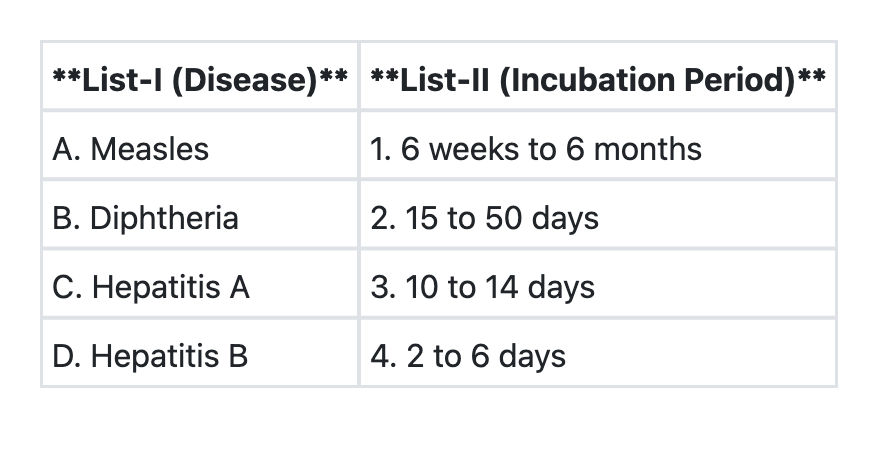
All of the following are indicators of the Physical Quality of Life Index except?
Man is the dead-end host for which of the following infections?
All of the following are true for a screening test except?
Approximately how many people can one tuberculosis-infected person infect in one year?
General fertility rate is a better measure of fertility than the crude birth rate because the denominator includes which of the following?
Berksonian bias is due to which of the following?
What is the principal impact indicator in Iodine Deficiency disorders?
Confounding can be eliminated by all except:
Which of the following statements about measles is FALSE?
Which of the following is a quarantinable disease?
Explanation: The **Physical Quality of Life Index (PQLI)** is a composite index developed by Morris David Morris to measure the quality of life or social well-being of a population. Unlike the Human Development Index (HDI), which includes economic factors, the PQLI focuses purely on social and health indicators. ### Why "Level of Living" is the Correct Answer **Level of Living** is a broad concept defined by the United Nations that includes nine components (health, food consumption, education, occupation, etc.). While it relates to well-being, it is **not** a component of the PQLI. It is often confused with the "Standard of Living," which is an economic measure (GNP/GDP). ### Explanation of Incorrect Options (Components of PQLI) The PQLI is calculated using three specific indicators, each scored from 0 to 100: * **Infant Mortality Rate (IMR):** A sensitive indicator of the health status of a population and the availability of primary health care. * **Life Expectancy at Age 1:** Note that PQLI uses life expectancy at **age 1**, whereas the Human Development Index (HDI) uses life expectancy at **birth**. * **Literacy:** Specifically, the adult literacy rate (percentage of the population aged 15+ who can read and write). ### High-Yield Pearls for NEET-PG * **PQLI Range:** The index ranges from **0 (worst)** to **100 (best)**. * **PQLI vs. HDI:** * **PQLI** = IMR + Life Expectancy at Age 1 + Literacy. (Mnemonic: **LIL**) * **HDI** = Life Expectancy at Birth + Mean/Expected Years of Schooling + Per Capita GNI. * **Key Distinction:** PQLI does **not** include per capita income (economic growth), making it a better measure of social distribution and equity than GDP. * **India's Context:** In India, Kerala was the first state to achieve a high PQLI score comparable to developed nations.
Explanation: ### Explanation **1. Understanding the Concept: Dead-end Host** A **dead-end host** (or incidental host) is an organism from which an infectious agent cannot be transmitted to another susceptible host. This usually occurs because the pathogen does not reach a sufficient concentration in the blood (viremia/bacteremia) or tissues to be picked up by a vector or shed into the environment to continue its life cycle. **2. Why Option D is Correct** * **Rabies:** Humans are infected through the bite of a rabid animal (usually a dog). While the virus travels to the human brain, humans do not typically bite other humans or animals to transmit the virus further. Thus, the chain of transmission ends with the human. * **Tetanus:** *Clostridium tetani* spores enter the body through contaminated wounds. The bacteria produce toxins locally; however, tetanus is **not communicable** from person to person. The bacteria are not shed from the patient to infect others. **3. Why Other Options are Incorrect** * **Measles (Options A & B):** Humans are the **only reservoir** and the primary source of infection. It is highly contagious via respiratory droplets. Humans are definitely not dead-end hosts here. * **Yellow Fever (Options B & C):** In the **Urban Cycle**, humans serve as a reservoir where the *Aedes aegypti* mosquito picks up the virus from an infected person and transmits it to another. Therefore, humans are part of the active transmission cycle. **4. NEET-PG High-Yield Pearls** * **Other Dead-end Hosts:** Humans are also dead-end hosts for **Japanese Encephalitis (JE)**, **Hydatid Disease** (*Echinococcus granulosus*), and **Trichinellosis**. * **JE Exception:** In Japanese Encephalitis, the **pig** is the "amplifier host," and the **Ardeid bird** is the "natural reservoir," while the human is the dead-end host. * **Tetanus Key Fact:** It is the only infectious disease that is **non-communicable** but vaccine-preventable.
Explanation: In epidemiology, it is crucial to distinguish between a **Screening Test** and a **Diagnostic Test**. ### Why "Forms the basis for treatment" is the Correct Answer (The Exception) A screening test is applied to **apparently healthy (asymptomatic)** individuals to identify those who *might* have a disease. It is not intended to be definitive. Because screening tests often yield false positives, initiating treatment based solely on a screening result is clinically unsafe. Treatment must always be based on a **Diagnostic Test**, which confirms the presence or absence of the disease in symptomatic individuals or those who screened positive. ### Explanation of Other Options * **A. Less accurate:** Screening tests prioritize **Sensitivity** (to catch all possible cases) over Specificity. They are inherently less accurate than diagnostic tests, which are the "Gold Standard." * **C. Test results are arbitrary:** Screening results are often based on a "cut-off" point chosen by the investigator (e.g., a specific blood pressure reading). This point is arbitrary and can be shifted to increase sensitivity or specificity depending on the program's goals. * **D. Less expensive:** Since screening is applied to large populations (mass screening), the tests must be inexpensive, simple, and rapid to be cost-effective. ### NEET-PG High-Yield Pearls * **Screening Test:** High Sensitivity, high negative predictive value (to "rule out" disease), applied to groups, less expensive. * **Diagnostic Test:** High Specificity, high positive predictive value (to "rule in" disease), applied to individuals, more expensive/invasive. * **Iceberg Phenomenon:** Screening is used to uncover the "submerged portion" of the iceberg (unmet need, undiagnosed cases). * **Lead Time:** The period between early detection by screening and the time of usual clinical diagnosis.
Explanation: **Explanation:** The correct answer is **10**. In the field of epidemiology, specifically regarding Tuberculosis (TB) control, it is a well-established public health statistic that an untreated smear-positive pulmonary TB patient can infect approximately **10 to 15 people** per year. This figure represents the average transmission rate in a community setting before the patient is diagnosed or placed on effective treatment. **Why the other options are incorrect:** * **Option B (30) & C (20):** These numbers overestimate the average transmission rate. While "superspreaders" or individuals in highly congested, poorly ventilated environments might infect more people, the standard epidemiological average used by the WHO and the National Tuberculosis Elimination Program (NTEP) remains 10–15. * **Option D (5):** This underestimates the infectiousness of TB. Given that TB is an airborne disease transmitted via droplet nuclei, a single untreated case typically reaches a double-digit number of secondary infections annually. **High-Yield Clinical Pearls for NEET-PG:** * **Infectious Dose:** TB has a very low infectious dose; inhalation of just **1 to 10 bacilli** can be sufficient to cause infection. * **The "Rule of 10":** An untreated case infects ~10 people/year; if left untreated, approximately 50% of these patients will die within 5 years. * **Risk of Progression:** Only about **10%** of those infected with *M. tuberculosis* will develop active clinical disease during their lifetime (the risk is highest in the first two years). * **Impact of Treatment:** Once effective Anti-Tubercular Treatment (ATT) is started, the patient usually becomes non-infectious within **2 weeks**.
Explanation: ### Explanation **1. Why Option A is Correct:** The **General Fertility Rate (GFR)** is considered a more refined measure of fertility than the Crude Birth Rate (CBR) because it restricts the denominator to the population actually "at risk" of childbirth. While CBR uses the entire population, GFR uses the **total number of females in the reproductive age group (15–44 or 15–49 years)**. By excluding children, the elderly, and males, GFR provides a more accurate reflection of the fertility potential of a community. **2. Why Other Options are Incorrect:** * **Option B (Midyear Population):** This is the denominator for the **Crude Birth Rate (CBR)**. It is considered "crude" because it includes segments of the population (men and post-menopausal women) who cannot contribute to the numerator (live births). * **Option C (Total Female Population):** This is rarely used as a denominator in standard fertility indicators because it includes girls before menarche and women after menopause, which dilutes the fertility data. * **Option D (Married Female Population):** This is the denominator for the **General Marital Fertility Rate (GMFR)**. While specific, it excludes births occurring outside of legal marriage, which may be significant in various demographic contexts. **3. High-Yield Clinical Pearls for NEET-PG:** * **Hierarchy of Fertility Indicators:** Total Fertility Rate (TFR) > General Fertility Rate (GFR) > Crude Birth Rate (CBR). * **Total Fertility Rate (TFR):** The average number of children a woman would have if she were to pass through her reproductive years bearing children according to the current age-specific fertility rates. It is the best indicator of overall fertility. * **Replacement Level Fertility:** A TFR of **2.1** is considered the replacement level (where a population exactly replaces itself from one generation to the next). * **Denominator of ASFR (Age-Specific Fertility Rate):** Number of females in a specific age group (e.g., 20–24 years).
Explanation: **Explanation:** **Berksonian Bias** (also known as Admission Rate Bias) is a type of **selection bias** that occurs specifically in hospital-based case-control studies. It arises because the probability of hospitalization for individuals with two conditions (the exposure and the disease) is often higher than for those with only one. This creates a spurious or distorted association between the exposure and the disease that does not exist in the general population. **Why Option C is correct:** The bias occurs because patients are recruited from a hospital setting where **different diseases have different rates of admission**. If the exposure itself increases the chance of being admitted, the cases and controls are no longer representative of the community, leading to an overestimation of the risk. **Analysis of Incorrect Options:** * **Option A:** This describes **Confounding**, where an external variable is associated with both the exposure and the outcome, distorting the true relationship. * **Option B:** This describes **Interviewer Bias**, a type of information bias where the researcher probes one group more intensely than the other. * **Option D:** This describes **Recall Bias**, a common information bias in case-control studies where cases remember past exposures more accurately than healthy controls. **High-Yield Clinical Pearls for NEET-PG:** * **Type of Bias:** Berksonian bias is a **Selection Bias**. * **Setting:** It is the classic pitfall of **Hospital-based Case-Control studies**. * **Prevention:** The best way to avoid Berksonian bias is to conduct **Population-based studies** or select controls from the same source population as the cases. * **Neyman Bias:** Do not confuse this with Berksonian bias; Neyman bias (Prevalence-Incidence bias) occurs when very fatal or very mild cases are excluded from a study.
Explanation: **Explanation:** The assessment of Iodine Deficiency Disorders (IDD) relies on specific indicators categorized by their physiological relevance. **Urinary Iodine Excretion (UIE)** is considered the **principal impact indicator** because more than 90% of dietary iodine is eventually excreted in the urine. It serves as a sensitive, direct, and current biochemical marker of recent iodine intake (reflecting the status over the past few days). For public health monitoring, a median urinary iodine concentration of **100–199 µg/L** in school-age children indicates adequate iodine nutrition in a population. **Analysis of Incorrect Options:** * **Goitre Assessment (Option B):** This is a **process indicator** reflecting long-term cumulative exposure. While useful for baseline prevalence, goitre regresses slowly even after iodine supplementation, making it a poor indicator of recent impact or immediate changes in iodine status. * **Neonatal TSH levels (Option C):** This is a sensitive indicator of iodine deficiency during the critical period of brain development (pregnancy and early infancy). However, it is primarily used for screening congenital hypothyroidism rather than as the primary tool for general population impact monitoring. * **Salt Iodine Content (Option D):** This is a **process/input indicator**. It monitors the success of the Universal Salt Iodization (USI) program but does not measure the actual physiological status of the individuals consuming it. **High-Yield NEET-PG Pearls:** * **Best indicator for IDD monitoring in a community:** Urinary Iodine Excretion. * **Most sensitive indicator for iodine deficiency in newborns:** Neonatal TSH (levels >5 mU/L in >3% of samples indicate iodine deficiency). * **Standard Salt Iodization levels:** 30 ppm at the production level; 15 ppm at the consumer level. * **Goal of NIDDCP:** To reduce the prevalence of IDD to below 5% in the country.
Explanation: **Explanation:** **Confounding** occurs when the relationship between an exposure and an outcome is distorted by a third variable (confounder) that is associated with both. To ensure the validity of a study, confounding must be managed during either the **Design phase** or the **Analysis phase**. **Why Blinding is the correct answer:** **Blinding** is a technique used to eliminate **Bias** (specifically observer or participant bias), not confounding. It ensures that the participant, investigator, or data analyst does not know which group (case/control or treatment/placebo) the subject belongs to. While it improves the objectivity of the results, it has no effect on the distribution of confounding variables. **Why the other options are incorrect:** * **Randomization (Design Phase):** The "heart" of RCTs. It is the only method that controls for both known and **unknown** confounders by distributing them equally between groups. * **Matching (Design Phase):** Used primarily in Case-Control studies to ensure that cases and controls are identical regarding known confounders (e.g., age, sex). * **Multivariate Analysis (Analysis Phase):** A statistical method (like logistic regression) used to adjust for multiple confounders simultaneously after data collection. **High-Yield Clinical Pearls for NEET-PG:** * **Methods to control confounding at the Design Phase:** Randomization, Matching, and Restriction. * **Methods to control confounding at the Analysis Phase:** Stratification and Multivariate Analysis. * **Gold Standard:** Randomization is the best method to eliminate confounding. * **Restriction:** Limiting the study to a specific group (e.g., only non-smokers) to eliminate the effect of a confounder (smoking).
Explanation: **Explanation:** The correct answer is **C (Infectivity is low)** because measles is, in fact, one of the most highly infectious diseases known to mankind. It has a secondary attack rate (SAR) of over **90%** among susceptible household contacts. In epidemiology, the basic reproduction number ($R_0$) for measles is estimated between 12 and 18, meaning a single case can infect up to 18 non-immune individuals. **Analysis of other options:** * **A. Koplik's spots are pathognomonic:** This is a true statement. These small, bluish-white spots on an erythematous base (salt grains on a red background) appear on the buccal mucosa opposite the lower second molars 1–2 days before the rash. Their presence is diagnostic of measles. * **B. The source of infection is a case:** This is true. There are no subclinical cases or chronic carriers in measles. Humans are the only known reservoir, and infection spreads from an active clinical case via droplet nuclei. * **D. Age group 1 to 3 years:** This is true. While it can affect any age, in endemic areas with high birth rates, the peak incidence is seen in children aged 1 to 3 years after maternal antibodies wane (around 6–9 months). **High-Yield Clinical Pearls for NEET-PG:** * **Period of Communicability:** 4 days before to 5 days after the appearance of the rash. * **Incubation Period:** Commonly 10 days (range 7–14 days). * **Vitamin A:** Supplementation is mandatory in measles management to reduce mortality and prevent complications like blindness. * **Most Common Complication:** Otitis media. * **Most Serious/Deadly Complication:** Bronchopneumonia (most common cause of death) and SSPE (delayed neurological complication).
Explanation: **Explanation:** The concept of **Quarantine** refers to the limitation of movement of healthy persons (or domestic animals) who have been exposed to a communicable disease for a period of time equal to the longest incubation period of that disease. This prevents contact with those not exposed. **Why "All of the above" is correct:** While the International Health Regulations (IHR) currently focus on "Diseases of International Concern" (Yellow Fever, Plague, and Cholera), the term "quarantinable diseases" in a broader epidemiological and historical context includes any disease where the restriction of movement of healthy contacts is practiced to prevent transmission. * **Yellow Fever (Option B):** This is a classic "International Quarantinable Disease." Strict quarantine measures and international certificates of vaccination are mandatory for travelers coming from endemic zones. * **Diphtheria (Option A):** In clinical public health, contacts of diphtheria patients are often quarantined (modified quarantine) until they are proven not to be carriers via throat swabs, as the disease is highly infectious and fatal. * **Infectious TB (Option C):** While modern management focuses on "isolation" of the sick, historically and in specific public health emergencies, the restriction of contacts of highly infectious (MDR/XDR) TB cases is a recognized quarantine practice. **Clinical Pearls for NEET-PG:** 1. **Quarantine vs. Isolation:** Quarantine is for **healthy/exposed** individuals (duration = longest incubation period). Isolation is for **sick/infected** individuals (duration = period of communicability). 2. **Absolute Quarantine:** Complete limitation of movement. 3. **Modified Quarantine:** Partial restriction (e.g., excluding children from school). 4. **IHR 2005:** Under current WHO regulations, only **Yellow Fever** requires a formal international certificate of vaccination, though the WHO monitors "Public Health Emergencies of International Concern" (PHEIC) like COVID-19 or Ebola.
Principles of Epidemiology
Practice Questions
Measures of Disease Frequency
Practice Questions
Epidemiological Study Designs
Practice Questions
Descriptive Epidemiology
Practice Questions
Analytical Epidemiology
Practice Questions
Experimental Epidemiology
Practice Questions
Screening for Disease
Practice Questions
Surveillance Systems
Practice Questions
Investigation of an Epidemic
Practice Questions
Association and Causation
Practice Questions
Modern Epidemiological Methods
Practice Questions
Critical Appraisal of Epidemiological Studies
Practice Questions
Get full access to all questions, explanations, and performance tracking.
Start For Free