Where does the synthesis of rRNA take place?
Which one of the following DNA sequences is complementary to 5'-TGGCAGCCT-3'?
The gene coding for androgen receptors is located on which region of the sex chromosomes?
Reverse transcription causes the synthesis of what?
Which of the following is a termination nucleotide sequence?
In E. coli, the structural genes of the lac operon are stimulated under which condition?
Which of the following best describes the inheritance pattern of an X-linked recessive disease?
Which techniques are used to detect gene mutations?
A Punnett square is used to predict the genotypic outcome of genetic crosses. Which of the following best describes its primary function?
All of the following require 5' capping except?
Explanation: **Explanation:** The **nucleolus** is a non-membrane-bound sub-compartment within the nucleus and is the primary site for **ribosomal RNA (rRNA) synthesis** and ribosome biogenesis. Specifically, RNA Polymerase I transcribes the 45S precursor rRNA, which is then processed into the 18S, 5.8S, and 28S subunits within the nucleolus. **Analysis of Options:** * **Nucleolus (Correct):** It acts as the "ribosome factory." It organizes around the Nucleolar Organizer Regions (NORs) of acrocentric chromosomes (13, 14, 15, 21, and 22), which contain the genes for rRNA. * **Cytosol:** This is the site of **translation** (protein synthesis), not rRNA transcription. While ribosomal subunits assemble into functional ribosomes here, the rRNA components are synthesized in the nucleus. * **Nucleus:** While the nucleolus is *inside* the nucleus, "Nucleolus" is the more specific and correct answer. The nucleoplasm (outside the nucleolus) is the site for mRNA and tRNA synthesis. * **Mitochondria:** Mitochondria do have their own DNA and synthesize their own specific mitochondrial rRNA, but the bulk of cellular rRNA required for general protein synthesis is produced in the nucleolus. **High-Yield NEET-PG Pearls:** * **RNA Polymerase I** transcribes most rRNA (18S, 5.8S, 28S). * **RNA Polymerase III** transcribes the **5S rRNA**, which is the only rRNA subunit synthesized **outside** the nucleolus (in the nucleoplasm). * **Acrocentric Chromosomes:** Remember the numbers **13, 14, 15, 21, and 22**; these contain the rRNA genes. * **Clinical Correlation:** Large, prominent nucleoli are often a cytological hallmark of rapidly dividing malignant cells (increased protein synthesis demand).
Explanation: ### Explanation **1. Understanding the Correct Answer (Option A)** In molecular biology, DNA strands are **antiparallel** and follow **Chargaff’s rule** of base pairing (Adenine pairs with Thymine; Guanine pairs with Cytosine). To find the complementary sequence, follow these two steps: 1. **Write the complementary bases** in the 3' to 5' direction: * Original: 5'- T G G C A G C C T -3' * Complement: 3'- A C C G T C G G A -5' 2. **Reverse the sequence** to read it in the standard 5' to 3' direction (as presented in exam options): * 3'- A C C G T C G G A -5' becomes **5'- A G G C C G T G C -3'**. **2. Analysis of Incorrect Options** * **Option B (5'-ACCGTCGGA-3'):** This is the complement written in the 3' to 5' direction but labeled as 5' to 3'. It ignores the antiparallel nature of DNA. * **Option C (5'-TCCGCTCCA-3'):** This sequence does not follow base-pairing rules and appears to be a random permutation. * **Option D (5'-GGCTGGCCA-3'):** This is simply the original sequence written backward (3' to 5' polarity) without changing the bases to their complements. **3. Clinical Pearls & High-Yield Facts for NEET-PG** * **Chargaff’s Rule:** In double-stranded DNA, A+G (Purines) = T+C (Pyrimidines). This ratio is always 1. * **Bonding:** A-T pairs have **2 hydrogen bonds**, while G-C pairs have **3 hydrogen bonds**. Therefore, DNA with high G-C content has a higher melting temperature ($T_m$). * **Directionality:** DNA polymerase always synthesizes DNA in the **5' to 3' direction**. * **Z-DNA:** While B-DNA is a right-handed helix, Z-DNA is a left-handed helix often found in regions with alternating purine-pyrimidine sequences (e.g., poly GC).
Explanation: **Explanation:** The **Androgen Receptor (AR) gene** is a critical mediator of male sexual development and function. It is located on the **long arm (q arm) of the X-chromosome**, specifically at the locus **Xq11-q12**. **1. Why the Correct Answer is Right:** The AR gene encodes a nuclear receptor that, upon binding to testosterone or dihydrotestosterone (DHT), acts as a transcription factor to regulate male gene expression. Because the gene is located on the X-chromosome, mutations in this gene follow an **X-linked recessive** inheritance pattern. This explains why conditions like Androgen Insensitivity Syndrome (AIS) primarily affect genotypic males (46, XY). **2. Why the Incorrect Options are Wrong:** * **Short arm of the X-chromosome (Xp):** This region contains genes like the *SHOX* gene (responsible for stature). Mutations here are associated with Turner Syndrome features but not androgen signaling. * **Short arm of the Y-chromosome (Yp):** This is the location of the **SRY gene** (Sex-determining Region Y), which initiates testis differentiation. While crucial for maleness, it does not code for the receptor itself. * **Long arm of the Y-chromosome (Yq):** This region contains the **AZF (Azoospermia Factor)** genes, which are essential for spermatogenesis, but not for androgen receptor synthesis. **3. Clinical Pearls for NEET-PG:** * **Androgen Insensitivity Syndrome (AIS):** Caused by mutations in the AR gene. Patients are 46, XY but have a female phenotype, "blind-ending" vagina, absent uterus, and undescended testes. * **Kennedy’s Disease (Spinal Bulbar Muscular Atrophy):** A trinucleotide repeat disorder (**CAG repeat**) occurring within the AR gene. * **Hormone Refractory Prostate Cancer:** Often involves amplification or hypersensitivity mutations of the AR gene located at Xq11-12.
Explanation: ### Explanation **Correct Answer: B. DNA from an RNA template** **1. Understanding the Concept** In the "Central Dogma" of molecular biology, genetic information typically flows from DNA to RNA (Transcription) and then to Protein (Translation). **Reverse Transcription** is the process where this flow is reversed: an enzyme called **Reverse Transcriptase** (an RNA-dependent DNA polymerase) uses a single-stranded RNA molecule as a template to synthesize a complementary DNA (cDNA) strand. **2. Analysis of Incorrect Options** * **Option A (RNA from a DNA template):** This is **Transcription**, mediated by RNA Polymerase. It is the standard process for gene expression in eukaryotes and prokaryotes. * **Option C (RNA from an RNA template):** This occurs in certain RNA viruses (like Poliovirus) via an enzyme called **RNA-dependent RNA polymerase (RdRp)**. * **Option D (DNA from a DNA template):** This is **Replication**, mediated by DNA Polymerase, occurring during the S-phase of the cell cycle to ensure genetic continuity. **3. Clinical Pearls & High-Yield Facts for NEET-PG** * **Retroviruses:** HIV is the most clinically significant example. It uses reverse transcriptase to integrate its viral genome into the host's DNA. * **Telomerase:** This enzyme is a specialized reverse transcriptase. It carries its own internal RNA template to maintain the length of telomeres (chromosomal ends), preventing cellular senescence. * **Laboratory Application:** **RT-PCR** (Reverse Transcription Polymerase Chain Reaction) is the gold standard for detecting RNA viruses (like SARS-CoV-2) and measuring gene expression. * **Drug Target:** Nucleoside Reverse Transcriptase Inhibitors (NRTIs) like **Zidovudine (AZT)** and Non-NRTIs like **Efavirenz** are key components of HAART therapy for HIV.
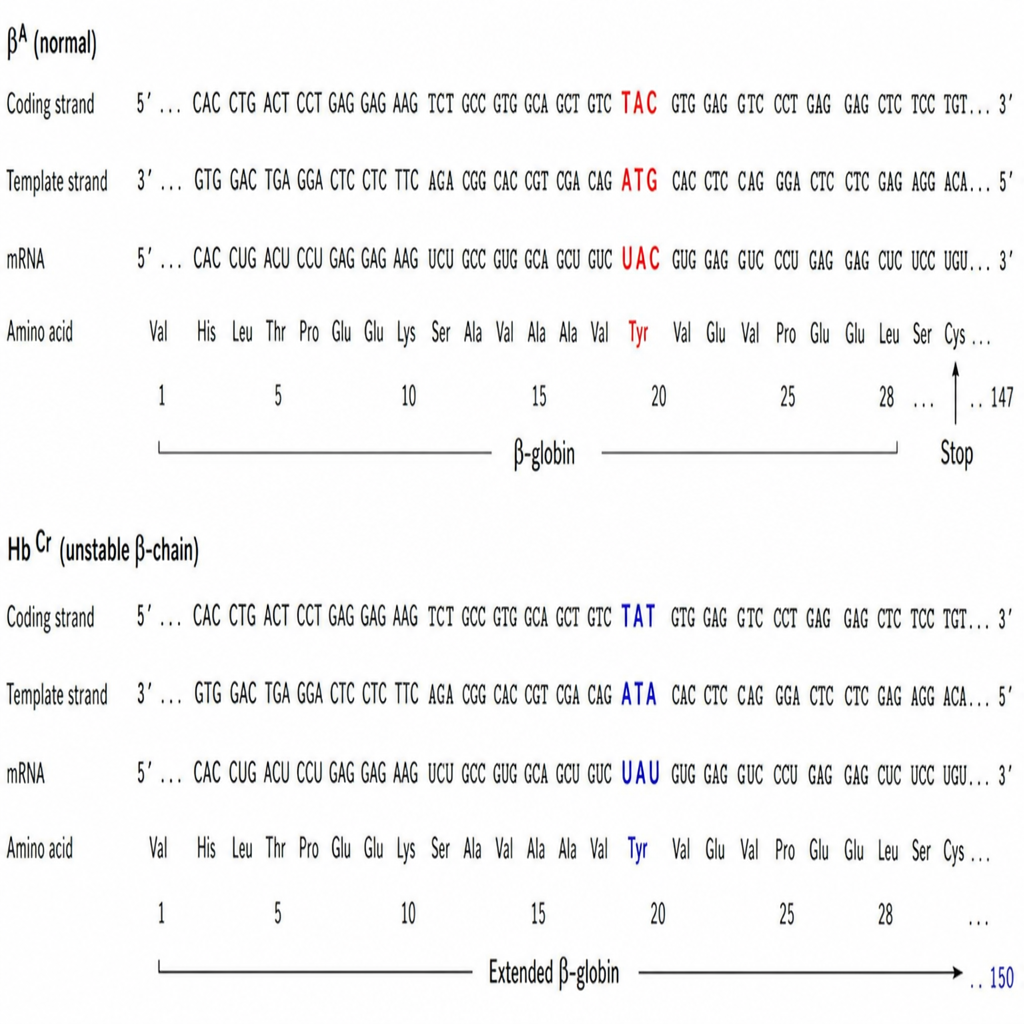
Explanation: ### Explanation **Correct Answer: B. UAA** In molecular biology, the genetic code consists of 64 codons. Of these, 61 code for amino acids, while **three** are designated as **Stop Codons (Termination Codons)**. These codons do not code for any amino acid and do not have corresponding tRNA molecules. Instead, they are recognized by **Release Factors (RFs)**, which trigger the hydrolysis of the ester bond between the peptide chain and the tRNA, effectively terminating translation. The three termination codons are: 1. **UAA** (Ochre) 2. **UAG** (Amber) 3. **UGA** (Opal) --- ### Analysis of Incorrect Options: * **A. AUG:** This is the **Start Codon (Initiation Codon)**. It codes for the amino acid **Methionine** in eukaryotes and **N-formylmethionine (fMet)** in prokaryotes. It sets the reading frame for translation. * **C. AUA:** This is a standard codon that codes for the amino acid **Isoleucine**. (Note: In mitochondrial DNA, AUA may code for Methionine, but in the universal genetic code, it is not a stop codon). * **D. AGG:** This is a standard codon that codes for the amino acid **Arginine**. --- ### High-Yield Clinical Pearls for NEET-PG: * **Non-sense Mutation:** A point mutation that changes a sense codon into a stop codon (UAA, UAG, or UGA), leading to premature termination of the protein and often resulting in a non-functional product. * **Exceptions to the Universal Code:** In human **mitochondria**, **UGA** codes for Tryptophan (not a stop), while **AGA** and **AGG** function as stop codons (instead of Arginine). * **Mnemonic for Stop Codons:** * **U** **A**re **A**way (UAA) * **U** **A**re **G**one (UAG) * **U** **G**o **A**way (UGA)
Explanation: The **Lac Operon** is a classic model of prokaryotic gene regulation, functioning as an inducible system that ensures *E. coli* metabolizes energy efficiently. ### **Mechanism of Regulation** The structural genes ($lacZ$, $lacY$, and $lacA$) are stimulated by two distinct control mechanisms: 1. **Induction (Presence of Lactose):** When lactose is present, its isomer **allolactose** binds to the repressor protein. This prevents the repressor from binding to the operator, "unlocking" the genes for transcription. 2. **Catabolite Repression (Absence of Glucose):** When glucose levels are low, **adenylate cyclase** is active, increasing **cAMP** levels. cAMP binds to the **Catabolite Activator Protein (CAP)**. The cAMP-CAP complex then binds to the promoter, acting as a "gas pedal" to recruit RNA polymerase. Therefore, maximal expression requires both the **removal of the repressor** (by lactose) and the **activation by cAMP-CAP** (due to lack of glucose). ### **Analysis of Options** * **Option A (Glucose only):** High glucose inhibits adenylate cyclase (low cAMP) and the absence of lactose keeps the repressor bound. The operon is **OFF**. * **Option B (Lactose only):** While lactose removes the repressor, if glucose were also present, cAMP levels would be too low for high-level transcription. However, in the context of the question, "Lactose only" implies the absence of glucose, making it the most favorable state. * **Option C (Glucose present, Lactose absent):** This is the state of maximum repression. * **Option D (Correct):** This satisfies both conditions: lactose induces the system, and the absence of glucose ensures high cAMP levels for maximal transcription. ### **NEET-PG High-Yield Pearls** * **Lac Z:** Encodes **$\beta$-galactosidase** (cleaves lactose into glucose and galactose). * **Lac Y:** Encodes **Permease** (allows lactose entry into the cell). * **Lac A:** Encodes **Transacetylase**. * **Diauxic Growth:** *E. coli* preferentially uses glucose first; the lac operon is only activated after glucose is exhausted. * **Constitutive Expression:** Mutations in the $i$ gene (repressor) or operator ($O^c$) lead to the operon being "always on."
Explanation: **Explanation:** In **X-linked recessive (XLR)** inheritance, the disease-causing gene is located on the X chromosome. Because males are hemizygous (XY), a single mutant allele results in the disease. Females (XX) are typically asymptomatic carriers unless they have two mutant alleles. **Why Option C is correct:** A carrier mother has the genotype **X$X^r$**. When she mates with a normal father (**XY**), each son has a 50% chance of inheriting the mutant **$X^r$** from the mother and a **Y** from the father, resulting in the disease ($X^r$Y). Conversely, each daughter has a 50% chance of being a carrier (X$X^r$). **Analysis of Incorrect Options:** * **Option A:** Males pass their **Y chromosome** to their sons. Therefore, **father-to-son transmission is impossible** in X-linked inheritance. If vertical transmission from father to son occurs, the trait is Y-linked or Autosomal. * **Option B:** If an affected father (**$X^r$Y**) mates with a normal mother (**XX**), **100% of daughters** will be carriers because they must inherit the father's only X chromosome. * **Option C vs D:** In XLR inheritance, males cannot be "carriers"; they are either affected or normal. Therefore, the term "50% of sons are carriers" is genetically inaccurate. **NEET-PG High-Yield Pearls:** * **Criss-cross inheritance:** XLR traits are typically passed from an affected father to a grandson through a carrier daughter. * **Lyonization (X-inactivation):** A carrier female may show symptoms if there is skewed inactivation of the normal X chromosome. * **Common Examples:** Hemophilia A & B, G6PD deficiency, Duchenne Muscular Dystrophy (DMD), and Color Blindness. * **Rule of Thumb:** Affected fathers = 0% affected sons, 100% carrier daughters.
Explanation: **Explanation:** Gene mutations are permanent alterations in the DNA sequence. Detecting these mutations is crucial for diagnosing genetic disorders, identifying predispositions to cancer, and personalized medicine. * **DNA Sequencing (Option C):** This is the **Gold Standard** for mutation detection. It allows for the base-by-base identification of the DNA sequence, making it capable of detecting point mutations, insertions, and deletions. * **Restriction Fragment Length Polymorphism (RFLP) (Option C):** This technique utilizes restriction enzymes that cut DNA at specific sequences. If a mutation occurs at a recognition site, the enzyme fails to cut, resulting in fragments of different lengths compared to the wild type. * **Denaturing Gradient Gel Electrophoresis (DGGE) (Option B):** This is a screening technique that separates DNA fragments based on their melting properties. Even a single base pair mutation changes the stability (melting temperature) of the DNA duplex, causing it to migrate differently in a gradient of denaturants. **Why "All of the above" is correct:** While the options provided represent different methodologies (sequencing is definitive, while DGGE and RFLP are screening/comparative methods), all are established laboratory techniques used to identify variations in the genetic code. **High-Yield Clinical Pearls for NEET-PG:** * **Gold Standard for Mutation Detection:** DNA Sequencing (Sanger or Next-Generation Sequencing). * **RFLP Application:** Classically used for diagnosing **Sickle Cell Anemia** (loss of *MstII* restriction site). * **PCR (Polymerase Chain Reaction):** Often the prerequisite step for all these techniques to amplify the target gene. * **Southern Blotting:** Used for detecting large structural changes like gene deletions or duplications, but not typically for single-point mutations.
Explanation: ### Explanation **1. Why Option A is Correct:** The Punnett square is a visual representation used in Mendelian genetics to determine the probability of an offspring having a particular **genotype**. It works by listing all possible gametes from one parent on one axis and the other parent on the other. The intersection of these gametes predicts the genetic combinations (homozygous dominant, heterozygous, or homozygous recessive) of the progeny. In medical genetics, it is the fundamental tool for calculating the **recurrence risk** of monogenic disorders (e.g., Autosomal Recessive or Autosomal Dominant conditions). **2. Why Other Options are Incorrect:** * **Option B:** Statistical analysis of genetic data (like calculating p-values or linkage disequilibrium) requires complex mathematical models and software, not a simple grid. * **Option C:** Testing a genetic hypothesis (e.g., determining if observed data fits Mendelian ratios) is the function of the **Chi-square ($\chi^2$) test**, not the Punnett square itself. * **Option D:** Tracking family history and inheritance patterns across multiple generations is the primary function of a **Pedigree Chart**. **3. NEET-PG High-Yield Clinical Pearls:** * **Mendelian Ratios:** For a monohybrid cross (Aa x Aa), the genotypic ratio is **1:2:1** and the phenotypic ratio is **3:1**. * **Test Cross:** To determine if an individual with a dominant phenotype is homozygous (AA) or heterozygous (Aa), they are crossed with a **homozygous recessive (aa)** individual. * **Dihybrid Cross:** The phenotypic ratio for two independent traits (AaBb x AaBb) is **9:3:3:1**. * **Hardy-Weinberg Equilibrium:** While Punnett squares predict individual crosses, the formula $p^2 + 2pq + q^2 = 1$ is used to predict genotype frequencies in a large **population**.
Explanation: **Explanation:** The 5' capping process involves the addition of a 7-methylguanosine cap to the 5' end of a nascent RNA molecule. This modification is a hallmark of **RNA Polymerase II** transcripts. **Why tRNA of Alanine is the correct answer:** Transfer RNAs (tRNAs) are transcribed by **RNA Polymerase III**. Unlike mRNA, tRNA molecules do not undergo 5' capping. Instead, their 5' ends are processed by **RNase P**, which cleaves the leader sequence to generate the mature 5' terminus. Therefore, tRNA of Alanine does not require a 5' cap. **Analysis of Incorrect Options:** * **mRNA for Histone:** Although histone mRNAs are unique because they lack a poly-A tail, they are transcribed by RNA Polymerase II and **do require a 5' cap** for stability and translation initiation. * **siRNA (Small Interfering RNA):** These are typically derived from longer double-stranded RNA precursors or primary transcripts (pri-miRNA/shRNA) transcribed by RNA Polymerase II, which possess a 5' cap during their processing stages. * **U6 snRNA:** While most snRNAs (U1, U2, U4, U5) are transcribed by Pol II and have a trimethylguanosine cap, U6 is transcribed by **RNA Polymerase III**. However, U6 undergoes a unique modification where its 5' end is capped with a **γ-monomethyl phosphate cap**, technically making it a "capped" RNA, unlike tRNA. **High-Yield Facts for NEET-PG:** 1. **RNA Polymerase I:** Transcribes 45S pre-rRNA (precursor for 18S, 28S, and 5.8S rRNA). 2. **RNA Polymerase II:** Transcribes mRNA, miRNA, and most snRNAs (U1-U5). These typically have a 7-methylguanosine cap. 3. **RNA Polymerase III:** Transcribes tRNA, 5S rRNA, and U6 snRNA. 4. **Functions of the 5' Cap:** Protects against 5'→3' exonuclease degradation, facilitates nuclear export, and is essential for the binding of the eIF4F complex during translation initiation.
DNA Replication and Repair Mechanisms
Practice Questions
Transcription Factors and Gene Regulation
Practice Questions
Epigenetics and DNA Methylation
Practice Questions
RNA Processing and Splicing
Practice Questions
miRNA and RNA Interference
Practice Questions
Protein Synthesis and Post-Translational Modifications
Practice Questions
Genomics and Human Genome Project
Practice Questions
Single Nucleotide Polymorphisms
Practice Questions
Gene Therapy Approaches
Practice Questions
CRISPR-Cas9 and Genome Editing
Practice Questions
DNA Fingerprinting and Forensics
Practice Questions
Molecular Basis of Genetic Diseases
Practice Questions
Get full access to all questions, explanations, and performance tracking.
Start For Free