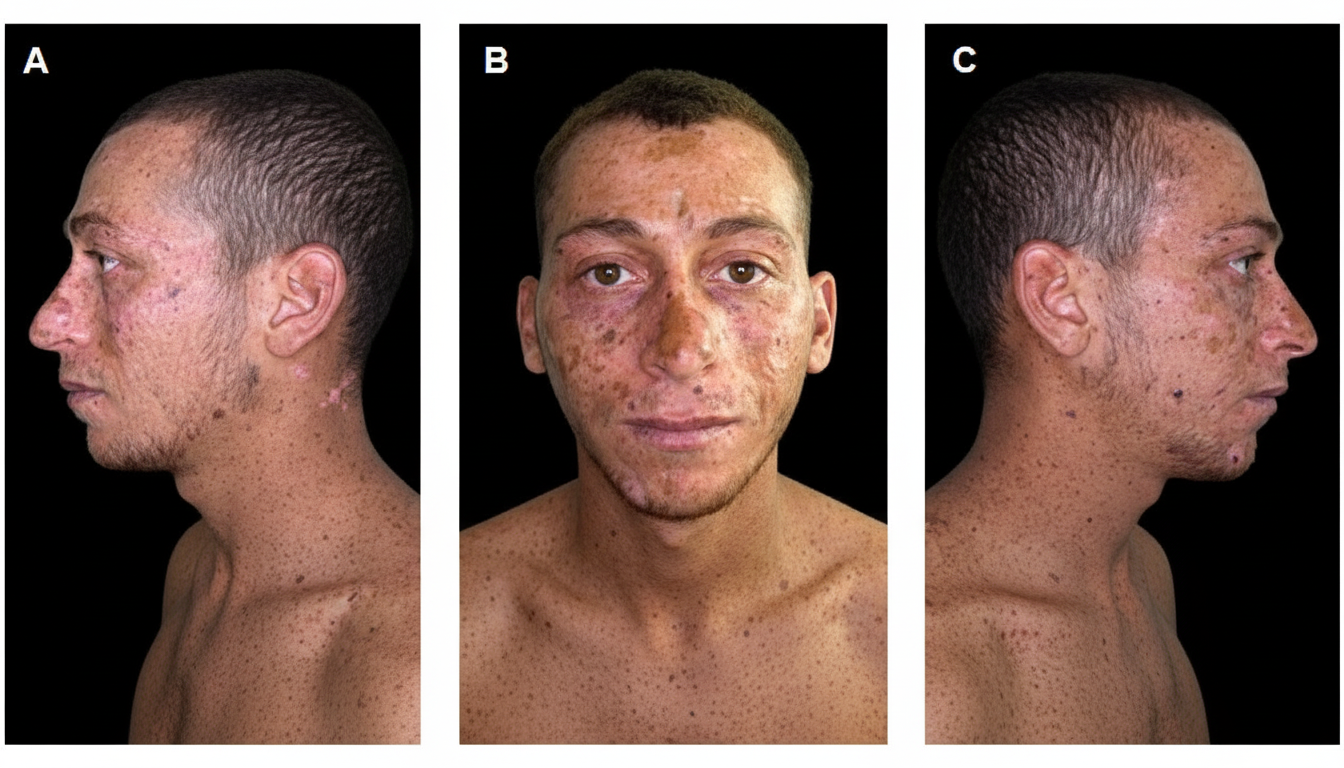
The nucleotide triplet CTC in the sixth position of the beta-globin chain in DNA normally forms a complementary nucleotide on mRNA that codes for glutamic acid. A point mutation in the beta-globin chain resulting in the nucleotide triplet CAC forms a complementary nucleotide on mRNA that codes for valine. In sickle cell anemia, what complementary nucleotide triplet on mRNA, read from 5' to 3', would be expected?
Which of the following statements is true about mitochondrial DNA?
Base stacking of DNA leads to which of the following phenomena?
A change in the second base of the serine codon UCA may result in the codon UAA. This is an example of which type of mutation?
Restriction endonucleases are enzymes that:
Random inactivation of the X chromosome is known as:
Which of the following is a feature of polymerase used in recombinant DNA synthesis?
Microarray is best characterized by what type of study?
Which form of DNA is predominantly seen?
Which of the following are methods used in gene therapy?
Explanation: **Explanation:** The question describes the molecular basis of **Sickle Cell Anemia**, a classic example of a **missense point mutation**. 1. **Why D is correct:** * In the normal $\beta$-globin gene, the DNA template strand triplet is **CTC**, which transcribes into the mRNA codon **GAG** (coding for Glutamic acid). * In Sickle Cell Anemia, a transversion mutation occurs where Adenine replaces Thymine in the DNA template, changing the triplet from CTC to **CAC**. * During transcription, mRNA is synthesized complementary to the DNA template. The DNA base **C** pairs with **G**, and **A** pairs with **U** (in RNA). Therefore, the DNA triplet **5'-CAC-3'** results in the mRNA codon **5'-GUG-3'**. * The codon **GUG** codes for **Valine**, replacing the polar Glutamic acid with a non-polar amino acid at the 6th position. 2. **Analysis of Incorrect Options:** * **A (GAG):** This is the normal mRNA codon for Glutamic acid. * **B (CTC):** This is the DNA sequence, not the mRNA sequence. mRNA contains Uracil (U) instead of Thymine (T). * **C (GTG):** This represents the mutated DNA sequence on the coding (non-template) strand. mRNA would not contain Thymine. **Clinical Pearls for NEET-PG:** * **Mutation Type:** Transversion (Point mutation). Specifically, $A \to T$ on the coding strand ($T \to A$ on the template strand). * **Amino Acid Change:** Glutamate (Acidic/Polar) $\to$ Valine (Neutral/Non-polar). * **Consequence:** Deoxygenated HbS polymerizes, leading to "sickling," hemolysis, and vaso-occlusive crises. * **Electrophoresis:** HbS moves slower than HbA toward the anode because it loses two negative charges (one per $\beta$-chain).
Explanation: ### Explanation **1. Why Option A is Correct:** Mitochondrial DNA (mtDNA) is a double-stranded, **circular** molecule, unlike the linear DNA found in the nucleus. It follows a pattern of **maternal inheritance** (non-Mendelian). During fertilization, the sperm's mitochondria are located in the neck/tail region, which usually does not enter the oocyte; even if they do, they are selectively degraded by the oocyte's ubiquitin-proteasome system. Therefore, almost all mitochondria in a zygote are derived from the mother. **2. Analysis of Incorrect Options:** * **Option B:** Incorrect because mtDNA is circular, not linear. It is transmitted almost exclusively by the mother, not both parents. * **Option C:** While it is true that mtDNA contains fewer genes (~37 genes) than nuclear DNA (~20,000–25,000 genes), the statement is incorrect because transmission is uniparental (maternal), not biparental. * **Option D:** While this statement is technically true (it is circular and has fewer genes), **Option A** is the "more complete" and classic description used in competitive exams to define the unique genetic behavior of mitochondria (Maternal Inheritance). **3. High-Yield Clinical Pearls for NEET-PG:** * **Gene Content:** mtDNA encodes 13 polypeptides (subunits of the Electron Transport Chain), 22 tRNAs, and 2 rRNAs. * **Heteroplasmy:** The presence of a mixture of more than one type of organellar genome (normal and mutated mtDNA) within a cell. This explains the variable clinical severity in mitochondrial diseases. * **Mutation Rate:** mtDNA has a 10–20 times higher mutation rate than nuclear DNA due to the lack of histones and proximity to reactive oxygen species (ROS) generation. * **Mitochondrial Diseases:** Examples include **LHON** (Leber’s Hereditary Optic Neuropathy), **MELAS**, and **MERRF**. These typically affect high-energy demanding tissues like the brain, heart, and muscles.
Explanation: **Explanation:** **1. Why Hypochromicity is Correct:** Hypochromicity refers to the phenomenon where double-stranded DNA (dsDNA) absorbs less Ultraviolet (UV) light (at 260 nm) compared to single-stranded DNA (ssDNA). This occurs because of **base stacking**. In the B-DNA double helix, the nitrogenous bases are stacked closely on top of each other, perpendicular to the helical axis. This tight packing and the electronic interactions between the pi-orbitals of the stacked bases "shield" them, reducing their ability to absorb UV light. **2. Analysis of Incorrect Options:** * **Hyperchromicity (Option C):** This is the opposite of hypochromicity. It refers to the *increase* in UV absorbance that occurs when DNA is denatured (melted) into single strands. When the hydrogen bonds break and base stacking is lost, the bases are exposed, leading to higher absorbance. * **Linear Dichromicity (Option A):** This relates to the differential absorption of polarized light based on the orientation of molecules. While DNA exhibits this property due to its structured nature, it is not the primary phenomenon defined by base stacking in standard biochemical contexts. * **Electrophoresis (Option D):** This is a laboratory technique used to separate DNA fragments based on their size and charge using an electric field; it is not a photophysical property caused by base stacking. **3. High-Yield Clinical Pearls for NEET-PG:** * **Melting Temperature (Tm):** The temperature at which 50% of DNA is denatured. Tm is higher in DNA with high **G-C content** because G-C pairs have three hydrogen bonds (compared to two in A-T) and stronger base-stacking interactions. * **Hyperchromic Shift:** This is used clinically and in research to monitor DNA denaturation and calculate the Tm. * **Absorbance Peak:** DNA absorbs maximally at **260 nm**, while proteins absorb at **280 nm**. The 260/280 ratio is used to assess DNA purity.
Explanation: ### Explanation **1. Why Nonsense is Correct:** A **nonsense mutation** occurs when a single nucleotide substitution results in a premature **stop codon** (UAA, UAG, or UGA). In this scenario, the codon **UCA** (which codes for the amino acid Serine) undergoes a point mutation at the second base (C → A), transforming it into **UAA**. Since UAA is a termination signal, translation stops prematurely, leading to a truncated, usually non-functional protein. **2. Why Other Options are Incorrect:** * **Missense:** This occurs when a point mutation changes one codon to another that codes for a *different* amino acid (e.g., UCA to UUA/Leucine). It does not stop translation. * **Silent:** This is a "synonymous" mutation where the nucleotide change results in a codon that codes for the *same* amino acid (e.g., UCA to UCG, both coding for Serine), usually due to the degeneracy of the genetic code. * **Frameshift:** This occurs due to the **insertion or deletion** of nucleotides (not divisible by three), which shifts the entire reading frame downstream. The question describes a single base substitution, not an indel. **3. NEET-PG Clinical Pearls:** * **Stop Codons:** Remember them with the mnemonic: **U** **A**re **A**way (**UAA**), **U** **A**re **G**one (**UAG**), **U** **G**o **A**way (**UGA**). * **Transition vs. Transversion:** Changing C (pyrimidine) to A (purine) as seen here is a **transversion**. * **Clinical Example:** Nonsense mutations are a common cause of **β-thalassemia major** (e.g., CAG → UAG at codon 39). * **Read-through therapy:** Drugs like **Aminoglycosides** (Gentamicin) or **Ataluren** can sometimes induce "ribosomal oversight" to bypass premature stop codons in genetic diseases.
Explanation: **Explanation:** **Restriction endonucleases (REs)**, often referred to as "molecular scissors," are enzymes primarily derived from bacteria. Their physiological role is to protect bacteria from viral (bacteriophage) infections by identifying and cutting foreign DNA. 1. **Why Option B is Correct:** Restriction endonucleases recognize specific, usually palindromic, nucleotide sequences (typically 4–8 base pairs long) known as **recognition sites**. They cleave the phosphodiester backbone of the DNA at these specific points. This specificity is what makes them indispensable tools in recombinant DNA technology, allowing scientists to cut DNA into predictable, reproducible fragments. 2. **Why Other Options are Incorrect:** * **Option A:** This describes the function of **DNA Ligase**, which acts as "molecular glue" to join DNA fragments. * **Option C:** Enzymes that cleave DNA randomly are generally referred to as non-specific **nucleases** (like DNase I). REs are defined by their sequence specificity. * **Option D:** While REs protect bacteria from "diseases" (viral infections), they do not "degrade" DNA in a general sense; they perform precise cleavage. **High-Yield Clinical Pearls for NEET-PG:** * **Nomenclature:** The first letter comes from the Genus, the next two from the species (e.g., **EcoRI** comes from *Escherichia coli*). * **Type II REs:** These are the most commonly used in labs because they cleave within or very close to the recognition site and do not require ATP. * **Blunt vs. Sticky Ends:** Some REs (like *SmaI*) produce blunt ends, while others (like *EcoRI*) produce staggered "sticky" ends, which are easier to ligate. * **RFLP (Restriction Fragment Length Polymorphism):** A technique using REs to detect genetic variations/mutations, used in forensic medicine and prenatal diagnosis.
Explanation: ### Explanation **1. Why Lyonization is Correct:** Lyonization (named after Mary Lyon) refers to the process in female mammals where one of the two X chromosomes is randomly inactivated during early embryonic development. This occurs to achieve **dosage compensation**, ensuring that females (XX) do not produce double the amount of X-linked gene products compared to males (XY). The inactivated X chromosome condenses into a heterochromatic structure known as a **Barr body**, visible at the periphery of the nucleus. This process is mediated by the **XIST gene** (X-inactive specific transcript), which produces a non-coding RNA that "coats" the chromosome to silence it. **2. Analysis of Incorrect Options:** * **B. Allelic exclusion:** This is a process where only one allele of a gene is expressed while the other is silenced (commonly seen in B-lymphocytes for immunoglobulin gene expression), but it does not involve an entire chromosome. * **C. Randomization:** This is a general statistical term and not a specific biological mechanism for gene silencing. * **D. Genomic imprinting:** This involves the epigenetic silencing of specific genes based on their **parent of origin** (e.g., Prader-Willi and Angelman syndromes). Unlike Lyonization, which is random, imprinting is predictable and specific to certain loci. **3. High-Yield Clinical Pearls for NEET-PG:** * **Mosaicism:** Because Lyonization is random, females are "genetic mosaics." This explains why female carriers of X-linked recessive disorders (like Hemophilia or G6PD deficiency) may show varying degrees of clinical symptoms (skewed lyonization). * **Barr Body Formula:** Number of Barr bodies = (Total number of X chromosomes – 1). * Turner Syndrome (45, XO): 0 Barr bodies. * Klinefelter Syndrome (47, XXY): 1 Barr body. * **XIST Gene:** Located in the X-inactivation center (Xic) at **Xq13**. It is essential for the initiation of inactivation.
Explanation: **Explanation:** The question refers to the **Polymerase Chain Reaction (PCR)**, a cornerstone of recombinant DNA technology used to amplify specific DNA sequences. **1. Why "Thermostable" is correct:** The PCR process involves repeated cycles of high-temperature heating (approx. 95°C) to denature the double-stranded DNA. Standard human DNA polymerases would denature and lose function at these temperatures. Therefore, PCR requires a **thermostable DNA polymerase**, most commonly **Taq Polymerase** (isolated from the bacterium *Thermus aquaticus*). This enzyme remains stable and active through multiple cycles of heating and cooling, allowing the reaction to proceed without adding new enzymes at every step. **2. Why the other options are incorrect:** * **Doesn't require a primer:** This is incorrect. All DNA polymerases (including Taq) require a **pre-existing 3'-OH group** provided by a short RNA or DNA primer to initiate synthesis. They cannot start a DNA chain *de novo*. * **Unusually active:** While Taq polymerase is efficient, "unusually active" is not a defining scientific characteristic. In fact, Taq polymerase lacks 3' to 5' exonuclease activity (proofreading), making it less accurate than some other polymerases. Its defining feature is its **thermal resilience**, not its speed or activity level. **High-Yield Clinical Pearls for NEET-PG:** * **Steps of PCR:** Denaturation (95°C) → Annealing (50-65°C) → Extension (72°C). * **Taq Polymerase:** Derived from *Thermus aquaticus*; lacks proofreading activity. * **Pfu Polymerase:** Derived from *Pyrococcus furiosus*; it is also thermostable but **has proofreading activity**, making it more accurate for high-fidelity cloning. * **RT-PCR:** Uses **Reverse Transcriptase** to convert RNA into cDNA before amplification (used for diagnosing RNA viruses like HIV or SARS-CoV-2).
Explanation: ### Explanation **1. Why the Correct Answer is Right:** A **DNA Microarray** (also known as a gene chip) is a high-throughput technology used to monitor the expression levels of **thousands of genes simultaneously** or to genotype multiple regions of a genome. It consists of a solid surface (glass or silicon) onto which microscopic spots of known DNA sequences (probes) are attached. When fluorescently labeled sample DNA or cDNA (derived from mRNA) is hybridized to the chip, the intensity of the signal at each spot indicates the level of expression or presence of a specific gene. This makes it the gold standard for large-scale comparative genomic studies. **2. Why the Other Options are Incorrect:** * **A. Study of organisms:** While microarrays can be used to identify pathogens, the term "study of organisms" usually refers to Taxonomy or Microbiology. Microarray is a molecular tool, not a field of organismal study. * **B. Study of disease:** Although microarrays are used *in* the study of diseases (like cancer profiling), the technology itself is defined by its ability to analyze genetic material, not the disease state itself (Pathology). * **D. Study of blood group:** Blood grouping is typically performed using serological agglutination tests or specific PCR for individual alleles, not massive parallel gene arrays. **3. NEET-PG High-Yield Pearls:** * **Gene Expression Profiling:** Microarrays are most commonly used to compare mRNA expression between healthy and diseased (e.g., cancerous) tissue. * **CGH (Comparative Genomic Hybridization):** A type of microarray used to detect chromosomal copy number variations (deletions or duplications). * **Vs. Northern Blot:** While Northern Blotting studies the expression of a **single** gene, Microarray studies **multiple** genes (global expression). * **Personalized Medicine:** Microarrays help in "Pharmacogenomics" to predict how a patient will respond to a specific drug based on their genetic profile.
Explanation: ***B DNA*** - **B-DNA** is the predominant physiological form found in living cells under normal **aqueous conditions** with optimal hydration. - It has a **right-handed double helix** with **10.5 base pairs per turn** and a **major groove** that allows protein binding for gene regulation. *C DNA* - **C-DNA** is a rare form that occurs under conditions of **very low humidity** (less than 44% relative humidity). - It has **9.3 base pairs per turn** and is **shorter and wider** than B-DNA, making it less stable in physiological conditions. *A DNA* - **A-DNA** forms under conditions of **low humidity** (75% relative humidity) and has **11 base pairs per turn**. - It is a **right-handed helix** but is **shorter and wider** than B-DNA, commonly found in **dehydrated DNA samples** or **RNA-DNA hybrids**. *Z DNA* - **Z-DNA** is a **left-handed double helix** that forms in regions with alternating **purine-pyrimidine sequences** under high salt conditions. - It has **12 base pairs per turn** and plays a role in **gene regulation**, but represents only a small fraction of cellular DNA.
Explanation: **Explanation:** Gene therapy involves the introduction, removal, or change in the content of an individual’s genetic code with the goal of treating or curing a disease. This requires efficient **gene delivery systems** to transport therapeutic DNA into target cells. * **Electroporation (Option A):** This is a physical method of gene transfer. It involves applying high-voltage electrical pulses to cells, which creates transient pores in the plasma membrane. These pores allow large, charged molecules like DNA to enter the cytoplasm. * **Intranuclear Injection (Option B):** Also known as microinjection, this is a direct mechanical method where the therapeutic gene is injected directly into the nucleus of a single cell using a fine glass micropipette. It is highly efficient for specific applications like *in vitro* fertilization or creating transgenic animals. * **Site-directed Mutagenesis (Option C):** While often used in research to study protein function, in the context of advanced gene therapy (like CRISPR/Cas9 or Zinc Finger Nucleases), it refers to the precise correction of a mutated gene sequence at its natural locus. This "gene editing" is a cornerstone of modern therapeutic strategies. Since all three techniques are established methods for modifying or delivering genetic material for therapeutic purposes, **Option D** is the correct answer. **High-Yield Clinical Pearls for NEET-PG:** * **Vectors:** Gene therapy uses **Viral vectors** (Adenovirus, Retrovirus, Lentivirus) or **Non-viral vectors** (Liposomes, Electroporation). * **First Gene Therapy:** Successfully performed in 1990 for **ADA-SCID** (Adenosine Deaminase deficiency). * **Ex-vivo vs. In-vivo:** *Ex-vivo* involves modifying cells outside the body (e.g., CAR-T cell therapy), while *In-vivo* involves direct delivery into the patient (e.g., Luxturna for retinal dystrophy).
DNA Replication and Repair Mechanisms
Practice Questions
Transcription Factors and Gene Regulation
Practice Questions
Epigenetics and DNA Methylation
Practice Questions
RNA Processing and Splicing
Practice Questions
miRNA and RNA Interference
Practice Questions
Protein Synthesis and Post-Translational Modifications
Practice Questions
Genomics and Human Genome Project
Practice Questions
Single Nucleotide Polymorphisms
Practice Questions
Gene Therapy Approaches
Practice Questions
CRISPR-Cas9 and Genome Editing
Practice Questions
DNA Fingerprinting and Forensics
Practice Questions
Molecular Basis of Genetic Diseases
Practice Questions
Get full access to all questions, explanations, and performance tracking.
Start For Free